Sleep tracking is the process of using technology to collect and analyze data about your sleep patterns and quality. Consumer-grade devices like wearables and nearables monitor biometric signals including movement, heart rate, and breathing to estimate sleep duration, stages, and overall quality. The clinical gold standard for sleep measurement is polysomnography (PSG), a lab-based test that reads brain waves directly. Consumer sleep trackers use indirect signals to approximate what PSG measures precisely. Understanding what sleep tracking can and cannot do is the first step toward using it well.
What is sleep tracking and how does the technology work?
Sleep trackers are pattern-matching devices that use indirect body signals, not direct brain wave measurement. This distinction matters. Clinical polysomnography attaches electrodes to your scalp and reads electroencephalogram (EEG) data in real time. Consumer devices have no access to that signal. Instead, they rely on sensors that read what your body does while your brain cycles through sleep stages.
The two core sensors in most sleep trackers are the accelerometer and the photoplethysmography (PPG) sensor. The accelerometer detects movement, registering stillness as likely sleep and restlessness as wakefulness or light sleep. The PPG sensor shines light through your skin to measure blood flow, which reveals heart rate and heart rate variability (HRV). Temperature sensors and microphones add further layers, detecting skin temperature drops at sleep onset and environmental noise that disrupts rest.
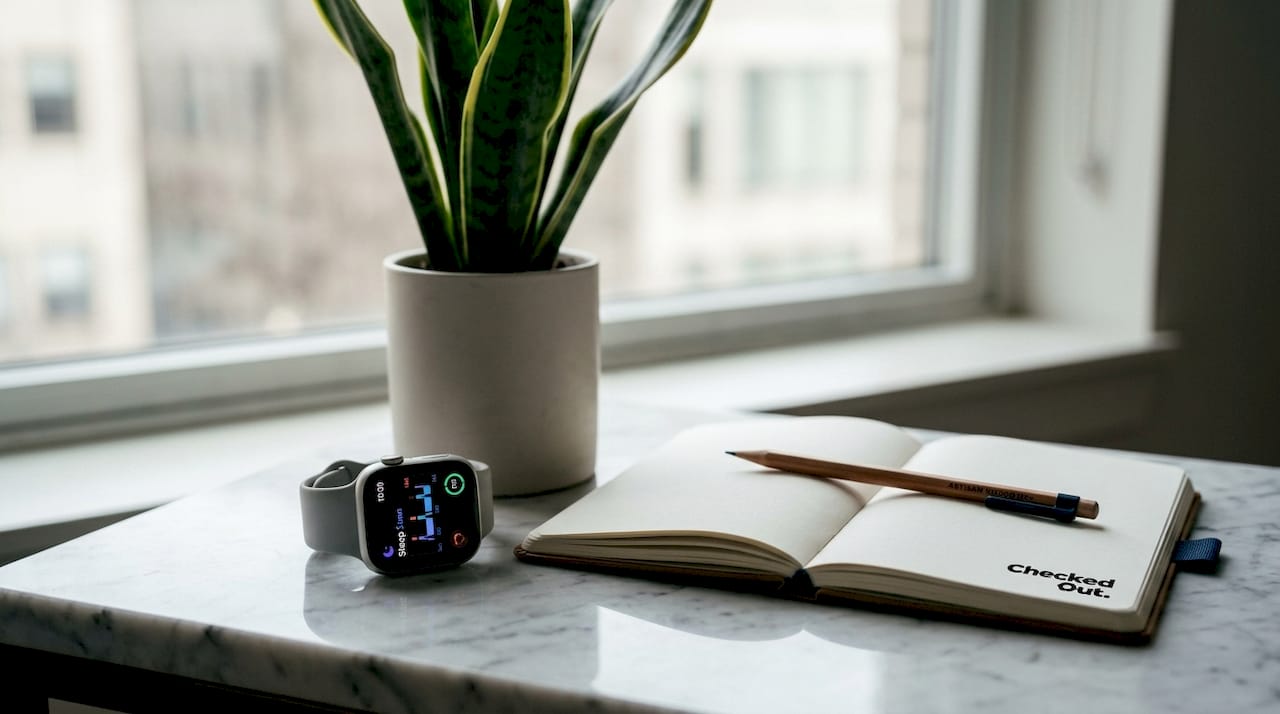
The intelligence behind these sensors lives in the algorithm. Device makers train machine learning models on thousands of nights of simultaneously recorded PSG and sensor data. The algorithm learns which sensor patterns correlate with REM sleep, deep sleep, and light sleep. When your device processes a night, it matches your sensor data to those learned patterns and assigns a stage estimate.
Sleep trackers reliably estimate total sleep duration but show only 53–60% epoch accuracy when distinguishing individual sleep stages compared to clinical PSG. That number sounds low, but it is enough to reveal meaningful trends over time. A single night’s stage breakdown is an estimate. A month of stage data is a pattern worth acting on.
Pro Tip: Never judge your sleep tracker’s value by one night. The signal-to-noise ratio improves dramatically after two weeks of consistent data.
What types of sleep tracking devices are available?
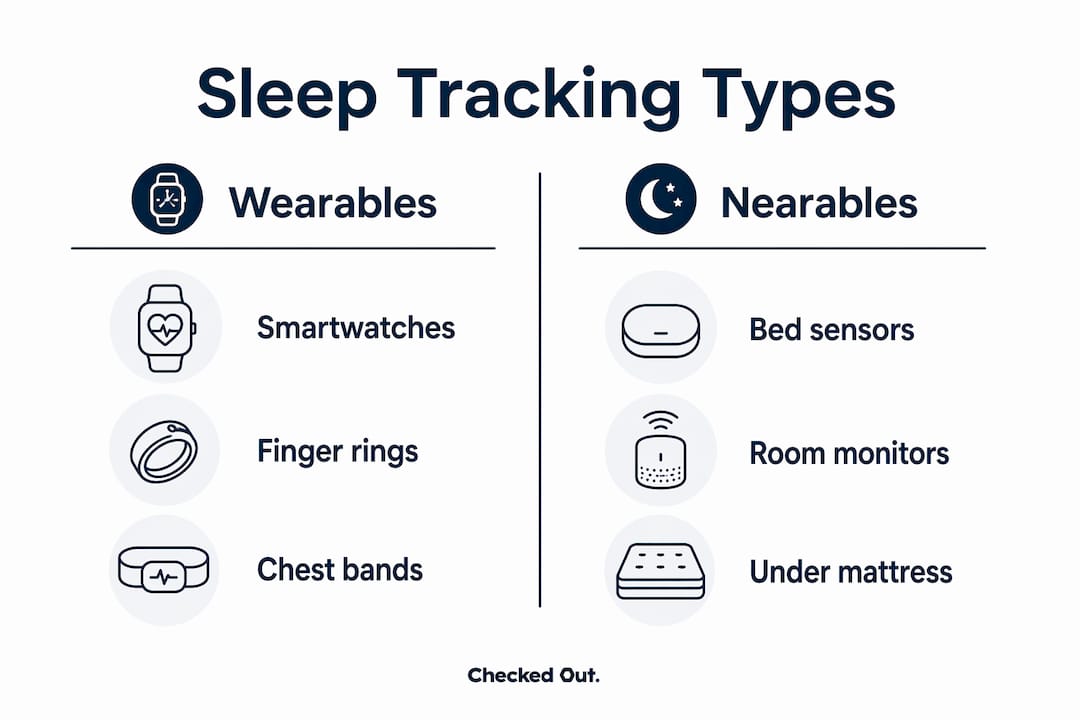
Sleep trackers fall into two main categories: wearables and nearables. Wearables sit directly on your body, typically on the wrist or finger. Nearables sit on or near the bed and detect signals without physical contact.
| Category |
Examples |
Key sensors |
Best for |
| Wrist wearables |
Smartwatches |
Accelerometer, PPG, temperature |
Daily tracking, activity integration |
| Finger wearables |
Smart rings |
PPG, accelerometer, temperature |
Comfort, HRV accuracy |
| Bedside nearables |
Radar or sound sensors |
Breathing, movement, environment |
No-contact preference |
| Under-mattress sensors |
Pad devices |
Movement, heart rate via ballistocardiography |
Passive, no wearing required |
Wearables generally collect richer biometric data because they sit close to blood vessels. Finger-worn devices often capture cleaner PPG signals than wrist devices because the finger has less movement artifact during sleep. Nearables sacrifice some biometric depth but gain the advantage of zero discomfort. Some people sleep poorly wearing anything on their wrist, making nearables the practical choice.
Not all consumer sleep trackers carry FDA approval, and those that do tend to be more reliable for clinical use cases. FDA approval status is a meaningful filter if you plan to share data with a healthcare provider. For general wellness tracking, non-approved devices still provide useful trend data.
Key features to look for when choosing a device:
-
Sleep scoring: A single nightly score combining duration, stages, restlessness, and heart rate
-
Stage breakdown: Estimates of time spent in light, deep, and REM sleep
-
HRV tracking: A proxy for recovery quality and autonomic nervous system balance
-
Breathing detection: Flags potential disturbances like snoring or irregular breathing
-
Environmental monitoring: Some nearables track room temperature and noise levels
What are the real benefits of sleep tracking?
The clearest benefit of sleep tracking is behavioral awareness. Consistent use for at least one week improves self-reported sleep quality by encouraging regular sleep behaviors. Seeing your bedtime consistency charted over two weeks creates accountability that willpower alone rarely achieves.
Sleep trackers also surface patterns you would never notice consciously. A device might reveal that your deep sleep drops sharply every Friday night, correlating with a later bedtime and alcohol. Without data, that connection stays invisible. With data, it becomes a choice you can make deliberately.
The importance of sleep tracking also lies in what it cannot do. Consumer devices are not diagnostic tools. They cannot confirm or rule out sleep apnea, insomnia disorder, or restless leg syndrome. Breathing irregularity flags from a consumer device are a prompt to seek clinical evaluation, not a diagnosis.
“Sleep trackers are best seen as awareness and behavior tools rather than diagnostic instruments for sleep disorders. The data they provide is a starting point for conversation with a clinician, not a conclusion.” — Cleveland Clinic
Common pitfalls with sleep tracking include:
-
Orthosomnia: Anxiety about achieving a perfect sleep score, which itself disrupts sleep
-
Over-reliance on scores: Treating a low score as a health crisis rather than a data point
-
Ignoring subjective feelings: Waking refreshed after a “poor” tracked night is valid information
-
Single-night conclusions: Drawing behavioral changes from one night’s data rather than trends
For better sleep tips that complement what your tracker reveals, pairing data with proven sleep hygiene practices produces the strongest results.
How do you interpret and use sleep tracking data well?
The most common mistake sleep trackers make is checking their data before checking in with themselves. Expert advice recommends assessing how you feel physically and mentally before looking at your sleep score each morning. Your subjective sense of restfulness is data too. When it conflicts with your device score, neither is automatically correct.
Meaningful use of sleep data follows a clear process:
-
Track for at least two weeks before drawing any conclusions. Short windows amplify noise.
-
Log lifestyle variables manually alongside your device data. Record alcohol intake, exercise timing, caffeine cutoff, and stress levels. Correlating these behaviors with sleep patterns reveals your personal levers.
-
Focus on trends, not scores. A week of consistently low deep sleep is more meaningful than one bad night.
-
Watch your resting heart rate. A rising resting heart rate over several nights often signals accumulated stress or illness before you consciously feel it.
-
Use stage breakdowns as context. If your REM sleep is consistently low, examine your alcohol use and sleep schedule consistency. REM is the stage most sensitive to both.
-
Apply insights to your sleep hygiene. A step-by-step sleep hygiene guide gives you the behavioral framework to act on what your tracker reveals.
Long-term trend analysis and manual lifestyle logging together create the most useful picture. Data without context is noise. Data with context is a map.
Pro Tip: Set a weekly review ritual. Spend five minutes every Sunday comparing your average sleep duration and HRV to the previous week. Monthly reviews reveal seasonal and lifestyle patterns that nightly checks miss entirely.
When should you consider using a sleep tracker?
Sleep tracking for better health makes the most sense when you have a specific question about your sleep or a clear goal to improve it. Vague curiosity produces vague results. A focused question, like “Does my late workout affect my sleep quality?” produces data you can actually use.
People who benefit most from sleep tracking include:
-
Curious optimizers who want to understand how lifestyle choices affect their recovery
-
People with disrupted sleep patterns from shift work, travel, or irregular schedules
-
High performers monitoring recovery alongside training load
-
Anyone noticing daytime fatigue without an obvious explanation
-
People managing stress who want objective feedback on how their nervous system is recovering overnight
Sleep tracking complements professional healthcare but does not replace it. If your device consistently flags breathing irregularities, or if you feel unrefreshed despite adequate tracked sleep duration, those are signals to book a clinical sleep study. A consumer device cannot diagnose obstructive sleep apnea. A sleep specialist can. The role of quality sleep in wellness extends far beyond what any single metric captures, which is why clinical evaluation remains the standard for serious concerns.
Avoid using consumer sleep data to self-diagnose or self-treat sleep disorders. Use it to build awareness, identify patterns, and have more informed conversations with your doctor.
Key Takeaways
Sleep tracking works best as a long-term behavior tool, not a nightly diagnostic, and its value grows when you pair objective data with subjective self-awareness and consistent sleep hygiene.
| Point |
Details |
| Core technology |
Trackers use accelerometers, PPG sensors, and algorithms to estimate sleep stages indirectly. |
| Accuracy expectations |
Stage accuracy runs 53–60% compared to clinical PSG; duration estimates are more reliable. |
| Biggest benefit |
Consistent tracking improves self-reported sleep quality by reinforcing regular sleep behaviors. |
| Critical limitation |
Consumer devices cannot diagnose sleep disorders; clinical evaluation is required for serious concerns. |
| Best practice |
Log lifestyle variables manually and analyze trends over weeks, not individual nights. |
Sleep data is a mirror, not a verdict
I have watched people become genuinely anxious about a sleep score of 72 when they woke up feeling completely fine. That anxiety is real, and it is counterproductive. The body keeps score quietly, and sometimes it keeps a different score than your wrist does.
What I have found, both personally and in observing how people engage with sleep data, is that the tracker’s greatest power is in the patterns it reveals over months, not the grades it assigns each morning. The nights I learned the most from were not the ones with the worst scores. They were the ones where I noticed a three-week trend of declining HRV that I could trace back to a shift in my evening routine.
The trap is treating sleep data the way some people treat a bathroom scale: stepping on it every morning and letting the number set the emotional tone for the day. Sleep is not a performance you optimize in isolation. It is a biological process shaped by everything you do while awake. Your tracker reflects that. It does not control it.
Use the data to ask better questions. Combine it with science-backed sleep improvement steps that address the root causes your numbers point toward. And when your body tells you something different from what your device says, trust the body first.
— Geeta
What Checkedoutwellness offers alongside your sleep data
Your tracker tells you what is happening. Checkedoutwellness helps you change it.
The natural sleep patches from Checkedoutwellness are designed to support your body’s own melatonin production using cofactors like magnesium, B6, B12, and GABA, with no synthetic melatonin and no dependency risk. They are manufactured in South Korea under ISO 22716 GMP pharmaceutical standards. When your tracker reveals that your sleep onset is slow or your deep sleep is shallow, these drug-free tools give you something concrete to try. Pair them with mouth tape for nasal breathing support and a blackout mask for light control. Visit Checkedoutwellness to see the full product range and the science behind each formula.
FAQ
What is sleep tracking in simple terms?
Sleep tracking is the use of a wearable or bedside device to monitor your body’s signals during sleep, including movement, heart rate, and breathing, to estimate how long and how well you slept.
How accurate are consumer sleep trackers?
Consumer sleep trackers reliably estimate total sleep duration but show only 53–60% accuracy when identifying individual sleep stages compared to clinical polysomnography. They are useful for trend analysis, not precise medical measurement.
Can a sleep tracker diagnose sleep apnea?
No. Consumer sleep trackers can flag breathing irregularities but cannot diagnose sleep apnea or any other sleep disorder. A formal diagnosis requires a clinical sleep study conducted by a healthcare provider.
How long should I track my sleep before drawing conclusions?
Track for at least two weeks before making behavioral changes based on the data. Long-term trend analysis over weeks produces far more reliable insights than any single night’s reading.
What is orthosomnia and should I be concerned?
Orthosomnia is anxiety caused by excessive focus on achieving a perfect sleep score, which itself disrupts sleep. Experts recommend checking how you feel before looking at your data each morning to keep the score in perspective.
Recommended

What Is Sleep Tracking? Your 2026 Guide to Better Sleep
Sleep tracking is the process of using technology to collect and analyze data about your sleep patterns and quality. Consumer-grade devices like wearables and nearables monitor biometric signals including movement, heart rate, and breathing to estimate sleep duration, stages, and overall quality. The clinical gold standard for sleep measurement is polysomnography (PSG), a lab-based test that reads brain waves directly. Consumer sleep trackers use indirect signals to approximate what PSG measures precisely. Understanding what sleep tracking can and cannot do is the first step toward using it well.
What is sleep tracking and how does the technology work?
Sleep trackers are pattern-matching devices that use indirect body signals, not direct brain wave measurement. This distinction matters. Clinical polysomnography attaches electrodes to your scalp and reads electroencephalogram (EEG) data in real time. Consumer devices have no access to that signal. Instead, they rely on sensors that read what your body does while your brain cycles through sleep stages.
The two core sensors in most sleep trackers are the accelerometer and the photoplethysmography (PPG) sensor. The accelerometer detects movement, registering stillness as likely sleep and restlessness as wakefulness or light sleep. The PPG sensor shines light through your skin to measure blood flow, which reveals heart rate and heart rate variability (HRV). Temperature sensors and microphones add further layers, detecting skin temperature drops at sleep onset and environmental noise that disrupts rest.
The intelligence behind these sensors lives in the algorithm. Device makers train machine learning models on thousands of nights of simultaneously recorded PSG and sensor data. The algorithm learns which sensor patterns correlate with REM sleep, deep sleep, and light sleep. When your device processes a night, it matches your sensor data to those learned patterns and assigns a stage estimate.
Sleep trackers reliably estimate total sleep duration but show only 53–60% epoch accuracy when distinguishing individual sleep stages compared to clinical PSG. That number sounds low, but it is enough to reveal meaningful trends over time. A single night’s stage breakdown is an estimate. A month of stage data is a pattern worth acting on.
Pro Tip: Never judge your sleep tracker’s value by one night. The signal-to-noise ratio improves dramatically after two weeks of consistent data.
What types of sleep tracking devices are available?
Sleep trackers fall into two main categories: wearables and nearables. Wearables sit directly on your body, typically on the wrist or finger. Nearables sit on or near the bed and detect signals without physical contact.
Wearables generally collect richer biometric data because they sit close to blood vessels. Finger-worn devices often capture cleaner PPG signals than wrist devices because the finger has less movement artifact during sleep. Nearables sacrifice some biometric depth but gain the advantage of zero discomfort. Some people sleep poorly wearing anything on their wrist, making nearables the practical choice.
Not all consumer sleep trackers carry FDA approval, and those that do tend to be more reliable for clinical use cases. FDA approval status is a meaningful filter if you plan to share data with a healthcare provider. For general wellness tracking, non-approved devices still provide useful trend data.
Key features to look for when choosing a device:
What are the real benefits of sleep tracking?
The clearest benefit of sleep tracking is behavioral awareness. Consistent use for at least one week improves self-reported sleep quality by encouraging regular sleep behaviors. Seeing your bedtime consistency charted over two weeks creates accountability that willpower alone rarely achieves.
Sleep trackers also surface patterns you would never notice consciously. A device might reveal that your deep sleep drops sharply every Friday night, correlating with a later bedtime and alcohol. Without data, that connection stays invisible. With data, it becomes a choice you can make deliberately.
The importance of sleep tracking also lies in what it cannot do. Consumer devices are not diagnostic tools. They cannot confirm or rule out sleep apnea, insomnia disorder, or restless leg syndrome. Breathing irregularity flags from a consumer device are a prompt to seek clinical evaluation, not a diagnosis.
Common pitfalls with sleep tracking include:
For better sleep tips that complement what your tracker reveals, pairing data with proven sleep hygiene practices produces the strongest results.
How do you interpret and use sleep tracking data well?
The most common mistake sleep trackers make is checking their data before checking in with themselves. Expert advice recommends assessing how you feel physically and mentally before looking at your sleep score each morning. Your subjective sense of restfulness is data too. When it conflicts with your device score, neither is automatically correct.
Meaningful use of sleep data follows a clear process:
Long-term trend analysis and manual lifestyle logging together create the most useful picture. Data without context is noise. Data with context is a map.
Pro Tip: Set a weekly review ritual. Spend five minutes every Sunday comparing your average sleep duration and HRV to the previous week. Monthly reviews reveal seasonal and lifestyle patterns that nightly checks miss entirely.
When should you consider using a sleep tracker?
Sleep tracking for better health makes the most sense when you have a specific question about your sleep or a clear goal to improve it. Vague curiosity produces vague results. A focused question, like “Does my late workout affect my sleep quality?” produces data you can actually use.
People who benefit most from sleep tracking include:
Sleep tracking complements professional healthcare but does not replace it. If your device consistently flags breathing irregularities, or if you feel unrefreshed despite adequate tracked sleep duration, those are signals to book a clinical sleep study. A consumer device cannot diagnose obstructive sleep apnea. A sleep specialist can. The role of quality sleep in wellness extends far beyond what any single metric captures, which is why clinical evaluation remains the standard for serious concerns.
Avoid using consumer sleep data to self-diagnose or self-treat sleep disorders. Use it to build awareness, identify patterns, and have more informed conversations with your doctor.
Key Takeaways
Sleep tracking works best as a long-term behavior tool, not a nightly diagnostic, and its value grows when you pair objective data with subjective self-awareness and consistent sleep hygiene.
Sleep data is a mirror, not a verdict
I have watched people become genuinely anxious about a sleep score of 72 when they woke up feeling completely fine. That anxiety is real, and it is counterproductive. The body keeps score quietly, and sometimes it keeps a different score than your wrist does.
What I have found, both personally and in observing how people engage with sleep data, is that the tracker’s greatest power is in the patterns it reveals over months, not the grades it assigns each morning. The nights I learned the most from were not the ones with the worst scores. They were the ones where I noticed a three-week trend of declining HRV that I could trace back to a shift in my evening routine.
The trap is treating sleep data the way some people treat a bathroom scale: stepping on it every morning and letting the number set the emotional tone for the day. Sleep is not a performance you optimize in isolation. It is a biological process shaped by everything you do while awake. Your tracker reflects that. It does not control it.
Use the data to ask better questions. Combine it with science-backed sleep improvement steps that address the root causes your numbers point toward. And when your body tells you something different from what your device says, trust the body first.
What Checkedoutwellness offers alongside your sleep data
Your tracker tells you what is happening. Checkedoutwellness helps you change it.
The natural sleep patches from Checkedoutwellness are designed to support your body’s own melatonin production using cofactors like magnesium, B6, B12, and GABA, with no synthetic melatonin and no dependency risk. They are manufactured in South Korea under ISO 22716 GMP pharmaceutical standards. When your tracker reveals that your sleep onset is slow or your deep sleep is shallow, these drug-free tools give you something concrete to try. Pair them with mouth tape for nasal breathing support and a blackout mask for light control. Visit Checkedoutwellness to see the full product range and the science behind each formula.
FAQ
What is sleep tracking in simple terms?
Sleep tracking is the use of a wearable or bedside device to monitor your body’s signals during sleep, including movement, heart rate, and breathing, to estimate how long and how well you slept.
How accurate are consumer sleep trackers?
Consumer sleep trackers reliably estimate total sleep duration but show only 53–60% accuracy when identifying individual sleep stages compared to clinical polysomnography. They are useful for trend analysis, not precise medical measurement.
Can a sleep tracker diagnose sleep apnea?
No. Consumer sleep trackers can flag breathing irregularities but cannot diagnose sleep apnea or any other sleep disorder. A formal diagnosis requires a clinical sleep study conducted by a healthcare provider.
How long should I track my sleep before drawing conclusions?
Track for at least two weeks before making behavioral changes based on the data. Long-term trend analysis over weeks produces far more reliable insights than any single night’s reading.
What is orthosomnia and should I be concerned?
Orthosomnia is anxiety caused by excessive focus on achieving a perfect sleep score, which itself disrupts sleep. Experts recommend checking how you feel before looking at your data each morning to keep the score in perspective.
Recommended