Sleep hygiene is defined as the consistent set of behavioral and environmental practices that promote high-quality, restorative sleep. Think of it as the prep work your body and brain need before sleep can do its job. Over 33% of U.S. adults do not get sufficient sleep, and 14.5% report difficulty falling asleep while 17.8% struggle to stay asleep. Those numbers reflect a population that is chronically under-recovered, not just tired. Sleep hygiene addresses the controllable inputs: your schedule, your room, your habits in the hours before bed. It is foundational, not a magic fix, and understanding that distinction is where real progress begins.
What is sleep hygiene, and what does it actually include?
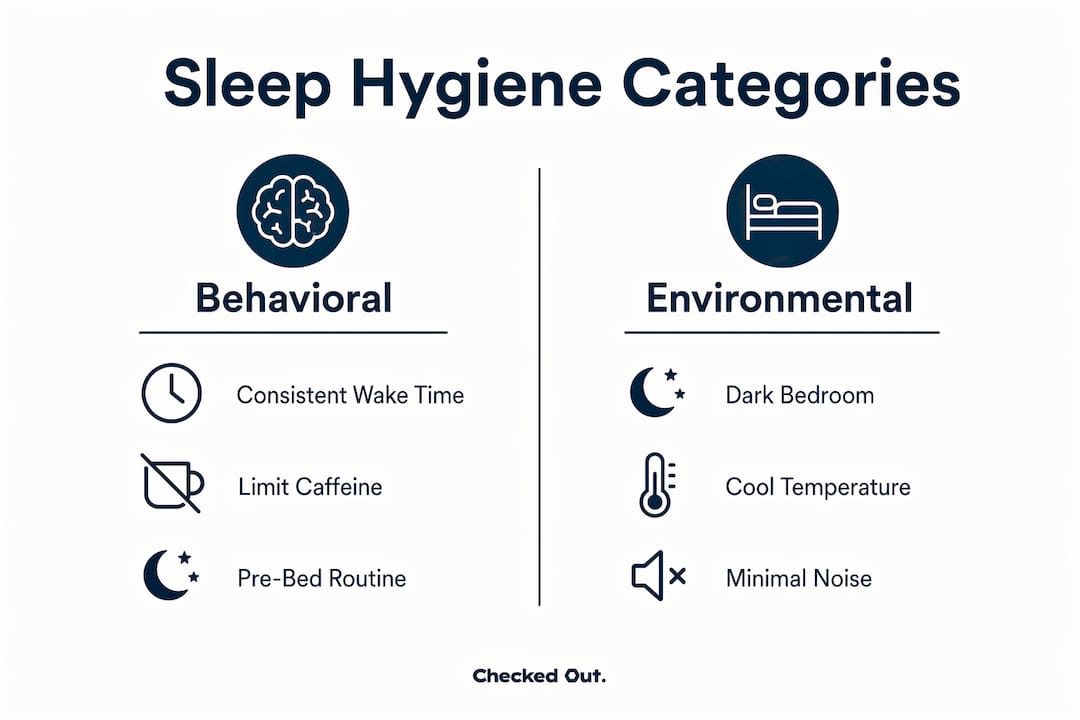
Sleep hygiene covers two categories: behaviors and environment. Both matter, and neglecting either one limits results.

Behavioral habits that anchor your sleep
Consistent wake time is the single most powerful circadian anchor you have. More powerful than your bedtime. More powerful than total hours in bed. Your body’s internal clock, the circadian rhythm, is set primarily by light exposure and the time you wake up each morning. Shifting that time even slightly on weekends creates what researchers call social jet lag, which disrupts cognition and metabolic markers.
Caffeine is the second major behavioral lever. Caffeine’s half-life is 5–7 hours, meaning a 2 PM coffee still has half its stimulant load in your bloodstream at 7 PM or 8 PM. Studies recommend a 10-hour cutoff before your target bedtime to protect deep, slow-wave sleep. That means a 10 PM bedtime requires your last caffeine by noon.
Blue light from screens suppresses melatonin production by signaling to your brain that it is still daytime. Dimming screens and shifting to warmer light tones after sunset helps, but blue light mitigation alone is not enough without pairing it with temperature and routine changes.
Environmental factors that set the stage
-
Temperature: Keep your bedroom at 65–68°F. Temperatures above 75°F reduce deep restorative sleep by interfering with the core body temperature drop your brain needs to initiate slow-wave sleep.
-
Darkness: Full blackout conditions signal the pineal gland to produce melatonin. Even small light sources, like a charging LED or streetlight through thin curtains, can disrupt this process.
-
Noise control: Consistent ambient sound, such as white noise or a fan, masks disruptive spikes better than silence in most urban environments.
-
Bed association: Use your bed only for sleep. Working or watching content in bed trains your brain to associate the space with wakefulness, which raises sleep onset latency over time.
Pro Tip: Set your alarm for the same wake time every day, including weekends, for at least four weeks before evaluating results. Consistency is the variable most people skip.
When does sleep hygiene stop being enough?
Sleep hygiene is foundational preparation, not a primary treatment for clinical insomnia, sleep apnea, restless leg syndrome, or other diagnosed sleep disorders. This distinction matters. People who rely solely on hygiene adjustments for medical conditions often spend months making marginal improvements while an underlying condition goes unaddressed.
Seek a specialist when you experience any of the following:
- Extreme daytime sleepiness that impairs work or driving, even after seven or more hours in bed
- Loud snoring, gasping, or breathing pauses during sleep reported by a partner
- Frequent nightmares or episodes of waking in a panic
- Persistent insomnia lasting more than three weeks despite consistent hygiene practices
- Restless or uncomfortable sensations in your legs that worsen at night
Cognitive behavioral therapy for insomnia, known as CBT-I, is the gold-standard clinical treatment for chronic insomnia. It restructures the thoughts and behaviors that perpetuate sleeplessness. Sleep hygiene practices play an adjunctive role within CBT-I, supporting the behavioral changes a therapist prescribes. They do not replace the therapy itself.
The body keeps score quietly. Ignoring persistent symptoms because your bedroom is dark and cool is a mistake that delays real recovery.
How to build a step-by-step sleep hygiene workflow
A sleep hygiene workflow works best when it runs on autopilot. The goal is to reduce decision fatigue in the evening so your nervous system can shift from alert to calm without friction.
Your daily sleep optimization checklist
-
Set a fixed wake time. Choose a time you can maintain seven days a week. This is your circadian anchor. Do not negotiate it on weekends.
-
Cut caffeine 10 hours before bed. If you wake at 6 AM and sleep at 10 PM, your last coffee is at noon. Adjust based on your actual schedule.
-
Get morning light within 30 minutes of waking. Natural light exposure in the morning sets your circadian clock and builds the melatonin timing for that night.
-
Dim lights and screens 90 minutes before bed. Shift your environment toward warmth and low stimulation as your target sleep time approaches.
-
Take a warm shower or bath 1–2 hours before bed. Peripheral vasodilation from warm water accelerates the core body temperature drop that signals sleep onset. This is one of the most underused techniques in a standard sleep hygiene checklist.
-
Do a brain dump 10–15 minutes before bed. Writing down unresolved tasks before sleep reduces the mental chatter that delays falling asleep. A simple list on paper is enough.
-
Keep your bedroom at 65–68°F. Lower the thermostat before you get into bed, not after you are already awake at 2 AM.
-
Avoid alcohol within three hours of sleep. Alcohol sedates but fragments sleep architecture, reducing REM and deep sleep quality.
Pro Tip: Treat your pre-bed routine like a meeting you cannot cancel. Fifteen minutes of consistent wind-down ritual signals your nervous system more reliably than any supplement.
Common pitfalls in a sleep hygiene workflow
| Pitfall |
Why it backfires |
Better approach |
| Sleeping in on weekends |
Shifts circadian midpoint and creates social jet lag |
Keep wake time within 30 minutes of weekday time |
| Checking your phone in bed |
Raises cortisol and delays melatonin onset |
Charge your phone outside the bedroom |
| Trying harder to fall asleep |
Creates performance anxiety and worsens onset latency |
Get out of bed after 20 minutes and do a quiet activity |
| Tracking sleep obsessively |
Increases anxiety around sleep metrics |
Focus on consistency, not nightly scores |
| Napping after 3 PM |
Reduces sleep pressure needed for nighttime sleep |
Limit naps to 20 minutes before 2 PM |
Sleep hygiene improvements should be measured over 4–8 weeks, focusing on sleep consistency rather than raw sleep duration. Consistency metrics, like keeping your sleep midpoint within 30 minutes each night, predict better outcomes than chasing eight hours.
What most people get wrong about sleep hygiene
The biggest misconception is that sleep hygiene is a checklist you complete once and then sleep improves. Sleep is a biological process, not a task. The habits work through repetition and signal accumulation, not through a single perfect night.
“Sleep should be viewed as a performance metric, but without obsession on tracking. Prioritizing natural conditions and stress management is the actual lever.” — Northwell Health
Social jet lag, caused by variable weekend wake times, disrupts cognition and metabolic markers including BMI. Most people think of jet lag as something that happens on international flights. The same circadian disruption happens every Monday morning for people who sleep two hours later on weekends. The metabolic cost is real and cumulative.
Forcing sleep is another common error. Lying in bed trying to will yourself to sleep raises arousal and creates performance anxiety around the act of sleeping. The most effective response to sleeplessness is cognitive offloading via journaling before bed, paired with the stimulus control technique of leaving the bed if sleep does not come within 20 minutes.
Blue light blocking glasses and screen filters help, but they are not sufficient on their own. Temperature management and a consistent pre-bed routine produce stronger results. Relying on blue light mitigation while keeping your bedroom at 72°F and scrolling until midnight is a partial solution at best.
Finally, wake time consistency is a stronger circadian anchor than sleep duration. Eight hours at irregular times produces worse outcomes than six and a half hours at a fixed schedule. This runs counter to the cultural obsession with hitting a specific hour count, but the biology is clear.
Key takeaways
Sleep hygiene is the set of consistent behavioral and environmental practices that build the biological conditions for restorative sleep, and its results depend entirely on repetition over weeks, not days.
| Point |
Details |
| Wake time is the anchor |
Fix your wake time every day, including weekends, to regulate your circadian rhythm. |
| Caffeine has a long tail |
Cut caffeine 10 hours before bed to protect deep sleep from stimulant interference. |
| Environment sets the stage |
Keep your bedroom at 65–68°F with full darkness and consistent ambient sound. |
| Hygiene has clinical limits |
Persistent insomnia or apnea symptoms require specialist evaluation, not more habit tweaks. |
| Measure consistency, not hours |
Track sleep midpoint stability over 4–8 weeks rather than chasing a nightly hour count. |
Sleep hygiene as prep work, not a promise
I have worked with enough people on sleep recovery to say this plainly: sleep hygiene is the floor, not the ceiling. It creates the conditions for sleep to happen. It does not guarantee it.
The mistake I see most often is people adopting three or four habits for a week, seeing partial improvement, and then abandoning the whole protocol when one bad night hits. Sleep does not respond to short-term effort. It responds to accumulated signal. Your circadian rhythm is not impressed by a single good night. It is shaped by weeks of consistent behavior.
The other pattern I notice is narrowing in on one habit, usually blue light or a supplement, while ignoring the bigger levers. Temperature and wake time consistency produce more measurable change than any single intervention. If you are going to prioritize, start there.
Patience is not passive. It is the active choice to keep showing up with the same routine even when the results feel slow. The people who see the most lasting improvement are not the ones who found the perfect protocol. They are the ones who stayed consistent long enough for their biology to catch up. For a deeper look at science-backed sleep steps that complement these habits, the research is worth your time.
— Geeta
What Checkedoutwellness offers for better sleep
Sleep hygiene builds the foundation. The right tools reinforce it.

Checkedoutwellness designs drug-free sleep support products for people who take recovery as seriously as their training and nutrition. The Sleep Patch delivers magnesium, B6, B12, and GABA transdermally, supporting your body’s own melatonin production without synthetic hormones or dependency risk. Manufactured in South Korea under ISO 22716 GMP pharmaceutical standards, every product reflects a commitment to ingredient transparency and safety. The Sleep Duo bundle pairs the Sleep Patch with mouth tape for people who want to address both sleep chemistry and breathing quality in one protocol. For the science behind the formulations, the Checkedoutwellness science page lays out the evidence clearly.
FAQ
What is sleep hygiene in simple terms?
Sleep hygiene is the collection of daily habits and bedroom conditions that support consistent, high-quality sleep. It covers behaviors like wake time, caffeine intake, and pre-bed routines, as well as environmental factors like temperature and light.
How long does it take for sleep hygiene to work?
Sleep hygiene improvements are best measured over 4–8 weeks, with progress tracked through consistency metrics like sleep midpoint stability rather than nightly hour counts.
Can sleep hygiene cure insomnia?
Sleep hygiene alone is not a primary treatment for clinical insomnia. It plays a supporting role alongside evidence-based therapies like cognitive behavioral therapy for insomnia (CBT-I), which addresses the thought patterns and behaviors that sustain sleeplessness.
What is the most important sleep hygiene habit?
Consistent wake time is the strongest single circadian anchor available. Fixing your wake time every day, including weekends, produces more reliable sleep quality improvement than any other single behavioral change.
What bedroom temperature is best for sleep?
The optimal bedroom temperature for restorative sleep is 65–68°F. Temperatures above 75°F reduce deep slow-wave sleep by interfering with the core body temperature drop that initiates and sustains sleep.
Recommended

What Is Sleep Hygiene? Your Step-by-Step Guide
Sleep hygiene is defined as the consistent set of behavioral and environmental practices that promote high-quality, restorative sleep. Think of it as the prep work your body and brain need before sleep can do its job. Over 33% of U.S. adults do not get sufficient sleep, and 14.5% report difficulty falling asleep while 17.8% struggle to stay asleep. Those numbers reflect a population that is chronically under-recovered, not just tired. Sleep hygiene addresses the controllable inputs: your schedule, your room, your habits in the hours before bed. It is foundational, not a magic fix, and understanding that distinction is where real progress begins.
What is sleep hygiene, and what does it actually include?
Sleep hygiene covers two categories: behaviors and environment. Both matter, and neglecting either one limits results.
Behavioral habits that anchor your sleep
Consistent wake time is the single most powerful circadian anchor you have. More powerful than your bedtime. More powerful than total hours in bed. Your body’s internal clock, the circadian rhythm, is set primarily by light exposure and the time you wake up each morning. Shifting that time even slightly on weekends creates what researchers call social jet lag, which disrupts cognition and metabolic markers.
Caffeine is the second major behavioral lever. Caffeine’s half-life is 5–7 hours, meaning a 2 PM coffee still has half its stimulant load in your bloodstream at 7 PM or 8 PM. Studies recommend a 10-hour cutoff before your target bedtime to protect deep, slow-wave sleep. That means a 10 PM bedtime requires your last caffeine by noon.
Blue light from screens suppresses melatonin production by signaling to your brain that it is still daytime. Dimming screens and shifting to warmer light tones after sunset helps, but blue light mitigation alone is not enough without pairing it with temperature and routine changes.
Environmental factors that set the stage
Pro Tip: Set your alarm for the same wake time every day, including weekends, for at least four weeks before evaluating results. Consistency is the variable most people skip.
When does sleep hygiene stop being enough?
Sleep hygiene is foundational preparation, not a primary treatment for clinical insomnia, sleep apnea, restless leg syndrome, or other diagnosed sleep disorders. This distinction matters. People who rely solely on hygiene adjustments for medical conditions often spend months making marginal improvements while an underlying condition goes unaddressed.
Seek a specialist when you experience any of the following:
Cognitive behavioral therapy for insomnia, known as CBT-I, is the gold-standard clinical treatment for chronic insomnia. It restructures the thoughts and behaviors that perpetuate sleeplessness. Sleep hygiene practices play an adjunctive role within CBT-I, supporting the behavioral changes a therapist prescribes. They do not replace the therapy itself.
The body keeps score quietly. Ignoring persistent symptoms because your bedroom is dark and cool is a mistake that delays real recovery.
How to build a step-by-step sleep hygiene workflow
A sleep hygiene workflow works best when it runs on autopilot. The goal is to reduce decision fatigue in the evening so your nervous system can shift from alert to calm without friction.
Your daily sleep optimization checklist
Pro Tip: Treat your pre-bed routine like a meeting you cannot cancel. Fifteen minutes of consistent wind-down ritual signals your nervous system more reliably than any supplement.
Common pitfalls in a sleep hygiene workflow
Sleep hygiene improvements should be measured over 4–8 weeks, focusing on sleep consistency rather than raw sleep duration. Consistency metrics, like keeping your sleep midpoint within 30 minutes each night, predict better outcomes than chasing eight hours.
What most people get wrong about sleep hygiene
The biggest misconception is that sleep hygiene is a checklist you complete once and then sleep improves. Sleep is a biological process, not a task. The habits work through repetition and signal accumulation, not through a single perfect night.
Social jet lag, caused by variable weekend wake times, disrupts cognition and metabolic markers including BMI. Most people think of jet lag as something that happens on international flights. The same circadian disruption happens every Monday morning for people who sleep two hours later on weekends. The metabolic cost is real and cumulative.
Forcing sleep is another common error. Lying in bed trying to will yourself to sleep raises arousal and creates performance anxiety around the act of sleeping. The most effective response to sleeplessness is cognitive offloading via journaling before bed, paired with the stimulus control technique of leaving the bed if sleep does not come within 20 minutes.
Blue light blocking glasses and screen filters help, but they are not sufficient on their own. Temperature management and a consistent pre-bed routine produce stronger results. Relying on blue light mitigation while keeping your bedroom at 72°F and scrolling until midnight is a partial solution at best.
Finally, wake time consistency is a stronger circadian anchor than sleep duration. Eight hours at irregular times produces worse outcomes than six and a half hours at a fixed schedule. This runs counter to the cultural obsession with hitting a specific hour count, but the biology is clear.
Key takeaways
Sleep hygiene is the set of consistent behavioral and environmental practices that build the biological conditions for restorative sleep, and its results depend entirely on repetition over weeks, not days.
Sleep hygiene as prep work, not a promise
I have worked with enough people on sleep recovery to say this plainly: sleep hygiene is the floor, not the ceiling. It creates the conditions for sleep to happen. It does not guarantee it.
The mistake I see most often is people adopting three or four habits for a week, seeing partial improvement, and then abandoning the whole protocol when one bad night hits. Sleep does not respond to short-term effort. It responds to accumulated signal. Your circadian rhythm is not impressed by a single good night. It is shaped by weeks of consistent behavior.
The other pattern I notice is narrowing in on one habit, usually blue light or a supplement, while ignoring the bigger levers. Temperature and wake time consistency produce more measurable change than any single intervention. If you are going to prioritize, start there.
Patience is not passive. It is the active choice to keep showing up with the same routine even when the results feel slow. The people who see the most lasting improvement are not the ones who found the perfect protocol. They are the ones who stayed consistent long enough for their biology to catch up. For a deeper look at science-backed sleep steps that complement these habits, the research is worth your time.
What Checkedoutwellness offers for better sleep
Sleep hygiene builds the foundation. The right tools reinforce it.
Checkedoutwellness designs drug-free sleep support products for people who take recovery as seriously as their training and nutrition. The Sleep Patch delivers magnesium, B6, B12, and GABA transdermally, supporting your body’s own melatonin production without synthetic hormones or dependency risk. Manufactured in South Korea under ISO 22716 GMP pharmaceutical standards, every product reflects a commitment to ingredient transparency and safety. The Sleep Duo bundle pairs the Sleep Patch with mouth tape for people who want to address both sleep chemistry and breathing quality in one protocol. For the science behind the formulations, the Checkedoutwellness science page lays out the evidence clearly.
FAQ
What is sleep hygiene in simple terms?
Sleep hygiene is the collection of daily habits and bedroom conditions that support consistent, high-quality sleep. It covers behaviors like wake time, caffeine intake, and pre-bed routines, as well as environmental factors like temperature and light.
How long does it take for sleep hygiene to work?
Sleep hygiene improvements are best measured over 4–8 weeks, with progress tracked through consistency metrics like sleep midpoint stability rather than nightly hour counts.
Can sleep hygiene cure insomnia?
Sleep hygiene alone is not a primary treatment for clinical insomnia. It plays a supporting role alongside evidence-based therapies like cognitive behavioral therapy for insomnia (CBT-I), which addresses the thought patterns and behaviors that sustain sleeplessness.
What is the most important sleep hygiene habit?
Consistent wake time is the strongest single circadian anchor available. Fixing your wake time every day, including weekends, produces more reliable sleep quality improvement than any other single behavioral change.
What bedroom temperature is best for sleep?
The optimal bedroom temperature for restorative sleep is 65–68°F. Temperatures above 75°F reduce deep slow-wave sleep by interfering with the core body temperature drop that initiates and sustains sleep.
Recommended