More than a third of American adults are chronically undersleeping, and the consequences run deeper than morning grogginess. Poor sleep quietly erodes cognitive performance, hormonal balance, immune resilience, and long-term metabolic health. If you’re a high performer who tracks macros, optimizes workouts, and monitors HRV, yet still wakes up feeling wrecked, this guide is for you. What follows is a practical, evidence-based, drug-free roadmap to genuinely better sleep, not a list of generic tips, but a layered system that works with your biology.
Table of Contents
Key Takeaways
| Point |
Details |
| Consistency is crucial |
Going to bed and waking up at the same time daily trains your body for high-quality sleep. |
| Optimize your environment |
A cool, dark, and quiet bedroom supports deeper, uninterrupted sleep cycles. |
| Mind your routines |
Avoid caffeine in the afternoon, exercise regularly, and limit heavy meals or alcohol close to bedtime for better rest. |
| Prioritize natural relaxation |
Techniques like deep breathing and muscle relaxation can significantly improve how quickly and soundly you fall asleep. |
| Know when to seek help |
If sleep problems persist after lifestyle changes, consult a professional for advanced treatment options. |
Understand what affects your sleep quality
Sleep is not a single state. It cycles through distinct stages every 90 minutes or so, including light sleep, deep slow-wave sleep, and REM (rapid eye movement) sleep. Deep sleep is where physical repair happens. REM is where memory consolidation and emotional processing occur. Together, they should account for 10 to 20 percent of your total sleep time, and adults need 7 to 9 hours to cycle through enough of each.
The problem is that most disruptors attack these stages silently. Alcohol, for example, feels sedating but suppresses REM sleep in the second half of the night. Irregular schedules fragment deep sleep by confusing your circadian rhythm, the internal 24-hour clock that regulates cortisol, melatonin, and body temperature. Understanding the science behind sleep quality at a biological level is what separates people who make lasting improvements from those who cycle through ineffective hacks.
Here are the major disruptors that undermine sleep architecture:
-
Irregular sleep schedule: Shifting your bedtime even 60 to 90 minutes on weekends can create what researchers call “social jetlag,” which suppresses deep sleep and elevates cortisol the next morning.
-
Caffeine after noon: Caffeine has a half-life of 5 to 7 hours, meaning an afternoon coffee is still 50 percent active at bedtime.
-
Alcohol in the evening: Reduces REM sleep and causes fragmented sleep in the second half of the night.
-
Light exposure at night: Blue light from screens suppresses melatonin production, delaying sleep onset by up to 90 minutes.
-
Thermal discomfort: A room that is too warm prevents the core body temperature drop your brain needs to initiate deep sleep.
| Factor |
Effect on sleep |
Severity |
| Irregular schedule |
Fragments deep sleep, disrupts circadian rhythm |
High |
| Evening alcohol |
Suppresses REM, causes early waking |
High |
| Blue light exposure |
Delays melatonin release |
Moderate to high |
| Warm room temperature |
Prevents core temperature drop |
Moderate |
| Late caffeine |
Increases sleep latency (time to fall asleep) |
Moderate |
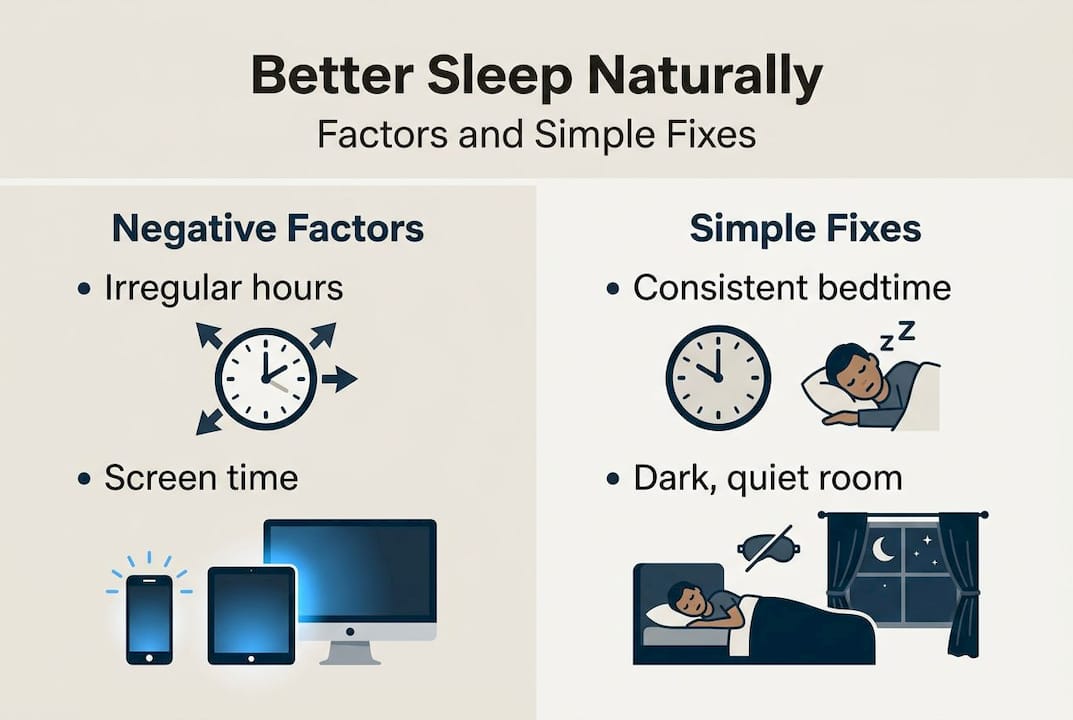
The CDC reports that over one-third of US adults fail to get adequate sleep regularly. That is not a personal failing. It is a systems problem, and systems problems require systems solutions.
Set up your environment for optimal sleep
Your bedroom sends signals to your nervous system before you even lie down. If those signals say “stimulation,” your brain will resist sleep. The goal is to make your room a cue for rest, and that starts with three variables: temperature, light, and sound.
Research consistently shows that the ideal sleep environment is cool (between 65 and 68°F), dark, and quiet. Here is how to build that environment systematically:
-
Lower the thermostat. Set your room to 65 to 68°F before bed. If that is not possible, use breathable, moisture-wicking bedding and a fan to create airflow.
-
Block all light. Even small amounts of ambient light, like a charging indicator or streetlamp glow, can suppress melatonin. Install blackout curtains or use a well-fitted contoured blackout sleep mask that does not press on your eyelids.
-
Control noise. Use a white noise machine, a fan, or earplugs to mask disruptive sounds. White noise works by creating a consistent audio baseline that prevents your brain from spiking into alertness when sounds occur.
-
Remove visual stimulation. Clocks, phones, and televisions all create low-level cognitive arousal. If you can see a clock from your bed, turn it away.
-
Reserve the bed for sleep only. Working or scrolling in bed trains your brain to associate the space with wakefulness. This is a behavioral conditioning principle, and it is surprisingly powerful.
| Common mistake |
Why it hurts sleep |
Simple fix |
| Sleeping with phone on nightstand |
Light and notification sounds fragment sleep |
Charge phone in another room |
| Visible clock face |
Creates performance anxiety around sleep |
Turn it away or remove it |
| Warm room (above 70°F) |
Prevents core temperature drop needed for deep sleep |
Use fan or lower thermostat |
| Thin curtains |
Ambient light suppresses melatonin |
Add blackout curtains or use a sleep mask |
| Exercising in bedroom |
Associates space with alertness |
Keep exercise gear out of the bedroom |
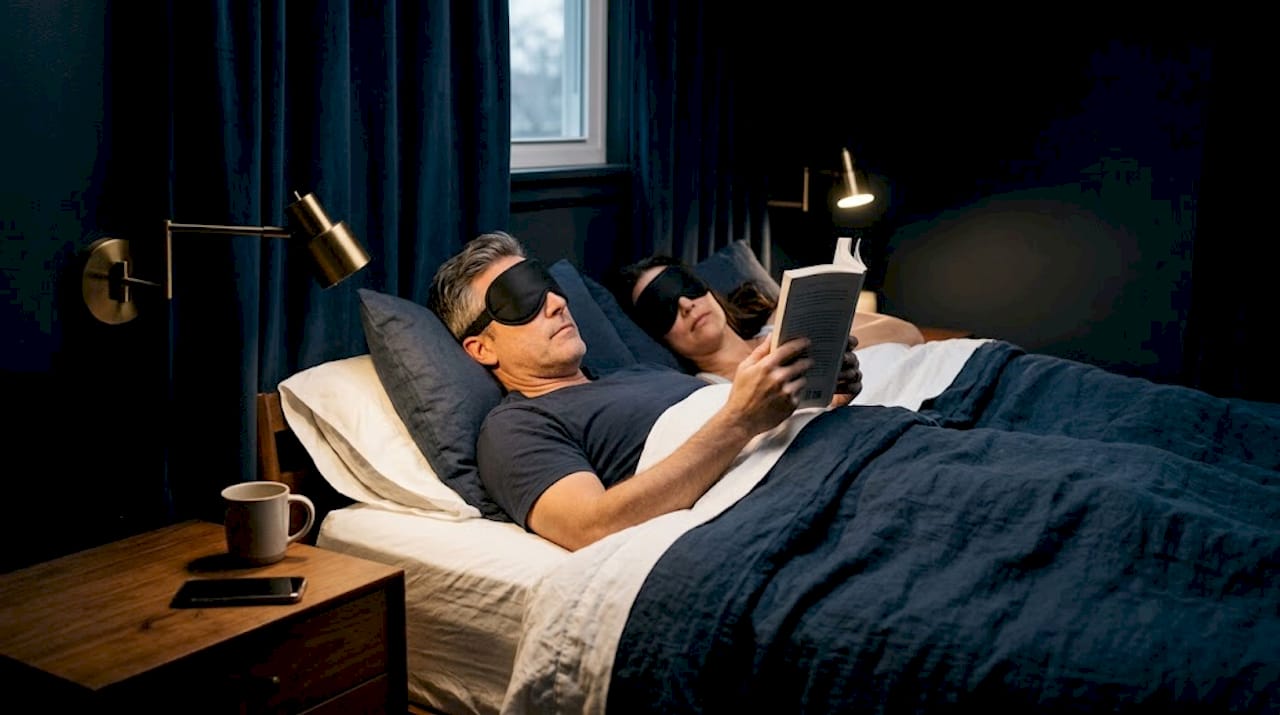
Pro Tip: If you share a bed with a partner who has a different sleep schedule, a contoured 3D sleep mask is one of the fastest, lowest-cost environmental upgrades you can make. It creates personal darkness without requiring blackout curtains in the entire room.
Master your sleep schedule and daily habits
Environment matters. But your daily habits are the engine that drives sleep quality over the long term. The most powerful lever you have is consistency.
Maintaining a consistent sleep-wake time every day, including weekends, reinforces your body’s circadian rhythm and reduces the time it takes to fall asleep. Think of your circadian clock like a muscle. It strengthens with regular use and weakens with inconsistency. Even one late night can shift your melatonin timing by 30 to 60 minutes.
Here is a sequenced daily routine that supports strong sleep:
-
Set a fixed wake time first. This is more important than your bedtime. Your wake time anchors your entire circadian rhythm.
-
Get morning sunlight within 30 minutes of waking. Natural light suppresses residual melatonin and sets your cortisol peak for the day, which determines when you feel sleepy at night.
-
Exercise in the morning or early afternoon. Regular exercise significantly improves sleep quality, but vigorous workouts within 2 to 3 hours of bedtime can delay sleep onset by raising core body temperature and adrenaline.
-
Cut caffeine by noon. Given caffeine’s 5 to 7 hour half-life, avoiding caffeine after midday means it is largely cleared by 10 p.m.
-
Finish eating 3 hours before bed. Digestion raises core body temperature and can trigger acid reflux when you lie down, both of which fragment sleep.
“Alcohol may help you fall asleep faster, but it fragments sleep architecture in the second half of the night, reducing REM and leaving you more tired in the morning than if you had not drunk at all.”
This is one of the most misunderstood sleep facts. Many people use alcohol as a wind-down tool, not realizing it is quietly degrading the most restorative phases of their sleep. The body metabolizes alcohol in roughly 3 to 4 hours, and as it clears, the nervous system rebounds into a state of heightened arousal.
Daily dos and don’ts:
- ✅ Wake at the same time every day, including weekends
- ✅ Get 10 to 20 minutes of morning sunlight
- ✅ Exercise regularly, earlier in the day
- ✅ Keep naps under 30 minutes and before 3 p.m.
- ❌ Avoid caffeine after noon
- ❌ Avoid alcohol within 3 hours of bedtime
- ❌ Avoid heavy meals close to bed
- ❌ Avoid intense screen use in the hour before sleep
You can explore more evidence-based strategies on the healthy sleep practices section of our site.
Integrate natural relaxation and recovery techniques
Even with the right environment and a solid schedule, many high performers still struggle to transition from “on” to “off” at night. The nervous system does not switch states on command. It needs a deliberate wind-down signal, and that is where targeted relaxation techniques become essential.
Progressive muscle relaxation and deep breathing are among the most studied non-pharmacological tools for improving sleep onset and reducing nighttime waking. Here is a simple pre-sleep routine:
-
Begin 45 to 60 minutes before bed. Dim the lights and lower your phone screen brightness or switch to night mode.
-
Practice diaphragmatic breathing for 5 minutes. Inhale for 4 counts, hold for 4, exhale for 6 to 8. The extended exhale activates the parasympathetic nervous system, which is your body’s rest-and-digest mode.
-
Do progressive muscle relaxation. Starting at your feet, tense each muscle group for 5 seconds, then release. Work upward through your calves, thighs, abdomen, chest, arms, and face. This technique reduces physical tension that often prevents sleep onset.
-
Avoid screens entirely for the final 30 to 60 minutes. Read a physical book, journal, or practice light stretching instead.
Pro Tip: A “digital sunset” at least 60 minutes before bed is one of the most impactful biohacks for sleep latency. Blue light from screens suppresses melatonin production and keeps your prefrontal cortex engaged. Replacing screen time with analog activities is not just a wellness cliché. It measurably shifts your brain toward sleep readiness.
For people with disrupted schedules, like shift workers or frequent travelers, timed light exposure and strategic napping can partially compensate for circadian disruption. Naps under 30 minutes taken before 3 p.m. restore alertness without creating sleep inertia or interfering with nighttime sleep. If you need deeper support for disrupted sleep patterns, natural sleep strategies that work with your body’s own melatonin production pathway are worth exploring.
Quick reference: natural relaxation toolkit
- 🌬️ Diaphragmatic breathing (4-4-6 pattern)
- 💪 Progressive muscle relaxation (bottom to top)
- 📖 Reading physical books instead of screens
- 🌡️ Warm shower or bath 90 minutes before bed (triggers core temperature drop)
- 🎵 Binaural beats or pink noise for sleep onset
Troubleshooting: when to seek advanced solutions
Good sleep hygiene is foundational. But it is not a cure for every sleep disorder. If you have consistently applied the strategies above for 4 to 6 weeks and still experience significant sleep difficulties, that is a signal worth taking seriously.
Cognitive behavioral therapy for insomnia (CBT-I) is the gold standard treatment for chronic insomnia, recommended over sleep medications even by the American College of Physicians. It addresses the cognitive patterns and behavioral loops that perpetuate sleeplessness, and its effects are more durable than pharmacological interventions.
“Sleep hygiene is the foundation, not the ceiling. For persistent insomnia, CBT-I produces lasting results where habits alone fall short.”
Red flags that mean it’s time to consult a professional:
- You have followed consistent sleep hygiene for more than 4 weeks with no improvement
- You wake feeling unrefreshed despite 7 to 9 hours in bed
- You experience loud snoring, gasping, or your partner notices breathing pauses (signs of sleep apnea)
- You feel a strong urge to move your legs at night (possible restless legs syndrome)
- Anxiety or intrusive thoughts consistently prevent sleep onset
- Daytime sleepiness impairs your work, relationships, or safety
These are not signs of weakness. They are signs that a deeper biological or psychological mechanism needs professional attention. Comprehensive sleep resources can help you understand where your symptoms fit and what next steps make sense.
Why most sleep advice misses what truly works
Here is something we have learned from working with high performers and biohackers: most sleep advice is reductive. It isolates one variable, a supplement, a blackout curtain, a breathing exercise, and presents it as the answer. And then people try it, get modest results, and conclude that sleep improvement is out of reach.
The truth is more nuanced. Sleep is a biological system, and systems respond to layered inputs, not single interventions. Magnesium alone will not save you if your room is 74°F and you are drinking coffee at 4 p.m. A perfect environment means little if your cortisol is dysregulated from inconsistent wake times. No single hack closes the gap. What works is the accumulation of aligned signals across your environment, schedule, nutrition, and nervous system state.
The other piece most advice misses is personalization. Your chronotype, your stress load, your gut microbiome, and your hormonal baseline all shape how you sleep. What works for someone who is naturally an early riser may not work for someone with a delayed circadian phase. This is why tracking matters. Use a sleep tracker, a journal, or even a simple morning energy rating (1 to 10) to identify which changes produce the most noticeable shifts for your specific biology. The evidence for holistic sleep consistently points to personalized, multi-variable approaches over one-size-fits-all prescriptions.
Experimentation is not optional. It is the method.
You now have the framework. The next step is equipping yourself with tools that reinforce it every night, without drugs, without dependency, and without compromise.

At Checked Out Wellness, we build sleep solutions for people who take recovery as seriously as their training and nutrition. Our 3D sleep mask creates total darkness without pressure on your eyelids, making it ideal for both home use and travel. Our natural sleep patch delivers key cofactors including magnesium, B6, B12, and GABA transdermally overnight, supporting your body’s own melatonin production pathway rather than replacing it. For a complete recovery stack, the sleep patch and mouth tape bundle pairs nasal breathing support with nutrient delivery for a measurably deeper night. All products are manufactured in South Korea under ISO 22716 GMP pharmaceutical standards. Drug-free, cruelty-free, and built for the long game.
Frequently asked questions
What is the single most effective way to improve sleep quality?
Maintaining a consistent sleep-wake schedule daily, including weekends, is the most evidence-backed strategy for improving sleep quality because it anchors your circadian rhythm and reduces sleep latency over time.
How dark should my bedroom be to improve deep sleep?
Your bedroom should be as close to total darkness as possible, since even low levels of ambient light suppress melatonin. Blackout curtains or a fitted sleep mask are the most effective tools for achieving this.
Is it okay to nap to recover lost sleep?
Short naps under 30 minutes taken early in the afternoon can restore alertness without disrupting nighttime sleep, but longer or late-day naps can fragment your circadian rhythm and make it harder to fall asleep at night.
What should I do if good sleep hygiene doesn’t improve my sleep?
If consistent sleep habits have not improved your sleep after several weeks, CBT-I is the recommended next step before turning to medication, as it addresses the underlying cognitive and behavioral patterns that sustain insomnia.
Recommended
Article generated by BabyLoveGrowth

How to improve sleep quality naturally: proven steps
More than a third of American adults are chronically undersleeping, and the consequences run deeper than morning grogginess. Poor sleep quietly erodes cognitive performance, hormonal balance, immune resilience, and long-term metabolic health. If you’re a high performer who tracks macros, optimizes workouts, and monitors HRV, yet still wakes up feeling wrecked, this guide is for you. What follows is a practical, evidence-based, drug-free roadmap to genuinely better sleep, not a list of generic tips, but a layered system that works with your biology.
Table of Contents
Key Takeaways
Understand what affects your sleep quality
Sleep is not a single state. It cycles through distinct stages every 90 minutes or so, including light sleep, deep slow-wave sleep, and REM (rapid eye movement) sleep. Deep sleep is where physical repair happens. REM is where memory consolidation and emotional processing occur. Together, they should account for 10 to 20 percent of your total sleep time, and adults need 7 to 9 hours to cycle through enough of each.
The problem is that most disruptors attack these stages silently. Alcohol, for example, feels sedating but suppresses REM sleep in the second half of the night. Irregular schedules fragment deep sleep by confusing your circadian rhythm, the internal 24-hour clock that regulates cortisol, melatonin, and body temperature. Understanding the science behind sleep quality at a biological level is what separates people who make lasting improvements from those who cycle through ineffective hacks.
Here are the major disruptors that undermine sleep architecture:
The CDC reports that over one-third of US adults fail to get adequate sleep regularly. That is not a personal failing. It is a systems problem, and systems problems require systems solutions.
Set up your environment for optimal sleep
Your bedroom sends signals to your nervous system before you even lie down. If those signals say “stimulation,” your brain will resist sleep. The goal is to make your room a cue for rest, and that starts with three variables: temperature, light, and sound.
Research consistently shows that the ideal sleep environment is cool (between 65 and 68°F), dark, and quiet. Here is how to build that environment systematically:
Pro Tip: If you share a bed with a partner who has a different sleep schedule, a contoured 3D sleep mask is one of the fastest, lowest-cost environmental upgrades you can make. It creates personal darkness without requiring blackout curtains in the entire room.
Master your sleep schedule and daily habits
Environment matters. But your daily habits are the engine that drives sleep quality over the long term. The most powerful lever you have is consistency.
Maintaining a consistent sleep-wake time every day, including weekends, reinforces your body’s circadian rhythm and reduces the time it takes to fall asleep. Think of your circadian clock like a muscle. It strengthens with regular use and weakens with inconsistency. Even one late night can shift your melatonin timing by 30 to 60 minutes.
Here is a sequenced daily routine that supports strong sleep:
This is one of the most misunderstood sleep facts. Many people use alcohol as a wind-down tool, not realizing it is quietly degrading the most restorative phases of their sleep. The body metabolizes alcohol in roughly 3 to 4 hours, and as it clears, the nervous system rebounds into a state of heightened arousal.
Daily dos and don’ts:
You can explore more evidence-based strategies on the healthy sleep practices section of our site.
Integrate natural relaxation and recovery techniques
Even with the right environment and a solid schedule, many high performers still struggle to transition from “on” to “off” at night. The nervous system does not switch states on command. It needs a deliberate wind-down signal, and that is where targeted relaxation techniques become essential.
Progressive muscle relaxation and deep breathing are among the most studied non-pharmacological tools for improving sleep onset and reducing nighttime waking. Here is a simple pre-sleep routine:
Pro Tip: A “digital sunset” at least 60 minutes before bed is one of the most impactful biohacks for sleep latency. Blue light from screens suppresses melatonin production and keeps your prefrontal cortex engaged. Replacing screen time with analog activities is not just a wellness cliché. It measurably shifts your brain toward sleep readiness.
For people with disrupted schedules, like shift workers or frequent travelers, timed light exposure and strategic napping can partially compensate for circadian disruption. Naps under 30 minutes taken before 3 p.m. restore alertness without creating sleep inertia or interfering with nighttime sleep. If you need deeper support for disrupted sleep patterns, natural sleep strategies that work with your body’s own melatonin production pathway are worth exploring.
Quick reference: natural relaxation toolkit
Troubleshooting: when to seek advanced solutions
Good sleep hygiene is foundational. But it is not a cure for every sleep disorder. If you have consistently applied the strategies above for 4 to 6 weeks and still experience significant sleep difficulties, that is a signal worth taking seriously.
Cognitive behavioral therapy for insomnia (CBT-I) is the gold standard treatment for chronic insomnia, recommended over sleep medications even by the American College of Physicians. It addresses the cognitive patterns and behavioral loops that perpetuate sleeplessness, and its effects are more durable than pharmacological interventions.
Red flags that mean it’s time to consult a professional:
These are not signs of weakness. They are signs that a deeper biological or psychological mechanism needs professional attention. Comprehensive sleep resources can help you understand where your symptoms fit and what next steps make sense.
Why most sleep advice misses what truly works
Here is something we have learned from working with high performers and biohackers: most sleep advice is reductive. It isolates one variable, a supplement, a blackout curtain, a breathing exercise, and presents it as the answer. And then people try it, get modest results, and conclude that sleep improvement is out of reach.
The truth is more nuanced. Sleep is a biological system, and systems respond to layered inputs, not single interventions. Magnesium alone will not save you if your room is 74°F and you are drinking coffee at 4 p.m. A perfect environment means little if your cortisol is dysregulated from inconsistent wake times. No single hack closes the gap. What works is the accumulation of aligned signals across your environment, schedule, nutrition, and nervous system state.
The other piece most advice misses is personalization. Your chronotype, your stress load, your gut microbiome, and your hormonal baseline all shape how you sleep. What works for someone who is naturally an early riser may not work for someone with a delayed circadian phase. This is why tracking matters. Use a sleep tracker, a journal, or even a simple morning energy rating (1 to 10) to identify which changes produce the most noticeable shifts for your specific biology. The evidence for holistic sleep consistently points to personalized, multi-variable approaches over one-size-fits-all prescriptions.
Experimentation is not optional. It is the method.
Take your sleep transformation further with Checked Out Wellness
You now have the framework. The next step is equipping yourself with tools that reinforce it every night, without drugs, without dependency, and without compromise.
At Checked Out Wellness, we build sleep solutions for people who take recovery as seriously as their training and nutrition. Our 3D sleep mask creates total darkness without pressure on your eyelids, making it ideal for both home use and travel. Our natural sleep patch delivers key cofactors including magnesium, B6, B12, and GABA transdermally overnight, supporting your body’s own melatonin production pathway rather than replacing it. For a complete recovery stack, the sleep patch and mouth tape bundle pairs nasal breathing support with nutrient delivery for a measurably deeper night. All products are manufactured in South Korea under ISO 22716 GMP pharmaceutical standards. Drug-free, cruelty-free, and built for the long game.
Frequently asked questions
What is the single most effective way to improve sleep quality?
Maintaining a consistent sleep-wake schedule daily, including weekends, is the most evidence-backed strategy for improving sleep quality because it anchors your circadian rhythm and reduces sleep latency over time.
How dark should my bedroom be to improve deep sleep?
Your bedroom should be as close to total darkness as possible, since even low levels of ambient light suppress melatonin. Blackout curtains or a fitted sleep mask are the most effective tools for achieving this.
Is it okay to nap to recover lost sleep?
Short naps under 30 minutes taken early in the afternoon can restore alertness without disrupting nighttime sleep, but longer or late-day naps can fragment your circadian rhythm and make it harder to fall asleep at night.
What should I do if good sleep hygiene doesn’t improve my sleep?
If consistent sleep habits have not improved your sleep after several weeks, CBT-I is the recommended next step before turning to medication, as it addresses the underlying cognitive and behavioral patterns that sustain insomnia.
Recommended
Article generated by BabyLoveGrowth