Sleep education basics are the foundational knowledge of how sleep works, why your body needs it, and what you can do to protect it. This is not passive rest. Sleep is an active physiological process vital to memory, hormone balance, immune defense, and emotional regulation. Institutions like the American Academy of Sleep Medicine (AASM), the National Institute of Neurological Disorders and Stroke (NINDS), and Harvard Health have spent decades building the science behind what most people still treat as an afterthought. If you train hard, think for a living, or simply want to feel human again by morning, understanding sleep is not optional. It is the foundation everything else rests on.
What are the sleep education basics everyone should know?
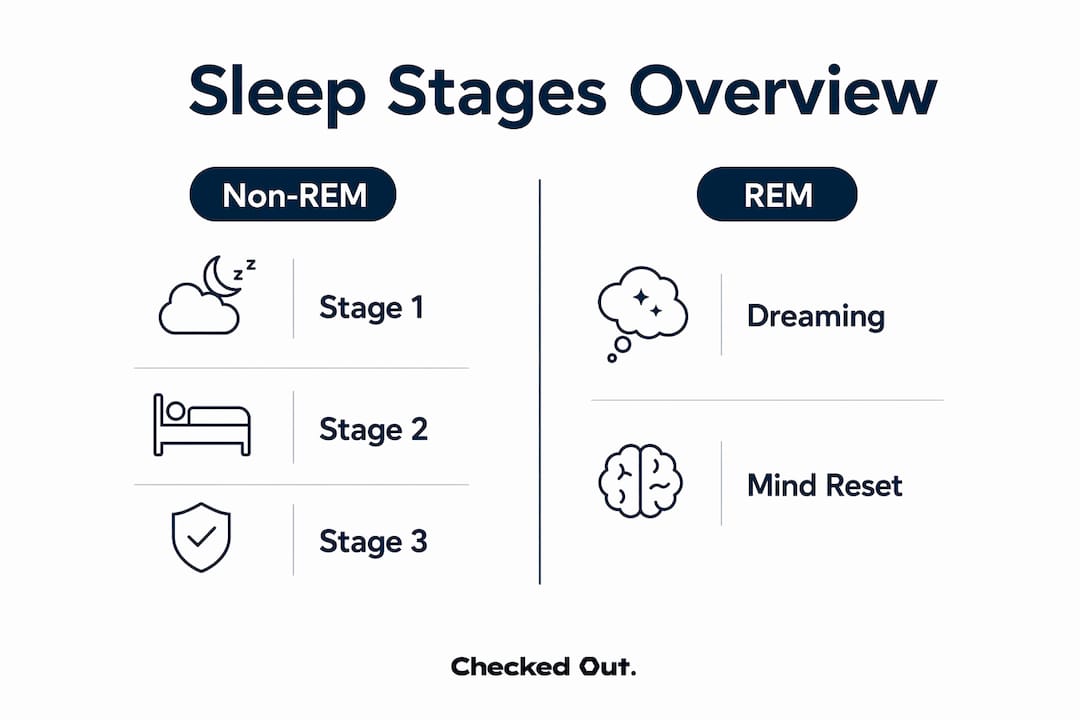
Sleep science, the recognized field behind what we call sleep education basics, divides sleep into two primary categories: Non-REM sleep and REM sleep. These two states alternate in repeating cycles throughout the night, each serving a distinct biological purpose. Skipping or shortening either one carries real consequences.
Non-REM sleep: the body’s repair window
Non-REM sleep contains three stages. Stage 1 is the lightest, a brief transition from wakefulness lasting just a few minutes. Stage 2 is where your body temperature drops, heart rate slows, and the brain begins producing sleep spindles, bursts of neural activity that support memory processing. Stage 3, often called slow-wave or deep sleep, is where physical repair happens. Growth hormone releases, tissue rebuilds, and the immune system strengthens during this stage. Most of your deep sleep occurs in the first half of the night, which is why cutting sleep short hits physical recovery hardest.

REM sleep: where the mind resets
REM sleep is where dreaming happens, but its role goes far beyond that. REM sleep periods become longer and deeper in the second half of the night. This is when the brain consolidates emotional memories, processes complex information, and regulates mood. People who consistently miss the later hours of sleep, whether from early alarms or alcohol disruption, lose disproportionate amounts of REM. The result shows up as irritability, poor decision-making, and reduced creativity the next day.
| Sleep Stage |
Type |
Primary Function |
Timing in Night |
| Stage 1 |
Non-REM |
Light transition, drowsiness |
First few minutes |
| Stage 2 |
Non-REM |
Memory processing, temperature drop |
Throughout night |
| Stage 3 |
Non-REM |
Physical repair, immune support |
First half |
| REM |
REM |
Dreaming, emotional regulation, memory |
Second half |
A full sleep cycle runs roughly 90 minutes. Most adults complete 4–6 cycles per night, which is why adults need 7 or more hours of sleep nightly for optimal cognitive function. Cutting that to five or six hours does not just leave you tired. It systematically strips away the most restorative stages.
Pro Tip: Set your alarm based on full 90-minute cycles. If you need to wake at 6:30 a.m., count back in 90-minute blocks from that time to find your ideal bedtime.
What are the best sleep hygiene tips to improve sleep quality?
Sleep hygiene is the clinical term for the behavioral and environmental practices that support consistent, restorative sleep. The Sleep Foundation defines it as a collection of habits, and the research is clear: fundamentals like schedule consistency and environment control outperform any complicated sleep protocol.
Here are the practices with the strongest evidence behind them:
-
Keep a fixed sleep and wake time. Your circadian rhythm is a biological clock. Irregular schedules confuse it. Waking at the same time every day, including weekends, is the single most powerful regulator of your internal clock.
-
Cool your bedroom to 65–68°F. Core body temperature must drop to initiate sleep. A cool room accelerates that process. This is not a preference. It is physiology.
-
Remove screens 60 minutes before bed. A 30–60 minute wind-down routine that excludes electronic devices reduces blue light exposure and lowers cortisol before sleep. Blue light suppresses melatonin production, delaying sleep onset.
-
Avoid caffeine after 2 p.m. Caffeine has a half-life of roughly 5–7 hours. A 3 p.m. coffee still has meaningful stimulant activity at 10 p.m.
-
Skip alcohol as a sleep aid. Alcohol disrupts REM sleep and fragments overall sleep quality despite its initial sedative effect. It causes mid-night awakenings as the sedative effect wears off, leaving you in lighter, less restorative sleep for the second half of the night.
-
Time exercise wisely. Morning or afternoon physical activity supports deeper sleep. Intense workouts within two hours of bedtime can elevate core temperature and adrenaline, making it harder to fall asleep.
-
Limit large meals late at night. Digestion competes with sleep. A heavy meal within two hours of bedtime raises body temperature and keeps the gut active when it should be winding down.
If your current schedule is far from ideal, do not overhaul it overnight. Adjusting sleep times in 30–60 minute increments helps reset your circadian rhythm with far less disruption than an abrupt shift. Gradual change sticks. Sudden change creates more sleep debt.
Pro Tip: Treat your bedroom like a sleep sanctuary. Reserve it exclusively for sleep. If your brain associates your bed with work, scrolling, or TV, it will resist switching off when you actually need it to.
What are the benefits of good sleep for mental and physical health?
The benefits of good sleep are not abstract. They show up in your reaction time, your mood, your waistline, and your immune response. Sleep is when your body runs its maintenance cycle, and skipping it is like skipping an oil change, except the engine is your brain.
“Poor sleep impairs memory, reaction time, and decision-making.” — Mayo Clinic
That statement from Mayo Clinic is not a warning for the chronically sleep-deprived. It describes what happens after a single bad night. The body keeps score quietly. One night of poor sleep raises cortisol, suppresses immune activity, and reduces prefrontal cortex function, the part of the brain responsible for judgment and impulse control.
Consistent, quality sleep delivers the opposite. Memory consolidation happens during both slow-wave and REM sleep, which is why studying before bed and sleeping well afterward produces better retention than cramming through the night. Hormone regulation, including growth hormone, testosterone, and leptin (the satiety hormone), depends on uninterrupted sleep cycles. People who sleep fewer than 7 hours consistently show higher rates of obesity, cardiovascular disease, and type 2 diabetes. That is not correlation. Sleep deprivation directly disrupts the hormonal systems that regulate appetite and metabolic function.
Emotional wellbeing is equally tied to sleep quality. REM sleep processes emotionally charged memories, essentially taking the emotional sting out of difficult experiences. Without enough REM, the brain’s threat-detection system, the amygdala, becomes hyperreactive. You feel more anxious, more irritable, and less able to regulate your responses. For high performers and biohackers who track every metric, sleep quality is the variable with the highest return on investment. You can learn more about why sleep quality matters for your long-term health outcomes.
How can you apply sleep education basics to your daily habits?
Knowing the science is one thing. Building it into your life is another. The fundamentals of sleep education only work when they become habits, not experiments you try for a week.
Here is a practical framework for translating sleep knowledge into daily behavior:
-
Audit your current sleep. Track your sleep and wake times for one week without changing anything. Use a journal or a wearable like an Oura Ring or WHOOP. You cannot fix what you have not measured.
-
Set one non-negotiable wake time. Pick a time you can hold seven days a week and commit to it for 30 days. This single habit anchors your circadian rhythm faster than any other change.
-
Build a 30-minute wind-down ritual. This could include light stretching, reading physical books, journaling, or breathwork. The goal is to signal to your nervous system that the day is over. Consistency matters more than the specific activity.
-
Optimize your sleep environment. Blackout curtains or a contoured sleep mask eliminate light. A white noise machine or earplugs manage sound. A thermostat set to 65–68°F handles temperature. These three changes address the three most common environmental sleep disruptors.
-
Manage middle-of-the-night waking. If you cannot fall back asleep within 20 minutes, get out of bed and do something calm in dim light. This prevents your brain from associating the bed with wakefulness and anxiety. Return only when you feel sleepy.
-
Know when to seek help. Sleep hygiene cannot cure sleep disorders. If you have followed these practices consistently for four weeks and still struggle, conditions like insomnia or sleep apnea may be the underlying cause. A board-certified sleep specialist or a referral from your primary care physician is the right next step.
For a deeper look at proven strategies for sleep quality, Checkedoutwellness has compiled a practical resource that goes beyond the basics. You can also explore natural methods to improve sleep if you prefer a drug-free approach to building better habits.
Key takeaways
Mastering sleep education basics means understanding that sleep is a structured biological process, not a passive state, and that consistent habits produce better results than any single intervention.
| Point |
Details |
| Sleep has distinct stages |
Non-REM and REM sleep each serve unique functions; losing either one impairs health and cognition. |
| Adults need 7+ hours nightly |
Fewer than 7 hours disrupts hormones, immunity, and decision-making in measurable ways. |
| Environment drives sleep quality |
Temperature, light, and noise control are the three highest-impact environmental changes you can make. |
| Gradual schedule changes work best |
Shifting sleep times in 30–60 minute increments prevents circadian disruption and sleep debt. |
| Persistent problems need professional review |
Sleep hygiene is a foundation, not a cure; sleep disorders require medical evaluation. |
What I have learned from taking sleep seriously
By Geeta
I used to believe that sleep was something you negotiated with. Push through the week, catch up on the weekend. Optimize the morning routine, ignore the night. That thinking cost me more than I realized at the time.
What I have come to understand, after years of studying sleep science and working with people who treat recovery as seriously as performance, is that sleep does not respond well to force or shortcuts. The body has a system. Your job is to stop interfering with it. Consistent wake times, a cool dark room, and a genuine wind-down routine are not glamorous. They are also not negotiable if you want to perform at your best.
The misconception I see most often is that people treat sleep hygiene as a temporary fix rather than a permanent practice. They clean up their habits for two weeks, sleep improves, and then they slide back into late nights and irregular schedules. Sleep hygiene is not a reset button. It is a daily commitment, like brushing your teeth, except the stakes are considerably higher.
One more thing worth saying plainly: if you have done everything right for a month and still cannot sleep, that is not a willpower problem. That is a medical signal. Conditions like sleep apnea affect millions of people who have no idea they have it. Get evaluated. The fundamentals of sleep education exist to help you, not to make you feel like a failure when they are not enough on their own.
— Geeta
How Checkedoutwellness supports your sleep foundation

Building good sleep habits is the foundation. Sometimes your body needs a little extra support to get there, especially if you travel frequently, work irregular hours, or are in the process of resetting a disrupted sleep pattern.
Checkedoutwellness designs science-backed, drug-free sleep tools that work alongside your habits, not instead of them. The natural sleep patch delivers cofactors like magnesium, B6, B12, and GABA transdermally to support your body’s own melatonin production, with no synthetic melatonin and no dependency risk. The contoured blackout sleep mask creates total darkness without pressure on your eyes. For those who want to address both sleep quality and nighttime breathing, the Sleep Duo bundle pairs the sleep patch with mouth tape for complete overnight support. All products are manufactured under ISO 22716 GMP pharmaceutical standards in South Korea. These are tools built for people who take sleep as seriously as their training and nutrition.
FAQ
What are sleep education basics?
Sleep education basics are the foundational knowledge of sleep stages, sleep hygiene, and the health benefits of adequate rest. They include understanding Non-REM and REM sleep cycles, evidence-based hygiene practices, and how sleep affects cognitive and physical health.
How many hours of sleep do adults actually need?
Adults aged 18 and older need 7 or more hours of sleep per night for optimal health and cognitive function. Consistently sleeping fewer than 7 hours is linked to increased risk of cardiovascular disease, obesity, and impaired decision-making.
What is the most effective sleep hygiene tip?
Keeping a consistent sleep and wake time every day, including weekends, is the most clinically supported sleep hygiene practice. It anchors your circadian rhythm and makes falling and staying asleep significantly easier over time.
Does alcohol help you sleep better?
No. Alcohol disrupts REM sleep and causes mid-night awakenings as its sedative effect wears off, reducing overall sleep quality even if it helps you fall asleep faster initially.
When should you see a doctor about sleep problems?
If consistent sleep hygiene practices have not improved your sleep after four weeks, consult a physician. Persistent sleep problems may indicate an underlying condition like insomnia or sleep apnea that requires medical evaluation and treatment.
Recommended

Sleep Education Basics: Your Complete Sleep Health Guide
Sleep education basics are the foundational knowledge of how sleep works, why your body needs it, and what you can do to protect it. This is not passive rest. Sleep is an active physiological process vital to memory, hormone balance, immune defense, and emotional regulation. Institutions like the American Academy of Sleep Medicine (AASM), the National Institute of Neurological Disorders and Stroke (NINDS), and Harvard Health have spent decades building the science behind what most people still treat as an afterthought. If you train hard, think for a living, or simply want to feel human again by morning, understanding sleep is not optional. It is the foundation everything else rests on.
What are the sleep education basics everyone should know?
Sleep science, the recognized field behind what we call sleep education basics, divides sleep into two primary categories: Non-REM sleep and REM sleep. These two states alternate in repeating cycles throughout the night, each serving a distinct biological purpose. Skipping or shortening either one carries real consequences.
Non-REM sleep: the body’s repair window
Non-REM sleep contains three stages. Stage 1 is the lightest, a brief transition from wakefulness lasting just a few minutes. Stage 2 is where your body temperature drops, heart rate slows, and the brain begins producing sleep spindles, bursts of neural activity that support memory processing. Stage 3, often called slow-wave or deep sleep, is where physical repair happens. Growth hormone releases, tissue rebuilds, and the immune system strengthens during this stage. Most of your deep sleep occurs in the first half of the night, which is why cutting sleep short hits physical recovery hardest.
REM sleep: where the mind resets
REM sleep is where dreaming happens, but its role goes far beyond that. REM sleep periods become longer and deeper in the second half of the night. This is when the brain consolidates emotional memories, processes complex information, and regulates mood. People who consistently miss the later hours of sleep, whether from early alarms or alcohol disruption, lose disproportionate amounts of REM. The result shows up as irritability, poor decision-making, and reduced creativity the next day.
A full sleep cycle runs roughly 90 minutes. Most adults complete 4–6 cycles per night, which is why adults need 7 or more hours of sleep nightly for optimal cognitive function. Cutting that to five or six hours does not just leave you tired. It systematically strips away the most restorative stages.
Pro Tip: Set your alarm based on full 90-minute cycles. If you need to wake at 6:30 a.m., count back in 90-minute blocks from that time to find your ideal bedtime.
What are the best sleep hygiene tips to improve sleep quality?
Sleep hygiene is the clinical term for the behavioral and environmental practices that support consistent, restorative sleep. The Sleep Foundation defines it as a collection of habits, and the research is clear: fundamentals like schedule consistency and environment control outperform any complicated sleep protocol.
Here are the practices with the strongest evidence behind them:
If your current schedule is far from ideal, do not overhaul it overnight. Adjusting sleep times in 30–60 minute increments helps reset your circadian rhythm with far less disruption than an abrupt shift. Gradual change sticks. Sudden change creates more sleep debt.
Pro Tip: Treat your bedroom like a sleep sanctuary. Reserve it exclusively for sleep. If your brain associates your bed with work, scrolling, or TV, it will resist switching off when you actually need it to.
What are the benefits of good sleep for mental and physical health?
The benefits of good sleep are not abstract. They show up in your reaction time, your mood, your waistline, and your immune response. Sleep is when your body runs its maintenance cycle, and skipping it is like skipping an oil change, except the engine is your brain.
That statement from Mayo Clinic is not a warning for the chronically sleep-deprived. It describes what happens after a single bad night. The body keeps score quietly. One night of poor sleep raises cortisol, suppresses immune activity, and reduces prefrontal cortex function, the part of the brain responsible for judgment and impulse control.
Consistent, quality sleep delivers the opposite. Memory consolidation happens during both slow-wave and REM sleep, which is why studying before bed and sleeping well afterward produces better retention than cramming through the night. Hormone regulation, including growth hormone, testosterone, and leptin (the satiety hormone), depends on uninterrupted sleep cycles. People who sleep fewer than 7 hours consistently show higher rates of obesity, cardiovascular disease, and type 2 diabetes. That is not correlation. Sleep deprivation directly disrupts the hormonal systems that regulate appetite and metabolic function.
Emotional wellbeing is equally tied to sleep quality. REM sleep processes emotionally charged memories, essentially taking the emotional sting out of difficult experiences. Without enough REM, the brain’s threat-detection system, the amygdala, becomes hyperreactive. You feel more anxious, more irritable, and less able to regulate your responses. For high performers and biohackers who track every metric, sleep quality is the variable with the highest return on investment. You can learn more about why sleep quality matters for your long-term health outcomes.
How can you apply sleep education basics to your daily habits?
Knowing the science is one thing. Building it into your life is another. The fundamentals of sleep education only work when they become habits, not experiments you try for a week.
Here is a practical framework for translating sleep knowledge into daily behavior:
For a deeper look at proven strategies for sleep quality, Checkedoutwellness has compiled a practical resource that goes beyond the basics. You can also explore natural methods to improve sleep if you prefer a drug-free approach to building better habits.
Key takeaways
Mastering sleep education basics means understanding that sleep is a structured biological process, not a passive state, and that consistent habits produce better results than any single intervention.
What I have learned from taking sleep seriously
By Geeta
I used to believe that sleep was something you negotiated with. Push through the week, catch up on the weekend. Optimize the morning routine, ignore the night. That thinking cost me more than I realized at the time.
What I have come to understand, after years of studying sleep science and working with people who treat recovery as seriously as performance, is that sleep does not respond well to force or shortcuts. The body has a system. Your job is to stop interfering with it. Consistent wake times, a cool dark room, and a genuine wind-down routine are not glamorous. They are also not negotiable if you want to perform at your best.
The misconception I see most often is that people treat sleep hygiene as a temporary fix rather than a permanent practice. They clean up their habits for two weeks, sleep improves, and then they slide back into late nights and irregular schedules. Sleep hygiene is not a reset button. It is a daily commitment, like brushing your teeth, except the stakes are considerably higher.
One more thing worth saying plainly: if you have done everything right for a month and still cannot sleep, that is not a willpower problem. That is a medical signal. Conditions like sleep apnea affect millions of people who have no idea they have it. Get evaluated. The fundamentals of sleep education exist to help you, not to make you feel like a failure when they are not enough on their own.
How Checkedoutwellness supports your sleep foundation
Building good sleep habits is the foundation. Sometimes your body needs a little extra support to get there, especially if you travel frequently, work irregular hours, or are in the process of resetting a disrupted sleep pattern.
Checkedoutwellness designs science-backed, drug-free sleep tools that work alongside your habits, not instead of them. The natural sleep patch delivers cofactors like magnesium, B6, B12, and GABA transdermally to support your body’s own melatonin production, with no synthetic melatonin and no dependency risk. The contoured blackout sleep mask creates total darkness without pressure on your eyes. For those who want to address both sleep quality and nighttime breathing, the Sleep Duo bundle pairs the sleep patch with mouth tape for complete overnight support. All products are manufactured under ISO 22716 GMP pharmaceutical standards in South Korea. These are tools built for people who take sleep as seriously as their training and nutrition.
FAQ
What are sleep education basics?
Sleep education basics are the foundational knowledge of sleep stages, sleep hygiene, and the health benefits of adequate rest. They include understanding Non-REM and REM sleep cycles, evidence-based hygiene practices, and how sleep affects cognitive and physical health.
How many hours of sleep do adults actually need?
Adults aged 18 and older need 7 or more hours of sleep per night for optimal health and cognitive function. Consistently sleeping fewer than 7 hours is linked to increased risk of cardiovascular disease, obesity, and impaired decision-making.
What is the most effective sleep hygiene tip?
Keeping a consistent sleep and wake time every day, including weekends, is the most clinically supported sleep hygiene practice. It anchors your circadian rhythm and makes falling and staying asleep significantly easier over time.
Does alcohol help you sleep better?
No. Alcohol disrupts REM sleep and causes mid-night awakenings as its sedative effect wears off, reducing overall sleep quality even if it helps you fall asleep faster initially.
When should you see a doctor about sleep problems?
If consistent sleep hygiene practices have not improved your sleep after four weeks, consult a physician. Persistent sleep problems may indicate an underlying condition like insomnia or sleep apnea that requires medical evaluation and treatment.
Recommended