You already know poor sleep makes you foggy and irritable. What most people miss is the deeper cost: consistently disrupted sleep quietly degrades immune function, hormonal balance, and the brain’s ability to consolidate memory. The full explanation of sleep enhancement goes far beyond “go to bed earlier.” It’s a systematic, biology-rooted process that works with your body’s own architecture. This article breaks down what sleep enhancement actually means, why natural methods outperform quick fixes every time, and how you can build a personal system that holds.
Table of Contents
Key takeaways
| Point |
Details |
| Sleep stages matter deeply |
REM and non-REM sleep each serve distinct biological functions that behavioral changes protect and strengthen. |
| Consistent wake time anchors everything |
A fixed wake time is the single highest-leverage change for rebuilding circadian rhythm stability. |
| Behavioral methods outperform supplements |
CBT-I frameworks address root conditioning; supplements work best when filling specific physiological gaps. |
| Environment shapes sleep physiology |
Temperature, light, and sound directly influence how quickly and deeply your nervous system can downregulate. |
| System beats tactics |
Sustainable sleep improvement requires layering multiple evidence-based methods, not rotating through isolated hacks. |
How your biology regulates sleep quality
Sleep is not passive rest. It is an active biological process your body runs through in precise cycles, each one serving functions that wakefulness simply cannot replicate. Understanding this architecture is the foundation of any real explanation of sleep enhancement.
Your sleep is structured around two major categories: REM (rapid eye movement) and non-REM sleep. Non-REM itself has three stages, with slow-wave sleep in stages two and three being the most physically restorative. This is where tissue repair happens, growth hormone releases, and your immune system does its overnight maintenance. REM sleep, on the other hand, is where emotional memory consolidation and creative problem-solving occur. Shortchange either category and you pay for it in ways that show up far beyond the bedroom.
Two biological systems govern when and how well you sleep. The first is your circadian rhythm, a roughly 24-hour internal clock driven by light exposure and social cues that determines when you feel sleepy and when you feel alert. The second is sleep pressure, also called the homeostatic drive, which is governed by adenosine accumulating in your brain during wakefulness. The longer you stay awake, the more adenosine builds, and the stronger your drive to sleep becomes. Enhanced sleep quality supports immune health, learning, and hormonal balance precisely because these two systems, when well-calibrated, deliver complete, restorative sleep cycles.

Temperature plays a more significant role than most people realize. Your core body temperature needs to drop by roughly one to two degrees Fahrenheit for sleep onset to occur. A bedroom that is too warm physically delays this process, regardless of how tired you feel.
Pro Tip: Keep your bedroom between 65 and 68 degrees Fahrenheit. This range supports the core temperature drop your body needs to initiate deep sleep efficiently.
Natural methods for improving sleep quality
The most evidence-backed framework for how to enhance sleep quality without medication is Cognitive Behavioral Therapy for Insomnia, known as CBT-I. It is first-line insomnia therapy, meaning it is recommended before sleep medication in clinical settings. CBT-I addresses the behavioral conditioning loops that keep poor sleep locked in place.
Here are the core CBT-I methods, applied practically:
-
Fix your wake time first. A consistent wake time anchors your circadian rhythm and amplifies every other change you make. Pick a time and hold it, even on weekends, even after a rough night. This single rule does more than most sleep supplements combined.
-
Apply stimulus control. Your brain learns associations. If you lie awake in bed scrolling, worrying, or watching TV, your nervous system starts linking the bedroom with alertness rather than sleep. Stimulus control breaks this conditioning by reserving the bed strictly for sleep and sex. Nothing else.
-
Use sleep restriction therapy carefully. This method intentionally limits time in bed to match your actual sleep time, creating stronger sleep pressure. It feels counterintuitive because you temporarily spend less time in bed. But the effect is a faster sleep onset and more consolidated sleep over time. Work up gradually and monitor carefully.
-
Build a wind-down routine. Low-stimulation activities about one hour before bedtime cue your nervous system toward sleep. The specific activities matter less than the consistency of the sequence. Reading, gentle stretching, dimming lights, and a warm shower are all effective because they become conditioned sleep signals over time.
-
Exit the bed if sleep stalls. If you are awake for more than 15 to 20 minutes, get up and do something calm in low light. Return only when sleepy. This rule sounds punishing, but it is one of the most powerful tools for breaking the wake-in-bed conditioning loop.
One pattern that trips people up: trying harder to fall asleep. Sleep is a passive process. Effort activates the arousal system. The goal of behavioral methods is to create the conditions for sleep and then release the outcome. Cognitive techniques, like scheduled worry time earlier in the evening or a brain dump journal before bed, help offload the mental load that keeps the nervous system activated at lights out.
Pro Tip: Write down everything on your mind 30 minutes before bed, with a brief note on the next step for each item. This “cognitive offloading” has been shown to reduce sleep-onset time by quieting the planning centers in the prefrontal cortex.
Lifestyle and environment factors that matter
The methods for better sleep do not live in a vacuum. The environment you sleep in and the choices you make during daylight hours either support or undermine your sleep architecture every night.
Here is what the research consistently points to:
-
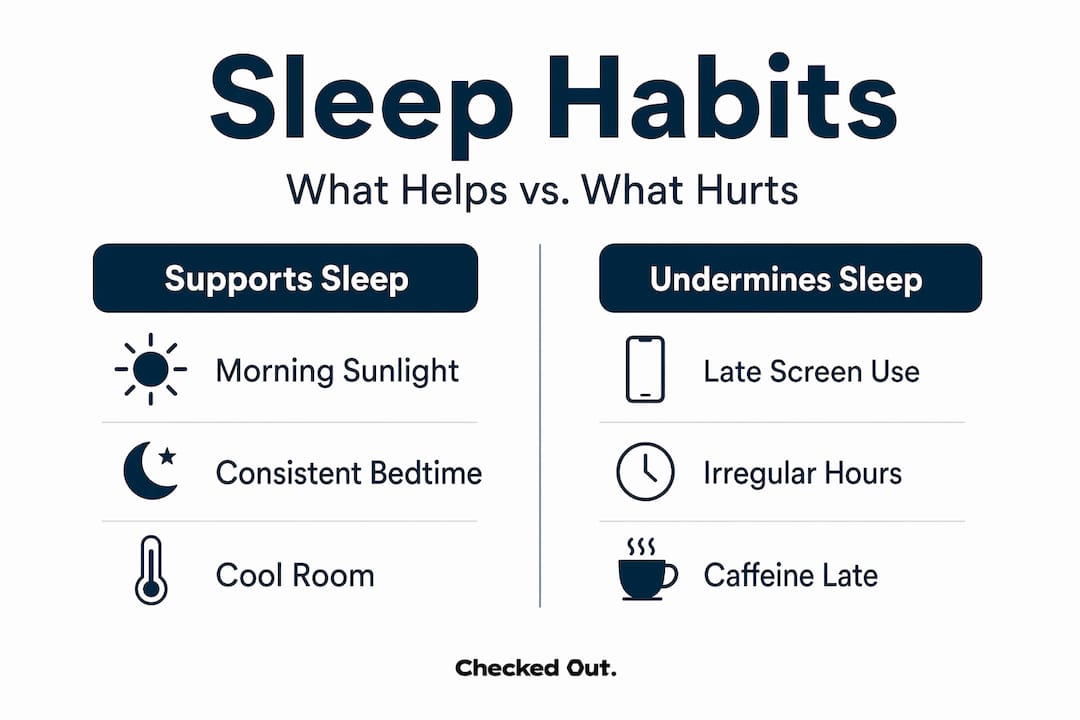
Morning light exposure. Getting bright natural light within 30 to 60 minutes of waking reinforces your circadian rhythm by resetting your internal clock each day. This single habit sharpens the timing of melatonin release at night.
-
Blue light reduction at night. Screens emit light in wavelengths that suppress melatonin production. Dimming screens or using blue-light-filtering settings two hours before bed gives your brain the dark signal it needs to begin the sleep cascade.
-
Bedroom environment optimization. Cool temperature, a blackout-level dark room, and minimal sound all reduce the micro-arousals that fragment your sleep cycles. Even small amounts of light at night can suppress melatonin, so sleep hygiene practices consistently recommend full darkness as a standard.
-
Exercise timing. Regular exercise significantly improves sleep depth and duration. Morning or afternoon sessions are generally ideal. Vigorous exercise within two to three hours of bedtime can raise core temperature and cortisol, both of which delay sleep onset for some people.
-
Nap management. Short naps of 20 minutes or less taken before 3 PM can restore alertness without depleting your sleep pressure for the night. Longer naps or late-afternoon napping chips away at the adenosine buildup that makes falling asleep at night feel natural.
Here is a comparison of habits that support sleep versus those that quietly erode it:
| Habit |
Supports sleep |
Undermines sleep |
| Light exposure |
Morning sunlight within 1 hour of waking |
Screen use within 2 hours of bed |
| Meal timing |
Finishing dinner 2 to 3 hours before bed |
Large meals or alcohol close to bedtime |
| Exercise |
Regular movement, morning or afternoon |
Vigorous workouts within 2 hours of sleep |
| Napping |
20 minutes, before 3 PM |
Long or late naps |
| Caffeine |
Cut off by early afternoon |
Caffeine after 2 PM for most people |
Common pitfalls and realistic timelines
One of the most misunderstood parts of sleep enhancement is the difference between what helps acutely and what creates lasting change. People often reach for a sleep hack, get one good night, then declare it “doesn’t work” when the effect fades. Sleep enhancement is not an event. It is a recalibration.
Here are the most common pitfalls worth knowing:
-
Irregular schedules compound insomnia. Oversleeping and inconsistent schedules weaken both sleep pressure and circadian cues, making insomnia harder to resolve. Saturday sleep-ins feel like recovery, but they often set your sleep system back several days.
-
Sleep hacks without a system rarely stick. Magnesium before bed, mouth taping, cold showers, these can all support sleep, but supplements remain secondary to a functioning behavioral system. They fill gaps; they do not build the foundation.
-
Short-term sleep restriction is not the same as chronic deprivation. Acute sleep rebound after a period of restriction can buffer short-term health risks. However, chronic sleep debt cycles carry genuine long-term health costs. The goal is a stable sleep opportunity, not a cycle of deprivation and rebound.
“Sleep hygiene is most effective as part of a multimodal, evidence-based approach addressing circadian alignment, arousal, and behavioral cues simultaneously.” — Sleep Science and Practice
Most people see meaningful improvement in sleep quality within two to four weeks of applying consistent CBT-I principles. The timeline feels slow when you are exhausted, but the changes you are making are neurological and physiological. The body keeps score quietly, and it rewards consistency in the same quiet way.
My honest take on sleep enhancement
I have watched a lot of people try to shortcut their way to better sleep. They buy a supplement, try it for three days, and move on when it does not transform their nights. I understand the impulse. When you are sleep-deprived, you want relief now. But this is where I think the popular conversation about sleep improvement goes wrong.
Sleep enhancement is a system problem. The behavioral foundations, your wake time, your bed association, your light exposure, have to be in place before anything else makes a meaningful difference. Once those foundations hold, targeted tools like natural sleep support products can genuinely accelerate results because you are adding to something that already works.
What I have learned is that the people who see the most lasting change are the ones who stop trying to hack their sleep and start treating it the way they treat nutrition and fitness: as a long-term practice worth refining. The uncomfortable truth is that there is no silver bullet. But there absolutely is a system. And the system works, if you commit to it long enough to let it.
— Geeta
Discover Checkedoutwellness sleep solutions

If you are building a sleep system based on the behavioral strategies above, Checkedoutwellness offers tools designed to support exactly that. The brand’s natural sleep patches deliver cofactors like magnesium, GABA, B6, and B12 transdermally to support your body’s own melatonin production, without synthetic melatonin or pharmaceutical dependency. Their contoured blackout sleep mask creates the full-darkness environment that sleep physiology actually requires. Manufactured under ISO 22716 GMP pharmaceutical standards in South Korea, every product is built to complement evidence-based sleep methods, not replace them. Explore the full product range and the science behind each solution at Checkedoutwellness.
FAQ
What does sleep enhancement actually mean?
Sleep enhancement refers to the process of improving both the quality and efficiency of sleep through behavioral, environmental, and lifestyle strategies. It focuses on supporting the body’s natural sleep architecture rather than forcing sleep through pharmaceutical means.
What is the most effective natural method for better sleep?
CBT-I, or Cognitive Behavioral Therapy for Insomnia, is the most evidence-backed natural approach. It combines stimulus control, sleep restriction, and relaxation techniques to address the root behavioral patterns that disrupt sleep.
How long before natural sleep improvements take hold?
Most people notice meaningful improvement within two to four weeks of consistently applying CBT-I principles like a fixed wake time, stimulus control, and a regular wind-down routine.
Can supplements replace behavioral sleep strategies?
Supplements work best when they address specific physiological gaps, such as magnesium deficiency, but they do not substitute for a functional behavioral sleep system. Building the behavioral foundation first makes any supplement far more effective.
Why does trying harder to sleep make things worse?
Effort activates your arousal system, which is the opposite of what sleep requires. Behavioral techniques like stimulus control and cognitive offloading are specifically designed to reduce this performance anxiety around sleep, allowing the passive process of sleep onset to occur naturally.
Recommended

Sleep Enhancement Explained: Natural Methods That Work
You already know poor sleep makes you foggy and irritable. What most people miss is the deeper cost: consistently disrupted sleep quietly degrades immune function, hormonal balance, and the brain’s ability to consolidate memory. The full explanation of sleep enhancement goes far beyond “go to bed earlier.” It’s a systematic, biology-rooted process that works with your body’s own architecture. This article breaks down what sleep enhancement actually means, why natural methods outperform quick fixes every time, and how you can build a personal system that holds.
Table of Contents
Key takeaways
How your biology regulates sleep quality
Sleep is not passive rest. It is an active biological process your body runs through in precise cycles, each one serving functions that wakefulness simply cannot replicate. Understanding this architecture is the foundation of any real explanation of sleep enhancement.
Your sleep is structured around two major categories: REM (rapid eye movement) and non-REM sleep. Non-REM itself has three stages, with slow-wave sleep in stages two and three being the most physically restorative. This is where tissue repair happens, growth hormone releases, and your immune system does its overnight maintenance. REM sleep, on the other hand, is where emotional memory consolidation and creative problem-solving occur. Shortchange either category and you pay for it in ways that show up far beyond the bedroom.
Two biological systems govern when and how well you sleep. The first is your circadian rhythm, a roughly 24-hour internal clock driven by light exposure and social cues that determines when you feel sleepy and when you feel alert. The second is sleep pressure, also called the homeostatic drive, which is governed by adenosine accumulating in your brain during wakefulness. The longer you stay awake, the more adenosine builds, and the stronger your drive to sleep becomes. Enhanced sleep quality supports immune health, learning, and hormonal balance precisely because these two systems, when well-calibrated, deliver complete, restorative sleep cycles.
Temperature plays a more significant role than most people realize. Your core body temperature needs to drop by roughly one to two degrees Fahrenheit for sleep onset to occur. A bedroom that is too warm physically delays this process, regardless of how tired you feel.
Pro Tip: Keep your bedroom between 65 and 68 degrees Fahrenheit. This range supports the core temperature drop your body needs to initiate deep sleep efficiently.
Natural methods for improving sleep quality
The most evidence-backed framework for how to enhance sleep quality without medication is Cognitive Behavioral Therapy for Insomnia, known as CBT-I. It is first-line insomnia therapy, meaning it is recommended before sleep medication in clinical settings. CBT-I addresses the behavioral conditioning loops that keep poor sleep locked in place.
Here are the core CBT-I methods, applied practically:
Fix your wake time first. A consistent wake time anchors your circadian rhythm and amplifies every other change you make. Pick a time and hold it, even on weekends, even after a rough night. This single rule does more than most sleep supplements combined.
Apply stimulus control. Your brain learns associations. If you lie awake in bed scrolling, worrying, or watching TV, your nervous system starts linking the bedroom with alertness rather than sleep. Stimulus control breaks this conditioning by reserving the bed strictly for sleep and sex. Nothing else.
Use sleep restriction therapy carefully. This method intentionally limits time in bed to match your actual sleep time, creating stronger sleep pressure. It feels counterintuitive because you temporarily spend less time in bed. But the effect is a faster sleep onset and more consolidated sleep over time. Work up gradually and monitor carefully.
Build a wind-down routine. Low-stimulation activities about one hour before bedtime cue your nervous system toward sleep. The specific activities matter less than the consistency of the sequence. Reading, gentle stretching, dimming lights, and a warm shower are all effective because they become conditioned sleep signals over time.
Exit the bed if sleep stalls. If you are awake for more than 15 to 20 minutes, get up and do something calm in low light. Return only when sleepy. This rule sounds punishing, but it is one of the most powerful tools for breaking the wake-in-bed conditioning loop.
One pattern that trips people up: trying harder to fall asleep. Sleep is a passive process. Effort activates the arousal system. The goal of behavioral methods is to create the conditions for sleep and then release the outcome. Cognitive techniques, like scheduled worry time earlier in the evening or a brain dump journal before bed, help offload the mental load that keeps the nervous system activated at lights out.
Pro Tip: Write down everything on your mind 30 minutes before bed, with a brief note on the next step for each item. This “cognitive offloading” has been shown to reduce sleep-onset time by quieting the planning centers in the prefrontal cortex.
Lifestyle and environment factors that matter
The methods for better sleep do not live in a vacuum. The environment you sleep in and the choices you make during daylight hours either support or undermine your sleep architecture every night.
Here is what the research consistently points to:
Here is a comparison of habits that support sleep versus those that quietly erode it:
Common pitfalls and realistic timelines
One of the most misunderstood parts of sleep enhancement is the difference between what helps acutely and what creates lasting change. People often reach for a sleep hack, get one good night, then declare it “doesn’t work” when the effect fades. Sleep enhancement is not an event. It is a recalibration.
Here are the most common pitfalls worth knowing:
Most people see meaningful improvement in sleep quality within two to four weeks of applying consistent CBT-I principles. The timeline feels slow when you are exhausted, but the changes you are making are neurological and physiological. The body keeps score quietly, and it rewards consistency in the same quiet way.
My honest take on sleep enhancement
I have watched a lot of people try to shortcut their way to better sleep. They buy a supplement, try it for three days, and move on when it does not transform their nights. I understand the impulse. When you are sleep-deprived, you want relief now. But this is where I think the popular conversation about sleep improvement goes wrong.
Sleep enhancement is a system problem. The behavioral foundations, your wake time, your bed association, your light exposure, have to be in place before anything else makes a meaningful difference. Once those foundations hold, targeted tools like natural sleep support products can genuinely accelerate results because you are adding to something that already works.
What I have learned is that the people who see the most lasting change are the ones who stop trying to hack their sleep and start treating it the way they treat nutrition and fitness: as a long-term practice worth refining. The uncomfortable truth is that there is no silver bullet. But there absolutely is a system. And the system works, if you commit to it long enough to let it.
Discover Checkedoutwellness sleep solutions
If you are building a sleep system based on the behavioral strategies above, Checkedoutwellness offers tools designed to support exactly that. The brand’s natural sleep patches deliver cofactors like magnesium, GABA, B6, and B12 transdermally to support your body’s own melatonin production, without synthetic melatonin or pharmaceutical dependency. Their contoured blackout sleep mask creates the full-darkness environment that sleep physiology actually requires. Manufactured under ISO 22716 GMP pharmaceutical standards in South Korea, every product is built to complement evidence-based sleep methods, not replace them. Explore the full product range and the science behind each solution at Checkedoutwellness.
FAQ
What does sleep enhancement actually mean?
Sleep enhancement refers to the process of improving both the quality and efficiency of sleep through behavioral, environmental, and lifestyle strategies. It focuses on supporting the body’s natural sleep architecture rather than forcing sleep through pharmaceutical means.
What is the most effective natural method for better sleep?
CBT-I, or Cognitive Behavioral Therapy for Insomnia, is the most evidence-backed natural approach. It combines stimulus control, sleep restriction, and relaxation techniques to address the root behavioral patterns that disrupt sleep.
How long before natural sleep improvements take hold?
Most people notice meaningful improvement within two to four weeks of consistently applying CBT-I principles like a fixed wake time, stimulus control, and a regular wind-down routine.
Can supplements replace behavioral sleep strategies?
Supplements work best when they address specific physiological gaps, such as magnesium deficiency, but they do not substitute for a functional behavioral sleep system. Building the behavioral foundation first makes any supplement far more effective.
Why does trying harder to sleep make things worse?
Effort activates your arousal system, which is the opposite of what sleep requires. Behavioral techniques like stimulus control and cognitive offloading are specifically designed to reduce this performance anxiety around sleep, allowing the passive process of sleep onset to occur naturally.
Recommended