Most people assume sleep is simply the absence of wakefulness. It isn’t. While you lie still in the dark, your brain cycles through complex biological programs, your immune system mounts repairs, and your neurons process the emotional residue of the day. Understanding the science behind natural sleep changes everything about how you approach rest. It shifts you from passive hoping to active strategy. And the best part? The most powerful interventions cost nothing and require no prescription.
Table of Contents
Key takeaways
| Point |
Details |
| Sleep is biologically active |
Your brain and body perform critical repairs, memory consolidation, and emotional processing every night. |
| Natural sleep cycles are structured |
Adults complete 4 to 6 cycles of 90 to 120 minutes, with deep sleep front-loaded and REM increasing later. |
| Circadian rhythm governs sleep timing |
Consistent wake times and morning light exposure are the highest-leverage habits for quality sleep. |
| Environment shapes sleep architecture |
Temperature, light, and sound directly influence which sleep stages you reach and how long you stay there. |
| Supplements support, not replace, behavior |
Melatonin and magnesium can help, but behavioral and environmental changes produce more lasting results. |
The science behind natural sleep architecture
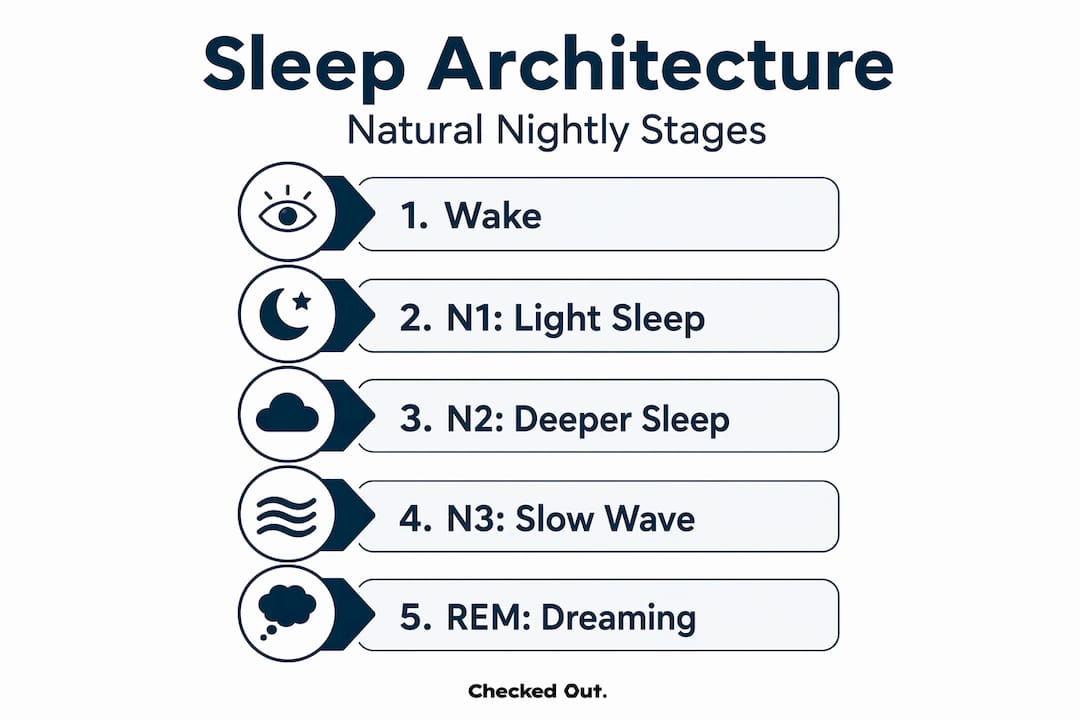
Your sleep is not one uniform state. It is a precisely timed sequence of stages, each serving a distinct biological function. Adults complete 4 to 6 sleep cycles per night, each lasting roughly 90 to 120 minutes, making the full architecture of a healthy night of sleep genuinely intricate.
Here is how the four stages break down:
-
N1 (Light Sleep): This is the transition from wakefulness. Muscle tone relaxes, heart rate slows, and the brain produces theta waves. It lasts only a few minutes per cycle.
-
N2 (Intermediate Sleep): This stage is where you spend the most cumulative time. The brain generates bursts of activity called sleep spindles, and research confirms that sleep spindle density correlates with learning and memory consolidation, not just deep sleep and REM as most people assume.
-
N3 (Deep or Slow-Wave Sleep): The most physically restorative stage. Growth hormone releases, the glymphatic system flushes metabolic waste from the brain, and the immune system strengthens. Deep sleep is front-loaded into the first half of the night, which means cutting your sleep short consistently robs you of this stage disproportionately.
-
REM Sleep: REM increases progressively through the night, dominating your final cycles. The brain activates the amygdala while suppressing norepinephrine and serotonin, which means REM fosters emotional regulation by allowing you to process difficult memories without the chemical weight of stress. It also drives creativity and complex problem-solving.
| Sleep stage |
Primary function |
Proportion of night |
| N1 |
Sleep onset, relaxation |
~5% |
| N2 |
Memory encoding, spindle activity |
~45–50% |
| N3 (Deep sleep) |
Physical repair, immune function |
~15–20% |
| REM |
Emotional processing, creativity |
~20–25% |
One insight that changes how many people think about mornings: waking mid-cycle causes grogginess, not because you slept poorly, but because your brain is interrupted during active processing. Timing an alarm to complete a full cycle, rather than cutting one short, can shift your mornings noticeably.
Your internal clock and sleep pressure
Two forces govern when and how deeply you sleep. The first is your circadian rhythm, driven by the suprachiasmatic nucleus (SCN), a small cluster of roughly 20,000 neurons in the hypothalamus that acts as your body’s master clock. The SCN orchestrates the timing of melatonin release from the pineal gland, cortisol peaks in the morning, and your core body temperature rhythm across 24 hours.

The second force is homeostatic sleep pressure, driven by adenosine, a metabolic byproduct that accumulates in the brain the longer you stay awake. The more adenosine builds, the stronger the urge to sleep. During sleep, adenosine clears. That is the system working as designed.
These two systems do not just coexist. They compete and coordinate. When your circadian rhythm is misaligned, even high sleep pressure may not produce genuinely restorative sleep. This is why irregular schedules feel so punishing.
Key factors that affect circadian alignment:
-
Wake time consistency: Varying your wake time by more than 30 minutes disrupts your rhythm as severely as crossing time zones.
-
Morning light exposure: Outdoor light delivers 10,000 to 100,000 lux versus the 100 to 500 lux found indoors. Just 10 to 20 minutes of outdoor light within the first hour of waking anchors your SCN to the actual time of day.
-
Evening light: Blue light from screens suppresses melatonin by signaling to the SCN that it is still daytime.
-
Meal timing: Late eating shifts your peripheral clocks, creating internal desynchrony even when your light exposure is consistent.
Pro Tip: Set your wake time first. Before you change anything else about your sleep, pick one consistent wake time and hold it for two weeks, including weekends. This single anchor produces more circadian stability than almost any other behavioral change.
The circadian system does not care that you stayed up late finishing a project. It releases cortisol at roughly the same time each morning regardless, which is why chronic late nights leave people feeling both tired and wired at the same time.
Environment and behavior that shape sleep quality
The bedroom is a biological tool. Most people treat it as a preference. Sleep health is multidimensional, encompassing regularity, timing, efficiency, and the physical environment in which it occurs. Getting those variables right, without pharmaceutical help, is entirely achievable.
Temperature
Your core body temperature needs to drop by about 1 to 2 degrees Fahrenheit to initiate and sustain sleep. A bedroom temperature of 65 to 68°F supports this process directly. Sleeping hot causes micro-arousals that pull you out of deep sleep without fully waking you. You may never remember them, but they cost you recovery.
Caffeine timing
This one surprises people. Caffeine does not destroy adenosine. It blocks adenosine receptors. The adenosine keeps accumulating behind that blockade, which is why the crash hits hard when caffeine clears. More critically, caffeine has a half-life of 5 to 7 hours and disrupts sleep architecture when consumed within 10 to 12 hours of bedtime. A 2 p.m. coffee can still compromise your slow-wave sleep at midnight.
Exercise
Exercise done 4 to 6 hours before bed increases slow-wave sleep and supports circadian alignment. High-intensity workouts within 2 hours of sleep, however, elevate cortisol and core temperature in ways that fight the very conditions sleep requires. Morning or early afternoon training is not just preference. It is biology-informed scheduling.
Pro Tip: If late evening is the only time you can exercise, opt for lower-intensity movement like walking, yoga, or mobility work. The circadian and temperature benefits still apply without the cortisol spike.
Additional environmental factors worth addressing systematically:
-
Light blocking: Even low ambient light through eyelids suppresses melatonin. A contoured blackout sleep mask eliminates this variable without room renovation.
-
Sound: Pink noise and white noise reduce the contrast between background silence and sudden sounds, decreasing arousals during lighter sleep stages.
-
Screen use before bed: The issue is not just blue light. The cognitive arousal from content keeps the prefrontal cortex active when it needs to wind down.
-
Consistent sleep schedule: Irregular bedtimes fragment the relationship between your circadian rhythm and sleep pressure, making it harder to fall asleep and stay asleep simultaneously.
If you want a structured approach to layering these habits, the proven sleep routine practices at Checkedoutwellness lay them out in sequence.
The real role of supplements in sleep science
Supplements occupy a complicated space in sleep science and health. They are real, and some have genuine evidence behind them. But the way most people use them misses the point entirely.
Take melatonin. It is not a sedative. It does not make you sleepy the way a sleeping pill does. It is a timing signal, telling your SCN that darkness has arrived. High-dose melatonin (5 to 10 mg) far exceeds what your body naturally produces and can blunt receptor sensitivity over time. Low-dose melatonin (0.3 to 0.5 mg), timed correctly, helps re-anchor the circadian rhythm for jet lag or shift work. That is a very specific tool, not a nightly sleep solution. For more on why synthetic melatonin deserves caution, the risks of synthetic melatonin are covered in depth at Checkedoutwellness.
Magnesium is a different story. It supports GABA receptor activity, which promotes nervous system calm, and helps regulate cortisol. Evidence shows measurable improvements in sleep quality and reduced sleep latency, particularly in individuals who are deficient. The evidence on magnesium for sleep is worth reading before choosing a form, since glycinate and threonate behave differently than oxide.
A few other supplements with credible research:
-
L-theanine: Promotes alpha brain wave activity, reducing anxiety without sedation.
-
GABA: May reduce sleep latency for some individuals, though oral bioavailability is debated.
-
B6 and B12: Both support the tryptophan-to-serotonin-to-melatonin conversion pathway that underpins your body’s natural melatonin production.
The honest takeaway is that no supplement will compensate for a dysregulated circadian rhythm, a hot bedroom, or a double espresso at 3 p.m. Behavioral and environmental changes remain the foundation. Supplements work best when placed on top of that foundation, not in place of it.
My perspective on changing sleep for good
By Geeta
I’ve talked to a lot of people who approach sleep the way they approach a crash diet. They try everything at once for three days and then declare it doesn’t work. I understand the impulse. When you’re exhausted, you want results fast.
What I’ve learned is that the body doesn’t respond well to overnight overhauls. The research backs this up too: sequential habit changes produce far better outcomes than a wholesale transformation attempted all at once. Start with one anchor. Fix your wake time. Hold it for two weeks before adding anything else.
I’ve also found it useful to think about sleep in weekly totals rather than nightly perfection. One bad night does not undo your biology. The body is more forgiving than we give it credit for. What matters is the weekly sleep pattern, not the single night. Stressing over one poor night of sleep, paradoxically, is one of the things most likely to cause another one.
The biggest misconception I see? People think that more hours always means better sleep. But research shows optimal sleep duration sits between 6.4 and 7.8 hours for minimizing biological aging. Beyond that range in either direction, health risks increase. That means sleeping 9 or 10 hours on weekends to “catch up” is not the recovery strategy it feels like.
Patience is not passive. Applied consistently, it is the most powerful sleep intervention you have.
— Geeta
Sleep products that work with your biology
Ready to put the science into practice? Checkedoutwellness was built precisely for this: supporting your natural sleep mechanisms rather than overriding them.

The Sleep Patch delivers cofactors including magnesium, B6, B12, and GABA transdermally, supporting your body’s own melatonin pathway without synthetic melatonin or dependency risk. Manufactured in South Korea under ISO 22716 GMP pharmaceutical standards, it works quietly while you sleep. Pair it with the contoured blackout mask or the mouth tape for nasal breathing support, or explore the Sleep Duo bundle for a complete drug-free system. Every product at Checkedoutwellness is designed to complement the behavioral and environmental strategies described in this article, not replace them.
FAQ
What are natural sleep cycles and how long do they last?
Natural sleep cycles last approximately 90 to 120 minutes each, and adults complete 4 to 6 cycles per night. Each cycle moves through N1, N2, N3 (deep sleep), and REM sleep, with deep sleep concentrated in the first half of the night and REM increasing toward morning.
Why do we need deep sleep specifically?
Deep sleep, or slow-wave sleep, is when the body releases growth hormone, the brain’s glymphatic system clears metabolic waste, and the immune system performs critical repairs. Without adequate deep sleep, physical recovery and immune function are significantly compromised.
What is the most effective natural remedy for better sleep?
Maintaining a consistent wake time every day, including weekends, is the single highest-leverage behavioral change for natural sleep quality. This anchors the circadian rhythm and stabilizes the relationship between sleep pressure and biological timing.
Does melatonin actually help you sleep naturally?
Melatonin is a circadian timing signal, not a sedative. Low doses (0.3 to 0.5 mg) timed appropriately can help realign the circadian clock for jet lag or shift work, but high doses (5 to 10 mg) commonly sold over the counter can reduce receptor sensitivity and are not recommended for nightly use.
How does understanding sleep stages help you improve sleep?
Knowing that deep sleep is front-loaded into early cycles motivates earlier, consistent bedtimes. Understanding that REM increases in the final cycles explains why cutting sleep short by even an hour disproportionately reduces emotional processing and memory consolidation, not just total rest time.
Recommended

The Science Behind Natural Sleep and Better Rest
Most people assume sleep is simply the absence of wakefulness. It isn’t. While you lie still in the dark, your brain cycles through complex biological programs, your immune system mounts repairs, and your neurons process the emotional residue of the day. Understanding the science behind natural sleep changes everything about how you approach rest. It shifts you from passive hoping to active strategy. And the best part? The most powerful interventions cost nothing and require no prescription.
Table of Contents
Key takeaways
The science behind natural sleep architecture
Your sleep is not one uniform state. It is a precisely timed sequence of stages, each serving a distinct biological function. Adults complete 4 to 6 sleep cycles per night, each lasting roughly 90 to 120 minutes, making the full architecture of a healthy night of sleep genuinely intricate.
Here is how the four stages break down:
One insight that changes how many people think about mornings: waking mid-cycle causes grogginess, not because you slept poorly, but because your brain is interrupted during active processing. Timing an alarm to complete a full cycle, rather than cutting one short, can shift your mornings noticeably.
Your internal clock and sleep pressure
Two forces govern when and how deeply you sleep. The first is your circadian rhythm, driven by the suprachiasmatic nucleus (SCN), a small cluster of roughly 20,000 neurons in the hypothalamus that acts as your body’s master clock. The SCN orchestrates the timing of melatonin release from the pineal gland, cortisol peaks in the morning, and your core body temperature rhythm across 24 hours.
The second force is homeostatic sleep pressure, driven by adenosine, a metabolic byproduct that accumulates in the brain the longer you stay awake. The more adenosine builds, the stronger the urge to sleep. During sleep, adenosine clears. That is the system working as designed.
These two systems do not just coexist. They compete and coordinate. When your circadian rhythm is misaligned, even high sleep pressure may not produce genuinely restorative sleep. This is why irregular schedules feel so punishing.
Key factors that affect circadian alignment:
Pro Tip: Set your wake time first. Before you change anything else about your sleep, pick one consistent wake time and hold it for two weeks, including weekends. This single anchor produces more circadian stability than almost any other behavioral change.
The circadian system does not care that you stayed up late finishing a project. It releases cortisol at roughly the same time each morning regardless, which is why chronic late nights leave people feeling both tired and wired at the same time.
Environment and behavior that shape sleep quality
The bedroom is a biological tool. Most people treat it as a preference. Sleep health is multidimensional, encompassing regularity, timing, efficiency, and the physical environment in which it occurs. Getting those variables right, without pharmaceutical help, is entirely achievable.
Temperature
Your core body temperature needs to drop by about 1 to 2 degrees Fahrenheit to initiate and sustain sleep. A bedroom temperature of 65 to 68°F supports this process directly. Sleeping hot causes micro-arousals that pull you out of deep sleep without fully waking you. You may never remember them, but they cost you recovery.
Caffeine timing
This one surprises people. Caffeine does not destroy adenosine. It blocks adenosine receptors. The adenosine keeps accumulating behind that blockade, which is why the crash hits hard when caffeine clears. More critically, caffeine has a half-life of 5 to 7 hours and disrupts sleep architecture when consumed within 10 to 12 hours of bedtime. A 2 p.m. coffee can still compromise your slow-wave sleep at midnight.
Exercise
Exercise done 4 to 6 hours before bed increases slow-wave sleep and supports circadian alignment. High-intensity workouts within 2 hours of sleep, however, elevate cortisol and core temperature in ways that fight the very conditions sleep requires. Morning or early afternoon training is not just preference. It is biology-informed scheduling.
Pro Tip: If late evening is the only time you can exercise, opt for lower-intensity movement like walking, yoga, or mobility work. The circadian and temperature benefits still apply without the cortisol spike.
Additional environmental factors worth addressing systematically:
If you want a structured approach to layering these habits, the proven sleep routine practices at Checkedoutwellness lay them out in sequence.
The real role of supplements in sleep science
Supplements occupy a complicated space in sleep science and health. They are real, and some have genuine evidence behind them. But the way most people use them misses the point entirely.
Take melatonin. It is not a sedative. It does not make you sleepy the way a sleeping pill does. It is a timing signal, telling your SCN that darkness has arrived. High-dose melatonin (5 to 10 mg) far exceeds what your body naturally produces and can blunt receptor sensitivity over time. Low-dose melatonin (0.3 to 0.5 mg), timed correctly, helps re-anchor the circadian rhythm for jet lag or shift work. That is a very specific tool, not a nightly sleep solution. For more on why synthetic melatonin deserves caution, the risks of synthetic melatonin are covered in depth at Checkedoutwellness.
Magnesium is a different story. It supports GABA receptor activity, which promotes nervous system calm, and helps regulate cortisol. Evidence shows measurable improvements in sleep quality and reduced sleep latency, particularly in individuals who are deficient. The evidence on magnesium for sleep is worth reading before choosing a form, since glycinate and threonate behave differently than oxide.
A few other supplements with credible research:
The honest takeaway is that no supplement will compensate for a dysregulated circadian rhythm, a hot bedroom, or a double espresso at 3 p.m. Behavioral and environmental changes remain the foundation. Supplements work best when placed on top of that foundation, not in place of it.
My perspective on changing sleep for good
By Geeta
I’ve talked to a lot of people who approach sleep the way they approach a crash diet. They try everything at once for three days and then declare it doesn’t work. I understand the impulse. When you’re exhausted, you want results fast.
What I’ve learned is that the body doesn’t respond well to overnight overhauls. The research backs this up too: sequential habit changes produce far better outcomes than a wholesale transformation attempted all at once. Start with one anchor. Fix your wake time. Hold it for two weeks before adding anything else.
I’ve also found it useful to think about sleep in weekly totals rather than nightly perfection. One bad night does not undo your biology. The body is more forgiving than we give it credit for. What matters is the weekly sleep pattern, not the single night. Stressing over one poor night of sleep, paradoxically, is one of the things most likely to cause another one.
The biggest misconception I see? People think that more hours always means better sleep. But research shows optimal sleep duration sits between 6.4 and 7.8 hours for minimizing biological aging. Beyond that range in either direction, health risks increase. That means sleeping 9 or 10 hours on weekends to “catch up” is not the recovery strategy it feels like.
Patience is not passive. Applied consistently, it is the most powerful sleep intervention you have.
Sleep products that work with your biology
Ready to put the science into practice? Checkedoutwellness was built precisely for this: supporting your natural sleep mechanisms rather than overriding them.
The Sleep Patch delivers cofactors including magnesium, B6, B12, and GABA transdermally, supporting your body’s own melatonin pathway without synthetic melatonin or dependency risk. Manufactured in South Korea under ISO 22716 GMP pharmaceutical standards, it works quietly while you sleep. Pair it with the contoured blackout mask or the mouth tape for nasal breathing support, or explore the Sleep Duo bundle for a complete drug-free system. Every product at Checkedoutwellness is designed to complement the behavioral and environmental strategies described in this article, not replace them.
FAQ
What are natural sleep cycles and how long do they last?
Natural sleep cycles last approximately 90 to 120 minutes each, and adults complete 4 to 6 cycles per night. Each cycle moves through N1, N2, N3 (deep sleep), and REM sleep, with deep sleep concentrated in the first half of the night and REM increasing toward morning.
Why do we need deep sleep specifically?
Deep sleep, or slow-wave sleep, is when the body releases growth hormone, the brain’s glymphatic system clears metabolic waste, and the immune system performs critical repairs. Without adequate deep sleep, physical recovery and immune function are significantly compromised.
What is the most effective natural remedy for better sleep?
Maintaining a consistent wake time every day, including weekends, is the single highest-leverage behavioral change for natural sleep quality. This anchors the circadian rhythm and stabilizes the relationship between sleep pressure and biological timing.
Does melatonin actually help you sleep naturally?
Melatonin is a circadian timing signal, not a sedative. Low doses (0.3 to 0.5 mg) timed appropriately can help realign the circadian clock for jet lag or shift work, but high doses (5 to 10 mg) commonly sold over the counter can reduce receptor sensitivity and are not recommended for nightly use.
How does understanding sleep stages help you improve sleep?
Knowing that deep sleep is front-loaded into early cycles motivates earlier, consistent bedtimes. Understanding that REM increases in the final cycles explains why cutting sleep short by even an hour disproportionately reduces emotional processing and memory consolidation, not just total rest time.
Recommended