You’ve tried the tips. You’ve read the threads. You’ve downloaded the apps and maybe even bought the magnesium gummies. And yet, you’re still lying awake at 1 a.m., watching the ceiling like it owes you an explanation. The truth is, the internet is flooded with sleep advice, much of it vague, contradictory, or just plain incomplete. What’s missing isn’t more tips. It’s a clear, science-grounded framework for knowing which habits actually move the needle, especially if you’re a light sleeper, a frequent traveler, or someone whose schedule refuses to cooperate.
Table of Contents
Key Takeaways
| Point |
Details |
| Consistency is crucial |
A regular sleep schedule and nightly routine make the biggest impact. |
| Control your environment |
Eliminating noise, minimizing light, and setting a cool room temperature boost sleep quality for everyone, especially light sleepers. |
| Daytime habits matter |
Prioritizing morning light, limiting caffeine, and reducing evening screen time help your body prepare for restful sleep. |
| Small upgrades, big impact |
Simple tools like blackout masks and white noise apps can instantly improve your ability to fall and stay asleep. |
How to evaluate: Core criteria for a healthy sleep routine
Before you adopt any sleep habit, it helps to know what makes a practice genuinely effective. Not all sleep tips are created equal, and throwing a dozen changes at your bedtime routine at once rarely works. What does work is understanding the pillars that matter most.
Sleep hygiene is a set of practices and routines that improve sleep, with core pillars including a consistent sleep schedule, a wind-down bedtime routine, and optimizing both your sleep environment and your daytime habits. These four categories form the backbone of every evidence-based recommendation you’ll find, from Harvard Health to the Mayo Clinic.
For light sleepers and travelers, these pillars carry even more weight. A light sleeper’s nervous system is more reactive to environmental cues, which means small disruptions in light, sound, or temperature can cascade into hours of fragmented sleep. Travelers face the added challenge of circadian disruption, unfamiliar environments, and time zone shifts. Knowing which pillar is most compromised in your life tells you exactly where to focus first.
Quick criteria to evaluate any sleep habit or product:
- Does it support a consistent sleep or wake time?
- Does it reduce sensory disruption (light, noise, temperature)?
- Does it help your body transition from alertness to rest?
- Is it sustainable without creating dependency?
- Is it backed by peer-reviewed research or clinical guidance?
| Core sleep practice |
Science-based benefit |
| Consistent sleep schedule |
Anchors circadian rhythm, reduces sleep onset time |
| Dark, cool, quiet room |
Lowers arousal threshold, supports deep sleep stages |
| Wind-down ritual |
Reduces cortisol, signals the brain to shift into sleep mode |
| Morning light exposure |
Regulates melatonin timing and circadian alignment |
| Limiting caffeine after 2 p.m. |
Prevents adenosine receptor blockade during sleep hours |
| Reducing evening screen time |
Minimizes blue light suppression of melatonin production |
“The foundation of better sleep isn’t a single hack. It’s a consistent set of behaviors that tell your body, night after night, that it’s safe to let go.”
You can explore more sleep environment articles to go deeper on any of these pillars. The key is starting with a clear picture of what good sleep hygiene actually looks like before deciding what to change.
Best practices: Your must-do sleep routine habits
With solid evaluation criteria in hand, let’s get into the most effective, do-now habits. These aren’t theoretical. They’re the changes that research consistently shows make the biggest difference.
-
Set a fixed wake time, every day. Your circadian rhythm is anchored by when you wake up, not just when you go to bed. Pick a time and protect it, even on weekends. This single habit does more for sleep consistency than almost anything else.
-
Take a tech break 60 minutes before bed. Blue light from screens suppresses melatonin production and keeps your prefrontal cortex in problem-solving mode. If you want practical guidance on this, evening screen time tips from behavioral researchers offer a step-by-step approach for winding down without the scroll.
-
Keep your room cool, dark, and quiet. Environmental and behavioral inputs matter significantly for light sleepers, particularly around noise, light, and temperature. Reducing or masking these disruptions is one of the highest-leverage changes you can make.
-
Build a relaxing wind-down ritual. This could be light stretching, journaling, reading a physical book, or applying a transdermal sleep patch as a consistent pre-sleep cue. The ritual itself trains your brain to associate those actions with sleep onset.
-
Get morning sunlight within 30 minutes of waking. Natural light exposure early in the day advances your circadian phase and sharpens the timing of your evening melatonin release. Even 10 minutes outside makes a measurable difference.
-
Cut caffeine after 2 p.m. Caffeine has a half-life of roughly 5 to 6 hours, meaning a 3 p.m. coffee still has half its caffeine load in your system at 8 p.m. That’s enough to delay sleep onset and reduce slow-wave sleep quality.
-
Limit alcohol close to bedtime. Alcohol may help you fall asleep faster, but it fragments the second half of your sleep cycle and suppresses REM sleep, the stage most critical for emotional regulation and memory consolidation.
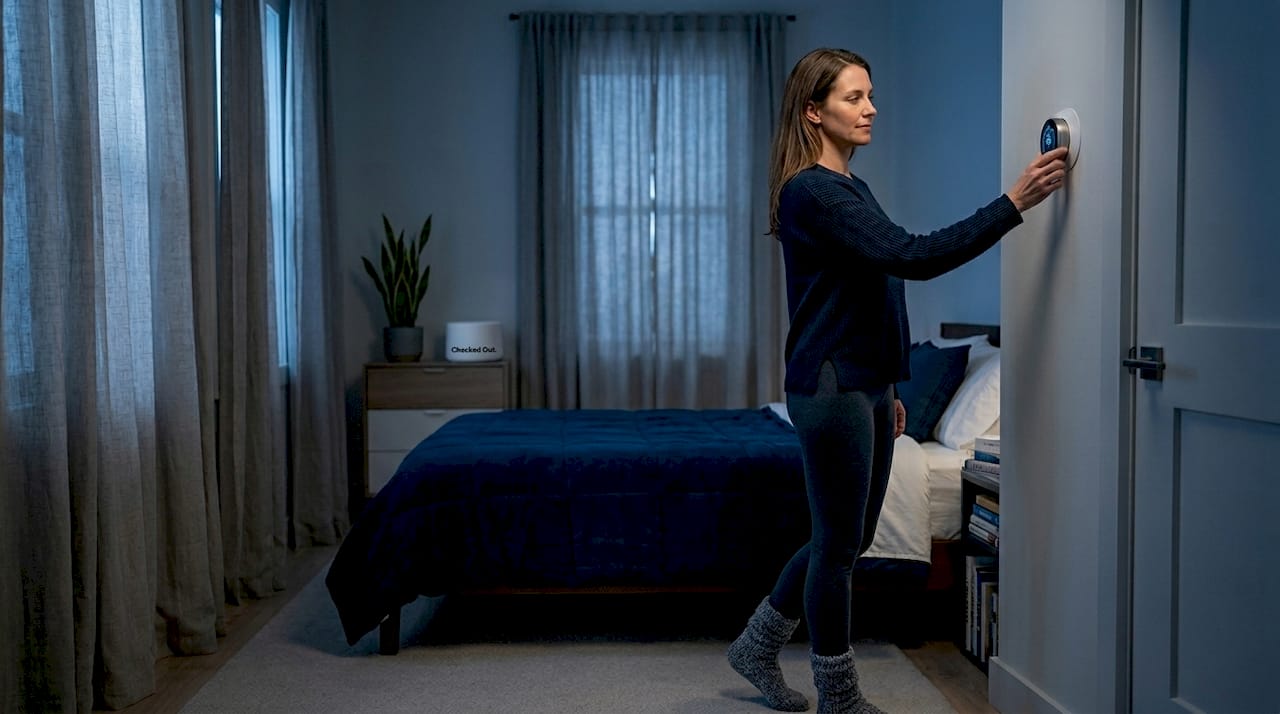
The ideal room temperature for sleep is between 65 and 68°F. Your core body temperature naturally drops during sleep onset, and a cooler room accelerates that process. Even a degree or two above 68°F can increase nighttime waking.
Pro Tip: If you’re a frequent traveler or light sleeper, pack a blackout sleep mask and a white noise app on your phone. These two tools alone can replicate a controlled sleep environment almost anywhere in the world. Pair them with a sleep patch for routine support and you’ve built a portable sleep kit that travels with you.
The sleep environment: Optimizing light, noise, and temperature
The last section introduced key habits. Now let’s zoom in on optimizing your actual sleeping space, because the environment you sleep in is often the most overlooked variable.
Light sleepers should treat bright light exposure in the evening and light intrusions during the night as primary sleep-disrupting inputs. Screens, streetlights bleeding through curtains, and even the glow of a charging phone can suppress melatonin and trigger micro-arousals that you won’t even remember in the morning, but your body will.
Quick environmental upgrades worth making:
- Blackout curtains or a contoured sleep mask to block all ambient light
- Earplugs or a white noise machine to mask unpredictable sounds
- A smart thermostat or portable fan to maintain a consistent room temperature
- Removing or covering LED indicator lights on electronics
- Using warm, dim lighting in the hour before bed to support melatonin onset
| Sleep disruptor |
Home solution |
Travel solution |
| Ambient light |
Blackout curtains |
Contoured 3D sleep mask |
| Noise |
White noise machine |
White noise app or earplugs |
| Temperature fluctuations |
Smart thermostat or fan |
Portable USB fan, request extra blankets |
| Irregular sleep cues |
Consistent bedtime ritual |
Sleep patch as a portable cue |
| Jet lag and circadian shift |
Morning light therapy lamp |
Timed light exposure, melatonin-free patch |
The comfortable sleep mask we designed at Checked Out Wellness uses a contoured 3D structure specifically so it doesn’t press against your eyelids, which matters more than most people realize. Pressure on the eyes during REM sleep can disrupt the rapid eye movement phase itself.
Pro Tip: When checking into a hotel, do a quick “sleep audit” before unpacking. Close the curtains and assess light leakage around the edges. Check whether the HVAC unit cycles on loudly. Position your phone charger out of your direct line of sight. These small adjustments take under three minutes and can meaningfully improve your sleep quality in an unfamiliar room. If you want to try a risk-free sleep patch as part of your travel kit, it’s one of the easiest ways to bring your bedtime ritual with you, no matter where you land.
Daytime habits for restful nights
After covering night-focused fixes, let’s not overlook the daytime habits that influence sleep more than you think. Your body is building toward tonight’s sleep from the moment you wake up.
Sleep hygiene includes daytime habits that optimize restful sleep, and the research is clear that what you do between 7 a.m. and 6 p.m. shapes your sleep architecture just as powerfully as your bedtime routine. This is good news because it means you have more control than you might think.
Your daytime sleep-building sequence:
-
Get bright light exposure within 30 minutes of waking. This is your circadian anchor. It tells your brain what time it is and sets the countdown clock for melatonin release roughly 14 to 16 hours later.
-
Exercise, ideally before 6 p.m. Physical activity increases sleep pressure (the natural drive to sleep) and helps regulate cortisol rhythms. Late-night intense exercise can delay sleep onset in some people, so timing matters.
-
Eat your last large meal at least 2 to 3 hours before bed. Digestion raises core body temperature and keeps your metabolism active, both of which work against sleep onset.
-
Stop caffeine by 2 p.m. We said it before, but it bears repeating. This single swap makes a measurable difference within days.
-
Start your wind-down at least 60 minutes before your target sleep time. Dim the lights, lower the volume, and let your nervous system begin its descent.
-
Put screens away one hour before bed. If your household needs a structured approach, family screen time reduction tips offer practical strategies that work for both adults and kids.
Quick swaps for common sleep-disrupting habits:
- Replace the late-night scroll with 15 minutes of light reading or journaling
- Swap the evening espresso for herbal tea or warm water with lemon
- Trade the 10 p.m. gym session for a morning or early evening workout
- Replace overhead fluorescent lighting after 8 p.m. with a warm-toned lamp
The science behind sleep routines consistently points to one insight: the body doesn’t switch off like a light. It winds down like a dimmer. The more you support that gradual descent during the day, the smoother and deeper your sleep will be at night. Explore drug-free sleep solutions that align with this approach if you’re ready to take it further.
Quick reference: Which best practices matter most for specific needs?
To wrap the educational core, here’s how to cut through the clutter and focus on what’s best for your unique sleep challenges.
| Sleep challenge |
Top 3 priorities |
| Light sleeper |
Blackout mask, white noise, consistent wake time |
| Frequent traveler |
Portable sleep kit (mask, patch, white noise app), timed light exposure |
| Trouble falling asleep |
Wind-down ritual, no screens 1 hour before bed, cool room |
| Waking in the night |
Consistent schedule, limit alcohol, manage room temperature |
| Daytime fatigue |
Morning light, regular exercise, caffeine cutoff at 2 p.m. |
Harvard and Mayo Clinic agree on the outsized impact of environmental adjustments, wind-down routines, and screen time reduction. These three categories consistently outperform more elaborate interventions in terms of real-world effectiveness.
How to quickly assess and pick your top changes:
- Identify your single biggest sleep disruptor (light, noise, irregular schedule, stress)
- Choose the two or three practices that directly address that disruptor
- Apply them consistently for two weeks before adding more
- Track your sleep quality subjectively, noting how rested you feel at wake time
Consistent application always beats complexity. A person who does three things every night will sleep better than someone who attempts ten things sporadically. Simplicity, done repeatedly, is the actual strategy.
Why most sleep routine advice fails—and what actually sticks
Here’s the uncomfortable truth we’ve come to after years of studying sleep and talking with people who struggle with it: most sleep advice fails not because it’s wrong, but because it’s presented as an all-or-nothing prescription. You’re handed a list of twelve things to do and told that all of them matter. So you try all twelve for three days, feel overwhelmed, and quietly abandon the whole thing by Thursday.
The body doesn’t respond to perfection. It responds to patterns. What actually creates lasting change is picking two or three practices that fit your real life and doing them so consistently that they become invisible, like brushing your teeth. You don’t think about brushing your teeth. You just do it. That’s the goal with sleep hygiene.
We’ve also noticed that the people who improve their sleep most dramatically aren’t the ones who optimize the most aggressively. They’re the ones who remove the biggest friction point first. For a light sleeper, that might be a blackout mask and a white noise app. For a traveler, it might be a consistent wind-down ritual that travels with them. For a high performer running on cortisol, it might be the caffeine cutoff and a 20-minute walk in the morning.
Personalization isn’t a luxury. It’s the mechanism. Generic lists are a starting point, not a destination. Use the framework in this article to identify your highest-leverage changes, then apply them with the kind of steady, unhurried commitment that your nervous system actually responds to. For deeper reading on what the evidence really says, the evidence-based sleep guides on our site are a good next step.
Find sleep solutions that fit your healthy routine
If these best practices have resonated with you, the next step is making them easy to execute, night after night, without friction.

At Checked Out Wellness, we build tools designed to slot into the routines you’re already building. Our contoured blackout sleep mask blocks light completely without pressing on your eyelids, making it ideal for both home use and travel. Our melatonin-free sleep patch delivers magnesium, B6, B12, GABA, and other cofactors transdermally to support your body’s own melatonin production, without synthetic hormones or dependency risk. Everything is manufactured under ISO 22716 GMP pharmaceutical standards in South Korea. Visit natural sleep support to find the right fit for your routine and your sleep goals.
Frequently asked questions
How long does it take to see improvements with better sleep hygiene?
Most people notice measurable improvements in sleep quality within one to two weeks of consistent sleep hygiene changes, particularly when they focus on schedule consistency and environmental adjustments first.
Should light sleepers use blackout curtains and sleep masks even when traveling?
Yes, portable blackout masks and travel-sized white noise devices are highly recommended for light sleepers. Minimizing light with masks and curtains is one of the most effective environmental adjustments available, regardless of where you’re sleeping.
Does eliminating screen time before bed really make a difference?
Absolutely. Avoiding screen light before bedtime significantly increases the likelihood of falling asleep faster and staying asleep through the night, largely because it stops blue light from suppressing your natural melatonin rise.
What’s the recommended bedroom temperature for optimal sleep?
A room temperature between 65 and 68°F is ideal for most adults. Keeping the room temperature around 65 to 68°F supports the natural drop in core body temperature that triggers and sustains deep sleep.
Recommended

11 best sleep routine practices that truly work
You’ve tried the tips. You’ve read the threads. You’ve downloaded the apps and maybe even bought the magnesium gummies. And yet, you’re still lying awake at 1 a.m., watching the ceiling like it owes you an explanation. The truth is, the internet is flooded with sleep advice, much of it vague, contradictory, or just plain incomplete. What’s missing isn’t more tips. It’s a clear, science-grounded framework for knowing which habits actually move the needle, especially if you’re a light sleeper, a frequent traveler, or someone whose schedule refuses to cooperate.
Table of Contents
Key Takeaways
How to evaluate: Core criteria for a healthy sleep routine
Before you adopt any sleep habit, it helps to know what makes a practice genuinely effective. Not all sleep tips are created equal, and throwing a dozen changes at your bedtime routine at once rarely works. What does work is understanding the pillars that matter most.
Sleep hygiene is a set of practices and routines that improve sleep, with core pillars including a consistent sleep schedule, a wind-down bedtime routine, and optimizing both your sleep environment and your daytime habits. These four categories form the backbone of every evidence-based recommendation you’ll find, from Harvard Health to the Mayo Clinic.
For light sleepers and travelers, these pillars carry even more weight. A light sleeper’s nervous system is more reactive to environmental cues, which means small disruptions in light, sound, or temperature can cascade into hours of fragmented sleep. Travelers face the added challenge of circadian disruption, unfamiliar environments, and time zone shifts. Knowing which pillar is most compromised in your life tells you exactly where to focus first.
Quick criteria to evaluate any sleep habit or product:
You can explore more sleep environment articles to go deeper on any of these pillars. The key is starting with a clear picture of what good sleep hygiene actually looks like before deciding what to change.
Best practices: Your must-do sleep routine habits
With solid evaluation criteria in hand, let’s get into the most effective, do-now habits. These aren’t theoretical. They’re the changes that research consistently shows make the biggest difference.
Set a fixed wake time, every day. Your circadian rhythm is anchored by when you wake up, not just when you go to bed. Pick a time and protect it, even on weekends. This single habit does more for sleep consistency than almost anything else.
Take a tech break 60 minutes before bed. Blue light from screens suppresses melatonin production and keeps your prefrontal cortex in problem-solving mode. If you want practical guidance on this, evening screen time tips from behavioral researchers offer a step-by-step approach for winding down without the scroll.
Keep your room cool, dark, and quiet. Environmental and behavioral inputs matter significantly for light sleepers, particularly around noise, light, and temperature. Reducing or masking these disruptions is one of the highest-leverage changes you can make.
Build a relaxing wind-down ritual. This could be light stretching, journaling, reading a physical book, or applying a transdermal sleep patch as a consistent pre-sleep cue. The ritual itself trains your brain to associate those actions with sleep onset.
Get morning sunlight within 30 minutes of waking. Natural light exposure early in the day advances your circadian phase and sharpens the timing of your evening melatonin release. Even 10 minutes outside makes a measurable difference.
Cut caffeine after 2 p.m. Caffeine has a half-life of roughly 5 to 6 hours, meaning a 3 p.m. coffee still has half its caffeine load in your system at 8 p.m. That’s enough to delay sleep onset and reduce slow-wave sleep quality.
Limit alcohol close to bedtime. Alcohol may help you fall asleep faster, but it fragments the second half of your sleep cycle and suppresses REM sleep, the stage most critical for emotional regulation and memory consolidation.
The ideal room temperature for sleep is between 65 and 68°F. Your core body temperature naturally drops during sleep onset, and a cooler room accelerates that process. Even a degree or two above 68°F can increase nighttime waking.
Pro Tip: If you’re a frequent traveler or light sleeper, pack a blackout sleep mask and a white noise app on your phone. These two tools alone can replicate a controlled sleep environment almost anywhere in the world. Pair them with a sleep patch for routine support and you’ve built a portable sleep kit that travels with you.
The sleep environment: Optimizing light, noise, and temperature
The last section introduced key habits. Now let’s zoom in on optimizing your actual sleeping space, because the environment you sleep in is often the most overlooked variable.
Light sleepers should treat bright light exposure in the evening and light intrusions during the night as primary sleep-disrupting inputs. Screens, streetlights bleeding through curtains, and even the glow of a charging phone can suppress melatonin and trigger micro-arousals that you won’t even remember in the morning, but your body will.
Quick environmental upgrades worth making:
The comfortable sleep mask we designed at Checked Out Wellness uses a contoured 3D structure specifically so it doesn’t press against your eyelids, which matters more than most people realize. Pressure on the eyes during REM sleep can disrupt the rapid eye movement phase itself.
Pro Tip: When checking into a hotel, do a quick “sleep audit” before unpacking. Close the curtains and assess light leakage around the edges. Check whether the HVAC unit cycles on loudly. Position your phone charger out of your direct line of sight. These small adjustments take under three minutes and can meaningfully improve your sleep quality in an unfamiliar room. If you want to try a risk-free sleep patch as part of your travel kit, it’s one of the easiest ways to bring your bedtime ritual with you, no matter where you land.
Daytime habits for restful nights
After covering night-focused fixes, let’s not overlook the daytime habits that influence sleep more than you think. Your body is building toward tonight’s sleep from the moment you wake up.
Sleep hygiene includes daytime habits that optimize restful sleep, and the research is clear that what you do between 7 a.m. and 6 p.m. shapes your sleep architecture just as powerfully as your bedtime routine. This is good news because it means you have more control than you might think.
Your daytime sleep-building sequence:
Quick swaps for common sleep-disrupting habits:
The science behind sleep routines consistently points to one insight: the body doesn’t switch off like a light. It winds down like a dimmer. The more you support that gradual descent during the day, the smoother and deeper your sleep will be at night. Explore drug-free sleep solutions that align with this approach if you’re ready to take it further.
Quick reference: Which best practices matter most for specific needs?
To wrap the educational core, here’s how to cut through the clutter and focus on what’s best for your unique sleep challenges.
Harvard and Mayo Clinic agree on the outsized impact of environmental adjustments, wind-down routines, and screen time reduction. These three categories consistently outperform more elaborate interventions in terms of real-world effectiveness.
How to quickly assess and pick your top changes:
Consistent application always beats complexity. A person who does three things every night will sleep better than someone who attempts ten things sporadically. Simplicity, done repeatedly, is the actual strategy.
Why most sleep routine advice fails—and what actually sticks
Here’s the uncomfortable truth we’ve come to after years of studying sleep and talking with people who struggle with it: most sleep advice fails not because it’s wrong, but because it’s presented as an all-or-nothing prescription. You’re handed a list of twelve things to do and told that all of them matter. So you try all twelve for three days, feel overwhelmed, and quietly abandon the whole thing by Thursday.
The body doesn’t respond to perfection. It responds to patterns. What actually creates lasting change is picking two or three practices that fit your real life and doing them so consistently that they become invisible, like brushing your teeth. You don’t think about brushing your teeth. You just do it. That’s the goal with sleep hygiene.
We’ve also noticed that the people who improve their sleep most dramatically aren’t the ones who optimize the most aggressively. They’re the ones who remove the biggest friction point first. For a light sleeper, that might be a blackout mask and a white noise app. For a traveler, it might be a consistent wind-down ritual that travels with them. For a high performer running on cortisol, it might be the caffeine cutoff and a 20-minute walk in the morning.
Personalization isn’t a luxury. It’s the mechanism. Generic lists are a starting point, not a destination. Use the framework in this article to identify your highest-leverage changes, then apply them with the kind of steady, unhurried commitment that your nervous system actually responds to. For deeper reading on what the evidence really says, the evidence-based sleep guides on our site are a good next step.
Find sleep solutions that fit your healthy routine
If these best practices have resonated with you, the next step is making them easy to execute, night after night, without friction.
At Checked Out Wellness, we build tools designed to slot into the routines you’re already building. Our contoured blackout sleep mask blocks light completely without pressing on your eyelids, making it ideal for both home use and travel. Our melatonin-free sleep patch delivers magnesium, B6, B12, GABA, and other cofactors transdermally to support your body’s own melatonin production, without synthetic hormones or dependency risk. Everything is manufactured under ISO 22716 GMP pharmaceutical standards in South Korea. Visit natural sleep support to find the right fit for your routine and your sleep goals.
Frequently asked questions
How long does it take to see improvements with better sleep hygiene?
Most people notice measurable improvements in sleep quality within one to two weeks of consistent sleep hygiene changes, particularly when they focus on schedule consistency and environmental adjustments first.
Should light sleepers use blackout curtains and sleep masks even when traveling?
Yes, portable blackout masks and travel-sized white noise devices are highly recommended for light sleepers. Minimizing light with masks and curtains is one of the most effective environmental adjustments available, regardless of where you’re sleeping.
Does eliminating screen time before bed really make a difference?
Absolutely. Avoiding screen light before bedtime significantly increases the likelihood of falling asleep faster and staying asleep through the night, largely because it stops blue light from suppressing your natural melatonin rise.
What’s the recommended bedroom temperature for optimal sleep?
A room temperature between 65 and 68°F is ideal for most adults. Keeping the room temperature around 65 to 68°F supports the natural drop in core body temperature that triggers and sustains deep sleep.
Recommended