Most people reach for melatonin the same way they’d reach for a sleeping pill, expecting it to knock them out within minutes. That’s the misconception that quietly undermines millions of sleep routines. Melatonin is a natural hormone produced by the pineal gland, and its job isn’t to sedate you. It’s to tell your brain what time it is. Understanding that single distinction changes everything about how you use it, when you take it, and whether it actually works for you.
Table of Contents
Key Takeaways
| Point |
Details |
| Melatonin is a timing signal |
Melatonin synchronizes your body’s sleep-wake cycle but is not a direct sleeping pill. |
| Low doses often work best |
Most people benefit from 0.3-1 mg taken before bed rather than higher doses. |
| Light exposure is crucial |
Melatonin works best with appropriate evening darkness and morning light routines. |
| Short-term use is safest |
Melatonin is effective for travel or shift changes but may carry risks with long-term daily use. |
| Natural sleep solutions abound |
Non-melatonin methods and tools can also improve sleep quality without dependence. |
Melatonin fundamentals: What it is and how it works
Think of melatonin as your body’s internal clock signal, not its off switch. It rises in the evening as darkness falls, peaks in the early morning hours, and fades as light returns. That rhythm is ancient, precise, and surprisingly fragile in modern life.
The pineal gland regulates your sleep-wake cycle by reading light and dark cues from the environment, then translating them into hormonal signals. When photoreceptors in your retina detect dimming light, they relay that message through the retinohypothalamic tract to the suprachiasmatic nucleus (SCN), the brain’s master clock. The SCN then signals the pineal gland to start producing melatonin. It’s a beautifully coordinated cascade, and it runs on light.

What melatonin actually does once it’s released is worth understanding in detail. It affects the hypothalamus by reducing body temperature, blood pressure, and alertness, essentially preparing every system for sleep. Your retinas become less sensitive to light. Your core temperature drops by about one degree Fahrenheit. Your heart rate slows. None of this is sedation. It’s calibration.
At the receptor level, melatonin works through two primary pathways:
-
MT1 receptors inhibit neuronal firing in the SCN, which promotes sleep onset and reduces wakefulness signals
-
MT2 receptors are responsible for shifting circadian phases, making them especially relevant for jet lag recovery and shift work adaptation
- Both receptor types are G-protein coupled, meaning they trigger intracellular signaling cascades rather than directly sedating neurons
- Melatonin’s effect on MT2 receptors is why timing matters so much. Taking it at the wrong hour can shift your clock in the wrong direction.
“Melatonin is best understood as a chronobiotic, a substance that adjusts the timing of biological rhythms, rather than a hypnotic that forces sleep. Its power lies in when it’s taken, not just that it’s taken.”
Understanding how sleep science works at this level gives you a real edge. When you treat melatonin as a timer rather than a sedative, you start using it in a way that actually aligns with your biology.
Natural rhythms and how modern life disrupts melatonin
Your circadian rhythm evolved over millions of years to sync with the sun. Melatonin rises roughly two hours before your natural sleep time, a point researchers call DLMO (dim-light melatonin onset), and it stays elevated for about 10 to 12 hours before light suppresses it again. That rhythm is your body’s internal schedule for when to sleep, when to repair tissue, when to consolidate memory, and when to wake.
The problem is that modern life runs on artificial light, screens, and schedules that have nothing to do with the sun. Here’s what’s actively working against your melatonin production every day:
-
Blue light from screens suppresses melatonin production even at low intensities, particularly in the 460 to 480 nm wavelength range
-
Late-night overhead lighting signals to your brain that it’s still midday, delaying melatonin onset by one to three hours
-
Shift work forces wakefulness during your biological night, creating a chronic mismatch between your clock and your schedule
-
Jet lag is essentially a hard reset failure, where your internal clock is still set to your departure city while your body is physically somewhere else
-
Social jet lag, a term for the mismatch between your weekday and weekend sleep schedules, creates a low-grade circadian disruption that most people never even notice
Melatonin is effective and safe short-term for jet lag in travelers crossing five or more time zones, particularly eastward travel, which is consistently harder for the body to adapt to. The reason eastward travel is tougher is that advancing your clock (going to bed earlier than your body wants) is biologically more difficult than delaying it.
When melatonin timing is disrupted chronically, the downstream effects go beyond just feeling tired. Irregular melatonin patterns are associated with difficulty falling asleep, waking unrefreshed even after a full night, mood instability, impaired immune function, and reduced cognitive performance the next day. The body keeps score quietly.
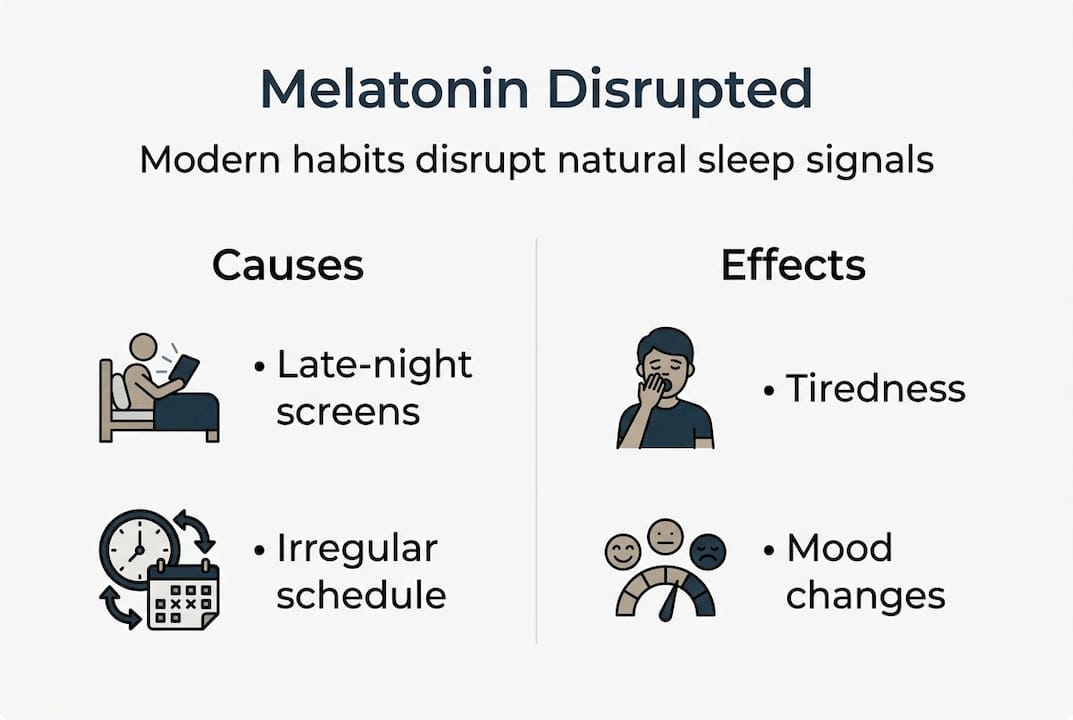
Pro Tip: If you travel frequently or work irregular hours, start protecting your melatonin environment before you even think about supplementing. Use amber-tinted glasses after 9 PM, dim your home lighting in the evening, and block out unwanted light during sleep. These environmental changes can shift your DLMO earlier within just a few nights.
Melatonin supplements: Dosages, timing, and real-world use
Here’s where most people go wrong. They buy a 10 mg melatonin gummy from the drugstore because more feels like more. In reality, low doses between 0.5 and 5 mg reduce sleep onset latency, and higher doses above 5 mg offer no additional benefit while significantly increasing the risk of next-morning grogginess, vivid dreams, and hormonal disruption.
Dosage comparison: Low vs. high dose melatonin
| Dose range |
Best use case |
Onset effect |
Risk of side effects |
| 0.3 to 1 mg |
Circadian reset, jet lag, biohacking |
Gentle, physiological |
Very low |
| 1 to 3 mg |
Occasional sleep difficulty, travel |
Moderate |
Low to moderate |
| 3 to 5 mg |
Short-term insomnia support |
Stronger |
Moderate |
| Above 5 mg |
Rarely justified |
No extra benefit |
Higher, including grogginess |
The sweet spot for most healthy adults is 0.5 to 1 mg, taken at the right time. That’s a fraction of what most commercial products sell. And timing, as we’ve established, matters as much as dose.
Practical protocol for travelers (jet lag):
- On the day of travel, avoid melatonin until you’re ready to sleep at your destination bedtime
- Take 0.5 to 1 mg one to three hours before your target sleep time in the new time zone
- Optimal timing for eastward travel across five or more time zones uses immediate-release melatonin, not slow-release, since you want a phase shift, not prolonged sedation
- Combine with morning light exposure at your destination to reinforce the new clock setting
- Continue for two to four nights until your rhythm stabilizes
Practical protocol for general sleep difficulty:
- Identify your natural DLMO by noting when you start feeling genuinely sleepy in a dim environment
- Take 0.3 to 1 mg approximately two hours before that point
- Dim all lights in your home at least 90 minutes before bed
- Avoid screens or use blue-light-blocking glasses during that window
- Keep your sleep and wake times consistent, even on weekends
Melatonin is best used as a chronobiotic combined with morning light and evening dimness, not as a standalone pill. The supplement works with your biology when the environment supports it. Without those environmental cues, you’re fighting an uphill battle.
Pro Tip: Older adults metabolize melatonin more slowly due to reduced liver enzyme activity. If you’re over 55, start with 0.3 mg and monitor for morning grogginess before increasing. The science of sleep supplementation shows that age-related changes in melatonin metabolism are significant enough to warrant a cautious, low-and-slow approach.
Safety, side effects, and when to avoid melatonin
Melatonin has a genuinely favorable safety profile compared to most sleep aids. That said, “natural” doesn’t mean “without risk,” and the supplement industry’s loose regulation in the United States means quality varies considerably from brand to brand.
What you might experience:
- Headache and mild dizziness, particularly with higher doses
- Nausea, especially when taken on an empty stomach
- Daytime drowsiness if taken too late or at too high a dose
- Vivid or unusually intense dreams, more common with doses above 3 mg
- Mood changes in sensitive individuals, though this is rare
Melatonin is unlikely to cause dependence the way benzodiazepines or Z-drugs do. Your body doesn’t build tolerance to melatonin in the same way, and stopping it doesn’t produce withdrawal symptoms. That’s a meaningful distinction for anyone who’s ever felt trapped by a prescription sleep medication.
“Unlike hypnotics that suppress the nervous system to force sleep, melatonin works with your existing biology. The absence of dependence risk is one of its most clinically significant advantages.”
Melatonin vs. common sleep aids: A safety comparison
| Sleep aid |
Habit-forming risk |
Withdrawal risk |
Common side effects |
Circadian benefit |
| Melatonin (low dose) |
Very low |
None |
Mild grogginess, vivid dreams |
Yes |
| Benzodiazepines |
High |
Significant |
Dependence, cognitive fog |
No |
| Z-drugs (Ambien, etc.) |
Moderate to high |
Moderate |
Sleepwalking, amnesia |
No |
| Antihistamines (OTC) |
Low |
Low |
Tolerance builds quickly |
No |
| Magnesium glycinate |
None |
None |
Loose stools at high doses |
Indirect support |
The longer-term picture is less clear. Long-term melatonin use may have negative health effects, including potential hormonal disruptions and concerns about supplement quality given that U.S. melatonin products are not tightly regulated. Studies have found that actual melatonin content in commercial supplements can vary by as much as 478% from what’s stated on the label. That’s not a minor discrepancy.
Who should be especially cautious:
- Pregnant or breastfeeding individuals, since melatonin’s effects on fetal development are not well studied
- Children and adolescents, where long-term hormonal effects are a genuine concern
- Anyone taking blood thinners, immunosuppressants, or diabetes medications, as melatonin can interact with these
- People with autoimmune conditions, since melatonin has immune-modulating properties
The evidence consistently points toward melatonin being most appropriate for short-term, targeted use: jet lag, shift work transitions, circadian resets, and occasional sleep disruption. Using it nightly as a substitute for addressing the root causes of poor sleep is where the risk-to-benefit ratio starts to shift.
A science-backed, practical take on melatonin
We’ve watched the melatonin conversation evolve considerably over the past decade, and the pattern is familiar. A compound with genuine, targeted utility gets popularized, doses balloon, and people start using it as a nightly ritual without ever asking whether they actually need it. The result is a lot of people taking 5 to 10 mg every night and wondering why they still wake up foggy.
Here’s our honest take: melatonin is one of the most misused wellness tools in the biohacker’s toolkit, not because it doesn’t work, but because most people use it like a blunt instrument when it requires precision. Physiological doses of 0.3 to 1 mg timed to DLMO with proper light hygiene produce meaningfully better outcomes than the high-dose, wrong-time approach that dominates most supplement routines.
The uncomfortable truth is that supplemental melatonin can’t fix a broken sleep environment. If you’re staring at a bright screen until midnight, eating late, and sleeping in a room that isn’t fully dark, adding melatonin to that mix is like trying to set a clock that keeps getting knocked off the wall. The environment has to support the signal.
What we advocate for is a tiered approach. Start with light hygiene, consistent sleep and wake times, and darkness optimization. Use melatonin strategically for jet lag, shift changes, or genuine circadian disruption. And when you do use it, use the lowest effective dose at the right time. The in-depth science perspective behind this approach isn’t complicated, but it does require you to stop thinking of melatonin as a sleeping pill and start thinking of it as a clock adjuster. That mental shift alone will change your results.
Long-term unknowns matter too. We don’t yet have robust data on what years of nightly melatonin supplementation does to the pineal gland’s own production capacity, to hormonal balance, or to receptor sensitivity. That uncertainty isn’t a reason to panic, but it is a reason to be intentional rather than habitual.
Better sleep, naturally: Melatonin alternatives and practical solutions
If this guide has clarified anything, it’s that the most powerful sleep tools aren’t always the most obvious ones. Melatonin has its place, but your body already knows how to produce it. The real work is giving it the conditions to do so.

At Checked Out Wellness, we built our product line around exactly that philosophy. Our melatonin-free sleep patches deliver key cofactors like magnesium, B6, B12, and GABA transdermally overnight, supporting your body’s own tryptophan-to-serotonin-to-melatonin conversion without adding synthetic melatonin to the equation. No dependency. No morning fog. Just the raw materials your biology already needs. Pair that with our blackout sleep mask, designed to eliminate light intrusion and support natural melatonin onset, and you have a system that works with your circadian biology rather than around it. If you want to go deeper, explore sleep science on our site for evidence-based guides, ingredient breakdowns, and practical protocols built for high performers and frequent travelers.
Frequently asked questions
Can I take melatonin every night for sleep?
Short-term melatonin use is considered safe for most adults, but long-term daily use may carry risks including potential hormonal disruption and uncertain effects from unregulated supplement quality. It’s best reserved for targeted, short-term use rather than as a nightly habit.
When is the best time to take melatonin for jet lag?
Take melatonin one to three hours before your target destination bedtime, particularly for eastward travel across five or more time zones. Immediate-release formulas work better than slow-release for circadian phase shifts.
Is melatonin addictive?
No. Unlike prescription sleep medications, melatonin does not cause dependence or withdrawal and doesn’t build tolerance the way hypnotics do. That said, relying on it nightly without addressing root causes of poor sleep isn’t a sustainable strategy.
What are the main side effects of melatonin?
The most common side effects include headache, dizziness, nausea, and daytime drowsiness, with vivid dreams and mood changes occurring less frequently. These are more likely at higher doses and can often be avoided by sticking to 0.5 to 1 mg.
Can everyone use melatonin supplements?
Not without consideration. Pregnant or breastfeeding individuals, children, and anyone taking medications that affect the immune system, blood clotting, or blood sugar should consult a healthcare provider before using melatonin, as interactions and developmental effects are not fully understood.
Recommended

Melatonin: Science, Safety, and Real Sleep Benefits
Most people reach for melatonin the same way they’d reach for a sleeping pill, expecting it to knock them out within minutes. That’s the misconception that quietly undermines millions of sleep routines. Melatonin is a natural hormone produced by the pineal gland, and its job isn’t to sedate you. It’s to tell your brain what time it is. Understanding that single distinction changes everything about how you use it, when you take it, and whether it actually works for you.
Table of Contents
Key Takeaways
Melatonin fundamentals: What it is and how it works
Think of melatonin as your body’s internal clock signal, not its off switch. It rises in the evening as darkness falls, peaks in the early morning hours, and fades as light returns. That rhythm is ancient, precise, and surprisingly fragile in modern life.
The pineal gland regulates your sleep-wake cycle by reading light and dark cues from the environment, then translating them into hormonal signals. When photoreceptors in your retina detect dimming light, they relay that message through the retinohypothalamic tract to the suprachiasmatic nucleus (SCN), the brain’s master clock. The SCN then signals the pineal gland to start producing melatonin. It’s a beautifully coordinated cascade, and it runs on light.
What melatonin actually does once it’s released is worth understanding in detail. It affects the hypothalamus by reducing body temperature, blood pressure, and alertness, essentially preparing every system for sleep. Your retinas become less sensitive to light. Your core temperature drops by about one degree Fahrenheit. Your heart rate slows. None of this is sedation. It’s calibration.
At the receptor level, melatonin works through two primary pathways:
Understanding how sleep science works at this level gives you a real edge. When you treat melatonin as a timer rather than a sedative, you start using it in a way that actually aligns with your biology.
Natural rhythms and how modern life disrupts melatonin
Your circadian rhythm evolved over millions of years to sync with the sun. Melatonin rises roughly two hours before your natural sleep time, a point researchers call DLMO (dim-light melatonin onset), and it stays elevated for about 10 to 12 hours before light suppresses it again. That rhythm is your body’s internal schedule for when to sleep, when to repair tissue, when to consolidate memory, and when to wake.
The problem is that modern life runs on artificial light, screens, and schedules that have nothing to do with the sun. Here’s what’s actively working against your melatonin production every day:
Melatonin is effective and safe short-term for jet lag in travelers crossing five or more time zones, particularly eastward travel, which is consistently harder for the body to adapt to. The reason eastward travel is tougher is that advancing your clock (going to bed earlier than your body wants) is biologically more difficult than delaying it.
When melatonin timing is disrupted chronically, the downstream effects go beyond just feeling tired. Irregular melatonin patterns are associated with difficulty falling asleep, waking unrefreshed even after a full night, mood instability, impaired immune function, and reduced cognitive performance the next day. The body keeps score quietly.
Pro Tip: If you travel frequently or work irregular hours, start protecting your melatonin environment before you even think about supplementing. Use amber-tinted glasses after 9 PM, dim your home lighting in the evening, and block out unwanted light during sleep. These environmental changes can shift your DLMO earlier within just a few nights.
Melatonin supplements: Dosages, timing, and real-world use
Here’s where most people go wrong. They buy a 10 mg melatonin gummy from the drugstore because more feels like more. In reality, low doses between 0.5 and 5 mg reduce sleep onset latency, and higher doses above 5 mg offer no additional benefit while significantly increasing the risk of next-morning grogginess, vivid dreams, and hormonal disruption.
Dosage comparison: Low vs. high dose melatonin
The sweet spot for most healthy adults is 0.5 to 1 mg, taken at the right time. That’s a fraction of what most commercial products sell. And timing, as we’ve established, matters as much as dose.
Practical protocol for travelers (jet lag):
Practical protocol for general sleep difficulty:
Melatonin is best used as a chronobiotic combined with morning light and evening dimness, not as a standalone pill. The supplement works with your biology when the environment supports it. Without those environmental cues, you’re fighting an uphill battle.
Pro Tip: Older adults metabolize melatonin more slowly due to reduced liver enzyme activity. If you’re over 55, start with 0.3 mg and monitor for morning grogginess before increasing. The science of sleep supplementation shows that age-related changes in melatonin metabolism are significant enough to warrant a cautious, low-and-slow approach.
Safety, side effects, and when to avoid melatonin
Melatonin has a genuinely favorable safety profile compared to most sleep aids. That said, “natural” doesn’t mean “without risk,” and the supplement industry’s loose regulation in the United States means quality varies considerably from brand to brand.
What you might experience:
Melatonin is unlikely to cause dependence the way benzodiazepines or Z-drugs do. Your body doesn’t build tolerance to melatonin in the same way, and stopping it doesn’t produce withdrawal symptoms. That’s a meaningful distinction for anyone who’s ever felt trapped by a prescription sleep medication.
Melatonin vs. common sleep aids: A safety comparison
The longer-term picture is less clear. Long-term melatonin use may have negative health effects, including potential hormonal disruptions and concerns about supplement quality given that U.S. melatonin products are not tightly regulated. Studies have found that actual melatonin content in commercial supplements can vary by as much as 478% from what’s stated on the label. That’s not a minor discrepancy.
Who should be especially cautious:
The evidence consistently points toward melatonin being most appropriate for short-term, targeted use: jet lag, shift work transitions, circadian resets, and occasional sleep disruption. Using it nightly as a substitute for addressing the root causes of poor sleep is where the risk-to-benefit ratio starts to shift.
A science-backed, practical take on melatonin
We’ve watched the melatonin conversation evolve considerably over the past decade, and the pattern is familiar. A compound with genuine, targeted utility gets popularized, doses balloon, and people start using it as a nightly ritual without ever asking whether they actually need it. The result is a lot of people taking 5 to 10 mg every night and wondering why they still wake up foggy.
Here’s our honest take: melatonin is one of the most misused wellness tools in the biohacker’s toolkit, not because it doesn’t work, but because most people use it like a blunt instrument when it requires precision. Physiological doses of 0.3 to 1 mg timed to DLMO with proper light hygiene produce meaningfully better outcomes than the high-dose, wrong-time approach that dominates most supplement routines.
The uncomfortable truth is that supplemental melatonin can’t fix a broken sleep environment. If you’re staring at a bright screen until midnight, eating late, and sleeping in a room that isn’t fully dark, adding melatonin to that mix is like trying to set a clock that keeps getting knocked off the wall. The environment has to support the signal.
What we advocate for is a tiered approach. Start with light hygiene, consistent sleep and wake times, and darkness optimization. Use melatonin strategically for jet lag, shift changes, or genuine circadian disruption. And when you do use it, use the lowest effective dose at the right time. The in-depth science perspective behind this approach isn’t complicated, but it does require you to stop thinking of melatonin as a sleeping pill and start thinking of it as a clock adjuster. That mental shift alone will change your results.
Long-term unknowns matter too. We don’t yet have robust data on what years of nightly melatonin supplementation does to the pineal gland’s own production capacity, to hormonal balance, or to receptor sensitivity. That uncertainty isn’t a reason to panic, but it is a reason to be intentional rather than habitual.
Better sleep, naturally: Melatonin alternatives and practical solutions
If this guide has clarified anything, it’s that the most powerful sleep tools aren’t always the most obvious ones. Melatonin has its place, but your body already knows how to produce it. The real work is giving it the conditions to do so.
At Checked Out Wellness, we built our product line around exactly that philosophy. Our melatonin-free sleep patches deliver key cofactors like magnesium, B6, B12, and GABA transdermally overnight, supporting your body’s own tryptophan-to-serotonin-to-melatonin conversion without adding synthetic melatonin to the equation. No dependency. No morning fog. Just the raw materials your biology already needs. Pair that with our blackout sleep mask, designed to eliminate light intrusion and support natural melatonin onset, and you have a system that works with your circadian biology rather than around it. If you want to go deeper, explore sleep science on our site for evidence-based guides, ingredient breakdowns, and practical protocols built for high performers and frequent travelers.
Frequently asked questions
Can I take melatonin every night for sleep?
Short-term melatonin use is considered safe for most adults, but long-term daily use may carry risks including potential hormonal disruption and uncertain effects from unregulated supplement quality. It’s best reserved for targeted, short-term use rather than as a nightly habit.
When is the best time to take melatonin for jet lag?
Take melatonin one to three hours before your target destination bedtime, particularly for eastward travel across five or more time zones. Immediate-release formulas work better than slow-release for circadian phase shifts.
Is melatonin addictive?
No. Unlike prescription sleep medications, melatonin does not cause dependence or withdrawal and doesn’t build tolerance the way hypnotics do. That said, relying on it nightly without addressing root causes of poor sleep isn’t a sustainable strategy.
What are the main side effects of melatonin?
The most common side effects include headache, dizziness, nausea, and daytime drowsiness, with vivid dreams and mood changes occurring less frequently. These are more likely at higher doses and can often be avoided by sticking to 0.5 to 1 mg.
Can everyone use melatonin supplements?
Not without consideration. Pregnant or breastfeeding individuals, children, and anyone taking medications that affect the immune system, blood clotting, or blood sugar should consult a healthcare provider before using melatonin, as interactions and developmental effects are not fully understood.
Recommended