Most people assume that any time spent unconscious counts equally toward recovery. It doesn’t. Deep sleep is the stage where your body does its most critical repair work, and millions of people are chronically missing it without realizing it. You might be logging eight hours and still waking up foggy, sore, or emotionally flat. Understanding what deep sleep actually is, when it happens, and how to protect it can genuinely change how you feel every single day.
Table of Contents
Key takeaways
| Point |
Details |
| Deep sleep is stage N3 |
It’s defined by delta brain waves and is the hardest sleep stage to wake from. |
| Early-night timing matters most |
N3 episodes are longest in your first two sleep cycles, so going to bed late cuts into it directly. |
| Adults need roughly 1.5–2 hours |
Healthy deep sleep represents about 25% of total sleep time on an 8-hour schedule. |
| You can’t force it, but you can support it |
Consistent schedule, cool darkness, and reduced stimulants create the conditions for deep sleep to occur naturally. |
| Trackers approximate, they don’t measure |
Consumer devices estimate deep sleep without reading EEG delta waves directly. |
What is deep sleep, exactly
Deep sleep is the third stage of non-REM (NREM) sleep, designated N3 by sleep researchers. It’s also called slow-wave sleep because the brain produces slow, high-amplitude delta waves during this phase. N3 is classified when at least 20% of a 30-second scoring epoch shows delta wave activity, which gives you a sense of how precisely scientists define it.
This is the stage your body guards most fiercely. It takes the longest to wake someone from N3 sleep. If you’ve ever tried to rouse a deeply sleeping teenager or watched someone sleep through a smoke alarm, you’ve witnessed N3 in action. Heart rate drops, breathing slows, and blood pressure falls. The body is doing serious maintenance.
Deep sleep occurs mostly in the first half of the night. Those early-night episodes last 20 to 40 minutes and gradually shorten with each successive sleep cycle. By the early morning hours, your brain has mostly transitioned to longer REM episodes instead. This matters enormously for anyone who cuts sleep short or goes to bed late.
How deep sleep compares to other stages
| Stage |
Brain waves |
Function |
Timing |
| N1 (light sleep) |
Alpha and theta |
Transition to sleep |
First minutes of each cycle |
| N2 (light sleep) |
Sleep spindles, K-complexes |
Memory consolidation begins |
Most of the night |
| N3 (deep sleep) |
Delta waves |
Physical repair, immune support |
First half of the night |
| REM |
Mixed, fast waves |
Emotional processing, learning |
Later cycles, toward morning |
Understanding these distinctions helps you see why the stages of deep sleep aren’t a free-floating event. They’re tightly anchored to the clock.
Why deep sleep is non-negotiable for health
The importance of deep sleep goes far beyond simply feeling rested. This is the stage where your body releases growth hormone, repairs muscle tissue, consolidates the day’s learning into long-term memory, and strengthens immune defenses. Deep sleep supports physical repair, immune function, growth, and cognitive processes like memory and creativity simultaneously. No other stage does all of that at once.
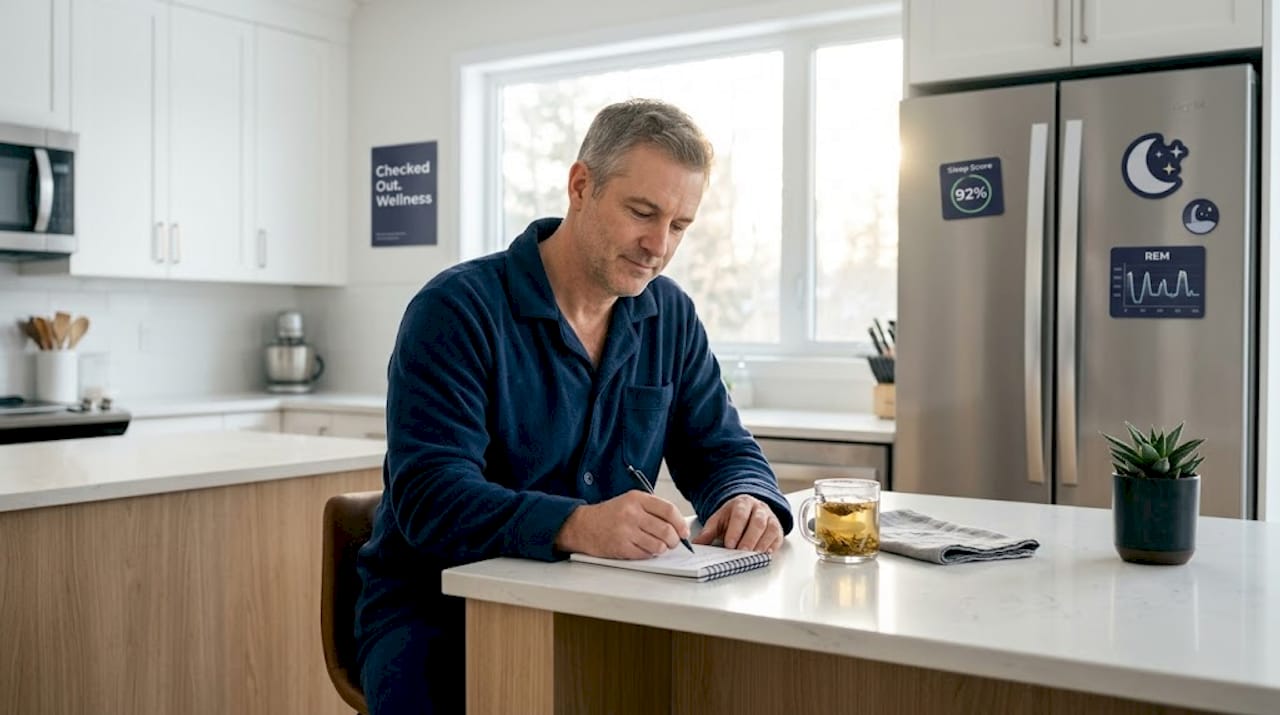
The cognitive stakes are particularly striking. Research has linked chronic loss of deep sleep to a measurably increased risk of dementia and Alzheimer’s disease. The brain’s glymphatic system, which clears metabolic waste including amyloid plaques, is most active during slow-wave sleep. Skimping on N3 isn’t just a performance issue. It’s a long-term neurological one.
On the hormonal side, deep sleep is when growth hormone secretion peaks. For athletes and high performers, this has direct implications for muscle recovery and tissue repair. Cortisol also reaches its lowest point during N3, giving the nervous system a genuine reprieve from the stress-response state most of us live in during the day.
“Deep sleep is when the body keeps score quietly. Every repair your immune system attempted, every memory your brain filed away, every hormone your endocrine system released — most of it traces back to this single, undervalued stage of sleep.”
If you want to understand sleep recovery in depth, the research on N3 is the best place to start.
How much deep sleep you actually need
Most healthy adults spend roughly 25% of their total sleep in deep N3 sleep. On a typical 8-hour night, that’s approximately 1.5 to 2 hours. But here’s what surprises most people: the total amount isn’t spread evenly across the night.
N3 lasts 20 to 40 minutes in the first sleep cycle and shortens with each cycle that follows. By cycles four and five, deep sleep may barely register at all. This architecture is why the first two hours of sleep are disproportionately valuable for physical restoration.
What the numbers actually look like
| Sleep duration |
Expected deep sleep (25%) |
When it’s concentrated |
| 6 hours |
~90 minutes |
Cycles 1 and 2 |
| 7 hours |
~105 minutes |
Cycles 1 and 2 |
| 8 hours |
~120 minutes |
Cycles 1 through 3 |
One counterintuitive fact: extending sleep duration alone won’t necessarily increase deep sleep unless you’re adding time at the beginning of the night. Sleeping in later mostly adds REM sleep, not N3. This is why a consistent, early-enough bedtime protects deep sleep more than sleeping longer on weekends.
Pro Tip: If you’re using a sleep tracker, treat the deep sleep number as a directional guide, not a verdict. Consumer trackers estimate sleep stages without reading EEG data directly. Polysomnography in a sleep clinic remains the only way to measure N3 with real precision.
How to achieve deep sleep naturally
Learning how to achieve deep sleep starts with accepting one honest limitation: you cannot consciously control which sleep stage you enter. What you can do is support the conditions that allow deep sleep to unfold reliably. Think of it as setting the stage and then getting out of the way.
Here are the most evidence-backed strategies:
-
Fix your sleep schedule first. Going to bed and waking at the same time every day, including weekends, anchors your circadian rhythm. When your body knows when to expect sleep, N3 episodes settle into their proper timing. A shifting schedule disrupts that architecture quickly.
-
Make your bedroom genuinely dark. Light suppresses melatonin production and fragments sleep continuity. A blackout mask or true blackout curtains can make a meaningful difference, especially for urban sleepers and shift workers. This isn’t aesthetic preference. It’s physiology.
-
Keep the room cool. Core body temperature needs to drop to initiate deep sleep. A room between 65°F and 68°F supports that drop. A warm bath or shower before bed actually helps by pulling blood to the surface and accelerating the post-bath cool-down.
-
Cut caffeine earlier than you think. Caffeine’s half-life is about five to seven hours. A 3 p.m. coffee still has meaningful adenosine-blocking activity at 10 p.m. Adenosine is one of the primary drivers of deep sleep pressure, so blocking it late in the day directly suppresses N3 quality.
-
Reduce alcohol consumption. Alcohol sedates initially but fragments sleep architecture in the second half of the night. It suppresses REM and can reduce deep sleep time, leaving you feeling unrestored even after a full night.
-
Build a wind-down routine. The nervous system doesn’t switch off on command. A consistent pre-sleep practice, whether that’s dim lighting, stretching, journaling, or breathing exercises, signals the body that the transition is coming.
-
Address persistent sleep disorders. If your deep sleep remains chronically low despite lifestyle improvements, investigate why. Sleep apnea, restless legs syndrome, and other disorders fragment N3 sleep in ways that lifestyle alone cannot fix. A sleep study changes the conversation entirely.
Pro Tip: For practical, research-backed guidance on building a sleep routine that supports deep sleep from the ground up, the specific sequence and timing of your pre-bed habits matter as much as the habits themselves.
Deep sleep vs REM sleep
The deep sleep vs REM debate often frames these stages as competitors, but they’re actually partners in a healthy night. They serve different systems and occupy different parts of the night with different biological priorities.
| Feature |
Deep sleep (N3) |
REM sleep |
| Primary function |
Physical restoration |
Mental and emotional restoration |
| Brain activity |
Slow delta waves |
Fast, mixed activity similar to waking |
| Body state |
Minimal movement, lowered vitals |
Temporary muscle paralysis |
| Hormones |
Growth hormone peak, cortisol trough |
Elevated acetylcholine |
| Timing |
First half of the night |
Progressively longer in later cycles |
| Memory role |
Declarative memory consolidation |
Procedural memory, emotional processing |
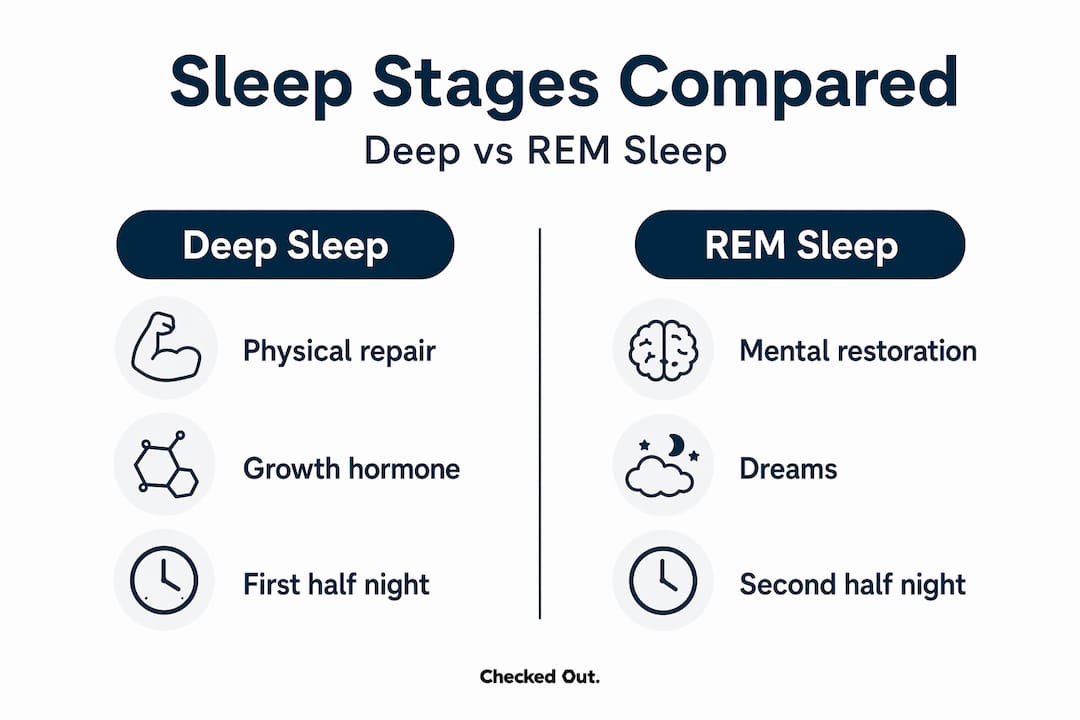
Deep sleep and REM sleep serve complementary roles: deep sleep for physical restoration and REM for mental restoration. Athletes who prioritize only quantity of sleep without considering stage distribution often find their mood, focus, and emotional regulation suffer even when their muscles feel recovered. You need both, in the right amounts, at the right times.
A healthy sleep cycle runs from light sleep through N3 and into REM, then begins again roughly every 90 minutes. Over an 8-hour night, most people complete four to five full cycles. The body naturally front-loads deep sleep and back-loads REM, which is why both an early bedtime and a consistent wake time work together to protect all the stages you need.
My perspective on chasing deep sleep
By Geeta
I’ve worked with a lot of people who became almost obsessive about their deep sleep numbers after getting a fitness tracker. They’d wake up, check their app, and let a percentage define how they felt about the night. I’ve been there myself, honestly. And what I’ve learned is that fixating on the output is often the worst thing you can do for the very thing you’re trying to improve.
The body responds to signals, not intentions. What actually moves the needle, consistently, is bedtime discipline. Getting to bed early enough that the first two sleep cycles happen before midnight is more powerful than any supplement or gadget. It’s unglamorous advice, and it’s also true.
What clinical practice keeps confirming is that when someone has done everything right for six weeks and their deep sleep is still fragmented and poor, it’s almost never a lifestyle failure. It’s a structural issue, usually undiagnosed sleep apnea or another disorder that needs clinical evaluation. Lifestyle optimization has a ceiling. When you’ve hit that ceiling, stop doubling down on it. Get a sleep study.
The other thing I’d say plainly: improving sleep quality naturally is not a quick fix. The changes compound over weeks, not days. Trust the process, and stop letting a wearable tell you how rested you are before your own body gets a chance to.
— Geeta

Understanding the science behind deep sleep is the first step. Putting it into practice is where most people get stuck. At Checkedoutwellness, we’ve built a line of drug-free, science-backed sleep solutions designed to work with your body’s own recovery processes, not override them. Our natural sleep patches deliver cofactors like magnesium, B6, B12, and GABA transdermally throughout the night, supporting your body’s own melatonin production pathway instead of flooding it with synthetic substitutes. Pair that with our contoured blackout sleep mask for complete light elimination, and you’ve addressed two of the most clinically supported levers for deeper, more restorative sleep. Explore the full range of natural sleep solutions and find what your nights have been missing.
FAQ
What is deep sleep and when does it happen?
Deep sleep, also called N3 or slow-wave sleep, is the stage of NREM sleep defined by delta brain waves. It occurs mostly in the first half of the night, with the longest episodes in the first one or two sleep cycles.
How much deep sleep do adults need per night?
Healthy adults typically spend about 25% of their total sleep time in deep sleep, which equals roughly 1.5 to 2 hours on an 8-hour schedule.
What happens if you don’t get enough deep sleep?
Insufficient deep sleep impairs physical repair, weakens immune function, disrupts hormone regulation, and is associated with increased risk of cognitive decline including dementia and Alzheimer’s disease.
How is deep sleep different from REM sleep?
Deep sleep focuses on physical restoration, releasing growth hormone and repairing tissue, while REM sleep supports emotional regulation, creativity, and memory processing. Both stages are necessary for full overnight recovery.
Can a fitness tracker accurately measure deep sleep?
Consumer sleep trackers estimate deep sleep stages without directly measuring EEG delta waves, which means their readings are approximations. Polysomnography, conducted in a clinical sleep lab, remains the gold standard for accurate deep sleep staging.
Recommended

What Is Deep Sleep and Why It Matters for Your Health
Most people assume that any time spent unconscious counts equally toward recovery. It doesn’t. Deep sleep is the stage where your body does its most critical repair work, and millions of people are chronically missing it without realizing it. You might be logging eight hours and still waking up foggy, sore, or emotionally flat. Understanding what deep sleep actually is, when it happens, and how to protect it can genuinely change how you feel every single day.
Table of Contents
Key takeaways
What is deep sleep, exactly
Deep sleep is the third stage of non-REM (NREM) sleep, designated N3 by sleep researchers. It’s also called slow-wave sleep because the brain produces slow, high-amplitude delta waves during this phase. N3 is classified when at least 20% of a 30-second scoring epoch shows delta wave activity, which gives you a sense of how precisely scientists define it.
This is the stage your body guards most fiercely. It takes the longest to wake someone from N3 sleep. If you’ve ever tried to rouse a deeply sleeping teenager or watched someone sleep through a smoke alarm, you’ve witnessed N3 in action. Heart rate drops, breathing slows, and blood pressure falls. The body is doing serious maintenance.
Deep sleep occurs mostly in the first half of the night. Those early-night episodes last 20 to 40 minutes and gradually shorten with each successive sleep cycle. By the early morning hours, your brain has mostly transitioned to longer REM episodes instead. This matters enormously for anyone who cuts sleep short or goes to bed late.
How deep sleep compares to other stages
Understanding these distinctions helps you see why the stages of deep sleep aren’t a free-floating event. They’re tightly anchored to the clock.
Why deep sleep is non-negotiable for health
The importance of deep sleep goes far beyond simply feeling rested. This is the stage where your body releases growth hormone, repairs muscle tissue, consolidates the day’s learning into long-term memory, and strengthens immune defenses. Deep sleep supports physical repair, immune function, growth, and cognitive processes like memory and creativity simultaneously. No other stage does all of that at once.
The cognitive stakes are particularly striking. Research has linked chronic loss of deep sleep to a measurably increased risk of dementia and Alzheimer’s disease. The brain’s glymphatic system, which clears metabolic waste including amyloid plaques, is most active during slow-wave sleep. Skimping on N3 isn’t just a performance issue. It’s a long-term neurological one.
On the hormonal side, deep sleep is when growth hormone secretion peaks. For athletes and high performers, this has direct implications for muscle recovery and tissue repair. Cortisol also reaches its lowest point during N3, giving the nervous system a genuine reprieve from the stress-response state most of us live in during the day.
If you want to understand sleep recovery in depth, the research on N3 is the best place to start.
How much deep sleep you actually need
Most healthy adults spend roughly 25% of their total sleep in deep N3 sleep. On a typical 8-hour night, that’s approximately 1.5 to 2 hours. But here’s what surprises most people: the total amount isn’t spread evenly across the night.
N3 lasts 20 to 40 minutes in the first sleep cycle and shortens with each cycle that follows. By cycles four and five, deep sleep may barely register at all. This architecture is why the first two hours of sleep are disproportionately valuable for physical restoration.
What the numbers actually look like
One counterintuitive fact: extending sleep duration alone won’t necessarily increase deep sleep unless you’re adding time at the beginning of the night. Sleeping in later mostly adds REM sleep, not N3. This is why a consistent, early-enough bedtime protects deep sleep more than sleeping longer on weekends.
Pro Tip: If you’re using a sleep tracker, treat the deep sleep number as a directional guide, not a verdict. Consumer trackers estimate sleep stages without reading EEG data directly. Polysomnography in a sleep clinic remains the only way to measure N3 with real precision.
How to achieve deep sleep naturally
Learning how to achieve deep sleep starts with accepting one honest limitation: you cannot consciously control which sleep stage you enter. What you can do is support the conditions that allow deep sleep to unfold reliably. Think of it as setting the stage and then getting out of the way.
Here are the most evidence-backed strategies:
Fix your sleep schedule first. Going to bed and waking at the same time every day, including weekends, anchors your circadian rhythm. When your body knows when to expect sleep, N3 episodes settle into their proper timing. A shifting schedule disrupts that architecture quickly.
Make your bedroom genuinely dark. Light suppresses melatonin production and fragments sleep continuity. A blackout mask or true blackout curtains can make a meaningful difference, especially for urban sleepers and shift workers. This isn’t aesthetic preference. It’s physiology.
Keep the room cool. Core body temperature needs to drop to initiate deep sleep. A room between 65°F and 68°F supports that drop. A warm bath or shower before bed actually helps by pulling blood to the surface and accelerating the post-bath cool-down.
Cut caffeine earlier than you think. Caffeine’s half-life is about five to seven hours. A 3 p.m. coffee still has meaningful adenosine-blocking activity at 10 p.m. Adenosine is one of the primary drivers of deep sleep pressure, so blocking it late in the day directly suppresses N3 quality.
Reduce alcohol consumption. Alcohol sedates initially but fragments sleep architecture in the second half of the night. It suppresses REM and can reduce deep sleep time, leaving you feeling unrestored even after a full night.
Build a wind-down routine. The nervous system doesn’t switch off on command. A consistent pre-sleep practice, whether that’s dim lighting, stretching, journaling, or breathing exercises, signals the body that the transition is coming.
Address persistent sleep disorders. If your deep sleep remains chronically low despite lifestyle improvements, investigate why. Sleep apnea, restless legs syndrome, and other disorders fragment N3 sleep in ways that lifestyle alone cannot fix. A sleep study changes the conversation entirely.
Pro Tip: For practical, research-backed guidance on building a sleep routine that supports deep sleep from the ground up, the specific sequence and timing of your pre-bed habits matter as much as the habits themselves.
Deep sleep vs REM sleep
The deep sleep vs REM debate often frames these stages as competitors, but they’re actually partners in a healthy night. They serve different systems and occupy different parts of the night with different biological priorities.
Deep sleep and REM sleep serve complementary roles: deep sleep for physical restoration and REM for mental restoration. Athletes who prioritize only quantity of sleep without considering stage distribution often find their mood, focus, and emotional regulation suffer even when their muscles feel recovered. You need both, in the right amounts, at the right times.
A healthy sleep cycle runs from light sleep through N3 and into REM, then begins again roughly every 90 minutes. Over an 8-hour night, most people complete four to five full cycles. The body naturally front-loads deep sleep and back-loads REM, which is why both an early bedtime and a consistent wake time work together to protect all the stages you need.
My perspective on chasing deep sleep
By Geeta
I’ve worked with a lot of people who became almost obsessive about their deep sleep numbers after getting a fitness tracker. They’d wake up, check their app, and let a percentage define how they felt about the night. I’ve been there myself, honestly. And what I’ve learned is that fixating on the output is often the worst thing you can do for the very thing you’re trying to improve.
The body responds to signals, not intentions. What actually moves the needle, consistently, is bedtime discipline. Getting to bed early enough that the first two sleep cycles happen before midnight is more powerful than any supplement or gadget. It’s unglamorous advice, and it’s also true.
What clinical practice keeps confirming is that when someone has done everything right for six weeks and their deep sleep is still fragmented and poor, it’s almost never a lifestyle failure. It’s a structural issue, usually undiagnosed sleep apnea or another disorder that needs clinical evaluation. Lifestyle optimization has a ceiling. When you’ve hit that ceiling, stop doubling down on it. Get a sleep study.
The other thing I’d say plainly: improving sleep quality naturally is not a quick fix. The changes compound over weeks, not days. Trust the process, and stop letting a wearable tell you how rested you are before your own body gets a chance to.
Support your deep sleep with tools that actually work
Understanding the science behind deep sleep is the first step. Putting it into practice is where most people get stuck. At Checkedoutwellness, we’ve built a line of drug-free, science-backed sleep solutions designed to work with your body’s own recovery processes, not override them. Our natural sleep patches deliver cofactors like magnesium, B6, B12, and GABA transdermally throughout the night, supporting your body’s own melatonin production pathway instead of flooding it with synthetic substitutes. Pair that with our contoured blackout sleep mask for complete light elimination, and you’ve addressed two of the most clinically supported levers for deeper, more restorative sleep. Explore the full range of natural sleep solutions and find what your nights have been missing.
FAQ
What is deep sleep and when does it happen?
Deep sleep, also called N3 or slow-wave sleep, is the stage of NREM sleep defined by delta brain waves. It occurs mostly in the first half of the night, with the longest episodes in the first one or two sleep cycles.
How much deep sleep do adults need per night?
Healthy adults typically spend about 25% of their total sleep time in deep sleep, which equals roughly 1.5 to 2 hours on an 8-hour schedule.
What happens if you don’t get enough deep sleep?
Insufficient deep sleep impairs physical repair, weakens immune function, disrupts hormone regulation, and is associated with increased risk of cognitive decline including dementia and Alzheimer’s disease.
How is deep sleep different from REM sleep?
Deep sleep focuses on physical restoration, releasing growth hormone and repairing tissue, while REM sleep supports emotional regulation, creativity, and memory processing. Both stages are necessary for full overnight recovery.
Can a fitness tracker accurately measure deep sleep?
Consumer sleep trackers estimate deep sleep stages without directly measuring EEG delta waves, which means their readings are approximations. Polysomnography, conducted in a clinical sleep lab, remains the gold standard for accurate deep sleep staging.
Recommended