You spent eight hours in bed last night, yet you woke up feeling like you barely rested. That’s the quiet frustration of missing out on deep sleep. These tips for deeper sleep go beyond the standard advice to uncover what actually moves the needle on restorative slow-wave sleep, the stage where your body repairs tissue, consolidates memory, and resets your nervous system. Whether you’ve struggled with this for months or just notice you’re not waking refreshed, the answers are practical, grounded in research, and within your reach.
Table of Contents
Key takeaways
| Point |
Details |
| Consistency matters most |
A fixed sleep and wake time, even on weekends, strengthens your circadian rhythm and deepens sleep cycles. |
| Environment is half the battle |
Keeping your room between 65 and 68°F with complete darkness directly increases slow-wave sleep. |
| Behavioral shifts beat supplements |
Routines and stimulus control outperform most over-the-counter sleep aids for long-term improvement. |
| Alcohol is not a sleep aid |
Even one or two drinks fragment the second half of your night and suppress deep sleep. |
| Medical causes are often missed |
Persistent light sleep despite good habits may signal sleep apnea, which requires clinical evaluation. |
1. Lock in a consistent sleep schedule
Consistent sleep schedules strengthen your circadian rhythm and help consolidate the sleep stages responsible for deep, restorative rest. Your brain releases growth hormone in predictable waves tied to your internal clock. Disrupt that clock on weekends, and you scatter those waves.
Pick a wake time and protect it. Not just on workdays. Every single day. It takes about two to three weeks for the rhythm to solidify, but once it does, you fall asleep faster and spend more time in slow-wave sleep without any other changes.
2. Optimize your bedroom environment
Temperature is the most underestimated lever in sleep quality. A bedroom kept at 65 to 68°F supports the core body temperature drop your brain uses as a signal to enter deep sleep. Too warm, and your brain keeps cycling you into lighter stages.
Darkness matters just as much. Even a small amount of ambient light suppresses melatonin and keeps your brain in a lighter state of alertness. A blackout mask or blackout curtains can close this gap quickly and inexpensively.
-
Temperature: Set the thermostat between 65 and 68°F before bed
-
Light: Use blackout curtains or a contoured sleep mask to eliminate all light
-
Sound: White noise machines or earplugs help mask sudden sounds that pull you out of deep sleep
-
Bedding: Natural fabric bedding like 100% cotton regulates body temperature and reduces heat-related awakenings
Pro Tip: If you share a bedroom with a partner who runs warm, try a dual-zone mattress topper so each of you can regulate your side independently without negotiating the thermostat.
3. Time your exercise right
Movement is one of the best ways to improve deep sleep naturally. 150 minutes of moderate exercise weekly improves sleep measurably, but timing matters enormously. Vigorous workouts raise your core body temperature significantly. If that heat hasn’t dissipated by bedtime, your brain reads it as daytime and fights the transition into slow-wave sleep.
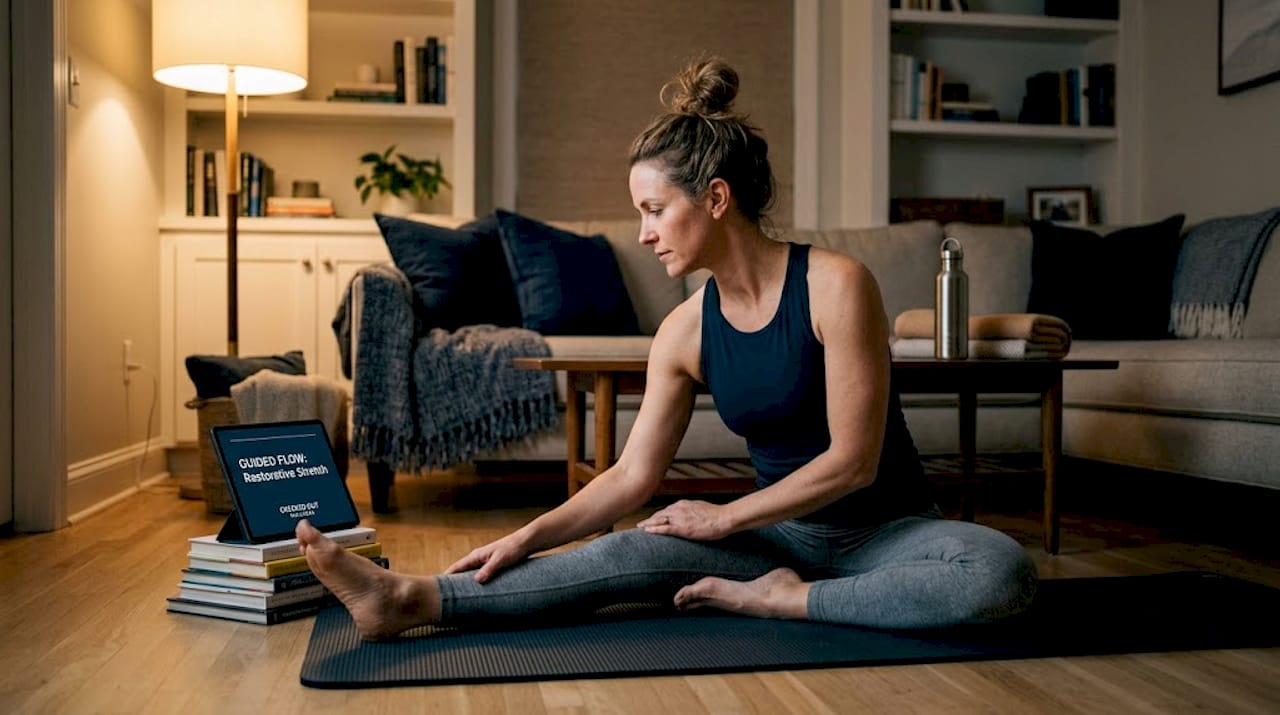
Give yourself at least three to four hours between intense training and sleep. Morning or midday workouts are ideal for deep sleep. Evening walks, yoga, or light stretching are fine and may even help you wind down. The key is understanding that exercise raises core body temperature, and cooling is the trigger for deeper sleep stages.
4. Cut off screens 60 minutes before bed
Blue light from phones, tablets, and computers suppresses melatonin production by signaling your brain that it’s still daytime. A 60-minute screen cutoff before bed gives your melatonin levels time to rise naturally and sets the stage for a smoother descent into deep sleep.
This is one of the simplest sleep hygiene tips that most people acknowledge but rarely follow. If cutting screens entirely feels too difficult, try using blue light-blocking glasses in the last hour or switching your devices to a warm-toned night mode. The goal is reducing the stimulus, not achieving perfection.
5. Build a 10 to 20 minute wind-down routine
Your nervous system does not flip a switch from “on” to “off.” It needs a ramp-down period. A gentle 10 to 20 minute wind-down shifts your autonomic nervous system from sympathetic activation into the parasympathetic rest mode your body needs to access deep, slow-wave sleep.
This routine could be reading physical print, light stretching, journaling, or a few minutes of slow breathing. What matters is that it’s consistent and calm. Over time, the routine itself becomes a neurological cue. Your brain learns that this sequence means sleep is coming, and it begins the hormonal preparation automatically.
6. Take a lukewarm shower before bed
This one sounds counterintuitive, but the science is solid. Taking a lukewarm shower 60 to 90 minutes before bed draws blood to the skin’s surface, which then dissipates heat quickly. The resulting drop in core body temperature mimics the natural cooling your brain uses to trigger sleep onset and deeper sleep stages.
Studies show this can reduce sleep onset by about 10 minutes and increase total sleep time meaningfully. A hot shower right before bed has the opposite effect because your core temperature stays elevated too long. Lukewarm, not scalding. Timing, not temperature alone.
Pro Tip: Combine the shower with your wind-down routine. Shower first, then spend 10 minutes reading or breathing exercises. You get the thermal benefit stacked with the behavioral cue.
7. Watch what you eat and drink in the evening
Heavy meals within two to three hours of bedtime pull blood flow and metabolic energy toward digestion at exactly the time your body needs to shift priorities toward cellular repair. Spicy, fatty, or large meals are the most disruptive.
Caffeine is another overlooked factor. Its half-life is about five to six hours, meaning an afternoon coffee at 3pm still has meaningful stimulant activity at 8pm. Aim to cut off caffeine by early afternoon for best results.
- Avoid large meals within 2 to 3 hours of bedtime
- Stop caffeine by 1 to 2pm if you have sleep sensitivity
- Limit fluid intake in the last 90 minutes to reduce nighttime awakenings
8. Understand what alcohol actually does to your sleep
This point deserves more emphasis than it usually gets. Alcohol may help you fall asleep faster, but it is a strong suppressor of deep sleep. Even one to two drinks disrupt sleep architecture and cause fragmented rest in the second half of the night, when the most restorative slow-wave and REM sleep naturally occurs.
The body keeps score quietly. You may feel like you slept, but your brain spent the night cycling through lighter stages and micro-awakenings you never consciously registered. If you want to understand how to enhance deep sleep genuinely, reducing or eliminating evening alcohol is one of the highest-impact changes you can make.
9. Use supplements strategically, not as shortcuts
Certain supplements have solid evidence behind them. Magnesium glycinate supports GABA activity and lowers cortisol, both of which contribute to deeper sleep. L-theanine, found naturally in green tea, promotes relaxation without sedation. Glycine taken before bed may reduce core body temperature and improve sleep efficiency.
Melatonin is more nuanced. It helps with sleep onset and circadian signaling but has limited direct impact on deep sleep depth itself. You can read more about the real role of supplements in sleep quality before starting anything new. Consult your healthcare provider before adding supplements, especially if you take medications or have existing conditions.
10. Pay attention to your sleep position
This is one of the lesser-known tips for restful sleep. Side sleeping, particularly on the left side, promotes airway openness and supports deeper sleep stages. Back sleeping increases the risk of airway collapse, which can cause micro-awakenings your brain registers even if you don’t.
If you tend to wake up unrefreshed and prefer sleeping on your back, it’s worth experimenting with a body pillow to keep you on your side. The impact on sleep depth may surprise you.
11. Know when to seek medical evaluation
Sometimes lifestyle changes simply aren’t enough because something physiological is working against you. 30 million Americans have sleep apnea, and the majority go undiagnosed. Sleep apnea causes deep sleep fragmentation at a neurological level that no supplement, routine, or environment change can fully offset.
Watch for these signs that warrant a conversation with your doctor:
- Waking unrefreshed despite seven to nine hours in bed
- Loud snoring or reports from a partner of breathing pauses during sleep
- Excessive daytime sleepiness even after what felt like a full night
- Morning headaches or dry mouth on waking
“Sleep restriction therapy is currently the only scientifically validated method explicitly targeted to increase the percentage of deep sleep, but it should only be done under professional supervision.”
CBT-I (Cognitive Behavioral Therapy for Insomnia) is also considered the clinical gold standard for improving sleep quality and often outperforms supplements alone for lasting results.
12. Build a personalized approach using what you know
No two people have the same sleep challenges. Someone with high cortisol from overtraining needs different fixes than someone whose sleep falls apart from late-night screen time. A comparison can help you prioritize where to start.
| Strategy |
Ease of adoption |
Impact on deep sleep |
| Consistent sleep schedule |
Medium |
Very high |
| Bedroom temperature control |
Easy |
High |
| Screen cutoff 60 min before bed |
Medium |
High |
| Lukewarm shower before bed |
Easy |
Moderate to high |
| Reducing evening alcohol |
Hard for some |
Very high |
| Magnesium supplementation |
Easy |
Moderate |
| Sleep position adjustment |
Easy |
Moderate |
| CBT-I or professional evaluation |
High effort |
Very high |
Start with one to two changes, not six at once. Give each change two full weeks before judging its effect. A simple sleep diary, even just noting a quality score from one to ten each morning, reveals patterns faster than memory alone.
Pro Tip: Tracking your sleep with even a basic wearable or free app helps you connect specific behaviors to your sleep quality. The data makes the relationship between your choices and your rest undeniable.
What I’ve learned about sleep that most people get wrong
I used to think better sleep was about adding the right thing: the right supplement, the right gadget, the right app. What I’ve learned, honestly, is that most people’s sleep problems come from what they haven’t removed. The glass of wine that “helps them relax.” The phone scroll that “helps them unwind.” The inconsistent wake time because weekends feel like the only recovery time available.
The body is not complicated when you stop fighting it. What I’ve seen work consistently isn’t a perfect protocol. It’s removing the friction first, then building consistency, and then adding support. Supplements and sleep aids can absolutely help, but they amplify a foundation. They don’t create one.
The hardest part is acknowledging that sleep apnea or a clinical condition might be involved. I’ve watched people spend years optimizing their bedtime routines while an undiagnosed airway issue undermined every night. If you’ve done the work and still wake exhausted, please get evaluated. That’s not a personal failure. It’s a medical reality that has real solutions.
Sleep is not a luxury you earn by finishing everything on your to-do list. It’s the process by which your body actually becomes capable of doing the things you want to do. Treat it that way.
— Geeta

Checkedoutwellness was built for people who take sleep as seriously as their training and nutrition. Every product in the lineup is drug-free, manufactured under pharmaceutical-grade ISO 22716 GMP standards in South Korea, and designed to support your body’s own sleep processes rather than override them. The natural sleep patch delivers cofactors like magnesium, B6, B12, and GABA transdermally, supporting melatonin production at the source. Pair it with the Sleep Duo bundle for comprehensive overnight recovery support. These tools are designed to complement the behavioral and environmental strategies you’ve just read about, giving your body what it needs to do the work you’ve set it up for.
FAQ
What is the most effective way to increase deep sleep?
Maintaining a consistent sleep schedule and optimizing bedroom temperature to between 65 and 68°F are among the most effective changes. For persistent issues, CBT-I under professional guidance is the clinical gold standard.
Does melatonin improve deep sleep?
Melatonin primarily supports sleep onset and circadian alignment rather than directly increasing deep sleep duration. Supporting your body’s own melatonin production through behavioral habits and nutrient cofactors tends to be more effective for sleep depth.
How does alcohol affect deep sleep?
Even one to two drinks suppress slow-wave sleep and fragment the second half of the night, reducing restorative rest despite making you feel sleepy at first.
When should I see a doctor about my sleep?
See a doctor if you consistently wake unrefreshed despite adequate time in bed, snore loudly, or experience daytime fatigue that doesn’t improve with better sleep habits. These can indicate sleep apnea or another treatable condition.
Can exercise really improve sleep quality?
Yes. 150 minutes of moderate exercise weekly measurably improves sleep depth, but vigorous workouts should end at least three to four hours before bed to avoid delaying sleep onset.
Recommended

Tips for Deeper Sleep: Science-Backed Strategies
You spent eight hours in bed last night, yet you woke up feeling like you barely rested. That’s the quiet frustration of missing out on deep sleep. These tips for deeper sleep go beyond the standard advice to uncover what actually moves the needle on restorative slow-wave sleep, the stage where your body repairs tissue, consolidates memory, and resets your nervous system. Whether you’ve struggled with this for months or just notice you’re not waking refreshed, the answers are practical, grounded in research, and within your reach.
Table of Contents
Key takeaways
1. Lock in a consistent sleep schedule
Consistent sleep schedules strengthen your circadian rhythm and help consolidate the sleep stages responsible for deep, restorative rest. Your brain releases growth hormone in predictable waves tied to your internal clock. Disrupt that clock on weekends, and you scatter those waves.
Pick a wake time and protect it. Not just on workdays. Every single day. It takes about two to three weeks for the rhythm to solidify, but once it does, you fall asleep faster and spend more time in slow-wave sleep without any other changes.
2. Optimize your bedroom environment
Temperature is the most underestimated lever in sleep quality. A bedroom kept at 65 to 68°F supports the core body temperature drop your brain uses as a signal to enter deep sleep. Too warm, and your brain keeps cycling you into lighter stages.
Darkness matters just as much. Even a small amount of ambient light suppresses melatonin and keeps your brain in a lighter state of alertness. A blackout mask or blackout curtains can close this gap quickly and inexpensively.
Pro Tip: If you share a bedroom with a partner who runs warm, try a dual-zone mattress topper so each of you can regulate your side independently without negotiating the thermostat.
3. Time your exercise right
Movement is one of the best ways to improve deep sleep naturally. 150 minutes of moderate exercise weekly improves sleep measurably, but timing matters enormously. Vigorous workouts raise your core body temperature significantly. If that heat hasn’t dissipated by bedtime, your brain reads it as daytime and fights the transition into slow-wave sleep.
Give yourself at least three to four hours between intense training and sleep. Morning or midday workouts are ideal for deep sleep. Evening walks, yoga, or light stretching are fine and may even help you wind down. The key is understanding that exercise raises core body temperature, and cooling is the trigger for deeper sleep stages.
4. Cut off screens 60 minutes before bed
Blue light from phones, tablets, and computers suppresses melatonin production by signaling your brain that it’s still daytime. A 60-minute screen cutoff before bed gives your melatonin levels time to rise naturally and sets the stage for a smoother descent into deep sleep.
This is one of the simplest sleep hygiene tips that most people acknowledge but rarely follow. If cutting screens entirely feels too difficult, try using blue light-blocking glasses in the last hour or switching your devices to a warm-toned night mode. The goal is reducing the stimulus, not achieving perfection.
5. Build a 10 to 20 minute wind-down routine
Your nervous system does not flip a switch from “on” to “off.” It needs a ramp-down period. A gentle 10 to 20 minute wind-down shifts your autonomic nervous system from sympathetic activation into the parasympathetic rest mode your body needs to access deep, slow-wave sleep.
This routine could be reading physical print, light stretching, journaling, or a few minutes of slow breathing. What matters is that it’s consistent and calm. Over time, the routine itself becomes a neurological cue. Your brain learns that this sequence means sleep is coming, and it begins the hormonal preparation automatically.
6. Take a lukewarm shower before bed
This one sounds counterintuitive, but the science is solid. Taking a lukewarm shower 60 to 90 minutes before bed draws blood to the skin’s surface, which then dissipates heat quickly. The resulting drop in core body temperature mimics the natural cooling your brain uses to trigger sleep onset and deeper sleep stages.
Studies show this can reduce sleep onset by about 10 minutes and increase total sleep time meaningfully. A hot shower right before bed has the opposite effect because your core temperature stays elevated too long. Lukewarm, not scalding. Timing, not temperature alone.
Pro Tip: Combine the shower with your wind-down routine. Shower first, then spend 10 minutes reading or breathing exercises. You get the thermal benefit stacked with the behavioral cue.
7. Watch what you eat and drink in the evening
Heavy meals within two to three hours of bedtime pull blood flow and metabolic energy toward digestion at exactly the time your body needs to shift priorities toward cellular repair. Spicy, fatty, or large meals are the most disruptive.
Caffeine is another overlooked factor. Its half-life is about five to six hours, meaning an afternoon coffee at 3pm still has meaningful stimulant activity at 8pm. Aim to cut off caffeine by early afternoon for best results.
8. Understand what alcohol actually does to your sleep
This point deserves more emphasis than it usually gets. Alcohol may help you fall asleep faster, but it is a strong suppressor of deep sleep. Even one to two drinks disrupt sleep architecture and cause fragmented rest in the second half of the night, when the most restorative slow-wave and REM sleep naturally occurs.
The body keeps score quietly. You may feel like you slept, but your brain spent the night cycling through lighter stages and micro-awakenings you never consciously registered. If you want to understand how to enhance deep sleep genuinely, reducing or eliminating evening alcohol is one of the highest-impact changes you can make.
9. Use supplements strategically, not as shortcuts
Certain supplements have solid evidence behind them. Magnesium glycinate supports GABA activity and lowers cortisol, both of which contribute to deeper sleep. L-theanine, found naturally in green tea, promotes relaxation without sedation. Glycine taken before bed may reduce core body temperature and improve sleep efficiency.
Melatonin is more nuanced. It helps with sleep onset and circadian signaling but has limited direct impact on deep sleep depth itself. You can read more about the real role of supplements in sleep quality before starting anything new. Consult your healthcare provider before adding supplements, especially if you take medications or have existing conditions.
10. Pay attention to your sleep position
This is one of the lesser-known tips for restful sleep. Side sleeping, particularly on the left side, promotes airway openness and supports deeper sleep stages. Back sleeping increases the risk of airway collapse, which can cause micro-awakenings your brain registers even if you don’t.
If you tend to wake up unrefreshed and prefer sleeping on your back, it’s worth experimenting with a body pillow to keep you on your side. The impact on sleep depth may surprise you.
11. Know when to seek medical evaluation
Sometimes lifestyle changes simply aren’t enough because something physiological is working against you. 30 million Americans have sleep apnea, and the majority go undiagnosed. Sleep apnea causes deep sleep fragmentation at a neurological level that no supplement, routine, or environment change can fully offset.
Watch for these signs that warrant a conversation with your doctor:
CBT-I (Cognitive Behavioral Therapy for Insomnia) is also considered the clinical gold standard for improving sleep quality and often outperforms supplements alone for lasting results.
12. Build a personalized approach using what you know
No two people have the same sleep challenges. Someone with high cortisol from overtraining needs different fixes than someone whose sleep falls apart from late-night screen time. A comparison can help you prioritize where to start.
Start with one to two changes, not six at once. Give each change two full weeks before judging its effect. A simple sleep diary, even just noting a quality score from one to ten each morning, reveals patterns faster than memory alone.
Pro Tip: Tracking your sleep with even a basic wearable or free app helps you connect specific behaviors to your sleep quality. The data makes the relationship between your choices and your rest undeniable.
What I’ve learned about sleep that most people get wrong
I used to think better sleep was about adding the right thing: the right supplement, the right gadget, the right app. What I’ve learned, honestly, is that most people’s sleep problems come from what they haven’t removed. The glass of wine that “helps them relax.” The phone scroll that “helps them unwind.” The inconsistent wake time because weekends feel like the only recovery time available.
The body is not complicated when you stop fighting it. What I’ve seen work consistently isn’t a perfect protocol. It’s removing the friction first, then building consistency, and then adding support. Supplements and sleep aids can absolutely help, but they amplify a foundation. They don’t create one.
The hardest part is acknowledging that sleep apnea or a clinical condition might be involved. I’ve watched people spend years optimizing their bedtime routines while an undiagnosed airway issue undermined every night. If you’ve done the work and still wake exhausted, please get evaluated. That’s not a personal failure. It’s a medical reality that has real solutions.
Sleep is not a luxury you earn by finishing everything on your to-do list. It’s the process by which your body actually becomes capable of doing the things you want to do. Treat it that way.
Support your deep sleep with science-backed tools from Checkedoutwellness
Checkedoutwellness was built for people who take sleep as seriously as their training and nutrition. Every product in the lineup is drug-free, manufactured under pharmaceutical-grade ISO 22716 GMP standards in South Korea, and designed to support your body’s own sleep processes rather than override them. The natural sleep patch delivers cofactors like magnesium, B6, B12, and GABA transdermally, supporting melatonin production at the source. Pair it with the Sleep Duo bundle for comprehensive overnight recovery support. These tools are designed to complement the behavioral and environmental strategies you’ve just read about, giving your body what it needs to do the work you’ve set it up for.
FAQ
What is the most effective way to increase deep sleep?
Maintaining a consistent sleep schedule and optimizing bedroom temperature to between 65 and 68°F are among the most effective changes. For persistent issues, CBT-I under professional guidance is the clinical gold standard.
Does melatonin improve deep sleep?
Melatonin primarily supports sleep onset and circadian alignment rather than directly increasing deep sleep duration. Supporting your body’s own melatonin production through behavioral habits and nutrient cofactors tends to be more effective for sleep depth.
How does alcohol affect deep sleep?
Even one to two drinks suppress slow-wave sleep and fragment the second half of the night, reducing restorative rest despite making you feel sleepy at first.
When should I see a doctor about my sleep?
See a doctor if you consistently wake unrefreshed despite adequate time in bed, snore loudly, or experience daytime fatigue that doesn’t improve with better sleep habits. These can indicate sleep apnea or another treatable condition.
Can exercise really improve sleep quality?
Yes. 150 minutes of moderate exercise weekly measurably improves sleep depth, but vigorous workouts should end at least three to four hours before bed to avoid delaying sleep onset.
Recommended