Most people have tried the obvious fixes: a sleepy tea, a melatonin gummy, an earlier bedtime. And most people are still tired. Understanding what is holistic sleep support means recognizing that poor sleep rarely has a single cause. It is a signal from multiple biological and behavioral systems falling out of sync at once. This guide breaks down the science, the practical strategies, and the specific tools that actually move the needle on sleep quality, not just on the nights you use them, but as a long-term foundation.
Table of Contents
Key takeaways
| Point |
Details |
| Sleep is a biological system |
Poor sleep reflects multiple dysregulated systems, not just one habit or deficiency. |
| Five pillars drive improvement |
Timing, environment, hygiene, behavioral techniques, and supplementation must work together for lasting change. |
| CBT-I outperforms medication |
Cognitive behavioral therapy for insomnia achieves 50-70% remission rates that hold long after treatment ends. |
| Change one variable at a time |
Introducing changes every 3-4 nights helps you identify what works without overwhelming your system. |
| Supplements support, not replace |
Magnesium, L-theanine, and GABA support the body’s chemistry, but only on a foundation of behavioral change. |
What holistic sleep support actually means
The phrase gets used loosely, so it is worth being precise. Holistic sleep support is the practice of addressing sleep through the full set of systems that govern it, namely your circadian rhythm, your core body temperature cycle, your neurochemical balance, your behavioral patterns, and your sleep environment, rather than suppressing wakefulness with sedatives or chasing a single supplement fix.
The explanation of holistic sleep starts with biology. Sleep is an active biological process, controlled by circadian clocks, fluctuating body temperature, and neurochemical balances. It is not a passive state your brain falls into when you stop stimulating it. The distinction matters enormously, because it shifts the entire strategy.
When you treat sleep as something to switch on, you reach for things that sedate. When you treat it as a biological process to support, you start asking which signals the body needs to do its job on its own terms. That is the core premise here. And it is why a fragmented approach, fixing just one thing at a time, rarely holds.
Here is what the body is actually managing every night:
-
Circadian rhythm regulation: Your suprachiasmatic nucleus tracks light and dark to time the release of melatonin. Disrupting this with inconsistent schedules or late-night screen light sends confusing signals.
-
Adenosine clearance: Adenosine, your sleepiness chemical, builds throughout the day and drives sleep pressure. Caffeine blocks its receptors rather than clearing it, which is why the crash returns.
-
Cortisol management: Cortisol should be highest in the morning and lowest at night. Chronic stress, late eating, and poor evening routines dysregulate this curve.
-
Core temperature cycling: Your body needs to drop its core temperature to initiate sleep. A warm bedroom, intense late exercise, or alcohol (which disrupts thermoregulation) all work against this.
-
Nervous system state: The parasympathetic nervous system needs to be dominant at bedtime. Pre-sleep anxiety, stimulating content, or irregular schedules keep the sympathetic system activated.
Pro Tip: Consistent morning light exposure within 30 minutes of waking is one of the highest-return habits you can build. It anchors your circadian rhythm and sets the countdown for melatonin release roughly 14-16 hours later.
The five pillars of sleep optimization
Defining holistic sleep health comes down to understanding that five evidence-based pillars structure every effective sleep improvement program: timing, environment, hygiene, behavioral techniques, and supplementation. No single pillar is sufficient. The power is in layering them.

| Pillar |
What it addresses |
Key actions |
| Timing |
Circadian alignment |
Fixed wake time, morning light, avoiding late naps |
| Environment |
Sleep-promoting conditions |
Blackout curtains, 65-68°F room temperature, white noise |
| Hygiene |
Pre-sleep behavioral patterns |
No caffeine after 2 PM, wind-down routine, screen limits |
| Techniques |
Cognitive and physiological reset |
CBT-I, sleep restriction, stimulus control, relaxation methods |
| Supplementation |
Neurochemical support |
Magnesium glycinate, L-theanine, adaptogens, GABA cofactors |
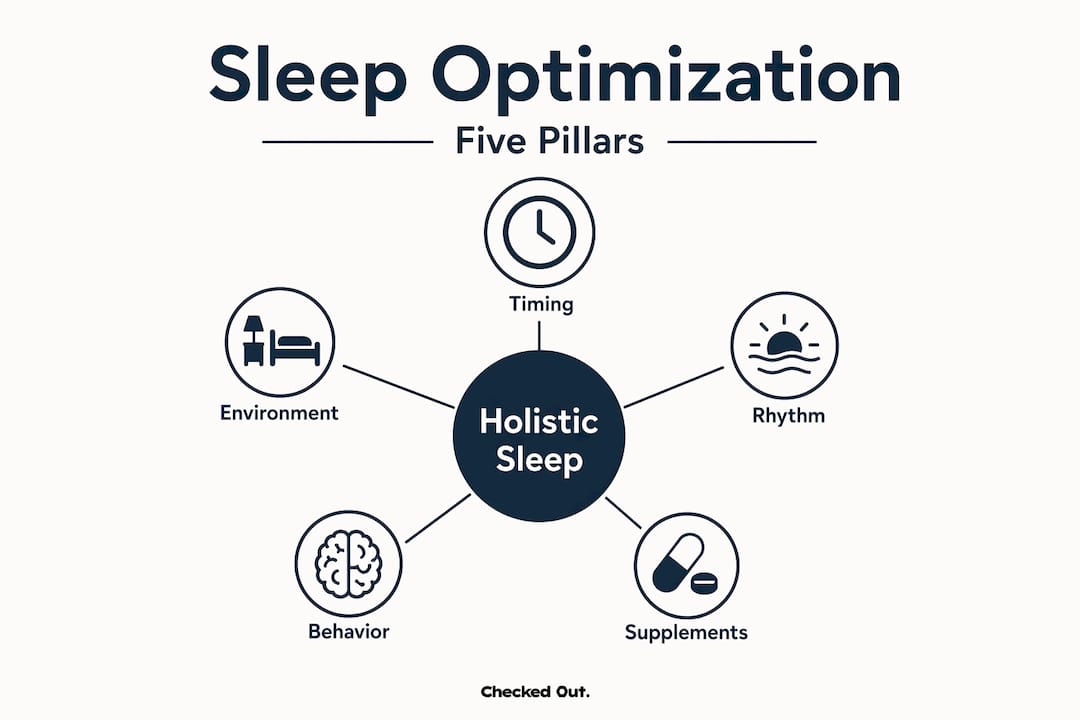
Most people start with pillar five (supplements) because it feels like the least effort. The problem is that supplementation layered on a dysregulated circadian rhythm and a chaotic sleep schedule tends to deliver marginal results. The sequence matters as much as the individual components.
The optimal sleep duration for slowing biological aging sits between 6.4 and 7.8 hours per night. That data point alone should reframe how most people think about sleep. You are not just managing fatigue. You are managing organ health, metabolic function, and longevity. The stakes justify building this properly.
Pro Tip: Fix your wake time first. Wake at the same hour seven days a week for two weeks before adjusting anything else. This single anchor does more for circadian alignment than most supplements combined.
Explore best sleep routine practices that address each of these pillars in concrete terms. The framework becomes much easier to apply when you see how the pieces connect in a daily structure.
Behavioral strategies for lasting change
Holistic sleep improvement strategies get their deepest traction from behavioral work. This is where the science is clearest, and where most people spend the least time.
CBT-I, or cognitive behavioral therapy for insomnia, is the gold-standard intervention for chronic insomnia. It achieves remission rates of 50-70% with effects that last well beyond the end of treatment, outperforming sleep medications on every meaningful long-term outcome. That is not a minor distinction. It means the change becomes structural.
Professional holistic sleep coaching, whether self-directed or with a practitioner, respects individual biological rhythms and avoids forcing rigid protocols that ignore your life. The approach integrates emotional context, developmental awareness, and lifestyle constraints that generic sleep advice ignores entirely.
Here is a sequential approach to behavioral sleep optimization that you can apply at home:
-
Lock in your wake time. Choose a fixed wake time and hold it regardless of how you slept. This is the foundation everything else is built on.
-
Get morning light immediately. Step outside or sit near a bright window within 30 minutes of waking. Bright light suppresses residual melatonin and anchors your circadian clock.
-
Map your caffeine cutoff. Caffeine has a six-hour half-life. If you are awake by 7 AM, cutting caffeine by 1 PM is a reasonable target. Adjust earlier if you are sensitive.
-
Build a 30-minute wind-down ritual. The nervous system does not switch off like a light. You need a deliberate transition. Dim lights, avoid screens, and choose calming activity.
-
Apply stimulus control. Use your bed only for sleep and sex. If you cannot sleep after 20 minutes, get up and do a quiet activity in dim light until sleepiness returns. This reconditions the brain to associate the bed with sleep rather than wakefulness.
-
Introduce sleep restriction gradually. If you are spending nine hours in bed and sleeping six, compress your sleep window to create stronger sleep pressure. The initial tiredness is temporary. Sleep restriction therapy temporarily reduces time in bed to consolidate sleep, which improves sleep efficiency over the following weeks.
-
Track your sleep window for 2-3 weeks before expanding it. When sleep efficiency reaches 85% or above, you can extend your window by 15-minute increments.
Behavioral and environmental tools like consistent routines, light management, temperature control, and noise reduction consistently outperform pharmacological options in long-term sleep health. They address root causes rather than covering symptoms.
Natural remedies and supplementation
Once behavioral and environmental foundations are in place, supplementation becomes genuinely useful. Think of it as fine-tuning, not rebuilding. The holistic sleep remedies list that actually holds up under scrutiny is shorter than most wellness content suggests.
-
Magnesium glycinate: Magnesium supports GABA receptor activity and helps lower cortisol in the evening. The glycinate form crosses the blood-brain barrier effectively and is gentle on digestion. The evidence for magnesium and sleep is solid, particularly for adults with suboptimal dietary intake.
-
L-theanine: This amino acid, found naturally in green tea, promotes alpha brainwave activity without sedation. It works well for people whose primary challenge is an overactive mind at bedtime, not a circadian timing issue.
-
GABA cofactors: GABA is the primary inhibitory neurotransmitter in the brain. Supporting its availability through precursors like B6, taurine, and specific botanicals can ease the transition into sleep.
-
Synthetic melatonin: use with caution. High-dose synthetic melatonin can suppress your body’s own production over time. If you use it at all, avoiding synthetic melatonin dependency matters more as a long-term strategy than short-term relief.
Sleep aids and supplements function as secondary supports layered on top of behavioral and environmental foundations, not as standalone solutions. That framing protects you from a pattern many people fall into: escalating doses of supplements while the underlying behavioral dysregulation goes unaddressed.
Pro Tip: Introduce one supplement at a time and hold it for at least ten days before assessing. Stacking multiple new supplements simultaneously makes it impossible to know which one, if any, is working.
Tracking progress and setting realistic expectations
Patience is not a passive virtue here. It is a structural requirement. The body adapts to new sleep signals gradually, and expecting transformation in three days usually leads to abandonment before results appear.
Changing one variable every 3-4 nights is the most practical approach to identifying what is actually working. Overhauling your sleep environment, supplements, and schedule simultaneously leaves you with no data and a lot of confusion.
Here is what to track in a simple sleep log:
-
Sleep onset time: How long after getting into bed did you feel sleepy?
-
Wake time and consistency: Did you hold your fixed wake time?
-
Middle-of-night waking: How many times, and were you able to return to sleep?
-
Morning feel: Rate subjective restoration on a 1-5 scale each morning.
-
Time in bed versus time asleep: Sleep quality and efficiency matter more than total hours. Lying awake in bed for long periods creates sleep anxiety that compounds the problem.
The first week of behavioral change, especially with sleep restriction, often feels harder than doing nothing. That discomfort is not a sign the approach is wrong. It is the system recalibrating. Most people who push through that window report noticeably deeper, more consolidated sleep within two to three weeks.
My honest take on holistic sleep: a perspective from Geeta
I spent years recommending single-lever sleep fixes to people who were desperate for an answer. A better pillow. A stricter bedtime. A magnesium supplement. And I watched those fixes deliver temporary relief while the underlying exhaustion quietly continued.
What shifted my thinking was recognizing that the body keeps score. Cortisol dysregulation accumulated over months does not reverse in a week because you started taking L-theanine. The tryptophan-to-serotonin-to-melatonin conversion pathway cannot compensate for a circadian rhythm that has been scrambled by years of shift work or travel.
What I have learned is that the people who sleep best are not the ones with the most optimized supplement stack. They are the ones who stopped treating sleep as a performance metric to hack and started treating it as a biological system to respect. That shift in orientation changes everything.
The biggest mistake I see? Starting with supplementation and skipping the environment and behavioral work entirely. The second biggest? Expecting a non-linear process to feel linear. Sleep improvement tends to stall, dip, and then suddenly consolidate. If you bail during the dip, you miss the consolidation.
Honor your own rhythm. Not the protocol you read about. Not someone else’s optimal sleep window. Yours. That is the heart of what a guide to holistic sleep health is really pointing toward.
— Geeta
If you have done the behavioral work and you want tools that genuinely complement it, this is where Checkedoutwellness was built to help.

The natural sleep patches from Checkedoutwellness deliver magnesium, B6, B12, GABA, and other cofactors transdermally, supporting your body’s own melatonin production without synthetic additives or dependency risk. They are manufactured under ISO 22716 GMP pharmaceutical standards in South Korea. For environment, the contoured blackout sleep mask blocks light without pressing on your eyes, which supports melatonin signaling all night. Pair both with the Sleep Duo bundle for a practical, drug-free toolkit that layers naturally onto the behavioral foundations you are already building. For the science behind each ingredient, the evidence page is worth your time.
FAQ
What is holistic sleep support in simple terms?
Holistic sleep support means addressing all the systems that govern sleep, including circadian rhythm, body temperature, neurochemistry, behavior, and environment, rather than treating a single symptom with a sedative or supplement.
How is holistic sleep different from taking a sleep aid?
Sleep aids typically suppress wakefulness rather than supporting the biological processes that create quality sleep. Holistic sleep improvement strategies work upstream, addressing why sleep is disrupted rather than sedating the symptom.
What are the most evidence-backed holistic sleep techniques?
CBT-I achieves remission rates of 50-70% for chronic insomnia with durable effects. Alongside CBT-I, consistent circadian anchoring through fixed wake times and morning light exposure are the most well-supported behavioral strategies.
Can supplements replace behavioral changes for sleep?
No. Supplements function as supporting layers on a foundation of behavioral and environmental changes. Supplements as secondary supports only show their full benefit once the circadian and behavioral foundations are addressed.
How long does holistic sleep improvement take to work?
Most people notice meaningful consolidation of sleep within two to three weeks of consistent implementation. Changing one variable every 3-4 nights and tracking sleep efficiency gives you the clearest read on what is actually driving improvement.
Recommended

What Is Holistic Sleep Support? Your 2026 Guide
Most people have tried the obvious fixes: a sleepy tea, a melatonin gummy, an earlier bedtime. And most people are still tired. Understanding what is holistic sleep support means recognizing that poor sleep rarely has a single cause. It is a signal from multiple biological and behavioral systems falling out of sync at once. This guide breaks down the science, the practical strategies, and the specific tools that actually move the needle on sleep quality, not just on the nights you use them, but as a long-term foundation.
Table of Contents
Key takeaways
What holistic sleep support actually means
The phrase gets used loosely, so it is worth being precise. Holistic sleep support is the practice of addressing sleep through the full set of systems that govern it, namely your circadian rhythm, your core body temperature cycle, your neurochemical balance, your behavioral patterns, and your sleep environment, rather than suppressing wakefulness with sedatives or chasing a single supplement fix.
The explanation of holistic sleep starts with biology. Sleep is an active biological process, controlled by circadian clocks, fluctuating body temperature, and neurochemical balances. It is not a passive state your brain falls into when you stop stimulating it. The distinction matters enormously, because it shifts the entire strategy.
When you treat sleep as something to switch on, you reach for things that sedate. When you treat it as a biological process to support, you start asking which signals the body needs to do its job on its own terms. That is the core premise here. And it is why a fragmented approach, fixing just one thing at a time, rarely holds.
Here is what the body is actually managing every night:
Pro Tip: Consistent morning light exposure within 30 minutes of waking is one of the highest-return habits you can build. It anchors your circadian rhythm and sets the countdown for melatonin release roughly 14-16 hours later.
The five pillars of sleep optimization
Defining holistic sleep health comes down to understanding that five evidence-based pillars structure every effective sleep improvement program: timing, environment, hygiene, behavioral techniques, and supplementation. No single pillar is sufficient. The power is in layering them.
Most people start with pillar five (supplements) because it feels like the least effort. The problem is that supplementation layered on a dysregulated circadian rhythm and a chaotic sleep schedule tends to deliver marginal results. The sequence matters as much as the individual components.
The optimal sleep duration for slowing biological aging sits between 6.4 and 7.8 hours per night. That data point alone should reframe how most people think about sleep. You are not just managing fatigue. You are managing organ health, metabolic function, and longevity. The stakes justify building this properly.
Pro Tip: Fix your wake time first. Wake at the same hour seven days a week for two weeks before adjusting anything else. This single anchor does more for circadian alignment than most supplements combined.
Explore best sleep routine practices that address each of these pillars in concrete terms. The framework becomes much easier to apply when you see how the pieces connect in a daily structure.
Behavioral strategies for lasting change
Holistic sleep improvement strategies get their deepest traction from behavioral work. This is where the science is clearest, and where most people spend the least time.
CBT-I, or cognitive behavioral therapy for insomnia, is the gold-standard intervention for chronic insomnia. It achieves remission rates of 50-70% with effects that last well beyond the end of treatment, outperforming sleep medications on every meaningful long-term outcome. That is not a minor distinction. It means the change becomes structural.
Professional holistic sleep coaching, whether self-directed or with a practitioner, respects individual biological rhythms and avoids forcing rigid protocols that ignore your life. The approach integrates emotional context, developmental awareness, and lifestyle constraints that generic sleep advice ignores entirely.
Here is a sequential approach to behavioral sleep optimization that you can apply at home:
Behavioral and environmental tools like consistent routines, light management, temperature control, and noise reduction consistently outperform pharmacological options in long-term sleep health. They address root causes rather than covering symptoms.
Natural remedies and supplementation
Once behavioral and environmental foundations are in place, supplementation becomes genuinely useful. Think of it as fine-tuning, not rebuilding. The holistic sleep remedies list that actually holds up under scrutiny is shorter than most wellness content suggests.
Sleep aids and supplements function as secondary supports layered on top of behavioral and environmental foundations, not as standalone solutions. That framing protects you from a pattern many people fall into: escalating doses of supplements while the underlying behavioral dysregulation goes unaddressed.
Pro Tip: Introduce one supplement at a time and hold it for at least ten days before assessing. Stacking multiple new supplements simultaneously makes it impossible to know which one, if any, is working.
Tracking progress and setting realistic expectations
Patience is not a passive virtue here. It is a structural requirement. The body adapts to new sleep signals gradually, and expecting transformation in three days usually leads to abandonment before results appear.
Changing one variable every 3-4 nights is the most practical approach to identifying what is actually working. Overhauling your sleep environment, supplements, and schedule simultaneously leaves you with no data and a lot of confusion.
Here is what to track in a simple sleep log:
The first week of behavioral change, especially with sleep restriction, often feels harder than doing nothing. That discomfort is not a sign the approach is wrong. It is the system recalibrating. Most people who push through that window report noticeably deeper, more consolidated sleep within two to three weeks.
My honest take on holistic sleep: a perspective from Geeta
I spent years recommending single-lever sleep fixes to people who were desperate for an answer. A better pillow. A stricter bedtime. A magnesium supplement. And I watched those fixes deliver temporary relief while the underlying exhaustion quietly continued.
What shifted my thinking was recognizing that the body keeps score. Cortisol dysregulation accumulated over months does not reverse in a week because you started taking L-theanine. The tryptophan-to-serotonin-to-melatonin conversion pathway cannot compensate for a circadian rhythm that has been scrambled by years of shift work or travel.
What I have learned is that the people who sleep best are not the ones with the most optimized supplement stack. They are the ones who stopped treating sleep as a performance metric to hack and started treating it as a biological system to respect. That shift in orientation changes everything.
The biggest mistake I see? Starting with supplementation and skipping the environment and behavioral work entirely. The second biggest? Expecting a non-linear process to feel linear. Sleep improvement tends to stall, dip, and then suddenly consolidate. If you bail during the dip, you miss the consolidation.
Honor your own rhythm. Not the protocol you read about. Not someone else’s optimal sleep window. Yours. That is the heart of what a guide to holistic sleep health is really pointing toward.
Sleep support tools that align with your practice
If you have done the behavioral work and you want tools that genuinely complement it, this is where Checkedoutwellness was built to help.
The natural sleep patches from Checkedoutwellness deliver magnesium, B6, B12, GABA, and other cofactors transdermally, supporting your body’s own melatonin production without synthetic additives or dependency risk. They are manufactured under ISO 22716 GMP pharmaceutical standards in South Korea. For environment, the contoured blackout sleep mask blocks light without pressing on your eyes, which supports melatonin signaling all night. Pair both with the Sleep Duo bundle for a practical, drug-free toolkit that layers naturally onto the behavioral foundations you are already building. For the science behind each ingredient, the evidence page is worth your time.
FAQ
What is holistic sleep support in simple terms?
Holistic sleep support means addressing all the systems that govern sleep, including circadian rhythm, body temperature, neurochemistry, behavior, and environment, rather than treating a single symptom with a sedative or supplement.
How is holistic sleep different from taking a sleep aid?
Sleep aids typically suppress wakefulness rather than supporting the biological processes that create quality sleep. Holistic sleep improvement strategies work upstream, addressing why sleep is disrupted rather than sedating the symptom.
What are the most evidence-backed holistic sleep techniques?
CBT-I achieves remission rates of 50-70% for chronic insomnia with durable effects. Alongside CBT-I, consistent circadian anchoring through fixed wake times and morning light exposure are the most well-supported behavioral strategies.
Can supplements replace behavioral changes for sleep?
No. Supplements function as supporting layers on a foundation of behavioral and environmental changes. Supplements as secondary supports only show their full benefit once the circadian and behavioral foundations are addressed.
How long does holistic sleep improvement take to work?
Most people notice meaningful consolidation of sleep within two to three weeks of consistent implementation. Changing one variable every 3-4 nights and tracking sleep efficiency gives you the clearest read on what is actually driving improvement.
Recommended