Quality sleep is defined as restorative, uninterrupted rest that allows the body and brain to complete essential repair cycles. The role of quality sleep in wellness extends far beyond simply feeling rested. The CDC and the American Academy of Sleep Medicine both recommend 7–9 hours for adults, yet one in three U.S. adults sleep less than 7 hours per night. That gap carries real consequences for mental clarity, physical health, and emotional balance. If you take your nutrition and fitness seriously, sleep belongs in the same category.
What are the mental health benefits of quality sleep?
Sleep quality and mental health share a relationship that runs in both directions. Poor sleep worsens anxiety and depression. Anxiety and depression then disrupt sleep further, trapping you in a cycle that feels impossible to break. The relationship is bidirectional, meaning you cannot fully address one without addressing the other.
The numbers make this concrete. Short sleep of 5 hours or fewer raises depression incidence by 14.1 percentage points compared to the recommended 6–8 hours. Long sleep of 9 or more hours raises it by 12.9 percentage points. Both extremes carry risk, which means duration alone is not a simple fix.
Sleep also drives memory consolidation. During deep sleep stages, the brain transfers short-term information into long-term storage. Miss those stages and your cognitive performance the next day reflects it, not just in mood, but in focus, decision-making, and recall.
The evidence-based treatment for chronic sleep problems is Cognitive Behavioral Therapy for Insomnia, known as CBT-I. Chronic insomnia affects 12.4% of people globally, and CBT-I works as a first-line treatment by addressing the thoughts and behaviors that perpetuate poor sleep. Critically, it also reduces depressive symptoms, not just sleep complaints.
“Sleep is not a passive state. It is an active biological process that regulates mood, memory, and the brain’s ability to manage stress. Treating insomnia is, in many cases, treating depression at its root.”
— Frontiers in Neurology, 2026
- Insufficient sleep increases the number of poor mental health days reported weekly.
- CBT-I modulates the HPA axis and reduces systemic inflammation, two pathways directly tied to depression.
- Emotional regulation depends on REM sleep, the stage most disrupted by alcohol and late-night screen exposure.
- Addressing sleep problems often reduces anxiety symptoms without additional intervention.
How does sleep affect physical health and immune function?
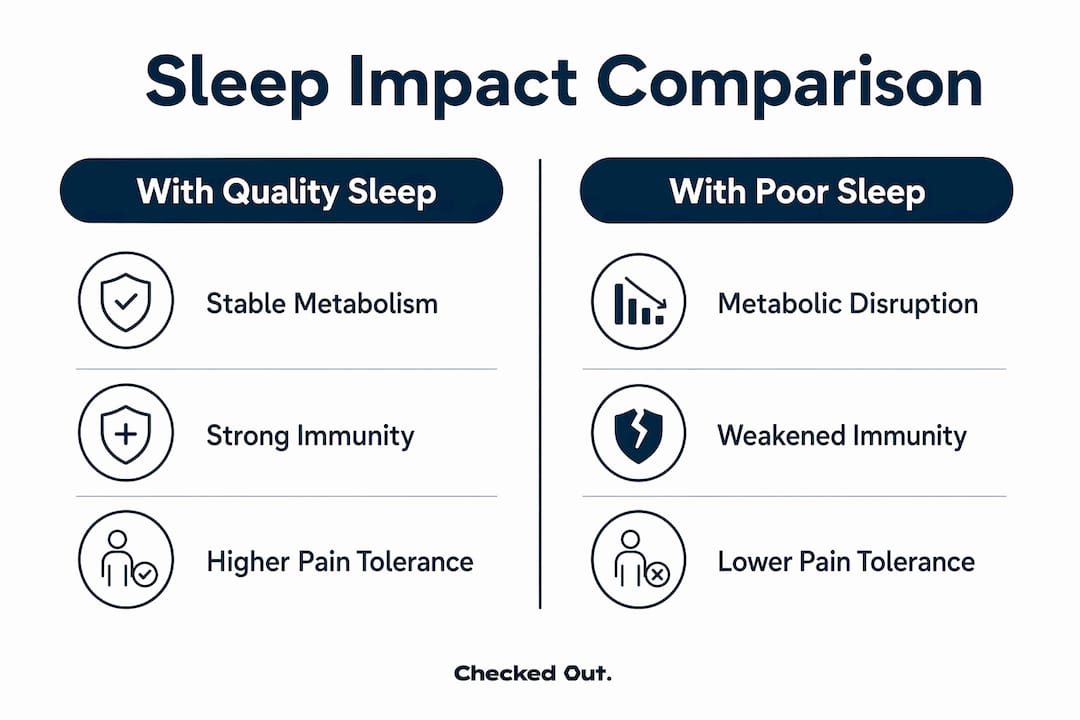
Sleep regulates your body’s metabolic machinery. Poor sleep disrupts glucose metabolism and hunger hormones, specifically ghrelin and leptin, pushing appetite upward and increasing type 2 diabetes risk. This is not a minor side effect. It is a direct hormonal consequence of cutting sleep short.

The immune system takes an equally serious hit. Sleep deprivation impairs the production of cytokines, the proteins your immune cells use to coordinate a defense response. You become more susceptible to illness, and recovery from existing conditions slows. The body keeps score quietly, and the bill arrives as frequent colds, slower healing, and elevated inflammation markers.
Pain tolerance also drops with poor sleep. Sleep deprivation lowers pain thresholds and worsens migraine severity. People managing chronic pain conditions often find that sleep problems make pain management far less effective, creating another self-reinforcing cycle.
| Physical health area |
With quality sleep |
With poor sleep |
| Metabolic function |
Stable glucose and appetite hormones |
Elevated diabetes risk, increased hunger |
| Immune response |
Strong cytokine production |
Impaired defense, slower recovery |
| Pain tolerance |
Higher threshold, better management |
Lower threshold, worsened migraines |
| Cardiovascular health |
Regulated blood pressure |
Elevated inflammation, higher disease risk |
| Tissue repair |
Active overnight restoration |
Slowed healing and recovery |
Pro Tip: If you manage migraines or chronic pain, prioritize sleep consistency before adding supplements or medications. Controlling sleep often reduces the frequency and severity of pain episodes more than people expect.
What biological mechanisms underlie the role of sleep in wellness?
The brain does not simply rest during sleep. It runs an active cleaning cycle. During sleep, the brain clears toxins accumulated during the waking day through the glymphatic system, a network of channels that flushes waste products linked to cognitive decline. Skip enough sleep and those toxins accumulate. The long-term consequences include increased risk for neurodegenerative conditions.

Sleep also regulates the hypothalamic-pituitary-adrenal axis, commonly called the HPA axis. This system controls cortisol release. When sleep is disrupted, cortisol dysregulation follows, driving systemic inflammation and weakening the body’s stress response. That is why chronic poor sleepers often feel wired but exhausted, a sign of a dysregulated stress system.
Sleep quality is multidimensional, covering six distinct dimensions beyond total hours. Understanding each one changes how you approach improvement:
-
Regularity. Sleeping and waking at consistent times anchors your circadian rhythm.
-
Satisfaction. Subjective sense of feeling rested after sleep, not just duration.
-
Alertness. Ability to stay awake and focused during the day without forcing it.
-
Timing. Alignment of sleep with your natural chronotype and light-dark cycles.
-
Efficiency. The percentage of time in bed actually spent asleep, ideally above 85%.
-
Duration. Total hours slept, calibrated to your individual biological need.
Fragmented sleep causes fatigue and cognitive impairment comparable to total sleep deprivation. Waking four times a night for five minutes each time is not meaningfully better than not sleeping at all. Consolidated, uninterrupted sleep is what allows the brain to cycle through all necessary stages.
Pro Tip: Track your sleep efficiency, not just your total hours. If you spend 8 hours in bed but wake frequently, your actual restorative sleep may be closer to 5 hours. A simple sleep diary for two weeks reveals patterns that wearables often miss.
What practical strategies can improve your sleep quality for wellness?
Sleep hygiene is the foundation. The term sounds clinical, but the practices are straightforward. Consistent wake times train your circadian rhythm more effectively than consistent bedtimes. Caffeine has a half-life of roughly 5–6 hours, meaning an afternoon coffee still affects your ability to fall asleep at 11 PM. Alcohol may help you fall asleep faster, but it fragments REM sleep and reduces overall sleep quality significantly.
For people with persistent insomnia, CBT-I addresses both physiological and behavioral pathways that maintain poor sleep. It is more effective than sleep medication for long-term outcomes and carries no dependency risk. Digital CBT-I programs now make this treatment accessible without a clinical referral.
Your sleep environment matters more than most people realize. Light suppresses melatonin production, even at low intensities. A blackout mask or blackout curtains can meaningfully extend deep sleep duration. Noise disrupts sleep continuity even when it does not fully wake you. White noise or earplugs protect sleep architecture in noisy environments.
- Maintain a consistent wake time seven days a week, including weekends.
- Cut caffeine intake after 1 PM to protect sleep onset.
- Dim lights in the hour before bed to support natural melatonin rise.
- Keep the bedroom cool, ideally between 65°F and 68°F.
- Avoid screens for 30 minutes before sleep or use blue light filtering.
- Consider natural sleep supplements like magnesium glycinate or L-theanine, which have evidence for improving sleep onset without dependency risk.
- Use science-backed sleep strategies to build a personal protocol rather than relying on a single fix.
Some people over-rely on sleep trackers, checking scores before they even feel how they slept. That anxiety itself can worsen sleep. Use tracking data as a trend tool over weeks, not a nightly report card.
Music therapy also has growing support as a sleep aid. Sleep practitioners use music to reduce pre-sleep arousal and support the transition into slow-wave sleep, making it a practical, drug-free addition to any sleep routine.
How does quality sleep support long-term wellness planning?
Sleep is not a recovery tool you use when you feel depleted. It is the foundation that makes every other wellness effort work. Nutrition, exercise, and stress management all depend on sleep to deliver their full benefit. A well-designed fitness program produces far less adaptation when sleep is chronically short, because tissue repair and hormone release peak during deep sleep.
Both too little and too much sleep harm metabolic and mood stability, following an inverse U-shaped curve. This means your personal sleep target is not simply “more is better.” It requires calibration. Most adults function best between 7 and 9 hours, but individual variation is real and worth tracking over time.
Chronic sleep deficits accumulate into what researchers call sleep debt, a deficit that does not fully reverse with one long night of rest. The impact of sleep on lifestyle compounds over years. Consistently short sleepers face higher risks for cardiovascular disease, metabolic disorders, and cognitive decline as they age.
“Sleep is the single most effective thing we can do to reset our brain and body health each day. The evidence is unambiguous.”
— Matthew Walker, neuroscientist and sleep researcher
Treating sleep as a long-term investment, not a short-term fix, is what separates people who maintain high performance over decades from those who burn out. Explore sleep wellness strategies for 2026 to build a plan that holds up across seasons and life demands.
Key Takeaways
Quality sleep is the single most foundational health behavior, directly regulating mental health, metabolic function, immune response, and long-term disease risk across all six dimensions of sleep quality.
| Point |
Details |
| Sleep and mental health are linked |
Short or long sleep both raise depression incidence; CBT-I treats both insomnia and depressive symptoms. |
| Physical health depends on sleep |
Poor sleep disrupts glucose metabolism, lowers pain thresholds, and impairs immune defense. |
| Quality has six dimensions |
Regularity, satisfaction, alertness, timing, efficiency, and duration all determine sleep’s health impact. |
| Fragmented sleep is as harmful as no sleep |
Interrupted sleep causes cognitive impairment comparable to total deprivation. |
| Sleep is a long-term wellness strategy |
Chronic sleep deficits compound into cardiovascular, metabolic, and cognitive disease risk over time. |
Sleep changed how I think about everything else
I spent years treating sleep as the variable I could compress when life got full. More work, less sleep. More travel, less sleep. The body adapts, I told myself. It does not. What it does is quietly accumulate the cost.
The shift for me came when I stopped measuring sleep by hours and started paying attention to how I actually felt. Not the tracker score. Not the total time in bed. The real question was: am I sharp, stable, and recovered? Most mornings, the answer was no, and I had been calling that normal.
What I have learned since is that sleep quality is not one thing. It is six things working together. You can sleep 8 hours and still wake up exhausted if your sleep is fragmented, poorly timed, or inefficient. That realization changed my entire approach to wellness. Sleep became the first variable I protected, not the last one I sacrificed.
The other misconception I see constantly is that sleep is passive. It is not. The brain is doing some of its most critical work while you are unconscious, clearing toxins, consolidating memory, regulating hormones. Treating that process carelessly is like skipping recovery days in training and wondering why performance stalls.
If you are serious about your health, start with sleep. Not because it is easy, but because nothing else works as well without it.
— Geeta
Natural sleep support from Checkedoutwellness
If you have done the work on sleep hygiene and still find yourself waking at 3 AM or struggling to fall asleep, the issue may be biochemical. The body needs specific cofactors, including magnesium, B6, B12, and GABA, to convert tryptophan into serotonin and then into melatonin naturally. Without them, the process stalls regardless of how dark your room is.

Checkedoutwellness builds drug-free, melatonin-free sleep products designed to support that natural conversion process. The Sleep Patch delivers these cofactors transdermally overnight, manufactured under ISO 22716 GMP pharmaceutical standards in South Korea. No synthetic melatonin. No dependency risk. Just the raw materials your body already knows how to use. Browse the full range at Checkedoutwellness and find the right fit for your sleep routine.
FAQ
What is quality sleep and why does it matter for wellness?
Quality sleep is restorative, consolidated rest that covers six dimensions: regularity, satisfaction, alertness, timing, efficiency, and duration. It directly regulates mental health, immune function, metabolism, and long-term disease risk.
How does poor sleep affect mental health?
Poor sleep raises depression incidence significantly, with short sleepers showing a 14.1 percentage point increase in depression risk compared to those sleeping the recommended 6–8 hours. The relationship between sleep and mental health is bidirectional, meaning each worsens the other.
Can improving sleep quality reduce physical health risks?
Yes. Better sleep stabilizes glucose metabolism, strengthens immune response, raises pain thresholds, and lowers cardiovascular inflammation. Many chronic conditions improve when sleep quality is addressed directly.
What is CBT-I and does it work?
Cognitive Behavioral Therapy for Insomnia (CBT-I) is the evidence-based first-line treatment for chronic insomnia. It improves both sleep quality and depressive symptoms by addressing the behavioral and physiological patterns that maintain poor sleep.
How many hours of sleep do adults actually need?
Most adults need 7–9 hours, as recommended by the CDC and the American Academy of Sleep Medicine. Individual optimum varies, and both too little and too much sleep harm mood and metabolic stability.
Recommended

The Role of Quality Sleep in Wellness: 2026 Guide
Quality sleep is defined as restorative, uninterrupted rest that allows the body and brain to complete essential repair cycles. The role of quality sleep in wellness extends far beyond simply feeling rested. The CDC and the American Academy of Sleep Medicine both recommend 7–9 hours for adults, yet one in three U.S. adults sleep less than 7 hours per night. That gap carries real consequences for mental clarity, physical health, and emotional balance. If you take your nutrition and fitness seriously, sleep belongs in the same category.
What are the mental health benefits of quality sleep?
Sleep quality and mental health share a relationship that runs in both directions. Poor sleep worsens anxiety and depression. Anxiety and depression then disrupt sleep further, trapping you in a cycle that feels impossible to break. The relationship is bidirectional, meaning you cannot fully address one without addressing the other.
The numbers make this concrete. Short sleep of 5 hours or fewer raises depression incidence by 14.1 percentage points compared to the recommended 6–8 hours. Long sleep of 9 or more hours raises it by 12.9 percentage points. Both extremes carry risk, which means duration alone is not a simple fix.
Sleep also drives memory consolidation. During deep sleep stages, the brain transfers short-term information into long-term storage. Miss those stages and your cognitive performance the next day reflects it, not just in mood, but in focus, decision-making, and recall.
The evidence-based treatment for chronic sleep problems is Cognitive Behavioral Therapy for Insomnia, known as CBT-I. Chronic insomnia affects 12.4% of people globally, and CBT-I works as a first-line treatment by addressing the thoughts and behaviors that perpetuate poor sleep. Critically, it also reduces depressive symptoms, not just sleep complaints.
How does sleep affect physical health and immune function?
Sleep regulates your body’s metabolic machinery. Poor sleep disrupts glucose metabolism and hunger hormones, specifically ghrelin and leptin, pushing appetite upward and increasing type 2 diabetes risk. This is not a minor side effect. It is a direct hormonal consequence of cutting sleep short.
The immune system takes an equally serious hit. Sleep deprivation impairs the production of cytokines, the proteins your immune cells use to coordinate a defense response. You become more susceptible to illness, and recovery from existing conditions slows. The body keeps score quietly, and the bill arrives as frequent colds, slower healing, and elevated inflammation markers.
Pain tolerance also drops with poor sleep. Sleep deprivation lowers pain thresholds and worsens migraine severity. People managing chronic pain conditions often find that sleep problems make pain management far less effective, creating another self-reinforcing cycle.
Pro Tip: If you manage migraines or chronic pain, prioritize sleep consistency before adding supplements or medications. Controlling sleep often reduces the frequency and severity of pain episodes more than people expect.
What biological mechanisms underlie the role of sleep in wellness?
The brain does not simply rest during sleep. It runs an active cleaning cycle. During sleep, the brain clears toxins accumulated during the waking day through the glymphatic system, a network of channels that flushes waste products linked to cognitive decline. Skip enough sleep and those toxins accumulate. The long-term consequences include increased risk for neurodegenerative conditions.
Sleep also regulates the hypothalamic-pituitary-adrenal axis, commonly called the HPA axis. This system controls cortisol release. When sleep is disrupted, cortisol dysregulation follows, driving systemic inflammation and weakening the body’s stress response. That is why chronic poor sleepers often feel wired but exhausted, a sign of a dysregulated stress system.
Sleep quality is multidimensional, covering six distinct dimensions beyond total hours. Understanding each one changes how you approach improvement:
Fragmented sleep causes fatigue and cognitive impairment comparable to total sleep deprivation. Waking four times a night for five minutes each time is not meaningfully better than not sleeping at all. Consolidated, uninterrupted sleep is what allows the brain to cycle through all necessary stages.
Pro Tip: Track your sleep efficiency, not just your total hours. If you spend 8 hours in bed but wake frequently, your actual restorative sleep may be closer to 5 hours. A simple sleep diary for two weeks reveals patterns that wearables often miss.
What practical strategies can improve your sleep quality for wellness?
Sleep hygiene is the foundation. The term sounds clinical, but the practices are straightforward. Consistent wake times train your circadian rhythm more effectively than consistent bedtimes. Caffeine has a half-life of roughly 5–6 hours, meaning an afternoon coffee still affects your ability to fall asleep at 11 PM. Alcohol may help you fall asleep faster, but it fragments REM sleep and reduces overall sleep quality significantly.
For people with persistent insomnia, CBT-I addresses both physiological and behavioral pathways that maintain poor sleep. It is more effective than sleep medication for long-term outcomes and carries no dependency risk. Digital CBT-I programs now make this treatment accessible without a clinical referral.
Your sleep environment matters more than most people realize. Light suppresses melatonin production, even at low intensities. A blackout mask or blackout curtains can meaningfully extend deep sleep duration. Noise disrupts sleep continuity even when it does not fully wake you. White noise or earplugs protect sleep architecture in noisy environments.
Some people over-rely on sleep trackers, checking scores before they even feel how they slept. That anxiety itself can worsen sleep. Use tracking data as a trend tool over weeks, not a nightly report card.
Music therapy also has growing support as a sleep aid. Sleep practitioners use music to reduce pre-sleep arousal and support the transition into slow-wave sleep, making it a practical, drug-free addition to any sleep routine.
How does quality sleep support long-term wellness planning?
Sleep is not a recovery tool you use when you feel depleted. It is the foundation that makes every other wellness effort work. Nutrition, exercise, and stress management all depend on sleep to deliver their full benefit. A well-designed fitness program produces far less adaptation when sleep is chronically short, because tissue repair and hormone release peak during deep sleep.
Both too little and too much sleep harm metabolic and mood stability, following an inverse U-shaped curve. This means your personal sleep target is not simply “more is better.” It requires calibration. Most adults function best between 7 and 9 hours, but individual variation is real and worth tracking over time.
Chronic sleep deficits accumulate into what researchers call sleep debt, a deficit that does not fully reverse with one long night of rest. The impact of sleep on lifestyle compounds over years. Consistently short sleepers face higher risks for cardiovascular disease, metabolic disorders, and cognitive decline as they age.
Treating sleep as a long-term investment, not a short-term fix, is what separates people who maintain high performance over decades from those who burn out. Explore sleep wellness strategies for 2026 to build a plan that holds up across seasons and life demands.
Key Takeaways
Quality sleep is the single most foundational health behavior, directly regulating mental health, metabolic function, immune response, and long-term disease risk across all six dimensions of sleep quality.
Sleep changed how I think about everything else
I spent years treating sleep as the variable I could compress when life got full. More work, less sleep. More travel, less sleep. The body adapts, I told myself. It does not. What it does is quietly accumulate the cost.
The shift for me came when I stopped measuring sleep by hours and started paying attention to how I actually felt. Not the tracker score. Not the total time in bed. The real question was: am I sharp, stable, and recovered? Most mornings, the answer was no, and I had been calling that normal.
What I have learned since is that sleep quality is not one thing. It is six things working together. You can sleep 8 hours and still wake up exhausted if your sleep is fragmented, poorly timed, or inefficient. That realization changed my entire approach to wellness. Sleep became the first variable I protected, not the last one I sacrificed.
The other misconception I see constantly is that sleep is passive. It is not. The brain is doing some of its most critical work while you are unconscious, clearing toxins, consolidating memory, regulating hormones. Treating that process carelessly is like skipping recovery days in training and wondering why performance stalls.
If you are serious about your health, start with sleep. Not because it is easy, but because nothing else works as well without it.
Natural sleep support from Checkedoutwellness
If you have done the work on sleep hygiene and still find yourself waking at 3 AM or struggling to fall asleep, the issue may be biochemical. The body needs specific cofactors, including magnesium, B6, B12, and GABA, to convert tryptophan into serotonin and then into melatonin naturally. Without them, the process stalls regardless of how dark your room is.
Checkedoutwellness builds drug-free, melatonin-free sleep products designed to support that natural conversion process. The Sleep Patch delivers these cofactors transdermally overnight, manufactured under ISO 22716 GMP pharmaceutical standards in South Korea. No synthetic melatonin. No dependency risk. Just the raw materials your body already knows how to use. Browse the full range at Checkedoutwellness and find the right fit for your sleep routine.
FAQ
What is quality sleep and why does it matter for wellness?
Quality sleep is restorative, consolidated rest that covers six dimensions: regularity, satisfaction, alertness, timing, efficiency, and duration. It directly regulates mental health, immune function, metabolism, and long-term disease risk.
How does poor sleep affect mental health?
Poor sleep raises depression incidence significantly, with short sleepers showing a 14.1 percentage point increase in depression risk compared to those sleeping the recommended 6–8 hours. The relationship between sleep and mental health is bidirectional, meaning each worsens the other.
Can improving sleep quality reduce physical health risks?
Yes. Better sleep stabilizes glucose metabolism, strengthens immune response, raises pain thresholds, and lowers cardiovascular inflammation. Many chronic conditions improve when sleep quality is addressed directly.
What is CBT-I and does it work?
Cognitive Behavioral Therapy for Insomnia (CBT-I) is the evidence-based first-line treatment for chronic insomnia. It improves both sleep quality and depressive symptoms by addressing the behavioral and physiological patterns that maintain poor sleep.
How many hours of sleep do adults actually need?
Most adults need 7–9 hours, as recommended by the CDC and the American Academy of Sleep Medicine. Individual optimum varies, and both too little and too much sleep harm mood and metabolic stability.
Recommended