Sleep quality is defined as the degree to which your sleep is restorative, efficient, and aligned with your biological rhythms — not simply the total hours you spend in bed. The National Sleep Foundation and recent 2026 research both confirm that healthy sleep spans six dimensions: regularity, satisfaction, alertness, timing, efficiency, and duration. Most people track only duration. That single blind spot explains why millions wake up exhausted after eight full hours. Understanding sleep quality means understanding all six dimensions, and knowing which ones you are actually getting right.
What is sleep quality defined by, and how is it measured?
Sleep quality is defined by four core, measurable metrics: sleep latency, continuity, efficiency, and timing. Each one tells a different story about what your body actually does between the moment you close your eyes and the moment your alarm sounds.
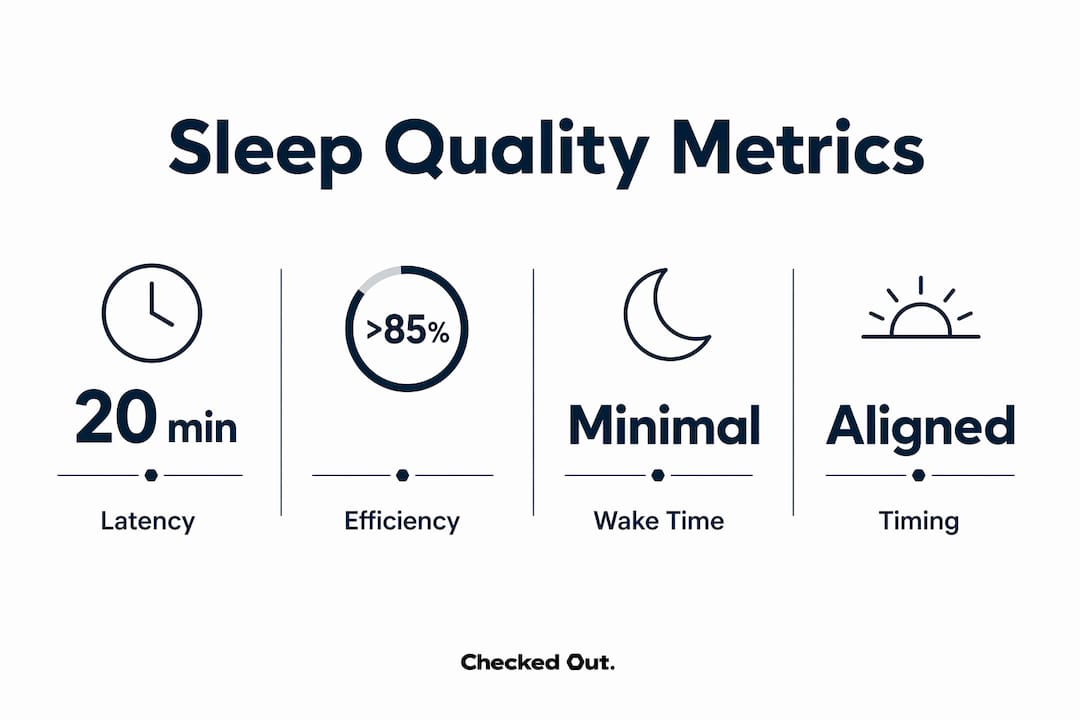
Sleep latency is the time it takes to fall asleep. High-quality sleep occurs when you fall asleep within 20 minutes of lying down. Taking longer than 30 minutes consistently signals either physiological hyperarousal or poor sleep environment conditions.
Sleep continuity measures how often you wake during the night and how long you stay awake after initial sleep onset. A single brief awakening is normal. Multiple awakenings exceeding five minutes each fragment your sleep architecture and reduce the time spent in deep, slow-wave sleep and REM, the stages where biological repair and memory consolidation actually happen.
Sleep efficiency is the ratio of time asleep to time spent in bed. Sleep efficiency is a more accurate indicator of sleep quality than raw time in bed, and a score above 85% is generally considered healthy. Someone lying in bed for nine hours but sleeping only six has an efficiency of 67%. That gap matters more than the nine hours they logged.
Sleep timing refers to alignment with your circadian rhythm. Sleeping from 2 a.m. to 10 a.m. may give you eight hours, but if your chronotype is naturally earlier, that misalignment suppresses melatonin production and reduces sleep depth.
Objective vs. subjective sleep quality assessment
Measuring sleep quality accurately requires both objective data and honest self-reporting. Wearables like the Oura Ring and WHOOP track heart rate variability, respiratory rate, and movement to estimate sleep stages. Sleep diaries, used in clinical settings like those at the Cleveland Clinic, capture subjective experience including how rested you feel upon waking. The Pittsburgh Sleep Quality Index (PSQI) is the most widely validated self-report tool in sleep research, covering all seven components of sleep quality in a single questionnaire.
Humans are poor at estimating sleep variables like latency and wakefulness after sleep onset, which makes objective tracking essential for anyone serious about sleep quality assessment. Your perception of how long it took you to fall asleep is almost always longer than reality. Technology corrects that bias.
Pro Tip: Use a wearable for two weeks without changing any habits first. Establish your baseline before you try to optimize. Changing too many variables at once makes it impossible to know what actually worked.
| Metric |
What it measures |
Healthy benchmark |
| Sleep latency |
Time to fall asleep |
Under 20 minutes |
| Sleep efficiency |
Time asleep vs. time in bed |
Above 85% |
| Wake after sleep onset |
Total wakefulness mid-night |
Under 30 minutes |
| Sleep timing |
Alignment with circadian rhythm |
Consistent within 30 minutes nightly |
How does sleep quality affect mental and physical health?
Poor sleep quality does not just make you tired. It restructures how your brain processes emotion, language, and social information at a neurological level. Less than 6 to 7 hours of quality sleep is linked to measurable declines in problem-solving, language tasks, and emotional regulation. That means one week of fragmented sleep can make you less articulate, less empathetic, and more reactive, even if you feel functional.
The restorative stages of sleep carry specific biological jobs. Slow-wave sleep (stages 3 and 4) drives physical repair: tissue regeneration, immune function, and growth hormone release. REM sleep processes emotional memory and supports creative thinking. When your sleep is fragmented, you lose disproportionate amounts of these deeper stages because the body cycles through lighter sleep first. Eight hours of interrupted sleep delivers far less slow-wave and REM time than six hours of consolidated, efficient sleep.
“Sleep is not a passive state. It is the body’s most active maintenance window. Disrupting it is not just losing rest. It is losing the repair cycle itself.”
The psychological consequences compound over time. Research links chronic poor sleep quality to increased risk of anxiety disorders, clinical depression, and accelerated cognitive decline. Social cognition, specifically the ability to read facial expressions and regulate interpersonal responses, degrades noticeably after even short periods of disrupted sleep. The importance of sleep quality extends far beyond feeling refreshed. It is the foundation of how you think, feel, and connect with others.
- Fragmented sleep reduces slow-wave and REM sleep disproportionately
- Emotional regulation declines after even short periods of poor sleep quality
- Cognitive tasks including language and problem-solving show measurable impairment
- Social cognition and empathy are among the first functions to degrade
- Chronic poor sleep quality is independently associated with anxiety and depression risk
What are common misconceptions about sleep quality?
The most persistent misconception is that sleep quantity and sleep quality are interchangeable. They are not. There is no single biomarker for good sleep. An individual with six hours of high-efficiency, well-timed sleep may be more genuinely rested than someone who logs nine hours of fragmented, poorly timed sleep. Duration is one input. It is not the output.
The second major misconception is that feeling tired is a reliable indicator of poor sleep quality. Fatigue has many causes: dehydration, sedentary behavior, blood sugar fluctuations, and even boredom. Conversely, some people with genuinely poor sleep quality feel alert during the day because their cortisol and adrenaline systems compensate. The body keeps score quietly. You may not feel the deficit until it becomes a crisis.
Chronotype is another misunderstood factor. Your natural sleep timing preference is partly genetic. Night owls forced into early schedules by work or social obligations experience chronic circadian misalignment, which degrades sleep quality regardless of how many hours they get. Aligning sleep timing with your natural chronotype markedly improves sleep quality and should be prioritized before any other intervention.
-
Quantity does not equal quality. Eight hours of fragmented sleep is not equivalent to six hours of consolidated, efficient sleep.
-
Feeling rested is not the only measure. Daytime performance, mood stability, and cognitive sharpness are more reliable indicators.
-
Your sleep need is individual. Genetics, age, activity level, and health status all influence how much sleep you personally require.
-
Tiredness is not always a sleep signal. Rule out hydration, nutrition, and movement before attributing fatigue solely to sleep.
-
Chronotype matters. Forcing an early schedule on a late chronotype degrades sleep quality at the biological level.
Pro Tip: Track your daytime alertness, mood, and focus alongside your nighttime sleep data. The correlation between those two datasets tells you far more than either one alone.
What practical steps can you take to improve sleep quality?
Basic sleep hygiene forms the foundation of good sleep, and without it, advanced sleep hacks fail. Before you invest in supplements, devices, or protocols, the fundamentals need to be in place. The Cleveland Clinic recommends the same sleep and wake time daily, a bedroom temperature between 60 and 67°F, and removing screens 30 to 60 minutes before bed. These three changes alone improve sleep latency and efficiency for most people within two weeks.
Cognitive arousal before bedtime is one of the most underestimated threats to sleep quality. Writing to-do lists an hour before bed moves intrusive thoughts out of working memory and facilitates faster sleep onset. This is not a wellness trend. It is a neurological offload. The brain cannot fully disengage from unresolved tasks, and the act of writing them down signals to the prefrontal cortex that the problem is captured and no longer needs active monitoring.
For a practical overview of science-backed sleep improvement steps, the sequence matters as much as the individual actions.
- Keep your sleep and wake times consistent within 30 minutes, even on weekends
- Set your bedroom temperature between 60 and 67°F
- Remove all screens at least 30 minutes before bed, 60 minutes if you are a light sleeper
- Use blackout curtains or a contoured sleep mask to eliminate light exposure
- Do a written brain dump of tomorrow’s tasks one hour before bed
- Avoid caffeine after 2 p.m. and alcohol within three hours of sleep
- Get morning sunlight within 30 minutes of waking to anchor your circadian rhythm
| Approach |
Best for |
Limitation |
| Consistent sleep schedule |
Everyone |
Requires discipline on weekends |
| Bedroom temperature control |
Light sleepers, hot climates |
Depends on HVAC access |
| Screen removal before bed |
High cognitive arousal types |
Requires habit replacement |
| Chronotype alignment |
Night owls, shift workers |
May conflict with work schedules |
| Brain dump journaling |
Overthinkers, high performers |
Needs 10 minutes of daily commitment |
Daytime behavior is also a direct indicator of sleep quality. If you need caffeine to function before 10 a.m., feel a strong urge to nap between 1 and 3 p.m., or struggle to stay alert in low-stimulation environments, your sleep quality is likely insufficient regardless of what your sleep tracker shows. These signals are the body’s honest report card.
Key takeaways
Sleep quality is defined by efficiency, timing, continuity, and regularity, and improving it requires addressing all four dimensions, not just adding more hours in bed.
| Point |
Details |
| Sleep quality is multidimensional |
Latency, efficiency, continuity, and timing each contribute independently to restorative sleep. |
| Efficiency beats duration |
A sleep efficiency score above 85% matters more than total hours logged in bed. |
| Chronotype alignment is non-negotiable |
Sleeping against your natural rhythm degrades quality regardless of duration. |
| Daytime signals reveal nighttime quality |
Mood, focus, and alertness during the day are the most honest indicators of how well you slept. |
| Hygiene before hacks |
Consistent schedule, cool room, and screen removal outperform supplements and devices when basics are missing. |
Why I think most people are solving the wrong sleep problem
By Geeta
Most people I speak with are trying to sleep longer. They set earlier bedtimes, take melatonin, and track their hours obsessively. But the number they are chasing is the wrong one. What I have found, both personally and through years of working in this space, is that the quality of sleep architecture matters far more than the clock time.
I went through a period where I was getting seven to eight hours every night and still waking up exhausted. My cortisol was dysregulated, my REM was fragmented, and my sleep efficiency was sitting around 72%. The hours looked fine on paper. The biology told a different story.
What actually moved the needle was not a supplement or a device. It was consistency and environment. Same wake time every day, including weekends. A cooler room. A written brain dump before bed that stopped my mind from rehearsing tomorrow’s problems at midnight. These are unglamorous changes. They work precisely because they work with the body’s own systems rather than trying to override them.
My honest advice: before you add anything to your sleep routine, subtract something first. Remove the screen, the irregular schedule, the late caffeine. Get your baseline clean. Then, if you still need support, layer in tools that work with your biology, not against it. The 10 proven sleep strategies worth trying are the ones grounded in circadian science, not convenience.
— Geeta
How Checkedoutwellness supports your sleep quality goals
If your fundamentals are in place and you are ready to go deeper, Checkedoutwellness offers tools designed to work with your body’s natural sleep chemistry, not replace it.

The natural sleep patch delivers magnesium, B6, B12, and GABA transdermally, supporting your body’s own tryptophan-to-serotonin-to-melatonin conversion without synthetic melatonin or dependency risk. Manufactured in South Korea under ISO 22716 GMP pharmaceutical standards, every ingredient earns its place. Pair it with the contoured blackout sleep mask to eliminate light disruption, or explore the Sleep Duo bundle for a complete sleep environment upgrade. These are not shortcuts. They are precision tools for people who have already done the foundational work and want to optimize what remains.
FAQ
What is sleep quality defined as in scientific terms?
Sleep quality is defined as a multidimensional construct encompassing sleep latency, efficiency, continuity, timing, and subjective satisfaction. The National Sleep Foundation and recent 2026 research recognize six dimensions: regularity, satisfaction, alertness, timing, efficiency, and duration.
What is a good sleep efficiency score?
A sleep efficiency score above 85% is considered healthy by sleep clinicians. This means that if you spend eight hours in bed, you should be asleep for at least six hours and 48 minutes of that time.
How can I assess my own sleep quality at home?
Use a validated self-report tool like the Pittsburgh Sleep Quality Index (PSQI) alongside a wearable device such as the Oura Ring or WHOOP. Track both your nighttime data and your daytime alertness, mood, and cognitive performance for the most accurate picture.
Does more sleep always mean better sleep quality?
No. Sleep quality and sleep quantity are independent variables. An individual with six hours of high-efficiency, well-timed sleep can be more rested than someone with nine hours of fragmented, poorly timed sleep. Efficiency and continuity matter more than raw duration.
What is the fastest way to improve sleep quality?
Establish a consistent sleep and wake time, lower your bedroom temperature to between 60 and 67°F, and remove screens 30 to 60 minutes before bed. These three changes address sleep latency, efficiency, and circadian alignment simultaneously and produce measurable results within two weeks for most people.
Recommended

Sleep Quality Defined: What It Really Means to Rest Well
Sleep quality is defined as the degree to which your sleep is restorative, efficient, and aligned with your biological rhythms — not simply the total hours you spend in bed. The National Sleep Foundation and recent 2026 research both confirm that healthy sleep spans six dimensions: regularity, satisfaction, alertness, timing, efficiency, and duration. Most people track only duration. That single blind spot explains why millions wake up exhausted after eight full hours. Understanding sleep quality means understanding all six dimensions, and knowing which ones you are actually getting right.
What is sleep quality defined by, and how is it measured?
Sleep quality is defined by four core, measurable metrics: sleep latency, continuity, efficiency, and timing. Each one tells a different story about what your body actually does between the moment you close your eyes and the moment your alarm sounds.
Sleep latency is the time it takes to fall asleep. High-quality sleep occurs when you fall asleep within 20 minutes of lying down. Taking longer than 30 minutes consistently signals either physiological hyperarousal or poor sleep environment conditions.
Sleep continuity measures how often you wake during the night and how long you stay awake after initial sleep onset. A single brief awakening is normal. Multiple awakenings exceeding five minutes each fragment your sleep architecture and reduce the time spent in deep, slow-wave sleep and REM, the stages where biological repair and memory consolidation actually happen.
Sleep efficiency is the ratio of time asleep to time spent in bed. Sleep efficiency is a more accurate indicator of sleep quality than raw time in bed, and a score above 85% is generally considered healthy. Someone lying in bed for nine hours but sleeping only six has an efficiency of 67%. That gap matters more than the nine hours they logged.
Sleep timing refers to alignment with your circadian rhythm. Sleeping from 2 a.m. to 10 a.m. may give you eight hours, but if your chronotype is naturally earlier, that misalignment suppresses melatonin production and reduces sleep depth.
Objective vs. subjective sleep quality assessment
Measuring sleep quality accurately requires both objective data and honest self-reporting. Wearables like the Oura Ring and WHOOP track heart rate variability, respiratory rate, and movement to estimate sleep stages. Sleep diaries, used in clinical settings like those at the Cleveland Clinic, capture subjective experience including how rested you feel upon waking. The Pittsburgh Sleep Quality Index (PSQI) is the most widely validated self-report tool in sleep research, covering all seven components of sleep quality in a single questionnaire.
Humans are poor at estimating sleep variables like latency and wakefulness after sleep onset, which makes objective tracking essential for anyone serious about sleep quality assessment. Your perception of how long it took you to fall asleep is almost always longer than reality. Technology corrects that bias.
Pro Tip: Use a wearable for two weeks without changing any habits first. Establish your baseline before you try to optimize. Changing too many variables at once makes it impossible to know what actually worked.
How does sleep quality affect mental and physical health?
Poor sleep quality does not just make you tired. It restructures how your brain processes emotion, language, and social information at a neurological level. Less than 6 to 7 hours of quality sleep is linked to measurable declines in problem-solving, language tasks, and emotional regulation. That means one week of fragmented sleep can make you less articulate, less empathetic, and more reactive, even if you feel functional.
The restorative stages of sleep carry specific biological jobs. Slow-wave sleep (stages 3 and 4) drives physical repair: tissue regeneration, immune function, and growth hormone release. REM sleep processes emotional memory and supports creative thinking. When your sleep is fragmented, you lose disproportionate amounts of these deeper stages because the body cycles through lighter sleep first. Eight hours of interrupted sleep delivers far less slow-wave and REM time than six hours of consolidated, efficient sleep.
The psychological consequences compound over time. Research links chronic poor sleep quality to increased risk of anxiety disorders, clinical depression, and accelerated cognitive decline. Social cognition, specifically the ability to read facial expressions and regulate interpersonal responses, degrades noticeably after even short periods of disrupted sleep. The importance of sleep quality extends far beyond feeling refreshed. It is the foundation of how you think, feel, and connect with others.
What are common misconceptions about sleep quality?
The most persistent misconception is that sleep quantity and sleep quality are interchangeable. They are not. There is no single biomarker for good sleep. An individual with six hours of high-efficiency, well-timed sleep may be more genuinely rested than someone who logs nine hours of fragmented, poorly timed sleep. Duration is one input. It is not the output.
The second major misconception is that feeling tired is a reliable indicator of poor sleep quality. Fatigue has many causes: dehydration, sedentary behavior, blood sugar fluctuations, and even boredom. Conversely, some people with genuinely poor sleep quality feel alert during the day because their cortisol and adrenaline systems compensate. The body keeps score quietly. You may not feel the deficit until it becomes a crisis.
Chronotype is another misunderstood factor. Your natural sleep timing preference is partly genetic. Night owls forced into early schedules by work or social obligations experience chronic circadian misalignment, which degrades sleep quality regardless of how many hours they get. Aligning sleep timing with your natural chronotype markedly improves sleep quality and should be prioritized before any other intervention.
Pro Tip: Track your daytime alertness, mood, and focus alongside your nighttime sleep data. The correlation between those two datasets tells you far more than either one alone.
What practical steps can you take to improve sleep quality?
Basic sleep hygiene forms the foundation of good sleep, and without it, advanced sleep hacks fail. Before you invest in supplements, devices, or protocols, the fundamentals need to be in place. The Cleveland Clinic recommends the same sleep and wake time daily, a bedroom temperature between 60 and 67°F, and removing screens 30 to 60 minutes before bed. These three changes alone improve sleep latency and efficiency for most people within two weeks.
Cognitive arousal before bedtime is one of the most underestimated threats to sleep quality. Writing to-do lists an hour before bed moves intrusive thoughts out of working memory and facilitates faster sleep onset. This is not a wellness trend. It is a neurological offload. The brain cannot fully disengage from unresolved tasks, and the act of writing them down signals to the prefrontal cortex that the problem is captured and no longer needs active monitoring.
For a practical overview of science-backed sleep improvement steps, the sequence matters as much as the individual actions.
Daytime behavior is also a direct indicator of sleep quality. If you need caffeine to function before 10 a.m., feel a strong urge to nap between 1 and 3 p.m., or struggle to stay alert in low-stimulation environments, your sleep quality is likely insufficient regardless of what your sleep tracker shows. These signals are the body’s honest report card.
Key takeaways
Sleep quality is defined by efficiency, timing, continuity, and regularity, and improving it requires addressing all four dimensions, not just adding more hours in bed.
Why I think most people are solving the wrong sleep problem
By Geeta
Most people I speak with are trying to sleep longer. They set earlier bedtimes, take melatonin, and track their hours obsessively. But the number they are chasing is the wrong one. What I have found, both personally and through years of working in this space, is that the quality of sleep architecture matters far more than the clock time.
I went through a period where I was getting seven to eight hours every night and still waking up exhausted. My cortisol was dysregulated, my REM was fragmented, and my sleep efficiency was sitting around 72%. The hours looked fine on paper. The biology told a different story.
What actually moved the needle was not a supplement or a device. It was consistency and environment. Same wake time every day, including weekends. A cooler room. A written brain dump before bed that stopped my mind from rehearsing tomorrow’s problems at midnight. These are unglamorous changes. They work precisely because they work with the body’s own systems rather than trying to override them.
My honest advice: before you add anything to your sleep routine, subtract something first. Remove the screen, the irregular schedule, the late caffeine. Get your baseline clean. Then, if you still need support, layer in tools that work with your biology, not against it. The 10 proven sleep strategies worth trying are the ones grounded in circadian science, not convenience.
How Checkedoutwellness supports your sleep quality goals
If your fundamentals are in place and you are ready to go deeper, Checkedoutwellness offers tools designed to work with your body’s natural sleep chemistry, not replace it.
The natural sleep patch delivers magnesium, B6, B12, and GABA transdermally, supporting your body’s own tryptophan-to-serotonin-to-melatonin conversion without synthetic melatonin or dependency risk. Manufactured in South Korea under ISO 22716 GMP pharmaceutical standards, every ingredient earns its place. Pair it with the contoured blackout sleep mask to eliminate light disruption, or explore the Sleep Duo bundle for a complete sleep environment upgrade. These are not shortcuts. They are precision tools for people who have already done the foundational work and want to optimize what remains.
FAQ
What is sleep quality defined as in scientific terms?
Sleep quality is defined as a multidimensional construct encompassing sleep latency, efficiency, continuity, timing, and subjective satisfaction. The National Sleep Foundation and recent 2026 research recognize six dimensions: regularity, satisfaction, alertness, timing, efficiency, and duration.
What is a good sleep efficiency score?
A sleep efficiency score above 85% is considered healthy by sleep clinicians. This means that if you spend eight hours in bed, you should be asleep for at least six hours and 48 minutes of that time.
How can I assess my own sleep quality at home?
Use a validated self-report tool like the Pittsburgh Sleep Quality Index (PSQI) alongside a wearable device such as the Oura Ring or WHOOP. Track both your nighttime data and your daytime alertness, mood, and cognitive performance for the most accurate picture.
Does more sleep always mean better sleep quality?
No. Sleep quality and sleep quantity are independent variables. An individual with six hours of high-efficiency, well-timed sleep can be more rested than someone with nine hours of fragmented, poorly timed sleep. Efficiency and continuity matter more than raw duration.
What is the fastest way to improve sleep quality?
Establish a consistent sleep and wake time, lower your bedroom temperature to between 60 and 67°F, and remove screens 30 to 60 minutes before bed. These three changes address sleep latency, efficiency, and circadian alignment simultaneously and produce measurable results within two weeks for most people.
Recommended