Sleep wellness tips are practical habits and environmental adjustments that improve sleep quality, help manage sleep disruptions, and support overall physical and mental health. Most people focus on hours slept, but sleep quality and regularity matter more than raw duration. Experts at Mayo Clinic, Johns Hopkins Medicine, and Cleveland Clinic consistently point to the same foundational practices: consistent schedules, controlled environments, and deliberate wind-down routines. If you have been chasing better sleep without a clear system, this guide gives you one.
1. What are the top daily habits to improve sleep quality?
The single most impactful daily habit is a fixed wake time, seven days a week. Adults need 7 to 8 hours of sleep per night, and a consistent wake time is the most reliable way to regulate your circadian rhythm. Sleeping in on weekends feels restorative but actually shifts your internal clock, making Monday mornings harder than they need to be.
Here are the daily behaviors that move the needle most:
-
Set a fixed wake time. Pick one time and hold it regardless of when you fell asleep. Your body will begin consolidating sleep more efficiently within two weeks.
-
Cut caffeine by early afternoon. Caffeine has a half-life of roughly five to six hours, meaning a 3 p.m. coffee still has half its stimulant load in your system at 8 p.m.
-
Limit alcohol close to bedtime. Alcohol may help you fall asleep faster but fragments the second half of your sleep cycle, reducing restorative REM sleep.
-
Get bright light in the morning. Morning sunlight suppresses residual melatonin and anchors your circadian rhythm to the day. Ten to fifteen minutes outside before 10 a.m. is enough.
-
Time your exercise carefully. Exercise at least four hours before bed to capture its sleep benefits without the alertness spike that follows intense physical activity.
-
Keep naps short and early. A 20-minute nap before 2 p.m. refreshes without stealing sleep pressure from the night.
Pro Tip: Set your wake alarm and a “wind-down alarm” 60 minutes before bed. The second alarm is the one that actually changes your sleep.
2. How to create an optimal sleep environment for wellness
Your bedroom is either working for your sleep or against it. Most bedrooms fail on at least two of the four critical variables: temperature, light, noise, and mental association.
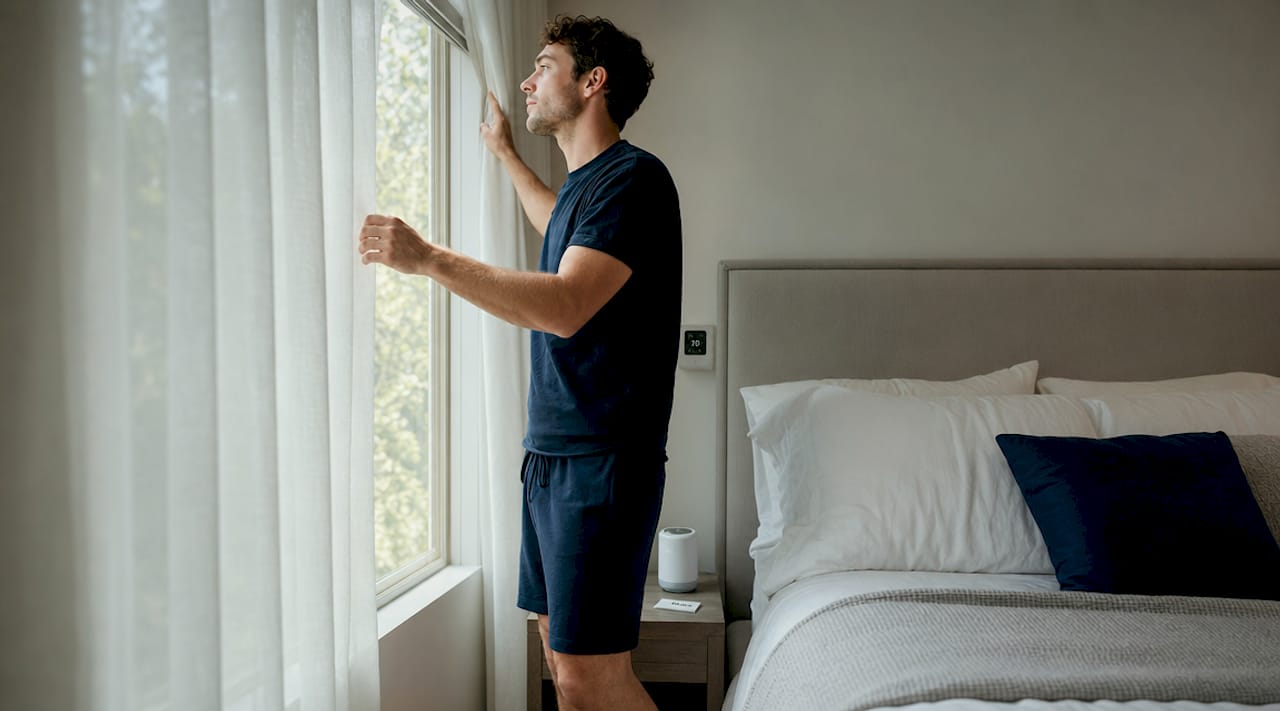
The ideal bedroom temperature sits between 60 and 72 degrees Fahrenheit, according to Cleveland Clinic. A cooler room supports the natural drop in core body temperature that triggers sleep onset. Even one or two degrees above that range can fragment sleep without you realizing it.
| Environmental factor |
Optimal condition |
Common mistake |
| Temperature |
60 to 72°F |
Sleeping too warm due to heavy bedding |
| Light |
Complete darkness |
Streetlights or standby device lights |
| Noise |
Below 30 decibels or masked |
Inconsistent ambient noise |
| Bedroom use |
Sleep and intimacy only |
Working, scrolling, or watching TV in bed |
Darkness deserves more attention than most people give it. A contoured blackout sleep mask or blackout curtains block the ambient light that suppresses melatonin even through closed eyelids. If you live in an urban area or travel frequently, this single change can produce noticeable results within the first night.
Noise is trickier because it is not volume alone that disrupts sleep. Sudden changes in sound, like a car alarm or a door closing, are what pull you out of deep sleep stages. A white noise machine or a fan creates a consistent acoustic baseline that masks those spikes.
Pro Tip: Reserve your bed strictly for sleep and intimacy. When you work or scroll in bed, your brain stops associating it with rest. That mental re-association alone can reduce the time it takes to fall asleep.
3. What wind-down routines help you fall asleep faster?
A 30 to 60 minute wind-down routine before bed is one of the most consistently recommended practices across sleep medicine. The body does not switch off like a light. It needs a transition period, and the activities you choose during that window either support or sabotage that process.
Here is a wind-down sequence that works with your biology, not against it:
-
Dim your lights one hour before bed. Lower light exposure triggers melatonin release. Melatonin is released about four hours before sleep onset and is suppressed by artificial light and screens. Dimming your environment earlier gives that process a head start.
-
Take a warm shower or bath 60 to 90 minutes before sleep. This sounds counterintuitive, but warm baths trigger a rapid drop in body temperature after you step out, which signals the brain to initiate sleep. The effect is measurable and well-documented.
-
Journal your next-day action steps. Writing tomorrow’s to-do list before bed clears cognitive load without triggering problem-solving arousal. This is not a gratitude journal. It is a brain dump of unfinished tasks so your mind stops rehearsing them.
-
Read physical print or an e-ink device. A paperback or a Kindle Paperwhite produces no blue light and requires no notifications. Twenty minutes of reading lowers heart rate and shifts attention away from the day’s stressors.
-
Try gentle yoga or progressive muscle relaxation. Slow, deliberate movement activates the parasympathetic nervous system. Apps like Insight Timer offer guided sessions under ten minutes that are specifically designed for pre-sleep use.
-
Avoid screens in the final 30 minutes. Blue light from phones, tablets, and laptops suppresses melatonin production and delays sleep readiness. If you must use a screen, enable a blue light filter and lower brightness to the minimum.
On the topic of melatonin supplements: they are worth understanding carefully. Melatonin supplements are unregulated by the FDA, and dosage accuracy varies widely between brands. If you want to support your body’s own melatonin production rather than supplement it externally, the approach Checkedoutwellness takes is worth exploring. Their transdermal patches deliver cofactors like magnesium, B6, and GABA that support the tryptophan-to-serotonin-to-melatonin conversion pathway your body already uses. You can read more about natural sleep enhancement methods if that approach resonates with you.
4. What should you do if you cannot fall asleep within 20 minutes?
Lying in bed unable to sleep is one of the fastest ways to train your brain to associate the bedroom with frustration. The 20-minute guideline from MedlinePlus is clear: if you are not asleep within 20 minutes, get up.
Follow these steps when it happens:
-
Leave the bedroom. Go to a dim, quiet room and do something low-stimulation: read a physical book, listen to a calm podcast, or practice slow breathing.
-
Avoid checking the clock. Clock-watching activates performance anxiety around sleep, which raises cortisol and makes falling asleep harder. Turn clocks away or remove them from the bedroom entirely.
-
Return only when sleepy. Not tired. Sleepy. There is a difference. Tired is a general sense of fatigue. Sleepy is the physical sensation of eyes closing and attention drifting.
-
Do not compensate the next morning. Sleeping in after a bad night feels logical but disrupts the following night. Hold your wake time and let sleep pressure rebuild naturally.
If this pattern repeats more than three nights per week for several weeks, that is a signal to consult a sleep specialist. Cognitive Behavioral Therapy for Insomnia, known as CBT-I, is the gold-standard treatment for chronic sleep onset issues and outperforms medication in long-term outcomes.
Pro Tip: Keep a notepad by your bed. If your mind races with thoughts when you lie down, write them out immediately rather than trying to suppress them. Suppression increases arousal. Externalizing the thought onto paper reduces it.
Key takeaways
Consistent sleep quality depends on foundational habits, a controlled environment, and a deliberate wind-down routine practiced before complex interventions or supplements are introduced.
| Point |
Details |
| Prioritize a fixed wake time |
A consistent wake time regulates your circadian rhythm faster than any other single change. |
| Control your sleep environment |
Keep your bedroom between 60 and 72°F, fully dark, and free from screens and work. |
| Build a wind-down routine |
A 30 to 60 minute pre-sleep routine including dim light, journaling, and no screens signals the body to prepare for sleep. |
| Use the 20-minute rule |
If you cannot fall asleep within 20 minutes, leave the bedroom to avoid training your brain to associate bed with wakefulness. |
| Support natural melatonin production |
Reduce artificial light exposure in the evening and consider cofactor-based support rather than synthetic melatonin supplements. |
What I have learned after years of studying sleep habits
By Geeta
The most common mistake I see is people trying to fix everything at once. They buy a new mattress, download a meditation app, cut caffeine, and start a supplement protocol in the same week. Then, when sleep does not improve immediately, they conclude that none of it works. The body keeps score quietly, and change in sleep patterns takes time to consolidate.
My honest experience is that foundational habits come first. A consistent wake time and a dark, cool bedroom will do more for most people than any supplement or device. Once those are locked in, layering a wind-down routine produces compounding results. The science-backed sleep improvement steps that actually move the needle are rarely the dramatic ones.
What I find most underappreciated is the role of cognitive arousal at bedtime. Most sleep problems are not physiological. They are mental. The racing thoughts, the replaying of conversations, the anticipatory anxiety about tomorrow. Addressing that layer through journaling, progressive relaxation, or CBT-I techniques often resolves what supplements and gadgets cannot. Start simple. Stay consistent. Give your body the time it needs to relearn what rest feels like.
— Geeta
How Checkedoutwellness supports your sleep wellness routine
Good habits are the foundation. The right tools make them easier to sustain.

Checkedoutwellness was built for people who take sleep as seriously as their nutrition and training. Their natural sleep patch delivers magnesium, B6, B12, and GABA transdermally overnight, supporting your body’s own melatonin pathway without synthetic additives or dependency risk. Manufactured in South Korea under ISO 22716 GMP pharmaceutical standards, every product is designed to complement the habits you are already building. If you want to go further, the Sleep Duo bundle pairs the sleep patch with mouth tape for enhanced overnight recovery. Explore the full range at Checkedoutwellness and find what fits your routine.
FAQ
How many hours of sleep do adults actually need?
Adults generally need 7 to 8 hours of sleep per night, though quality and consistency matter as much as duration. Fragmented sleep across eight hours is less restorative than consolidated sleep across seven.
What is the best bedroom temperature for sleep?
The optimal range is 60 to 72 degrees Fahrenheit, according to Cleveland Clinic. A cooler room supports the natural drop in core body temperature that initiates and maintains deep sleep.
Does melatonin actually help with sleep?
Melatonin supplements can help with circadian rhythm disruptions like jet lag, but they are unregulated by the FDA and vary widely in dosage accuracy. Supporting your body’s own melatonin production through light management and cofactor nutrition is a more reliable long-term approach.
What should I do if I wake up in the middle of the night?
If you cannot return to sleep within 20 minutes, leave the bedroom and do a quiet, low-stimulation activity in dim light. Avoid screens and clock-watching, then return to bed only when you feel genuinely sleepy.
How long does it take for new sleep habits to work?
Most people notice measurable improvement in sleep onset and quality within two to four weeks of consistently applying foundational changes like a fixed wake time, a cooler bedroom, and a screen-free wind-down routine. Consistency is the variable that determines the outcome.
Recommended

Sleep Wellness Tips That Actually Work in 2026
Sleep wellness tips are practical habits and environmental adjustments that improve sleep quality, help manage sleep disruptions, and support overall physical and mental health. Most people focus on hours slept, but sleep quality and regularity matter more than raw duration. Experts at Mayo Clinic, Johns Hopkins Medicine, and Cleveland Clinic consistently point to the same foundational practices: consistent schedules, controlled environments, and deliberate wind-down routines. If you have been chasing better sleep without a clear system, this guide gives you one.
1. What are the top daily habits to improve sleep quality?
The single most impactful daily habit is a fixed wake time, seven days a week. Adults need 7 to 8 hours of sleep per night, and a consistent wake time is the most reliable way to regulate your circadian rhythm. Sleeping in on weekends feels restorative but actually shifts your internal clock, making Monday mornings harder than they need to be.
Here are the daily behaviors that move the needle most:
Pro Tip: Set your wake alarm and a “wind-down alarm” 60 minutes before bed. The second alarm is the one that actually changes your sleep.
2. How to create an optimal sleep environment for wellness
Your bedroom is either working for your sleep or against it. Most bedrooms fail on at least two of the four critical variables: temperature, light, noise, and mental association.
The ideal bedroom temperature sits between 60 and 72 degrees Fahrenheit, according to Cleveland Clinic. A cooler room supports the natural drop in core body temperature that triggers sleep onset. Even one or two degrees above that range can fragment sleep without you realizing it.
Darkness deserves more attention than most people give it. A contoured blackout sleep mask or blackout curtains block the ambient light that suppresses melatonin even through closed eyelids. If you live in an urban area or travel frequently, this single change can produce noticeable results within the first night.
Noise is trickier because it is not volume alone that disrupts sleep. Sudden changes in sound, like a car alarm or a door closing, are what pull you out of deep sleep stages. A white noise machine or a fan creates a consistent acoustic baseline that masks those spikes.
Pro Tip: Reserve your bed strictly for sleep and intimacy. When you work or scroll in bed, your brain stops associating it with rest. That mental re-association alone can reduce the time it takes to fall asleep.
3. What wind-down routines help you fall asleep faster?
A 30 to 60 minute wind-down routine before bed is one of the most consistently recommended practices across sleep medicine. The body does not switch off like a light. It needs a transition period, and the activities you choose during that window either support or sabotage that process.
Here is a wind-down sequence that works with your biology, not against it:
On the topic of melatonin supplements: they are worth understanding carefully. Melatonin supplements are unregulated by the FDA, and dosage accuracy varies widely between brands. If you want to support your body’s own melatonin production rather than supplement it externally, the approach Checkedoutwellness takes is worth exploring. Their transdermal patches deliver cofactors like magnesium, B6, and GABA that support the tryptophan-to-serotonin-to-melatonin conversion pathway your body already uses. You can read more about natural sleep enhancement methods if that approach resonates with you.
4. What should you do if you cannot fall asleep within 20 minutes?
Lying in bed unable to sleep is one of the fastest ways to train your brain to associate the bedroom with frustration. The 20-minute guideline from MedlinePlus is clear: if you are not asleep within 20 minutes, get up.
Follow these steps when it happens:
If this pattern repeats more than three nights per week for several weeks, that is a signal to consult a sleep specialist. Cognitive Behavioral Therapy for Insomnia, known as CBT-I, is the gold-standard treatment for chronic sleep onset issues and outperforms medication in long-term outcomes.
Pro Tip: Keep a notepad by your bed. If your mind races with thoughts when you lie down, write them out immediately rather than trying to suppress them. Suppression increases arousal. Externalizing the thought onto paper reduces it.
Key takeaways
Consistent sleep quality depends on foundational habits, a controlled environment, and a deliberate wind-down routine practiced before complex interventions or supplements are introduced.
What I have learned after years of studying sleep habits
By Geeta
The most common mistake I see is people trying to fix everything at once. They buy a new mattress, download a meditation app, cut caffeine, and start a supplement protocol in the same week. Then, when sleep does not improve immediately, they conclude that none of it works. The body keeps score quietly, and change in sleep patterns takes time to consolidate.
My honest experience is that foundational habits come first. A consistent wake time and a dark, cool bedroom will do more for most people than any supplement or device. Once those are locked in, layering a wind-down routine produces compounding results. The science-backed sleep improvement steps that actually move the needle are rarely the dramatic ones.
What I find most underappreciated is the role of cognitive arousal at bedtime. Most sleep problems are not physiological. They are mental. The racing thoughts, the replaying of conversations, the anticipatory anxiety about tomorrow. Addressing that layer through journaling, progressive relaxation, or CBT-I techniques often resolves what supplements and gadgets cannot. Start simple. Stay consistent. Give your body the time it needs to relearn what rest feels like.
How Checkedoutwellness supports your sleep wellness routine
Good habits are the foundation. The right tools make them easier to sustain.
Checkedoutwellness was built for people who take sleep as seriously as their nutrition and training. Their natural sleep patch delivers magnesium, B6, B12, and GABA transdermally overnight, supporting your body’s own melatonin pathway without synthetic additives or dependency risk. Manufactured in South Korea under ISO 22716 GMP pharmaceutical standards, every product is designed to complement the habits you are already building. If you want to go further, the Sleep Duo bundle pairs the sleep patch with mouth tape for enhanced overnight recovery. Explore the full range at Checkedoutwellness and find what fits your routine.
FAQ
How many hours of sleep do adults actually need?
Adults generally need 7 to 8 hours of sleep per night, though quality and consistency matter as much as duration. Fragmented sleep across eight hours is less restorative than consolidated sleep across seven.
What is the best bedroom temperature for sleep?
The optimal range is 60 to 72 degrees Fahrenheit, according to Cleveland Clinic. A cooler room supports the natural drop in core body temperature that initiates and maintains deep sleep.
Does melatonin actually help with sleep?
Melatonin supplements can help with circadian rhythm disruptions like jet lag, but they are unregulated by the FDA and vary widely in dosage accuracy. Supporting your body’s own melatonin production through light management and cofactor nutrition is a more reliable long-term approach.
What should I do if I wake up in the middle of the night?
If you cannot return to sleep within 20 minutes, leave the bedroom and do a quiet, low-stimulation activity in dim light. Avoid screens and clock-watching, then return to bed only when you feel genuinely sleepy.
How long does it take for new sleep habits to work?
Most people notice measurable improvement in sleep onset and quality within two to four weeks of consistently applying foundational changes like a fixed wake time, a cooler bedroom, and a screen-free wind-down routine. Consistency is the variable that determines the outcome.
Recommended