You’ve probably stood in a wellness aisle — or more likely, scrolled past hundreds of product pages at midnight — wondering which sleep product is actually worth it. Knowing how to choose sleep wellness products is genuinely hard right now. The market is flooded with options, the marketing is polished, and the science behind many products is quietly absent. This guide cuts through that. You will walk away knowing exactly what to look for, what to skip, and how to build a sleep setup that matches your body, your bedroom, and your biology.
Table of Contents
Key takeaways
| Point |
Details |
| Assess your sleep profile first |
Identify your sleep position, core issues, and environment before buying anything. |
| Match products to physiology |
Mattress firmness and pillow loft should align with sleep position and body weight, not brand popularity. |
| Prioritize environment over supplements |
Light, temperature, and sensory controls deliver measurable results with less risk than unverified supplements. |
| Verify certifications and trial policies |
Third-party testing and generous return windows protect you from wasted money and unsafe products. |
| Combine small interventions |
Layering sleep masks, temperature control, and targeted supplements produces better results than any single product. |
How to choose sleep wellness products: start with your sleep profile
Before you spend a dollar, get honest about what is actually disrupting your sleep. This step gets skipped constantly, and it is the reason most people end up with a drawer full of supplements they used twice.
Map your personal sleep patterns
Start by identifying your primary sleep position. Do you sleep on your side, back, or stomach? Do you switch throughout the night? This single factor will determine the correct mattress firmness and pillow loft more reliably than any brand recommendation. Beyond position, think about your most common complaints.
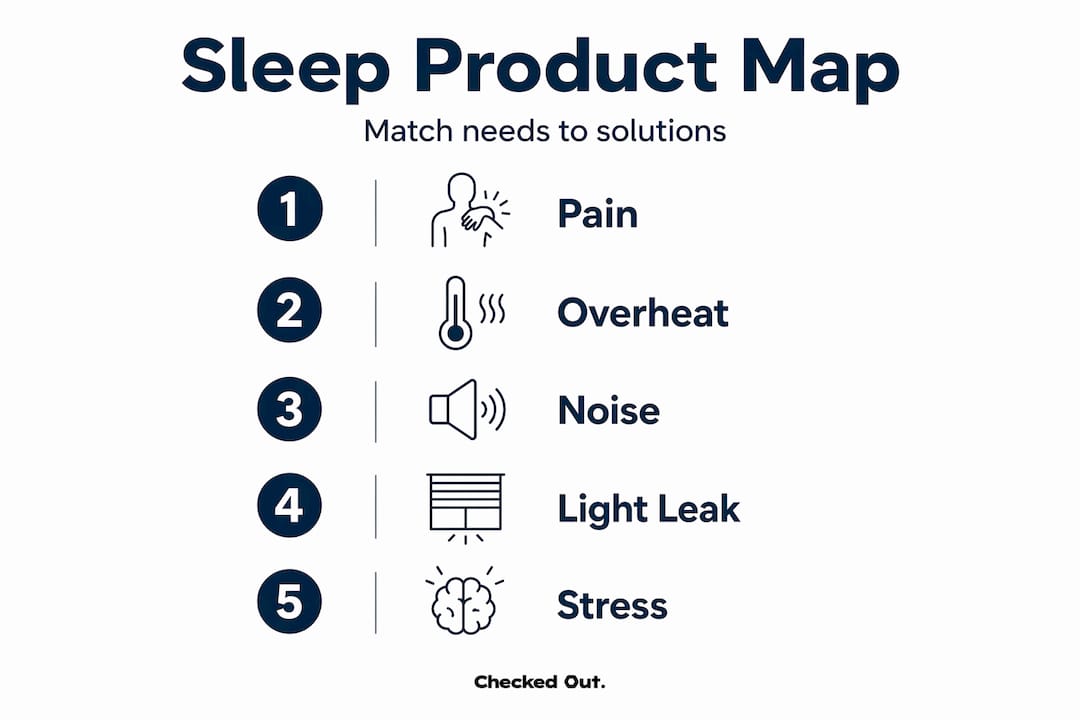
- Do you wake up stiff or in pain?
- Do you overheat during the night?
- Do you struggle to fall asleep, stay asleep, or both?
- Is your room too bright, too loud, or both?
Each complaint maps to a specific product category. Pain and stiffness point to mattress and pillow alignment. Overheating points to bedding materials and room temperature. Difficulty falling asleep often traces back to light exposure, circadian disruption, or mineral deficiencies. Staying asleep problems can involve environment, anxiety, or breathing patterns.
Understanding your bedroom environment
Your bedroom is a biological signal. The environment you sleep in tells your nervous system whether it is safe to drop into deep, restorative sleep or stay on alert. Bedroom temperature, lighting, and routines are not soft lifestyle choices. They are physiological levers.
| Product category |
Primary sleep problem it addresses |
| Mattress and topper |
Spinal misalignment, pressure pain, overheating |
| Pillow |
Cervical strain, neck and shoulder pain |
| Weighted blanket |
Anxiety, light sleeping, restlessness |
| Sleep mask |
Light intrusion, early waking, travel disruption |
| Mouth tape |
Mouth breathing, snoring, dry throat |
| Magnesium supplement |
Difficulty falling asleep, poor deep sleep |
| White noise machine |
Noise sensitivity, fragmented sleep |
Pro Tip: Keep a simple sleep log for five to seven nights before buying anything. Note your wake time, sleep time, how rested you feel, and any disruptions. Patterns reveal the real problem faster than any quiz.
Choosing core sleep products: mattress, pillows, and bedding
These are the non-negotiables. Getting your foundational sleep surface wrong means no supplementary product will fully compensate.
Matching mattress firmness to your body
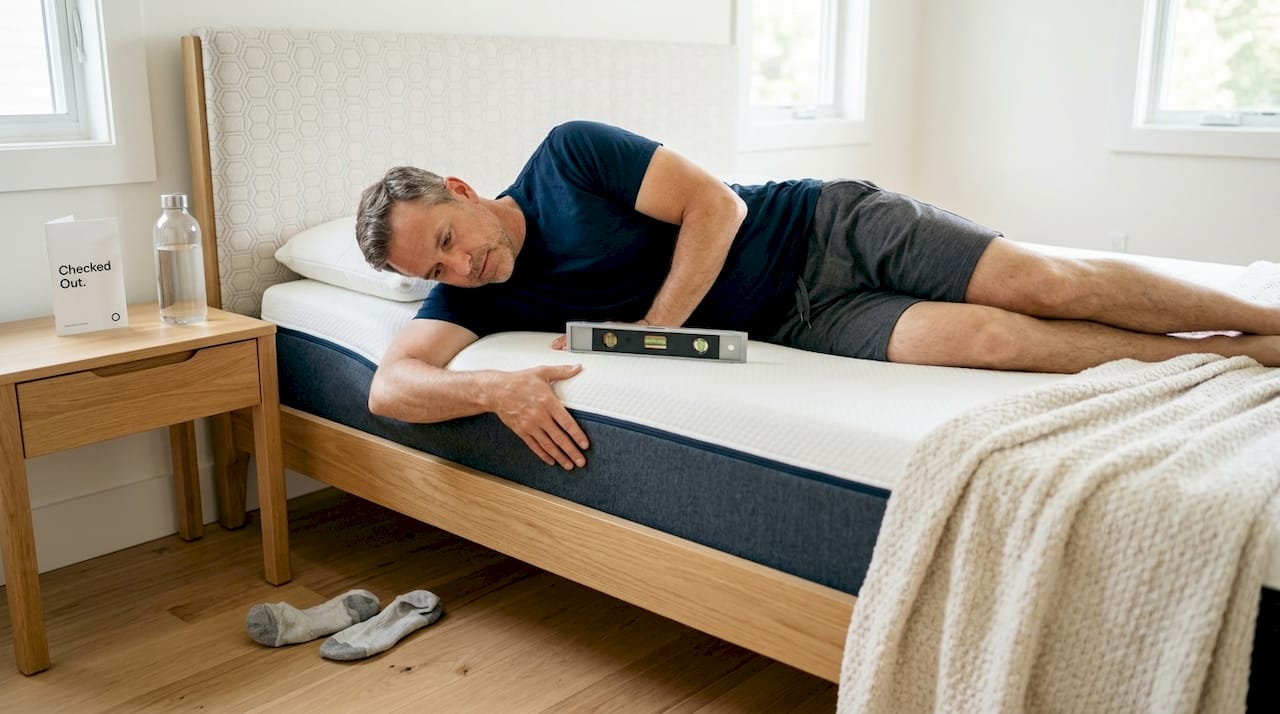
Medium-firm mattresses offer the strongest evidence-backed support for most adults. A randomized clinical trial found they reduced low-back pain and improved disability scores at 90 days compared to very firm options. That said, medium-firm is not universal. A lighter person who sleeps on their side needs a softer surface to allow hip and shoulder pressure relief. A heavier back sleeper needs firmer support to prevent spinal sag.
Spinal alignment is the non-negotiable factor. Your spine should maintain its natural curve whether you’re on your side or back. If you wake with lower back pain on a mattress, it is usually too firm. If you wake with mid-back aching and feel like you are sinking, it is too soft.
Pillow loft and material selection
Side sleepers need higher loft pillows. The gap between your head and the mattress is wider on your side, so a thicker pillow keeps your cervical spine neutral. Stomach sleepers need a very thin pillow or none at all. A standard pillow under a stomach sleeper’s head creates hyperextension in the neck over hours. Back sleepers do best with medium loft.
Material choices involve real tradeoffs:
-
Memory foam contours closely and reduces pressure but retains heat. Look for gel-infused or open-cell foam if you sleep warm.
-
Latex is naturally cooling, responsive, and durable. It is a strong choice for combination sleepers who change positions.
-
Down and down alternative are soft and lightweight but may not offer enough cervical support for side sleepers.
-
Buckwheat is fully adjustable and stays cool but feels firmer and can be noisy.
What certifications actually matter
Look for CertiPUR-US on foam products, GOTS or OEKO-TEX on textiles, and GREENGUARD Gold for overall chemical emission safety. These are independent third-party certifications, not marketing claims. Always check the trial and warranty policy before committing. A mattress without a minimum 90-night trial gives you no real way to assess long-term fit.
Pro Tip: If you share a bed with someone who has a different sleep profile, consider a split-firmness option or a mattress topper on one side. Compromise mattresses often serve no one well.
Supplementary sleep wellness products that actually make a difference
Once your sleep surface is right, supplementary products can meaningfully deepen your sleep quality. The key is choosing them based on evidence, not wellness trend cycles.
Natural supplements: what works and what needs caution
Magnesium glycinate has the most consistent evidence among sleep supplements. A randomized double-blind crossover trial showed oral magnesium increased sleep duration and deep sleep versus placebo. The glycinate form is gentler on digestion and crosses the blood-brain barrier more effectively than cheaper oxide forms. It supports the tryptophan-to-serotonin-to-melatonin conversion pathway your body runs every night.
Herbal options like valerian are a different story. The NCCIH states valerian is not a proven treatment and carries real safety considerations for children and pregnant women. Beyond valerian, the broader supplement category has a serious safety problem. The FDA has flagged over 1,000 sleep aid products containing unapproved or unsafe ingredients. Any sleep supplement you consider should have third-party testing documentation. If that documentation does not exist, move on.
A note on synthetic melatonin: Many consumers default to melatonin supplements without realizing that supporting the body’s own melatonin production through cofactors like magnesium, B6, and GABA tends to produce more natural, sustained sleep without the morning grogginess that high-dose synthetic melatonin can create. Check the science behind any sleep support product before you assume melatonin is the only path.
Sleep masks, blackout curtains, and light control
Light exposure is the primary driver of circadian rhythm. Even low-level ambient light through closed eyelids can suppress melatonin production and delay sleep onset. A contoured blackout sleep mask addresses this without requiring you to black out an entire room. They are especially effective for light sleepers, shift workers, and frequent travelers.
When choosing a sleep mask for light control, prioritize contoured designs that do not press on the eyelids. Flat masks create pressure on the eyes during REM movement and can cause fragmented sleep. Look for breathable, skin-safe materials and an adjustable strap that does not create pressure points around the ears or back of the head.
Weighted blankets and temperature management
Weighted blankets show real promise for reducing insomnia symptoms. A pilot trial randomizing 102 adults with clinical insomnia found significant improvements on the Pittsburgh Sleep Quality Index in the weighted blanket group. The mechanism is deep pressure stimulation, which activates the parasympathetic nervous system.
Temperature management is equally important. Bedroom temperature between 60 and 67 degrees Fahrenheit is consistently recommended for optimal sleep quality. Your core body temperature naturally drops as you enter sleep, and a cooler room supports that process. If you cannot control room temperature, cooling mattress toppers and moisture-wicking bedding are effective alternatives.
One surprisingly accessible fix: wearing socks to bed can help you fall asleep 7.5 minutes faster and extend total sleep time by 32 minutes. Warm feet dilate peripheral blood vessels, which accelerates the core body temperature drop that triggers sleep onset. It costs nothing and works.
Pro Tip: Natural sleep aids work best in combination with environmental adjustments. A magnesium supplement taken without addressing a bright, warm bedroom will underperform consistently.
A decision-making workflow for smarter product choices
Now that you understand the categories, here is a process that actually produces results rather than a recycled product list.
-
Define your top two sleep complaints. Pick the two problems that affect you most nights. These become your purchasing priorities. Everything else is secondary.
-
Map each complaint to a product category. Use the table from the first section. Pain points to mattress and pillow. Light points to masks or blackout solutions. Anxiety and restlessness point to weighted blankets or magnesium.
-
Set a budget by category, not total. A cheap mattress is expensive when it wrecks your sleep for years. Spend where it matters most. Supplementary products can be modest.
-
Verify certifications and trial policies before purchase. No trial period, no sale. A product that cannot stand behind a 30 to 90 night window is not confident in its own performance.
-
Test one major change at a time. If you change your mattress, pillow, and start three new supplements simultaneously, you will not know what worked. Space out introductions by at least two weeks.
-
Track outcomes, not feelings. Use a simple sleep log or a wearable tracker. Look for changes in time to fall asleep, number of wake events, and how you feel at 90 minutes after waking. Feelings right at waking can be misleading.
-
Reassess at 30 and 90 days. Your sleep needs change with seasons, stress load, age, and health status. What works at 35 may need adjustment at 45.
Pro Tip: Avoid choosing products based on brand popularity alone. Matching firmness and loft to your physiology consistently outperforms brand loyalty in sleep outcomes.
My honest take on sleep product selection
I have watched a lot of high performers go deep into the sleep optimization rabbit hole, buying thousand-dollar gadgets and stacking supplements, and still waking up exhausted. Here is what I have learned.
The body keeps score quietly. You can throw money at a sleep problem without ever asking why the problem exists. Most people do not need the most expensive mattress or the most exotic supplement stack. They need the right mattress firmness for how they actually sleep, a bedroom that is dark and cool enough, and maybe one or two targeted supplements that support what their body is already trying to do.
What I have seen work consistently is combination thinking. Not one silver bullet, but several small, well-chosen interventions layered together. A contoured sleep mask plus a cooler room plus magnesium glycinate before bed beats any single premium product used alone. The math is simple: each small fix removes one friction point that would otherwise interrupt sleep.
The piece that frustrates me most is how aggressively unverified supplements get marketed. People buy them out of desperation, get inconsistent results, and then conclude that “natural sleep aids don’t work.” That is the wrong conclusion. The right conclusion is that unverified, underdosed, or poorly formulated products do not work. Products built on actual science, manufactured to pharmaceutical standards, and transparent about ingredients absolutely can work. The difference is due diligence.
If you take one thing from my perspective: focus on alignment and environment before supplements. Get the physical setup right first. Then use targeted, evidence-backed supplements to fill the remaining gaps. And always, always read what is actually in what you are taking.
— Geeta

If this guide has shown you anything, it is that smart sleep product selection comes down to science, specificity, and transparency. Checkedoutwellness was built on exactly those principles. The brand’s natural sleep patches are manufactured in South Korea to ISO 22716 GMP pharmaceutical standards and deliver magnesium, B6, B12, and GABA transdermally, supporting your body’s own melatonin production rather than overriding it with synthetic doses. The contoured blackout sleep mask is designed to block light without pressing on the eyes. For those ready to address multiple sleep disruptors at once, the Sleep Duo bundle combines the sleep patch with mouth tape for comprehensive overnight recovery support. Every product is cruelty-free, additive-free, and backed by the science behind the formulations.
FAQ
What should I look for in sleep wellness products?
Look for products with third-party testing certifications, clear ingredient transparency, and trial or return policies. Match each product to a specific sleep complaint rather than buying broadly.
Are natural sleep supplements safe to use every night?
It depends on the supplement and its formulation. Magnesium glycinate is generally safe for nightly use and has strong evidence for improving sleep duration and deep sleep. Herbal supplements like valerian lack consistent efficacy data and carry safety considerations for some populations.
How do I know if a sleep product is actually working?
Track objective markers: time to fall asleep, number of nighttime wake events, and how alert you feel 90 minutes after waking. Use a sleep log or wearable tracker and assess after 30 and 90 days of consistent use.
Does bedroom temperature really affect sleep quality?
Yes, significantly. Research supports keeping your room between 60 and 67 degrees Fahrenheit to align with your body’s natural overnight temperature drop. Even a few degrees warmer can fragment sleep without you realizing the cause.
How do I improve sleep without relying on melatonin?
Support your body’s own melatonin production by controlling light exposure in the evening, maintaining a consistent sleep schedule, and using cofactor supplements like magnesium and B6. You can also explore naturally improving sleep quality through environmental and behavioral changes that work alongside your circadian biology rather than bypassing it.
Recommended

How to Choose Sleep Wellness Products That Work
You’ve probably stood in a wellness aisle — or more likely, scrolled past hundreds of product pages at midnight — wondering which sleep product is actually worth it. Knowing how to choose sleep wellness products is genuinely hard right now. The market is flooded with options, the marketing is polished, and the science behind many products is quietly absent. This guide cuts through that. You will walk away knowing exactly what to look for, what to skip, and how to build a sleep setup that matches your body, your bedroom, and your biology.
Table of Contents
Key takeaways
How to choose sleep wellness products: start with your sleep profile
Before you spend a dollar, get honest about what is actually disrupting your sleep. This step gets skipped constantly, and it is the reason most people end up with a drawer full of supplements they used twice.
Map your personal sleep patterns
Start by identifying your primary sleep position. Do you sleep on your side, back, or stomach? Do you switch throughout the night? This single factor will determine the correct mattress firmness and pillow loft more reliably than any brand recommendation. Beyond position, think about your most common complaints.
Each complaint maps to a specific product category. Pain and stiffness point to mattress and pillow alignment. Overheating points to bedding materials and room temperature. Difficulty falling asleep often traces back to light exposure, circadian disruption, or mineral deficiencies. Staying asleep problems can involve environment, anxiety, or breathing patterns.
Understanding your bedroom environment
Your bedroom is a biological signal. The environment you sleep in tells your nervous system whether it is safe to drop into deep, restorative sleep or stay on alert. Bedroom temperature, lighting, and routines are not soft lifestyle choices. They are physiological levers.
Pro Tip: Keep a simple sleep log for five to seven nights before buying anything. Note your wake time, sleep time, how rested you feel, and any disruptions. Patterns reveal the real problem faster than any quiz.
Choosing core sleep products: mattress, pillows, and bedding
These are the non-negotiables. Getting your foundational sleep surface wrong means no supplementary product will fully compensate.
Matching mattress firmness to your body
Medium-firm mattresses offer the strongest evidence-backed support for most adults. A randomized clinical trial found they reduced low-back pain and improved disability scores at 90 days compared to very firm options. That said, medium-firm is not universal. A lighter person who sleeps on their side needs a softer surface to allow hip and shoulder pressure relief. A heavier back sleeper needs firmer support to prevent spinal sag.
Spinal alignment is the non-negotiable factor. Your spine should maintain its natural curve whether you’re on your side or back. If you wake with lower back pain on a mattress, it is usually too firm. If you wake with mid-back aching and feel like you are sinking, it is too soft.
Pillow loft and material selection
Side sleepers need higher loft pillows. The gap between your head and the mattress is wider on your side, so a thicker pillow keeps your cervical spine neutral. Stomach sleepers need a very thin pillow or none at all. A standard pillow under a stomach sleeper’s head creates hyperextension in the neck over hours. Back sleepers do best with medium loft.
Material choices involve real tradeoffs:
What certifications actually matter
Look for CertiPUR-US on foam products, GOTS or OEKO-TEX on textiles, and GREENGUARD Gold for overall chemical emission safety. These are independent third-party certifications, not marketing claims. Always check the trial and warranty policy before committing. A mattress without a minimum 90-night trial gives you no real way to assess long-term fit.
Pro Tip: If you share a bed with someone who has a different sleep profile, consider a split-firmness option or a mattress topper on one side. Compromise mattresses often serve no one well.
Supplementary sleep wellness products that actually make a difference
Once your sleep surface is right, supplementary products can meaningfully deepen your sleep quality. The key is choosing them based on evidence, not wellness trend cycles.
Natural supplements: what works and what needs caution
Magnesium glycinate has the most consistent evidence among sleep supplements. A randomized double-blind crossover trial showed oral magnesium increased sleep duration and deep sleep versus placebo. The glycinate form is gentler on digestion and crosses the blood-brain barrier more effectively than cheaper oxide forms. It supports the tryptophan-to-serotonin-to-melatonin conversion pathway your body runs every night.
Herbal options like valerian are a different story. The NCCIH states valerian is not a proven treatment and carries real safety considerations for children and pregnant women. Beyond valerian, the broader supplement category has a serious safety problem. The FDA has flagged over 1,000 sleep aid products containing unapproved or unsafe ingredients. Any sleep supplement you consider should have third-party testing documentation. If that documentation does not exist, move on.
Sleep masks, blackout curtains, and light control
Light exposure is the primary driver of circadian rhythm. Even low-level ambient light through closed eyelids can suppress melatonin production and delay sleep onset. A contoured blackout sleep mask addresses this without requiring you to black out an entire room. They are especially effective for light sleepers, shift workers, and frequent travelers.
When choosing a sleep mask for light control, prioritize contoured designs that do not press on the eyelids. Flat masks create pressure on the eyes during REM movement and can cause fragmented sleep. Look for breathable, skin-safe materials and an adjustable strap that does not create pressure points around the ears or back of the head.
Weighted blankets and temperature management
Weighted blankets show real promise for reducing insomnia symptoms. A pilot trial randomizing 102 adults with clinical insomnia found significant improvements on the Pittsburgh Sleep Quality Index in the weighted blanket group. The mechanism is deep pressure stimulation, which activates the parasympathetic nervous system.
Temperature management is equally important. Bedroom temperature between 60 and 67 degrees Fahrenheit is consistently recommended for optimal sleep quality. Your core body temperature naturally drops as you enter sleep, and a cooler room supports that process. If you cannot control room temperature, cooling mattress toppers and moisture-wicking bedding are effective alternatives.
One surprisingly accessible fix: wearing socks to bed can help you fall asleep 7.5 minutes faster and extend total sleep time by 32 minutes. Warm feet dilate peripheral blood vessels, which accelerates the core body temperature drop that triggers sleep onset. It costs nothing and works.
Pro Tip: Natural sleep aids work best in combination with environmental adjustments. A magnesium supplement taken without addressing a bright, warm bedroom will underperform consistently.
A decision-making workflow for smarter product choices
Now that you understand the categories, here is a process that actually produces results rather than a recycled product list.
Pro Tip: Avoid choosing products based on brand popularity alone. Matching firmness and loft to your physiology consistently outperforms brand loyalty in sleep outcomes.
My honest take on sleep product selection
I have watched a lot of high performers go deep into the sleep optimization rabbit hole, buying thousand-dollar gadgets and stacking supplements, and still waking up exhausted. Here is what I have learned.
The body keeps score quietly. You can throw money at a sleep problem without ever asking why the problem exists. Most people do not need the most expensive mattress or the most exotic supplement stack. They need the right mattress firmness for how they actually sleep, a bedroom that is dark and cool enough, and maybe one or two targeted supplements that support what their body is already trying to do.
What I have seen work consistently is combination thinking. Not one silver bullet, but several small, well-chosen interventions layered together. A contoured sleep mask plus a cooler room plus magnesium glycinate before bed beats any single premium product used alone. The math is simple: each small fix removes one friction point that would otherwise interrupt sleep.
The piece that frustrates me most is how aggressively unverified supplements get marketed. People buy them out of desperation, get inconsistent results, and then conclude that “natural sleep aids don’t work.” That is the wrong conclusion. The right conclusion is that unverified, underdosed, or poorly formulated products do not work. Products built on actual science, manufactured to pharmaceutical standards, and transparent about ingredients absolutely can work. The difference is due diligence.
If you take one thing from my perspective: focus on alignment and environment before supplements. Get the physical setup right first. Then use targeted, evidence-backed supplements to fill the remaining gaps. And always, always read what is actually in what you are taking.
What Checkedoutwellness offers for your sleep toolkit
If this guide has shown you anything, it is that smart sleep product selection comes down to science, specificity, and transparency. Checkedoutwellness was built on exactly those principles. The brand’s natural sleep patches are manufactured in South Korea to ISO 22716 GMP pharmaceutical standards and deliver magnesium, B6, B12, and GABA transdermally, supporting your body’s own melatonin production rather than overriding it with synthetic doses. The contoured blackout sleep mask is designed to block light without pressing on the eyes. For those ready to address multiple sleep disruptors at once, the Sleep Duo bundle combines the sleep patch with mouth tape for comprehensive overnight recovery support. Every product is cruelty-free, additive-free, and backed by the science behind the formulations.
FAQ
What should I look for in sleep wellness products?
Look for products with third-party testing certifications, clear ingredient transparency, and trial or return policies. Match each product to a specific sleep complaint rather than buying broadly.
Are natural sleep supplements safe to use every night?
It depends on the supplement and its formulation. Magnesium glycinate is generally safe for nightly use and has strong evidence for improving sleep duration and deep sleep. Herbal supplements like valerian lack consistent efficacy data and carry safety considerations for some populations.
How do I know if a sleep product is actually working?
Track objective markers: time to fall asleep, number of nighttime wake events, and how alert you feel 90 minutes after waking. Use a sleep log or wearable tracker and assess after 30 and 90 days of consistent use.
Does bedroom temperature really affect sleep quality?
Yes, significantly. Research supports keeping your room between 60 and 67 degrees Fahrenheit to align with your body’s natural overnight temperature drop. Even a few degrees warmer can fragment sleep without you realizing the cause.
How do I improve sleep without relying on melatonin?
Support your body’s own melatonin production by controlling light exposure in the evening, maintaining a consistent sleep schedule, and using cofactor supplements like magnesium and B6. You can also explore naturally improving sleep quality through environmental and behavioral changes that work alongside your circadian biology rather than bypassing it.
Recommended