Sleep optimization is defined as the systematic practice of enhancing both sleep quality and quantity to maximize the body’s restorative processes, cognitive performance, and long-term health. It goes well beyond counting hours. Where basic sleep hygiene offers general rules like “avoid caffeine,” sleep optimization treats your sleep as a biological system requiring phased, evidence-based adjustments. Approximately 1 in 3 adults in industrialized nations fail to meet the recommended 7 to 9 hours per night. That gap represents not just fatigue, but compounding deficits in immune function, metabolic health, and mental clarity. Tools like the Oura Ring, light therapy lamps, and transdermal sleep patches have moved sleep improvement from guesswork into measurable science.
What is sleep optimization and how does it differ from sleep hygiene?
Sleep optimization is the recognized clinical framework for treating sleep as a complex biological system, not a passive habit. The distinction matters. Sleep hygiene is a checklist. Sleep optimization is a phased, evidence-based process that prioritizes circadian entrainment first, then layers in environment control, behavioral techniques, and supplementation in sequence.

Think of it this way: brushing your teeth is dental hygiene. Orthodontics, fluoride treatments, and bite correction are dental optimization. Both matter, but they operate at different levels of precision and intention.
The benefits of sleep optimization extend beyond feeling rested. Consistent, well-structured sleep supports cortisol regulation, tryptophan-to-serotonin-to-melatonin conversion, and cellular repair. For high performers, biohackers, and anyone serious about longevity, understanding how to optimize sleep is as foundational as nutrition or training.
What biological systems govern sleep quality?
Two interlocking systems control every aspect of your sleep. Understanding them is the first step toward meaningful improvement.
The circadian rhythm is your master 24-hour biological clock, regulated primarily by light exposure. It governs the timing of cortisol release, core body temperature, and melatonin secretion. When your circadian rhythm is well-aligned, sleep onset feels natural and wake-up feels clean.
Sleep pressure, also called the homeostatic drive, builds through the accumulation of adenosine in the brain during waking hours. The longer you are awake, the stronger the drive to sleep. These two biological processes work together to govern sleep onset, quality, and timing. When they fall out of sync, the result is fragmented sleep, early waking, or the frustrating experience of lying awake despite exhaustion.
Key consequences of circadian misalignment include:
-
Reduced slow-wave sleep, the deepest and most physically restorative stage
-
Elevated evening cortisol, which delays sleep onset and increases nighttime arousal
-
Suppressed melatonin production, particularly from artificial light exposure after sunset
-
Impaired adenosine clearance, which disrupts the natural build-up of sleep pressure
-
Increased risk of metabolic and cardiovascular dysfunction over time
The body keeps score quietly. Misalignment rarely announces itself as a dramatic crisis. It shows up as a 2 p.m. energy crash, a foggy morning, or a mood that never quite lifts. Addressing these systems directly is what separates sleep optimization from surface-level fixes.
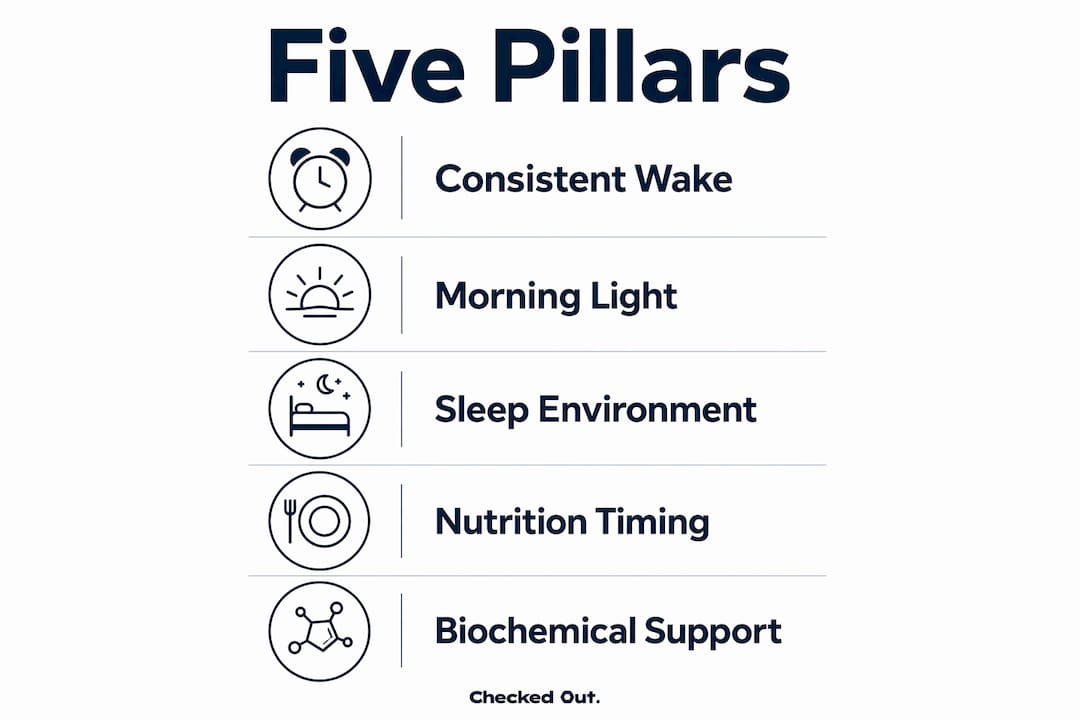
What are the five pillars of sleep optimization?
Sleep optimization is a system of five pillars working in harmony, not a collection of isolated hacks. Implementing them in sequence produces far better results than trying to change everything at once.
-
Timing. A consistent wake time anchors your circadian rhythm more powerfully than any supplement. Bright morning light exposure for 10 to 20 minutes outdoors sets your cortisol rhythm and calibrates melatonin timing for the evening ahead. This single habit is the foundation everything else builds on.
-
Environment. Your bedroom should signal one thing to your nervous system: safety and rest. Bedroom temperature between 60 and 68 degrees Fahrenheit supports the core body temperature drop that initiates deep sleep. Blackout conditions, low noise, and minimal clutter reduce arousal signals that keep the brain on alert.
-
Hygiene. Lifestyle habits in the 6 to 8 hours before bed shape sleep architecture. Caffeine’s half-life of 5 to 7 hours means an afternoon coffee is still partially active at midnight. Alcohol fragments REM sleep. Heavy meals raise core temperature. These are not minor inconveniences. They are direct inputs into your sleep biology.
-
Behavioral techniques. Cognitive Behavioral Therapy for Insomnia, known as CBT-I, produces lasting improvements in 80% of patients and outperforms sleeping pills in long-term outcomes. Relaxation protocols, stimulus control, and sleep restriction therapy are among its core tools. Meditation and body scan practices also reduce pre-sleep cognitive arousal.
-
Supplementation. Evidence-backed options include magnesium glycinate, L-theanine, and cofactors like B6 and B12 that support the body’s own melatonin production. The goal is to support natural pathways, not override them with synthetic melatonin at doses that can disrupt receptor sensitivity over time.
| Approach |
What it addresses |
Typical timeline |
| Consistent wake time |
Circadian anchor |
1 to 2 weeks |
| Environment control |
Arousal reduction |
Immediate |
| Caffeine and alcohol limits |
Sleep architecture |
3 to 7 days |
| CBT-I or relaxation |
Psychological arousal |
4 to 8 weeks |
| Targeted supplementation |
Biochemical support |
2 to 4 weeks |
Pro Tip: Establish a fixed wake time and 10 minutes of morning outdoor light for two full weeks before adding any other intervention. This gives your circadian system a stable baseline and makes every subsequent change easier to evaluate.
What practical strategies can help you optimize sleep now?
The gap between knowing and doing is where most sleep improvement efforts stall. These strategies are specific, measurable, and grounded in current research.
-
Morning light first. Step outside within 30 minutes of waking. Overcast sky still delivers 10,000 lux compared to indoor lighting at 100 to 500 lux. This single habit recalibrates your entire circadian phase.
-
Blue light management. Blue light in the 415 to 495nm range suppresses melatonin and creates a jet lag effect when exposure occurs 2 to 3 hours before bed. Use blue-light-blocking glasses, dim warm lighting, or simply put screens away after 9 p.m.
-
Temperature control. Keep your bedroom between 60 and 68°F. A warm bath 60 to 90 minutes before bed accelerates core body temperature drop, which triggers sleep onset more reliably than most supplements.
-
Strategic napping. Limit naps to 20 minutes and schedule them before 3 p.m. to preserve adenosine build-up for nighttime sleep pressure.
-
Wearable tracking. Devices like the Oura Ring and WHOOP offer 70 to 80% accuracy distinguishing sleep from wakefulness. Use them to identify trends over weeks, not to judge individual nights.
-
Mouth taping and sleep patches. Nasal breathing during sleep improves oxygen saturation and reduces nighttime arousal. Transdermal patches delivering magnesium, GABA, B6, and B12 support the body’s melatonin production pathway without synthetic override. Checkedoutwellness offers both as part of a layered sleep quality improvement approach.
Pro Tip: If you wake at 3 a.m. regularly, check your evening meal timing and alcohol intake before assuming it is a sleep disorder. Both raise core temperature and fragment the second half of sleep, which is disproportionately REM-rich.
How to personalize your sleep optimization and avoid common pitfalls
Sleep optimization is not a protocol you install once. It is a system you calibrate over time. And the calibration requires patience that most high performers find genuinely difficult.
Measurable improvements typically appear within 14 to 21 days of consistent habit implementation. That timeline assumes you are making one or two changes at a time, not ten simultaneously. Layering changes progressively is the only way to isolate what is actually working.
The most common and counterproductive mistake is obsessing over sleep data. Psychological arousal from monitoring sleep metrics impairs sleep itself. Checking your Oura Ring score the moment you wake up and feeling anxious about a low deep-sleep percentage creates the very arousal pattern that fragments sleep. Use data weekly, not nightly.
Common pitfalls to watch for:
-
Skipping circadian alignment and jumping straight to supplements or gadgets
-
Changing multiple variables at once, making it impossible to identify what helped
-
Treating sleep compression as punishment rather than a therapeutic tool for rebuilding sleep efficiency
-
Ignoring psychological factors like pre-sleep rumination, which CBT-I addresses directly
-
Delaying professional evaluation when symptoms suggest sleep apnea, restless leg syndrome, or clinical insomnia
“The goal is not a perfect sleep score. The goal is a body that knows how to sleep.”
When symptoms persist beyond four to six weeks of consistent effort, a sleep specialist or polysomnography study is the right next step. Undiagnosed sleep apnea, for example, makes every other optimization effort largely ineffective. Address the structural issue first, then refine the system around it. You can explore evidence-based sleep improvement steps to build a structured starting point before seeking clinical support.
Key takeaways
Sleep optimization works because it treats sleep as a biological system requiring sequential, evidence-based adjustments starting with circadian alignment, not a checklist of isolated habits.
| Point |
Details |
| Define before you optimize |
Sleep optimization addresses quality, timing, and architecture, not just total hours slept. |
| Circadian rhythm is foundational |
Fix light exposure and wake time consistency before adding supplements or technology. |
| CBT-I outperforms medication |
CBT-I produces lasting results in 80% of patients and should be the first behavioral tool for chronic insomnia. |
| Patience is part of the protocol |
Expect 14 to 21 days before measurable improvements appear from consistent habit changes. |
| Track trends, not nights |
Wearables like Oura Ring are useful for weekly patterns, not nightly judgment calls. |
Sleep optimization in practice: what I’ve actually learned
I spent years treating sleep as something that happened to me rather than something I could actively shape. The turning point was not a new gadget or a supplement stack. It was accepting that consistency is the intervention.
The most overlooked factor in every sleep conversation is the one that costs nothing: a fixed wake time, held even on weekends. Not because it feels good in the moment, but because it is the single most powerful circadian anchor available to you. Everything else, the temperature, the patches, the blackout mask, works better once that foundation is solid.
I have also seen firsthand how digital tracking can quietly become its own source of sleep anxiety. The Oura Ring and WHOOP are genuinely useful tools, but they reward a particular kind of detachment. You have to be willing to look at the data without letting it define how you feel. That balance is harder than it sounds, and it is worth practicing deliberately.
What I tell anyone starting this process: pick one pillar, hold it for two weeks, then add the next. Sleep optimization is not a sprint. It is the kind of health optimization practice that compounds quietly over months, the same way good training does. The nights you barely notice are the ones doing the most work.
— Geeta
How Checkedoutwellness supports your sleep optimization goals
If you are ready to move beyond lifestyle adjustments and add targeted biochemical support, Checkedoutwellness builds products specifically for this layer of the system.

The natural Sleep Patch delivers magnesium, GABA, B6, and B12 transdermally, supporting your body’s own melatonin production without synthetic melatonin or dependency risk. Manufactured under ISO 22716 GMP pharmaceutical standards in South Korea, each patch is designed to work with your circadian biology, not around it. Pair it with the mouth tape for nasal breathing support, or try The Sleep Duo bundle for a layered approach that addresses both biochemical and mechanical sleep factors. For those who need complete light control, the contoured blackout sleep mask completes the environment pillar. These are tools built for people who take sleep as seriously as their training.
FAQ
What is sleep optimization in simple terms?
Sleep optimization is the practice of systematically improving both the quality and timing of your sleep using evidence-based strategies. It goes beyond basic hygiene by addressing circadian rhythm, sleep environment, behavior, and biochemistry as an integrated system.
How long does it take to see results from sleep optimization?
Measurable improvements typically appear within 14 to 21 days of consistent habit implementation. Results come faster when changes are layered sequentially rather than introduced all at once.
What is the most effective sleep improvement technique?
CBT-I is the first-line treatment for insomnia with an 80% success rate, outperforming sleep medication in long-term outcomes. For general sleep quality, fixing wake time consistency and morning light exposure produces the broadest foundational benefit.
Are wearable sleep trackers worth using?
Devices like the Oura Ring and WHOOP are useful for identifying trends over weeks but should not be used to judge individual nights. Their accuracy for distinguishing sleep stages is limited, so treat the data as directional, not diagnostic.
When should I see a doctor about my sleep?
Seek professional evaluation if symptoms persist beyond four to six weeks of consistent optimization efforts, or if you experience loud snoring, gasping, or excessive daytime sleepiness. These may indicate sleep apnea or another clinical condition that requires direct treatment before optimization can be effective.
Recommended

What Is Sleep Optimization? Your 2026 Wellness Guide
Sleep optimization is defined as the systematic practice of enhancing both sleep quality and quantity to maximize the body’s restorative processes, cognitive performance, and long-term health. It goes well beyond counting hours. Where basic sleep hygiene offers general rules like “avoid caffeine,” sleep optimization treats your sleep as a biological system requiring phased, evidence-based adjustments. Approximately 1 in 3 adults in industrialized nations fail to meet the recommended 7 to 9 hours per night. That gap represents not just fatigue, but compounding deficits in immune function, metabolic health, and mental clarity. Tools like the Oura Ring, light therapy lamps, and transdermal sleep patches have moved sleep improvement from guesswork into measurable science.
What is sleep optimization and how does it differ from sleep hygiene?
Sleep optimization is the recognized clinical framework for treating sleep as a complex biological system, not a passive habit. The distinction matters. Sleep hygiene is a checklist. Sleep optimization is a phased, evidence-based process that prioritizes circadian entrainment first, then layers in environment control, behavioral techniques, and supplementation in sequence.
Think of it this way: brushing your teeth is dental hygiene. Orthodontics, fluoride treatments, and bite correction are dental optimization. Both matter, but they operate at different levels of precision and intention.
The benefits of sleep optimization extend beyond feeling rested. Consistent, well-structured sleep supports cortisol regulation, tryptophan-to-serotonin-to-melatonin conversion, and cellular repair. For high performers, biohackers, and anyone serious about longevity, understanding how to optimize sleep is as foundational as nutrition or training.
What biological systems govern sleep quality?
Two interlocking systems control every aspect of your sleep. Understanding them is the first step toward meaningful improvement.
The circadian rhythm is your master 24-hour biological clock, regulated primarily by light exposure. It governs the timing of cortisol release, core body temperature, and melatonin secretion. When your circadian rhythm is well-aligned, sleep onset feels natural and wake-up feels clean.
Sleep pressure, also called the homeostatic drive, builds through the accumulation of adenosine in the brain during waking hours. The longer you are awake, the stronger the drive to sleep. These two biological processes work together to govern sleep onset, quality, and timing. When they fall out of sync, the result is fragmented sleep, early waking, or the frustrating experience of lying awake despite exhaustion.
Key consequences of circadian misalignment include:
The body keeps score quietly. Misalignment rarely announces itself as a dramatic crisis. It shows up as a 2 p.m. energy crash, a foggy morning, or a mood that never quite lifts. Addressing these systems directly is what separates sleep optimization from surface-level fixes.
What are the five pillars of sleep optimization?
Sleep optimization is a system of five pillars working in harmony, not a collection of isolated hacks. Implementing them in sequence produces far better results than trying to change everything at once.
Timing. A consistent wake time anchors your circadian rhythm more powerfully than any supplement. Bright morning light exposure for 10 to 20 minutes outdoors sets your cortisol rhythm and calibrates melatonin timing for the evening ahead. This single habit is the foundation everything else builds on.
Environment. Your bedroom should signal one thing to your nervous system: safety and rest. Bedroom temperature between 60 and 68 degrees Fahrenheit supports the core body temperature drop that initiates deep sleep. Blackout conditions, low noise, and minimal clutter reduce arousal signals that keep the brain on alert.
Hygiene. Lifestyle habits in the 6 to 8 hours before bed shape sleep architecture. Caffeine’s half-life of 5 to 7 hours means an afternoon coffee is still partially active at midnight. Alcohol fragments REM sleep. Heavy meals raise core temperature. These are not minor inconveniences. They are direct inputs into your sleep biology.
Behavioral techniques. Cognitive Behavioral Therapy for Insomnia, known as CBT-I, produces lasting improvements in 80% of patients and outperforms sleeping pills in long-term outcomes. Relaxation protocols, stimulus control, and sleep restriction therapy are among its core tools. Meditation and body scan practices also reduce pre-sleep cognitive arousal.
Supplementation. Evidence-backed options include magnesium glycinate, L-theanine, and cofactors like B6 and B12 that support the body’s own melatonin production. The goal is to support natural pathways, not override them with synthetic melatonin at doses that can disrupt receptor sensitivity over time.
Pro Tip: Establish a fixed wake time and 10 minutes of morning outdoor light for two full weeks before adding any other intervention. This gives your circadian system a stable baseline and makes every subsequent change easier to evaluate.
What practical strategies can help you optimize sleep now?
The gap between knowing and doing is where most sleep improvement efforts stall. These strategies are specific, measurable, and grounded in current research.
Pro Tip: If you wake at 3 a.m. regularly, check your evening meal timing and alcohol intake before assuming it is a sleep disorder. Both raise core temperature and fragment the second half of sleep, which is disproportionately REM-rich.
How to personalize your sleep optimization and avoid common pitfalls
Sleep optimization is not a protocol you install once. It is a system you calibrate over time. And the calibration requires patience that most high performers find genuinely difficult.
Measurable improvements typically appear within 14 to 21 days of consistent habit implementation. That timeline assumes you are making one or two changes at a time, not ten simultaneously. Layering changes progressively is the only way to isolate what is actually working.
The most common and counterproductive mistake is obsessing over sleep data. Psychological arousal from monitoring sleep metrics impairs sleep itself. Checking your Oura Ring score the moment you wake up and feeling anxious about a low deep-sleep percentage creates the very arousal pattern that fragments sleep. Use data weekly, not nightly.
Common pitfalls to watch for:
When symptoms persist beyond four to six weeks of consistent effort, a sleep specialist or polysomnography study is the right next step. Undiagnosed sleep apnea, for example, makes every other optimization effort largely ineffective. Address the structural issue first, then refine the system around it. You can explore evidence-based sleep improvement steps to build a structured starting point before seeking clinical support.
Key takeaways
Sleep optimization works because it treats sleep as a biological system requiring sequential, evidence-based adjustments starting with circadian alignment, not a checklist of isolated habits.
Sleep optimization in practice: what I’ve actually learned
I spent years treating sleep as something that happened to me rather than something I could actively shape. The turning point was not a new gadget or a supplement stack. It was accepting that consistency is the intervention.
The most overlooked factor in every sleep conversation is the one that costs nothing: a fixed wake time, held even on weekends. Not because it feels good in the moment, but because it is the single most powerful circadian anchor available to you. Everything else, the temperature, the patches, the blackout mask, works better once that foundation is solid.
I have also seen firsthand how digital tracking can quietly become its own source of sleep anxiety. The Oura Ring and WHOOP are genuinely useful tools, but they reward a particular kind of detachment. You have to be willing to look at the data without letting it define how you feel. That balance is harder than it sounds, and it is worth practicing deliberately.
What I tell anyone starting this process: pick one pillar, hold it for two weeks, then add the next. Sleep optimization is not a sprint. It is the kind of health optimization practice that compounds quietly over months, the same way good training does. The nights you barely notice are the ones doing the most work.
How Checkedoutwellness supports your sleep optimization goals
If you are ready to move beyond lifestyle adjustments and add targeted biochemical support, Checkedoutwellness builds products specifically for this layer of the system.
The natural Sleep Patch delivers magnesium, GABA, B6, and B12 transdermally, supporting your body’s own melatonin production without synthetic melatonin or dependency risk. Manufactured under ISO 22716 GMP pharmaceutical standards in South Korea, each patch is designed to work with your circadian biology, not around it. Pair it with the mouth tape for nasal breathing support, or try The Sleep Duo bundle for a layered approach that addresses both biochemical and mechanical sleep factors. For those who need complete light control, the contoured blackout sleep mask completes the environment pillar. These are tools built for people who take sleep as seriously as their training.
FAQ
What is sleep optimization in simple terms?
Sleep optimization is the practice of systematically improving both the quality and timing of your sleep using evidence-based strategies. It goes beyond basic hygiene by addressing circadian rhythm, sleep environment, behavior, and biochemistry as an integrated system.
How long does it take to see results from sleep optimization?
Measurable improvements typically appear within 14 to 21 days of consistent habit implementation. Results come faster when changes are layered sequentially rather than introduced all at once.
What is the most effective sleep improvement technique?
CBT-I is the first-line treatment for insomnia with an 80% success rate, outperforming sleep medication in long-term outcomes. For general sleep quality, fixing wake time consistency and morning light exposure produces the broadest foundational benefit.
Are wearable sleep trackers worth using?
Devices like the Oura Ring and WHOOP are useful for identifying trends over weeks but should not be used to judge individual nights. Their accuracy for distinguishing sleep stages is limited, so treat the data as directional, not diagnostic.
When should I see a doctor about my sleep?
Seek professional evaluation if symptoms persist beyond four to six weeks of consistent optimization efforts, or if you experience loud snoring, gasping, or excessive daytime sleepiness. These may indicate sleep apnea or another clinical condition that requires direct treatment before optimization can be effective.
Recommended