Sleep architecture is defined as the organized sequence of 4–6 sleep cycles per night, each lasting approximately 90–110 minutes, composed of distinct NREM and REM stages that together determine your sleep quality and overall health. Most people track hours slept and stop there. The body, however, runs a far more precise program every night. Understanding what is sleep architecture reveals why two people sleeping the same number of hours can feel worlds apart in the morning. The American Academy of Family Physicians, Harvard Health, and Simply Psychology all confirm that the structure of sleep, not just its duration, drives cognitive function, immune support, and metabolic health.
What is sleep architecture made of?
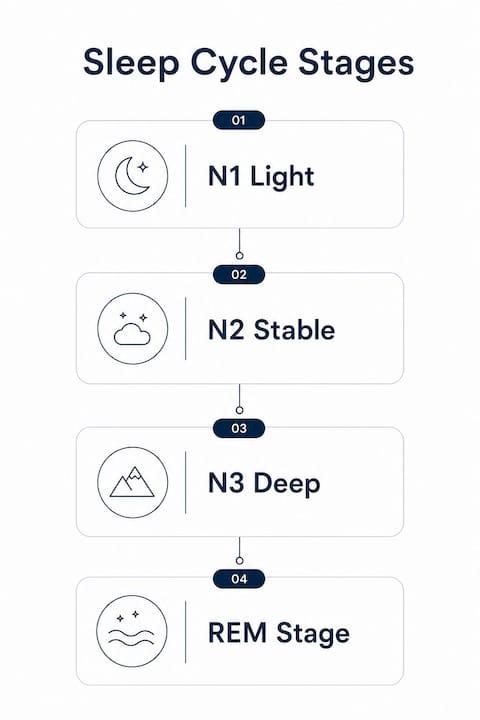
Sleep architecture is the organized pattern of 4–6 cycles per night, with each cycle containing four distinct stages. Those stages are NREM Stage 1 (N1), NREM Stage 2 (N2), NREM Stage 3 (N3), and REM sleep. Each stage has a unique biological signature and a specific job to do.
The four stages explained
N1 (light transition sleep) lasts just 1–7 minutes. Your brain slows from waking beta waves into theta waves. Muscle twitches are common, and you can be woken easily. This stage is a doorway, not a destination.
N2 (stable light sleep) is the most abundant stage, accounting for about 50% of your total sleep time. The brain produces sleep spindles and K-complexes, two electrical bursts that actively suppress external stimuli and begin consolidating memories. Think of N2 as the brain’s filing system running in the background.
N3 (slow-wave or deep sleep) accounts for roughly 25% of sleep and is the most physically restorative stage. Delta waves dominate the EEG. Growth hormone releases. Tissue repairs. The immune system regenerates. Your body does its heaviest maintenance work here.
REM sleep also makes up about 25% of the sleep cycle and increases in proportion as the night progresses. Brain activity during REM resembles waking beta waves, which is why vivid dreaming happens here. Emotional memory processing, creativity, and procedural learning all depend on REM.

| Stage |
Duration per cycle |
EEG signature |
Primary function |
| N1 |
1–7 minutes |
Theta waves |
Sleep transition |
| N2 |
20–25 minutes |
Spindles, K-complexes |
Memory filing, light restoration |
| N3 |
20–40 minutes (early cycles) |
Delta waves |
Physical repair, immune support |
| REM |
10–60 minutes (grows later) |
Beta-like waves |
Emotional regulation, memory |
Early cycles contain more N3, while later cycles extend REM. This is why cutting sleep short by even 90 minutes strips away a disproportionate amount of your REM time.
Pro Tip: If you wake up groggy and disoriented, you likely woke from N3. This is called sleep inertia, and it is a normal physiological response, not a sign of poor sleep quality. Waking naturally from REM or light N2 sleep generally avoids it.
Why does sleep architecture matter for your health?
Sleep is not a passive state. It is an active neurological sequence where each stage performs functions the waking brain simply cannot. Disrupting that sequence has measurable, serious consequences.
N3 deep sleep drives physical restoration. Growth hormone peaks during slow-wave sleep, repairing muscle tissue and reinforcing the immune system. People who consistently miss N3 get sick more often and recover more slowly. The body keeps score quietly, and the bill arrives in the form of fatigue, inflammation, and vulnerability to illness.
REM sleep handles the mind’s emotional ledger. Inadequate REM sleep is linked to impaired emotional regulation, weakened memory consolidation, and an elevated risk of dementia. Creativity and problem-solving also depend on REM, which is why a full night’s sleep often produces solutions that eluded you the evening before.
“24 hours of wakefulness produces cognitive and motor impairment equivalent to a blood alcohol content of 0.10%.” This single data point, drawn from Harvard Health research, reframes sleep deprivation not as a productivity trade-off but as a genuine safety risk.
Sleep deprivation acts as a multisystem stressor, disrupting glucose metabolism and hormonal balance. Leptin and ghrelin, the hormones that regulate hunger and satiety, fall out of sync. Over time, this raises the risk of obesity, type 2 diabetes, and hypertension. Poor sleep architecture does not just make you tired. It rewires your metabolic baseline.
Sleep spindle activity in N2 also plays a role that most people overlook. Spindles actively transfer information from the hippocampus to the cortex for long-term storage. Students who sleep poorly before an exam do not just feel worse. They literally retain less, because the spindle-driven transfer never completed.
For deeper sleep strategies that target N3 specifically, the science points to consistent sleep timing, cool room temperatures, and avoiding alcohol within three hours of bedtime.
How does sleep architecture change with age and conditions?
Sleep structure is dynamic, not fixed. It shifts across the lifespan and responds to health conditions, medications, and lifestyle choices.
The proportion of N3 sleep declines with age. Older adults spend less time in slow-wave sleep than younger adults, which explains why physical restoration feels less complete and recovery from illness takes longer. This is a biological shift, not a personal failure. Recognizing it helps you respond with targeted habits rather than frustration.
Conditions like obstructive sleep apnea fragment deep sleep repeatedly throughout the night. Each apnea event pulls the brain toward lighter stages, preventing sustained N3. The result is a person who sleeps eight hours but never reaches the restorative depth their body needs. Certain antidepressants and beta-blockers suppress REM sleep, altering the architecture in ways that affect mood and memory even when total sleep time looks adequate.
| Condition |
Architecture impact |
Health consequence |
| Normal aging |
Reduced N3 proportion |
Less physical restoration |
| Sleep apnea |
Fragmented N3 and N2 |
Fatigue, cardiovascular strain |
| Depression |
Shortened REM latency, excess REM early |
Mood dysregulation |
| Alcohol use |
Suppressed REM in second half |
Impaired memory, emotional processing |
| Circadian misalignment |
Shifted cycle timing |
Reduced deep sleep efficiency |
Pro Tip: Not all sleep changes are problems. Sleep cycles follow a dynamic pattern, and occasional variation in stage order is normal. The concern is consistent fragmentation or stage suppression, not a single unusual night.
What practical steps support healthy sleep architecture?
Improving sleep structure does not require a sleep lab. It requires consistent, evidence-based habits applied with intention.
-
Keep a fixed sleep and wake time. Your circadian rhythm anchors your sleep architecture. Irregular schedules shift cycle timing and reduce N3 efficiency.
-
Cool your bedroom to 65–68°F. Core body temperature must drop to initiate deep sleep. A cool environment accelerates that drop.
-
Avoid alcohol within three hours of bedtime. Alcohol suppresses REM in the second half of the night, even when it helps you fall asleep faster.
-
Exercise regularly, but not within two hours of sleep. Physical activity increases slow-wave sleep, but late-night exercise raises core temperature and delays sleep onset.
-
Limit blue light exposure after 9:00 PM. Blue light suppresses melatonin production, delaying the onset of N1 and compressing the entire cycle sequence.
-
Practice a wind-down routine. Anxiety and unresolved stress keep the brain in lighter sleep stages. A 20-minute relaxation practice, whether breathing exercises, journaling, or stretching, reduces cortisol and allows deeper stage entry.
-
Consider targeted supplementation. Cofactors like magnesium, GABA, B6, and B12 support the tryptophan-to-serotonin-to-melatonin conversion pathway, helping the body produce melatonin naturally rather than relying on synthetic doses.
For a full breakdown of proven sleep quality strategies, Checkedoutwellness has compiled research-backed approaches that align with each stage of the sleep cycle. You can also explore better sleep tips from Health Navigator AI for additional lifestyle-level guidance.
Key Takeaways
Sleep architecture, the structured sequence of NREM and REM cycles, determines whether sleep actually restores the body and mind, regardless of total hours slept.
| Point |
Details |
| Architecture over duration |
Eight hours of fragmented sleep delivers far less restoration than six hours of intact cycles. |
| N3 is the repair stage |
Deep slow-wave sleep drives immune regeneration, tissue repair, and growth hormone release. |
| REM protects the mind |
Adequate REM sleep reduces dementia risk and supports emotional regulation and memory. |
| Architecture changes with age |
N3 proportion declines naturally over time, requiring proactive habits to compensate. |
| Lifestyle shapes structure |
Sleep timing, temperature, alcohol, and light exposure all directly alter stage composition. |
Sleep architecture taught me to stop counting hours
By Geeta
For years, I thought eight hours was the goal. I tracked it obsessively. I hit the number most nights and still woke up feeling like I had barely slept. What I did not understand was that the number meant almost nothing without the structure behind it.
The moment sleep architecture clicked for me was reading about how alcohol suppresses REM in the second half of the night. I was having one glass of wine most evenings, convinced it helped me relax into sleep. It did. But it was quietly stealing the stage my brain needed most for emotional processing and memory. I was sleeping through the night and waking up emotionally flat and mentally slower than I should have been.
What changed my practice was shifting focus from duration to depth. I started protecting my N3 window by keeping a fixed bedtime, cooling my room, and cutting alcohol entirely on weeknights. Within two weeks, the difference was real. Not dramatic, but steady. The grogginess lifted. My recall sharpened. My mood stabilized in ways that surprised me.
The uncomfortable truth about sleep architecture is that most people will never know theirs is broken. They just feel chronically tired and blame stress or age. Understanding the structure gives you a map. Even small, consistent improvements in how you move through each stage add up to meaningful gains in how you think, feel, and recover. Sleep does not just happen to you. You can shape it.
— Geeta
How Checkedoutwellness supports your natural sleep cycles
Sleep architecture works best when your body produces melatonin on its own schedule, without synthetic shortcuts that disrupt the rhythm.

Checkedoutwellness designs its natural sleep patches around this principle. Each patch delivers cofactors including magnesium, GABA, B6, and B12 transdermally, supporting your body’s own melatonin production pathway rather than replacing it. The sleep mask blocks light precisely to protect melatonin onset, and the mouth tape supports nasal breathing through the night, reducing the micro-arousals that fragment deep sleep. All products are manufactured in South Korea under ISO 22716 GMP pharmaceutical standards. Explore the full science behind the formulas to see how each ingredient maps to a specific stage of your sleep cycle.
FAQ
What is sleep architecture in simple terms?
Sleep architecture is the structured sequence of sleep stages your body moves through each night, organized into 4–6 cycles of approximately 90–110 minutes each, including NREM stages 1–3 and REM sleep.
How many sleep cycles does a person need per night?
Most adults need 4–6 complete sleep cycles per night. Each cycle lasts roughly 90–110 minutes, meaning 7–9 hours of sleep gives the body enough time to complete the full sequence of restorative stages.
What happens if you skip deep sleep?
Skipping or fragmenting N3 deep sleep impairs immune function, reduces growth hormone release, and leaves the body physically under-restored. Over time, chronic deep sleep deficiency raises the risk of metabolic and cardiovascular disease.
Does REM sleep affect mental health?
Yes. Inadequate REM sleep is directly linked to impaired emotional regulation, weakened memory consolidation, and elevated dementia risk. REM is the stage where the brain processes emotional experiences and consolidates learning.
Can you improve your sleep architecture naturally?
Yes. Consistent sleep timing, a cool sleep environment, reduced alcohol intake, and targeted nutritional support for the melatonin production pathway all improve stage composition without medication. Checkedoutwellness products are formulated specifically to support this natural process.
Recommended

What Is Sleep Architecture and Why It Matters
Sleep architecture is defined as the organized sequence of 4–6 sleep cycles per night, each lasting approximately 90–110 minutes, composed of distinct NREM and REM stages that together determine your sleep quality and overall health. Most people track hours slept and stop there. The body, however, runs a far more precise program every night. Understanding what is sleep architecture reveals why two people sleeping the same number of hours can feel worlds apart in the morning. The American Academy of Family Physicians, Harvard Health, and Simply Psychology all confirm that the structure of sleep, not just its duration, drives cognitive function, immune support, and metabolic health.
What is sleep architecture made of?
Sleep architecture is the organized pattern of 4–6 cycles per night, with each cycle containing four distinct stages. Those stages are NREM Stage 1 (N1), NREM Stage 2 (N2), NREM Stage 3 (N3), and REM sleep. Each stage has a unique biological signature and a specific job to do.
The four stages explained
N1 (light transition sleep) lasts just 1–7 minutes. Your brain slows from waking beta waves into theta waves. Muscle twitches are common, and you can be woken easily. This stage is a doorway, not a destination.
N2 (stable light sleep) is the most abundant stage, accounting for about 50% of your total sleep time. The brain produces sleep spindles and K-complexes, two electrical bursts that actively suppress external stimuli and begin consolidating memories. Think of N2 as the brain’s filing system running in the background.
N3 (slow-wave or deep sleep) accounts for roughly 25% of sleep and is the most physically restorative stage. Delta waves dominate the EEG. Growth hormone releases. Tissue repairs. The immune system regenerates. Your body does its heaviest maintenance work here.
REM sleep also makes up about 25% of the sleep cycle and increases in proportion as the night progresses. Brain activity during REM resembles waking beta waves, which is why vivid dreaming happens here. Emotional memory processing, creativity, and procedural learning all depend on REM.
Early cycles contain more N3, while later cycles extend REM. This is why cutting sleep short by even 90 minutes strips away a disproportionate amount of your REM time.
Pro Tip: If you wake up groggy and disoriented, you likely woke from N3. This is called sleep inertia, and it is a normal physiological response, not a sign of poor sleep quality. Waking naturally from REM or light N2 sleep generally avoids it.
Why does sleep architecture matter for your health?
Sleep is not a passive state. It is an active neurological sequence where each stage performs functions the waking brain simply cannot. Disrupting that sequence has measurable, serious consequences.
N3 deep sleep drives physical restoration. Growth hormone peaks during slow-wave sleep, repairing muscle tissue and reinforcing the immune system. People who consistently miss N3 get sick more often and recover more slowly. The body keeps score quietly, and the bill arrives in the form of fatigue, inflammation, and vulnerability to illness.
REM sleep handles the mind’s emotional ledger. Inadequate REM sleep is linked to impaired emotional regulation, weakened memory consolidation, and an elevated risk of dementia. Creativity and problem-solving also depend on REM, which is why a full night’s sleep often produces solutions that eluded you the evening before.
Sleep deprivation acts as a multisystem stressor, disrupting glucose metabolism and hormonal balance. Leptin and ghrelin, the hormones that regulate hunger and satiety, fall out of sync. Over time, this raises the risk of obesity, type 2 diabetes, and hypertension. Poor sleep architecture does not just make you tired. It rewires your metabolic baseline.
Sleep spindle activity in N2 also plays a role that most people overlook. Spindles actively transfer information from the hippocampus to the cortex for long-term storage. Students who sleep poorly before an exam do not just feel worse. They literally retain less, because the spindle-driven transfer never completed.
For deeper sleep strategies that target N3 specifically, the science points to consistent sleep timing, cool room temperatures, and avoiding alcohol within three hours of bedtime.
How does sleep architecture change with age and conditions?
Sleep structure is dynamic, not fixed. It shifts across the lifespan and responds to health conditions, medications, and lifestyle choices.
The proportion of N3 sleep declines with age. Older adults spend less time in slow-wave sleep than younger adults, which explains why physical restoration feels less complete and recovery from illness takes longer. This is a biological shift, not a personal failure. Recognizing it helps you respond with targeted habits rather than frustration.
Conditions like obstructive sleep apnea fragment deep sleep repeatedly throughout the night. Each apnea event pulls the brain toward lighter stages, preventing sustained N3. The result is a person who sleeps eight hours but never reaches the restorative depth their body needs. Certain antidepressants and beta-blockers suppress REM sleep, altering the architecture in ways that affect mood and memory even when total sleep time looks adequate.
Pro Tip: Not all sleep changes are problems. Sleep cycles follow a dynamic pattern, and occasional variation in stage order is normal. The concern is consistent fragmentation or stage suppression, not a single unusual night.
What practical steps support healthy sleep architecture?
Improving sleep structure does not require a sleep lab. It requires consistent, evidence-based habits applied with intention.
For a full breakdown of proven sleep quality strategies, Checkedoutwellness has compiled research-backed approaches that align with each stage of the sleep cycle. You can also explore better sleep tips from Health Navigator AI for additional lifestyle-level guidance.
Key Takeaways
Sleep architecture, the structured sequence of NREM and REM cycles, determines whether sleep actually restores the body and mind, regardless of total hours slept.
Sleep architecture taught me to stop counting hours
By Geeta
For years, I thought eight hours was the goal. I tracked it obsessively. I hit the number most nights and still woke up feeling like I had barely slept. What I did not understand was that the number meant almost nothing without the structure behind it.
The moment sleep architecture clicked for me was reading about how alcohol suppresses REM in the second half of the night. I was having one glass of wine most evenings, convinced it helped me relax into sleep. It did. But it was quietly stealing the stage my brain needed most for emotional processing and memory. I was sleeping through the night and waking up emotionally flat and mentally slower than I should have been.
What changed my practice was shifting focus from duration to depth. I started protecting my N3 window by keeping a fixed bedtime, cooling my room, and cutting alcohol entirely on weeknights. Within two weeks, the difference was real. Not dramatic, but steady. The grogginess lifted. My recall sharpened. My mood stabilized in ways that surprised me.
The uncomfortable truth about sleep architecture is that most people will never know theirs is broken. They just feel chronically tired and blame stress or age. Understanding the structure gives you a map. Even small, consistent improvements in how you move through each stage add up to meaningful gains in how you think, feel, and recover. Sleep does not just happen to you. You can shape it.
How Checkedoutwellness supports your natural sleep cycles
Sleep architecture works best when your body produces melatonin on its own schedule, without synthetic shortcuts that disrupt the rhythm.
Checkedoutwellness designs its natural sleep patches around this principle. Each patch delivers cofactors including magnesium, GABA, B6, and B12 transdermally, supporting your body’s own melatonin production pathway rather than replacing it. The sleep mask blocks light precisely to protect melatonin onset, and the mouth tape supports nasal breathing through the night, reducing the micro-arousals that fragment deep sleep. All products are manufactured in South Korea under ISO 22716 GMP pharmaceutical standards. Explore the full science behind the formulas to see how each ingredient maps to a specific stage of your sleep cycle.
FAQ
What is sleep architecture in simple terms?
Sleep architecture is the structured sequence of sleep stages your body moves through each night, organized into 4–6 cycles of approximately 90–110 minutes each, including NREM stages 1–3 and REM sleep.
How many sleep cycles does a person need per night?
Most adults need 4–6 complete sleep cycles per night. Each cycle lasts roughly 90–110 minutes, meaning 7–9 hours of sleep gives the body enough time to complete the full sequence of restorative stages.
What happens if you skip deep sleep?
Skipping or fragmenting N3 deep sleep impairs immune function, reduces growth hormone release, and leaves the body physically under-restored. Over time, chronic deep sleep deficiency raises the risk of metabolic and cardiovascular disease.
Does REM sleep affect mental health?
Yes. Inadequate REM sleep is directly linked to impaired emotional regulation, weakened memory consolidation, and elevated dementia risk. REM is the stage where the brain processes emotional experiences and consolidates learning.
Can you improve your sleep architecture naturally?
Yes. Consistent sleep timing, a cool sleep environment, reduced alcohol intake, and targeted nutritional support for the melatonin production pathway all improve stage composition without medication. Checkedoutwellness products are formulated specifically to support this natural process.
Recommended