Sleep education is defined as the structured teaching of evidence-based knowledge and practical skills that help people improve their sleep health. Most adults treat sleep as something that simply happens to them. The truth is that sleep is an active, multidimensional physiological process, and understanding its dimensions changes everything about how you approach rest. Remarkably, 45% of adults have never discussed sleep health with a healthcare provider, despite its direct impact on memory, mood, immunity, and cognitive performance. Explaining sleep education is not about memorizing rules. It is about building a personal relationship with your own biology.
What is sleep education and why does it matter?
Sleep education is the process of teaching people how sleep works, what disrupts it, and how to build habits that protect it. The American Academy of Sleep Medicine defines sleep health as a multidimensional concept covering six core areas: regularity, satisfaction, alertness, timing, efficiency, and duration. Each dimension interacts with the others. You can sleep eight hours and still wake up exhausted if your timing is off or your sleep is fragmented.
The importance of sleep education becomes clear when you look at what poor sleep actually costs. Cognitive performance, emotional regulation, immune function, and metabolic health all degrade without consistent, quality sleep. Optimal cognitive performance requires 7–8 hours of high-quality sleep nightly for most adults. That is not a suggestion. It is a biological requirement.
Sleep education addresses the most common barriers people face:
-
Irregular sleep schedules that confuse the body’s internal clock
-
Poor sleep hygiene built from years of unexamined habits
-
Lack of awareness about how light, temperature, and screen time affect sleep architecture
-
Anxiety about sleep itself, which paradoxically makes sleep harder to achieve
-
Misinformation, such as believing that catching up on weekends fully restores lost sleep
The goal of sleep education is not to make you anxious about every choice. It is to give you enough understanding to make informed decisions and course-correct when something is not working.
What are the key components of effective sleep education?

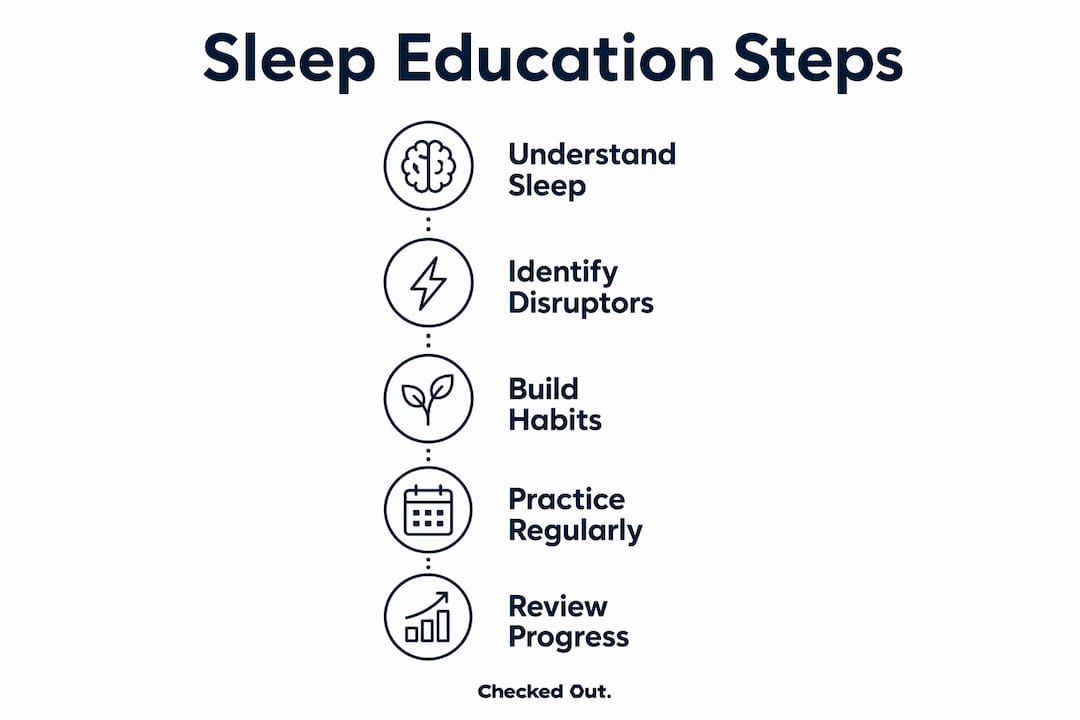
Effective sleep education does not hand you a checklist and call it done. It teaches you the reasoning behind each recommendation so you can adapt it to your life.
Sleep hygiene as a lifestyle, not a rulebook
Sleep hygiene is best understood as the collection of daytime and pre-bedtime habits that train your body’s internal clock. Sleep hygiene is highly individualized, and rigid rules can actually increase sleep anxiety and decrease effectiveness. The Cleveland Clinic frames it as lifestyle habits rather than a fixed protocol, and that framing matters. When you understand why a dark, cool room helps, you stop treating it as a rule and start treating it as a tool.
The foundational behaviors taught in sleep education programs typically follow this sequence:
-
Set a consistent wake time. Your wake time anchors your circadian rhythm more powerfully than your bedtime does. Pick one and protect it, even on weekends.
-
Build a pre-sleep wind-down routine. A 20–30 minute buffer of low stimulation before bed signals the nervous system to shift gears. Reading, light stretching, or breathing exercises all qualify.
-
Optimize your sleep environment. Darkness, quiet, and a cool room temperature create the physiological conditions your body needs to drop into deep sleep.
-
Limit caffeine after 2:00 PM. Caffeine has a half-life of roughly five to six hours. An afternoon coffee is still active in your system at midnight.
-
Reduce screen exposure before bed. Blue light from screens suppresses melatonin production and delays sleep onset. Dimming screens or using blue-light filters one hour before bed makes a measurable difference.
Pro Tip: The benefits of bedtime routines are dose-dependent. Consistency over many nights matters far more than perfection on any single night. Start with one change and hold it for two weeks before adding another.
Individual sleep needs vary. Some people genuinely function well on six and a half hours. Others need nine. Sleep education teaches you to read your own signals rather than chase a universal number.
How does sleep education benefit children and adolescents?
Sleep education for children and adolescents is one of the most well-studied areas in sleep research, and the results are striking. A 2026 school-based program showed that structured sleep education reduced insufficient sleep duration by 2.4 times and borderline sleep duration by 1.7 times among participating adolescents. Those are not marginal gains. They represent a meaningful shift in how young people sleep.
The key to effective sleep education for children is active participation. Programs that engage children directly, rather than simply informing parents, produce stronger outcomes. Child-led approaches using self-mapping tools and goal-setting exercises build motivation and a sense of ownership over sleep habits. When a child understands why they feel better after a full night of sleep, they are far more likely to protect that sleep voluntarily.
The benefits extend well beyond the bedroom:
-
Academic performance improves when adolescents get adequate sleep, with better attention, memory consolidation, and problem-solving capacity
-
Mental health outcomes are strongly linked to sleep quality, with sleep-deprived teens showing higher rates of anxiety and depression
-
Physical development depends on deep sleep stages that release growth hormone
Changing family routines is the hardest part. Screens in bedrooms, late-night activities, and inconsistent school schedules all work against good sleep. Long-term reinforcement over 6–12 months with structured follow-ups is necessary for lasting behavioral change. A single workshop does not move the needle. Sustained, repeated education does.
| Population |
Key Challenge |
Proven Benefit |
| Young children |
Parental routine inconsistency |
Improved bedtime compliance |
| Adolescents |
Screen use and late schedules |
Reduced insufficient sleep by 2.4x |
| Adults |
Work stress and irregular hours |
Better sleep efficiency and duration |
What natural strategies does sleep education teach?
Sleep education consistently points to the same cluster of natural, drug-free strategies. These are not alternative remedies. They are the behavioral interventions that sleep medicine professionals recommend first, before any pharmaceutical option is considered.

Morning light exposure is one of the most underused tools available. Getting natural light within 30 minutes of waking resets your circadian clock and makes it easier to fall asleep at night. This single habit costs nothing and works reliably. Pair it with natural sleep improvement steps for a compounding effect.
Exercise improves sleep quality across nearly every studied population. Moderate aerobic activity, done consistently, reduces the time it takes to fall asleep and increases the proportion of deep sleep. Timing matters: vigorous exercise within two hours of bedtime can delay sleep onset for some people.
Additional strategies taught in sleep education programs include:
-
Relaxation techniques such as progressive muscle relaxation, diaphragmatic breathing, and body-scan meditation, which lower cortisol and prepare the nervous system for sleep
-
Stimulus control, which means using your bed only for sleep so your brain associates the bedroom with rest rather than wakefulness
-
Sleep restriction therapy, a counterintuitive but effective method where you temporarily limit time in bed to consolidate sleep and rebuild sleep drive
-
Dietary awareness, including reducing alcohol, which fragments sleep architecture even when it feels sedating
Pro Tip: If sleep problems persist after two to four weeks of consistent sleep hygiene practices, specialist evaluation is recommended. Persistent issues often signal an underlying medical or psychological condition that behavioral strategies alone cannot resolve.
For adults navigating a holistic health approach, sleep sits alongside nutrition and movement as a non-negotiable pillar. Treating it as optional is one of the most common and costly sleep health mistakes high performers make.
Key Takeaways
Sleep education is the most direct path from poor sleep to lasting, natural recovery because it addresses behavior, biology, and environment together.
| Point |
Details |
| Sleep is multidimensional |
Regularity, timing, efficiency, and satisfaction all matter, not just total hours. |
| Hygiene requires personalization |
Rigid sleep rules can increase anxiety; tailor habits to your own biology. |
| Children benefit most from active learning |
Programs that engage kids directly produce stronger, longer-lasting sleep improvements. |
| Natural strategies work first |
Morning light, exercise, and relaxation techniques are the first-line interventions in sleep medicine. |
| Lasting change takes months |
Follow-up and reinforcement over 6–12 months are required for real behavioral change. |
Why I think sleep education is the most underrated health investment
I have watched people spend thousands of dollars on supplements, wearables, and recovery protocols while completely ignoring the foundational knowledge that would make all of those tools actually work. Sleep education is not glamorous. It does not come in a bottle. But it is the framework that makes everything else more effective.
What I have seen consistently is that people who understand how sleep works stop fighting their biology. They stop trying to hack their way to eight hours and start building the conditions that make eight hours feel natural. The shift is subtle but profound. The body keeps score quietly, and when you give it what it needs, it responds.
The hardest part is accepting that there is no universal prescription. What works for a 28-year-old athlete is not what works for a 52-year-old executive managing cortisol dysregulation and a packed travel schedule. Individualized approaches are not a luxury. They are the only approach that actually holds over time.
If self-directed efforts stall after a few weeks, that is not a failure of willpower. It is a signal that you need a more structured assessment. Sleep medicine specialists, behavioral sleep therapists, and even well-designed digital programs can provide the personalized feedback that general advice cannot. View sleep quality as a proactive, ongoing investment, not a problem you solve once and forget.
— Geeta
Sleep support from Checkedoutwellness
Checkedoutwellness was built for people who take sleep as seriously as their nutrition and training. The brand’s natural sleep patches are manufactured in South Korea under ISO 22716 GMP pharmaceutical standards and deliver magnesium, B6, B12, and GABA transdermally to support your body’s own melatonin production, without synthetic melatonin or dependency risk.
The contoured blackout sleep mask pairs with the patch to eliminate light disruption, one of the most common and overlooked barriers to deep sleep. For anyone ready to put the principles of sleep education into practice with science-backed, drug-free tools, Checkedoutwellness offers a clear starting point.
FAQ
What is sleep education, exactly?
Sleep education is the structured teaching of evidence-based knowledge and practical habits that improve sleep health. It covers sleep science, sleep hygiene, behavioral strategies, and when to seek professional help.
How does sleep hygiene education differ from general sleep advice?
Sleep hygiene education is personalized and behavior-focused, teaching you to adjust daytime and pre-bedtime habits based on your own biology. General sleep advice tends to be one-size-fits-all and often increases anxiety when it does not work.
What are the proven benefits of sleep education for adolescents?
A 2026 school-based program showed sleep education reduced insufficient sleep by 2.4 times among adolescents. Benefits include better academic performance, improved mood, and stronger mental health outcomes.
How long does it take for sleep education to produce results?
Behavioral changes from sleep education typically require consistent follow-up over 6–12 months for lasting results. Single sessions or short programs rarely produce sustained improvement.
When should someone seek professional help for sleep problems?
If sleep problems persist after two to four weeks of consistent sleep hygiene practices, a specialist evaluation is recommended. Ongoing issues often indicate an underlying medical or psychological condition.
Recommended

Explaining Sleep Education: Your Natural Sleep Guide
Sleep education is defined as the structured teaching of evidence-based knowledge and practical skills that help people improve their sleep health. Most adults treat sleep as something that simply happens to them. The truth is that sleep is an active, multidimensional physiological process, and understanding its dimensions changes everything about how you approach rest. Remarkably, 45% of adults have never discussed sleep health with a healthcare provider, despite its direct impact on memory, mood, immunity, and cognitive performance. Explaining sleep education is not about memorizing rules. It is about building a personal relationship with your own biology.
What is sleep education and why does it matter?
Sleep education is the process of teaching people how sleep works, what disrupts it, and how to build habits that protect it. The American Academy of Sleep Medicine defines sleep health as a multidimensional concept covering six core areas: regularity, satisfaction, alertness, timing, efficiency, and duration. Each dimension interacts with the others. You can sleep eight hours and still wake up exhausted if your timing is off or your sleep is fragmented.
The importance of sleep education becomes clear when you look at what poor sleep actually costs. Cognitive performance, emotional regulation, immune function, and metabolic health all degrade without consistent, quality sleep. Optimal cognitive performance requires 7–8 hours of high-quality sleep nightly for most adults. That is not a suggestion. It is a biological requirement.
Sleep education addresses the most common barriers people face:
The goal of sleep education is not to make you anxious about every choice. It is to give you enough understanding to make informed decisions and course-correct when something is not working.
What are the key components of effective sleep education?
Effective sleep education does not hand you a checklist and call it done. It teaches you the reasoning behind each recommendation so you can adapt it to your life.
Sleep hygiene as a lifestyle, not a rulebook
Sleep hygiene is best understood as the collection of daytime and pre-bedtime habits that train your body’s internal clock. Sleep hygiene is highly individualized, and rigid rules can actually increase sleep anxiety and decrease effectiveness. The Cleveland Clinic frames it as lifestyle habits rather than a fixed protocol, and that framing matters. When you understand why a dark, cool room helps, you stop treating it as a rule and start treating it as a tool.
The foundational behaviors taught in sleep education programs typically follow this sequence:
Pro Tip: The benefits of bedtime routines are dose-dependent. Consistency over many nights matters far more than perfection on any single night. Start with one change and hold it for two weeks before adding another.
Individual sleep needs vary. Some people genuinely function well on six and a half hours. Others need nine. Sleep education teaches you to read your own signals rather than chase a universal number.
How does sleep education benefit children and adolescents?
Sleep education for children and adolescents is one of the most well-studied areas in sleep research, and the results are striking. A 2026 school-based program showed that structured sleep education reduced insufficient sleep duration by 2.4 times and borderline sleep duration by 1.7 times among participating adolescents. Those are not marginal gains. They represent a meaningful shift in how young people sleep.
The key to effective sleep education for children is active participation. Programs that engage children directly, rather than simply informing parents, produce stronger outcomes. Child-led approaches using self-mapping tools and goal-setting exercises build motivation and a sense of ownership over sleep habits. When a child understands why they feel better after a full night of sleep, they are far more likely to protect that sleep voluntarily.
The benefits extend well beyond the bedroom:
Changing family routines is the hardest part. Screens in bedrooms, late-night activities, and inconsistent school schedules all work against good sleep. Long-term reinforcement over 6–12 months with structured follow-ups is necessary for lasting behavioral change. A single workshop does not move the needle. Sustained, repeated education does.
What natural strategies does sleep education teach?
Sleep education consistently points to the same cluster of natural, drug-free strategies. These are not alternative remedies. They are the behavioral interventions that sleep medicine professionals recommend first, before any pharmaceutical option is considered.
Morning light exposure is one of the most underused tools available. Getting natural light within 30 minutes of waking resets your circadian clock and makes it easier to fall asleep at night. This single habit costs nothing and works reliably. Pair it with natural sleep improvement steps for a compounding effect.
Exercise improves sleep quality across nearly every studied population. Moderate aerobic activity, done consistently, reduces the time it takes to fall asleep and increases the proportion of deep sleep. Timing matters: vigorous exercise within two hours of bedtime can delay sleep onset for some people.
Additional strategies taught in sleep education programs include:
Pro Tip: If sleep problems persist after two to four weeks of consistent sleep hygiene practices, specialist evaluation is recommended. Persistent issues often signal an underlying medical or psychological condition that behavioral strategies alone cannot resolve.
For adults navigating a holistic health approach, sleep sits alongside nutrition and movement as a non-negotiable pillar. Treating it as optional is one of the most common and costly sleep health mistakes high performers make.
Key Takeaways
Sleep education is the most direct path from poor sleep to lasting, natural recovery because it addresses behavior, biology, and environment together.
Why I think sleep education is the most underrated health investment
I have watched people spend thousands of dollars on supplements, wearables, and recovery protocols while completely ignoring the foundational knowledge that would make all of those tools actually work. Sleep education is not glamorous. It does not come in a bottle. But it is the framework that makes everything else more effective.
What I have seen consistently is that people who understand how sleep works stop fighting their biology. They stop trying to hack their way to eight hours and start building the conditions that make eight hours feel natural. The shift is subtle but profound. The body keeps score quietly, and when you give it what it needs, it responds.
The hardest part is accepting that there is no universal prescription. What works for a 28-year-old athlete is not what works for a 52-year-old executive managing cortisol dysregulation and a packed travel schedule. Individualized approaches are not a luxury. They are the only approach that actually holds over time.
If self-directed efforts stall after a few weeks, that is not a failure of willpower. It is a signal that you need a more structured assessment. Sleep medicine specialists, behavioral sleep therapists, and even well-designed digital programs can provide the personalized feedback that general advice cannot. View sleep quality as a proactive, ongoing investment, not a problem you solve once and forget.
Sleep support from Checkedoutwellness
Checkedoutwellness was built for people who take sleep as seriously as their nutrition and training. The brand’s natural sleep patches are manufactured in South Korea under ISO 22716 GMP pharmaceutical standards and deliver magnesium, B6, B12, and GABA transdermally to support your body’s own melatonin production, without synthetic melatonin or dependency risk.
The contoured blackout sleep mask pairs with the patch to eliminate light disruption, one of the most common and overlooked barriers to deep sleep. For anyone ready to put the principles of sleep education into practice with science-backed, drug-free tools, Checkedoutwellness offers a clear starting point.
FAQ
What is sleep education, exactly?
Sleep education is the structured teaching of evidence-based knowledge and practical habits that improve sleep health. It covers sleep science, sleep hygiene, behavioral strategies, and when to seek professional help.
How does sleep hygiene education differ from general sleep advice?
Sleep hygiene education is personalized and behavior-focused, teaching you to adjust daytime and pre-bedtime habits based on your own biology. General sleep advice tends to be one-size-fits-all and often increases anxiety when it does not work.
What are the proven benefits of sleep education for adolescents?
A 2026 school-based program showed sleep education reduced insufficient sleep by 2.4 times among adolescents. Benefits include better academic performance, improved mood, and stronger mental health outcomes.
How long does it take for sleep education to produce results?
Behavioral changes from sleep education typically require consistent follow-up over 6–12 months for lasting results. Single sessions or short programs rarely produce sustained improvement.
When should someone seek professional help for sleep problems?
If sleep problems persist after two to four weeks of consistent sleep hygiene practices, a specialist evaluation is recommended. Ongoing issues often indicate an underlying medical or psychological condition.
Recommended