Performance sleep is the quantified measure of how effectively your sleep fulfills your body’s biological recovery needs, typically expressed as a score between 85% and 95%. Most people track hours. High performers track effectiveness. That single shift in thinking changes everything about how you approach rest, recovery, and daily output. If you’ve ever woken up after eight hours feeling wrecked, you already know that time in bed and biological restoration are not the same thing.
Performance sleep is a specific framework for measuring sleep effectiveness, not just duration. Tools like WHOOP quantify it as a sleep performance score, calculated by comparing actual sleep against your body’s biological need on any given night. A score between 85% and 95% reflects optimal recovery. Scores below 70% sustained over multiple nights signal that your lifestyle needs real adjustment.
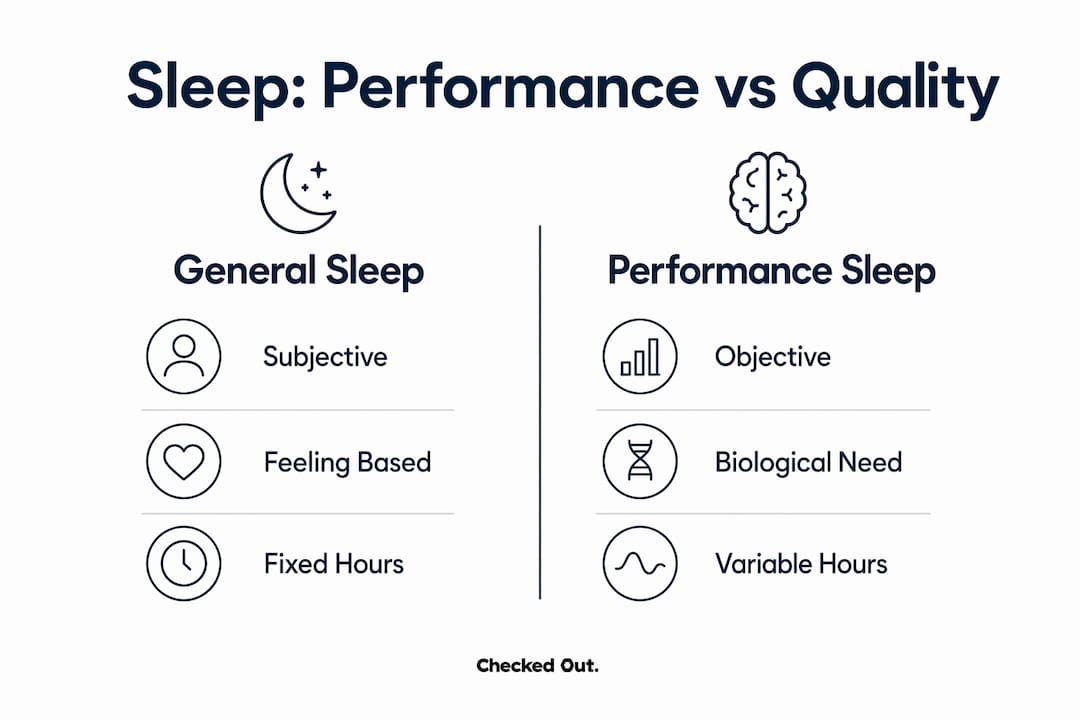
The difference between performance sleep and general sleep quality is the difference between subjective feeling and objective data. You might feel rested after six hours on a low-strain day. That same six hours after an intense training session or a high-stress workday leaves you running a biological deficit. Performance sleep accounts for that variability. General sleep quality does not.
This matters because the body keeps score quietly. Cognitive sharpness, immune function, hormone balance, and reaction time all depend on whether your sleep actually met your recovery need. Feeling fine is not the same as recovering fully.

Deep sleep and REM sleep are the two stages where the most critical recovery happens. Deep sleep drives muscle repair, growth hormone release, and immune system reinforcement. REM sleep consolidates memory, processes emotion, and restores cognitive sharpness. Shortchanging either stage creates deficits that compound over days.
The athletic data on this is striking. Sleep extension to 9–10 hours per night improved tennis serve accuracy from 36% to 42% and boosted basketball shooting by 9%. Reaction time and anaerobic capacity, including jump height, also improved. These are not marginal gains. They are the kind of numbers coaches look for in training blocks.
The immune consequences of poor sleep are equally serious. People sleeping 5–6 hours nightly are 4.5 times more likely to develop colds after viral exposure than those sleeping 7 hours. Chronic sleep loss also increases cortisol and reduces anabolic hormones like testosterone and growth hormone. That hormonal shift means your body is simultaneously more stressed and less equipped to rebuild.
The cognitive side is just as consequential. Research shows that cognitive alertness and neuromuscular efficiency are the primary drivers of performance gains from improved sleep, more so than hormonal changes alone. Your nervous system needs sleep to fire accurately and quickly. No amount of caffeine fully compensates for that deficit.
Key physiological and cognitive benefits of performance sleep include:
- Accelerated muscle repair through deep sleep growth hormone release
- Stronger immune response and lower susceptibility to illness
- Faster reaction time and improved motor accuracy
- Reduced cortisol and restored anabolic hormone balance
- Sharper memory consolidation and emotional regulation through REM sleep
“Athletes often do not perceive damage from sleep deprivation until performance metrics significantly drop, making sleep tracking as crucial as training monitoring.”
General sleep quality is largely subjective. It reflects how rested you feel, how long it took to fall asleep, and whether you woke up during the night. Performance sleep is objective. It scores how well your actual sleep matched what your body needed, factoring in prior sleep debt accumulated over the past 14 days, physical strain, and naps.
The table below shows the core differences between the two frameworks.
| Factor |
General sleep quality |
Performance sleep |
| Measurement |
Subjective feeling |
Objective score (85%–95% optimal) |
| Accounts for sleep debt |
No |
Yes, over prior 14 days |
| Adjusts for physical strain |
No |
Yes, daily variation |
| Tracks recovery need |
No |
Yes, individualized per night |
| Tools used |
Self-report, basic apps |
WHOOP, advanced wearables |
Sleep needs vary day to day based on physical strain and accumulated sleep debt. The same person may need 7 hours one night and 9 hours the next to hit an equivalent performance score. That dynamic nature is what makes performance sleep a more honest measure of recovery than a fixed hour target.
Feeling rested is a lagging indicator. By the time you notice cognitive fog or sluggish workouts, your sleep debt has already been building for days. Objective scoring catches that drift earlier, giving you a chance to course-correct before performance drops become visible.
Consistency is the single most powerful lever. Consistent sleep hygiene routines yield better results than intermittent efforts or weekend catch-up sleep, which disrupts circadian rhythms and fragments recovery. Your body’s sleep architecture depends on a stable schedule to time hormone release and temperature regulation correctly.
A structured approach to sleep hygiene works. A 14-day sleep hygiene protocol in university athletes improved sleep duration, reduced time to fall asleep, lowered anticipatory cortisol, and improved sprint times and aerobic performance. Two weeks of consistent practice produced measurable athletic results.
Here are the core strategies that drive real improvement:
-
Set a fixed wake time. Your wake time anchors your circadian rhythm more powerfully than your bedtime. Pick one and protect it, even on weekends.
-
Cool your bedroom to 60–68°F. The optimal bedroom temperature for deep sleep falls between 60°F and 68°F. Temperatures above 70°F block the core body temperature drop that triggers restorative slow-wave sleep.
-
Eliminate light exposure 60 minutes before bed. Blue light from screens suppresses melatonin production and delays sleep onset. A blackout mask can compensate for early morning light intrusion.
-
Apply the 20-minute rule. If you cannot fall asleep within 20 minutes, leave the bed and do something calm in dim light. Lying awake in bed builds a mental association between your bedroom and wakefulness, which compounds insomnia over time.
-
Limit naps to 20 minutes before 3 p.m. Longer or later naps reduce sleep pressure and fragment nighttime architecture.
-
Manage caffeine cutoff at 1–2 p.m. Caffeine has a half-life of roughly 5–6 hours. An afternoon coffee at 3 p.m. still has measurable stimulant activity at 9 p.m.
Pro Tip: Avoid the “sleep debt weekend” trap. Sleeping in two hours on Saturday feels restorative but shifts your circadian phase, making Monday morning feel like jet lag. A 30-minute extension is the ceiling for effective catch-up.
For a deeper look at building these habits into a repeatable system, the 11 best sleep routine practices guide at Checkedoutwellness covers the sequencing in detail.
Tracking performance sleep requires moving beyond how you feel in the morning. Wearable devices like WHOOP calculate a sleep performance score that accounts for sleep duration relative to need, prior 14-day sleep debt, naps, and physical strain. That composite score gives you a number you can act on, not just a vague sense of whether last night was good or bad.
Key metrics worth tracking include:
-
Sleep performance score: The percentage of your sleep need that was met (target: 85%–95%)
-
Sleep stages: Time in deep sleep, REM sleep, and light sleep across the night
-
Sleep latency: How long it takes to fall asleep (under 20 minutes is healthy)
-
Sleep consistency: Variance in your sleep and wake times across the week
-
Resting heart rate and HRV: Indirect markers of nervous system recovery overnight
Subjective sleep logs add context that wearables miss. Noting stress levels, alcohol intake, late meals, or travel helps explain score drops that the device cannot attribute on its own. The combination of objective data and personal notes creates a feedback loop you can actually use.
Performance sleep improvements manifest primarily through neuromuscular and cognitive pathways. That means the gains show up in your focus, coordination, and reaction speed before they show up in how you feel emotionally. Tracking those downstream markers, like workout quality and decision accuracy, gives you a fuller picture of whether your sleep is actually performing.
For a structured starting point, the science-backed sleep improvement steps at Checkedoutwellness walk through how to interpret your data and build a response plan. You can also explore a sleep meditation checklist as a complementary wind-down tool to lower pre-sleep arousal before tracking begins.
Key Takeaways
Performance sleep is the most accurate measure of overnight recovery because it scores biological need fulfillment, not just hours in bed.
| Point |
Details |
| Performance sleep is scored |
Optimal recovery falls between 85%–95% on a sleep performance score. |
| Sleep need is dynamic |
The same person may need 7 or 9 hours depending on strain and prior sleep debt. |
| Deep sleep and REM drive recovery |
These stages control muscle repair, immune function, memory, and hormone balance. |
| Consistency beats catch-up |
A stable schedule outperforms weekend sleep extensions for circadian health. |
| Environment shapes sleep quality |
A bedroom kept at 60–68°F and free of light directly improves deep sleep architecture. |
What I’ve learned from tracking sleep like a training variable
I used to treat sleep as the thing that happened between workouts. Eight hours felt like a checkbox. Then I started seeing my performance score drop on nights I thought were fine, and I had to reckon with the fact that I was measuring the wrong thing entirely.
The most uncomfortable truth I’ve found is that sleep debt is invisible until it isn’t. You adapt to a low-grade deficit and mistake that adaptation for resilience. Your reaction time slows. Your mood flattens. Your workouts feel harder. And you attribute all of it to stress or overtraining, never to the 71% sleep performance score you’ve been averaging for two weeks.
What actually changed my sleep was not a single habit. It was the combination of a fixed wake time, a cooler room, and stopping the habit of lying in bed scrolling when I couldn’t fall asleep. The 20-minute rule felt counterintuitive at first. Getting up when you’re tired seems wrong. But the mental association between bed and wakefulness is real, and breaking it changed my sleep latency within days.
The other thing I’d push back on is the idea that more hours always solves the problem. Sometimes a 7-hour night with a score of 91% is more restorative than a 9-hour night with a score of 78%. The quality of the architecture matters as much as the duration. That’s why I keep coming back to tracking. Not to obsess over numbers, but to stay honest about what my body actually needed versus what I gave it.
Perfection is not the goal. Consistency and self-awareness are. The people who sleep best are not the ones who never have a bad night. They’re the ones who notice the pattern early and adjust before the deficit compounds.
— Geeta

Building better sleep performance takes more than intention. The environment and the inputs your body receives before bed matter enormously. Checkedoutwellness designs drug-free, science-backed products specifically for people who take sleep as seriously as their training and nutrition.
The natural sleep patch delivers cofactors like magnesium, B6, B12, and GABA transdermally to support your body’s own melatonin production without synthetic additives or dependency risk. Pair it with the Sleep Duo bundle, which combines the sleep patch with mouth tape for nasal breathing support, and you address two of the most overlooked factors in overnight recovery. Every product is manufactured in South Korea under ISO 22716 GMP pharmaceutical standards.
FAQ
A performance sleep score between 85% and 95% reflects optimal biological recovery. Scores below 70% sustained over multiple nights indicate a need for lifestyle or sleep hygiene changes.
Performance sleep accounts for your individual recovery need, prior sleep debt, and physical strain. Getting enough hours does not guarantee a high performance score if sleep architecture is fragmented or biological need exceeds duration.
Yes. Sleep extension to 9–10 hours improved tennis serve accuracy and basketball shooting by measurable margins, with additional gains in reaction time and anaerobic capacity.
The optimal range is 60–68°F. Temperatures above 70°F prevent the core body temperature drop needed to enter and sustain deep slow-wave sleep.
A structured 14-day sleep hygiene protocol produced measurable improvements in sleep duration, sleep latency, and athletic performance in university athletes. Consistent practice over two weeks is a realistic starting point.
Recommended

What Is Performance Sleep and How to Achieve It
Performance sleep is the quantified measure of how effectively your sleep fulfills your body’s biological recovery needs, typically expressed as a score between 85% and 95%. Most people track hours. High performers track effectiveness. That single shift in thinking changes everything about how you approach rest, recovery, and daily output. If you’ve ever woken up after eight hours feeling wrecked, you already know that time in bed and biological restoration are not the same thing.
What is performance sleep and why does it matter?
Performance sleep is a specific framework for measuring sleep effectiveness, not just duration. Tools like WHOOP quantify it as a sleep performance score, calculated by comparing actual sleep against your body’s biological need on any given night. A score between 85% and 95% reflects optimal recovery. Scores below 70% sustained over multiple nights signal that your lifestyle needs real adjustment.
The difference between performance sleep and general sleep quality is the difference between subjective feeling and objective data. You might feel rested after six hours on a low-strain day. That same six hours after an intense training session or a high-stress workday leaves you running a biological deficit. Performance sleep accounts for that variability. General sleep quality does not.
This matters because the body keeps score quietly. Cognitive sharpness, immune function, hormone balance, and reaction time all depend on whether your sleep actually met your recovery need. Feeling fine is not the same as recovering fully.
What are the physiological and cognitive benefits of optimal performance sleep?
Deep sleep and REM sleep are the two stages where the most critical recovery happens. Deep sleep drives muscle repair, growth hormone release, and immune system reinforcement. REM sleep consolidates memory, processes emotion, and restores cognitive sharpness. Shortchanging either stage creates deficits that compound over days.
The athletic data on this is striking. Sleep extension to 9–10 hours per night improved tennis serve accuracy from 36% to 42% and boosted basketball shooting by 9%. Reaction time and anaerobic capacity, including jump height, also improved. These are not marginal gains. They are the kind of numbers coaches look for in training blocks.
The immune consequences of poor sleep are equally serious. People sleeping 5–6 hours nightly are 4.5 times more likely to develop colds after viral exposure than those sleeping 7 hours. Chronic sleep loss also increases cortisol and reduces anabolic hormones like testosterone and growth hormone. That hormonal shift means your body is simultaneously more stressed and less equipped to rebuild.
The cognitive side is just as consequential. Research shows that cognitive alertness and neuromuscular efficiency are the primary drivers of performance gains from improved sleep, more so than hormonal changes alone. Your nervous system needs sleep to fire accurately and quickly. No amount of caffeine fully compensates for that deficit.
Key physiological and cognitive benefits of performance sleep include:
How does performance sleep differ from general sleep quality?
General sleep quality is largely subjective. It reflects how rested you feel, how long it took to fall asleep, and whether you woke up during the night. Performance sleep is objective. It scores how well your actual sleep matched what your body needed, factoring in prior sleep debt accumulated over the past 14 days, physical strain, and naps.
The table below shows the core differences between the two frameworks.
Sleep needs vary day to day based on physical strain and accumulated sleep debt. The same person may need 7 hours one night and 9 hours the next to hit an equivalent performance score. That dynamic nature is what makes performance sleep a more honest measure of recovery than a fixed hour target.
Feeling rested is a lagging indicator. By the time you notice cognitive fog or sluggish workouts, your sleep debt has already been building for days. Objective scoring catches that drift earlier, giving you a chance to course-correct before performance drops become visible.
What practical strategies improve performance sleep?
Consistency is the single most powerful lever. Consistent sleep hygiene routines yield better results than intermittent efforts or weekend catch-up sleep, which disrupts circadian rhythms and fragments recovery. Your body’s sleep architecture depends on a stable schedule to time hormone release and temperature regulation correctly.
A structured approach to sleep hygiene works. A 14-day sleep hygiene protocol in university athletes improved sleep duration, reduced time to fall asleep, lowered anticipatory cortisol, and improved sprint times and aerobic performance. Two weeks of consistent practice produced measurable athletic results.
Here are the core strategies that drive real improvement:
Pro Tip: Avoid the “sleep debt weekend” trap. Sleeping in two hours on Saturday feels restorative but shifts your circadian phase, making Monday morning feel like jet lag. A 30-minute extension is the ceiling for effective catch-up.
For a deeper look at building these habits into a repeatable system, the 11 best sleep routine practices guide at Checkedoutwellness covers the sequencing in detail.
How can you monitor and track performance sleep over time?
Tracking performance sleep requires moving beyond how you feel in the morning. Wearable devices like WHOOP calculate a sleep performance score that accounts for sleep duration relative to need, prior 14-day sleep debt, naps, and physical strain. That composite score gives you a number you can act on, not just a vague sense of whether last night was good or bad.
Key metrics worth tracking include:
Subjective sleep logs add context that wearables miss. Noting stress levels, alcohol intake, late meals, or travel helps explain score drops that the device cannot attribute on its own. The combination of objective data and personal notes creates a feedback loop you can actually use.
Performance sleep improvements manifest primarily through neuromuscular and cognitive pathways. That means the gains show up in your focus, coordination, and reaction speed before they show up in how you feel emotionally. Tracking those downstream markers, like workout quality and decision accuracy, gives you a fuller picture of whether your sleep is actually performing.
For a structured starting point, the science-backed sleep improvement steps at Checkedoutwellness walk through how to interpret your data and build a response plan. You can also explore a sleep meditation checklist as a complementary wind-down tool to lower pre-sleep arousal before tracking begins.
Key Takeaways
Performance sleep is the most accurate measure of overnight recovery because it scores biological need fulfillment, not just hours in bed.
What I’ve learned from tracking sleep like a training variable
I used to treat sleep as the thing that happened between workouts. Eight hours felt like a checkbox. Then I started seeing my performance score drop on nights I thought were fine, and I had to reckon with the fact that I was measuring the wrong thing entirely.
The most uncomfortable truth I’ve found is that sleep debt is invisible until it isn’t. You adapt to a low-grade deficit and mistake that adaptation for resilience. Your reaction time slows. Your mood flattens. Your workouts feel harder. And you attribute all of it to stress or overtraining, never to the 71% sleep performance score you’ve been averaging for two weeks.
What actually changed my sleep was not a single habit. It was the combination of a fixed wake time, a cooler room, and stopping the habit of lying in bed scrolling when I couldn’t fall asleep. The 20-minute rule felt counterintuitive at first. Getting up when you’re tired seems wrong. But the mental association between bed and wakefulness is real, and breaking it changed my sleep latency within days.
The other thing I’d push back on is the idea that more hours always solves the problem. Sometimes a 7-hour night with a score of 91% is more restorative than a 9-hour night with a score of 78%. The quality of the architecture matters as much as the duration. That’s why I keep coming back to tracking. Not to obsess over numbers, but to stay honest about what my body actually needed versus what I gave it.
Perfection is not the goal. Consistency and self-awareness are. The people who sleep best are not the ones who never have a bad night. They’re the ones who notice the pattern early and adjust before the deficit compounds.
How Checkedoutwellness supports your performance sleep goals
Building better sleep performance takes more than intention. The environment and the inputs your body receives before bed matter enormously. Checkedoutwellness designs drug-free, science-backed products specifically for people who take sleep as seriously as their training and nutrition.
The natural sleep patch delivers cofactors like magnesium, B6, B12, and GABA transdermally to support your body’s own melatonin production without synthetic additives or dependency risk. Pair it with the Sleep Duo bundle, which combines the sleep patch with mouth tape for nasal breathing support, and you address two of the most overlooked factors in overnight recovery. Every product is manufactured in South Korea under ISO 22716 GMP pharmaceutical standards.
FAQ
What is a good performance sleep score?
A performance sleep score between 85% and 95% reflects optimal biological recovery. Scores below 70% sustained over multiple nights indicate a need for lifestyle or sleep hygiene changes.
How is performance sleep different from just getting enough sleep?
Performance sleep accounts for your individual recovery need, prior sleep debt, and physical strain. Getting enough hours does not guarantee a high performance score if sleep architecture is fragmented or biological need exceeds duration.
Can athletes improve performance through better sleep alone?
Yes. Sleep extension to 9–10 hours improved tennis serve accuracy and basketball shooting by measurable margins, with additional gains in reaction time and anaerobic capacity.
What bedroom temperature is best for performance sleep?
The optimal range is 60–68°F. Temperatures above 70°F prevent the core body temperature drop needed to enter and sustain deep slow-wave sleep.
How long does it take to improve sleep performance with better habits?
A structured 14-day sleep hygiene protocol produced measurable improvements in sleep duration, sleep latency, and athletic performance in university athletes. Consistent practice over two weeks is a realistic starting point.
Recommended