Sleep diversity — the presence of varied sleep stages, timing patterns, and neural complexity — matters more than total hours in bed. Your brain and body don’t run a single overnight program. They run several, each stage doing work the others can’t.
Here’s what the science says, fast:
-
Stage variety is non-negotiable. Deep NREM clears metabolic waste and rebuilds tissue. REM consolidates memory and processes emotion. Neither substitutes for the other.
-
Timing regularity anchors everything. A systematic review of 92,340 adults found that later timing and greater day-to-day variability consistently linked to worse health outcomes.
-
Neural complexity shifts by design. EEG signal diversity drops progressively from wake into deep NREM, then rises again in REM. That arc is a sign of a healthy, functioning brain.
-
Age changes the equation. Younger adults suffer more from timing variability; older adults can sometimes adapt to non-light-related schedule shifts.
-
Duration alone is an incomplete metric. Protecting hours without protecting stage architecture leaves critical restorative functions unfinished.
Table of Contents
What does “sleep diversity” actually mean?
Sleep diversity is not a clinical term you’ll find in a diagnostic manual. It’s a useful shorthand for three overlapping dimensions of sleep health: stage variety, intra-night neural complexity, and day-to-day timing regularity.
Stage variety refers to the full cycling of NREM stages (N1, N2, N3) and REM across a night. Neural complexity describes how much the brain’s electrical activity shifts between states, measurable via EEG. Timing regularity captures whether you fall asleep and wake at consistent times across days.
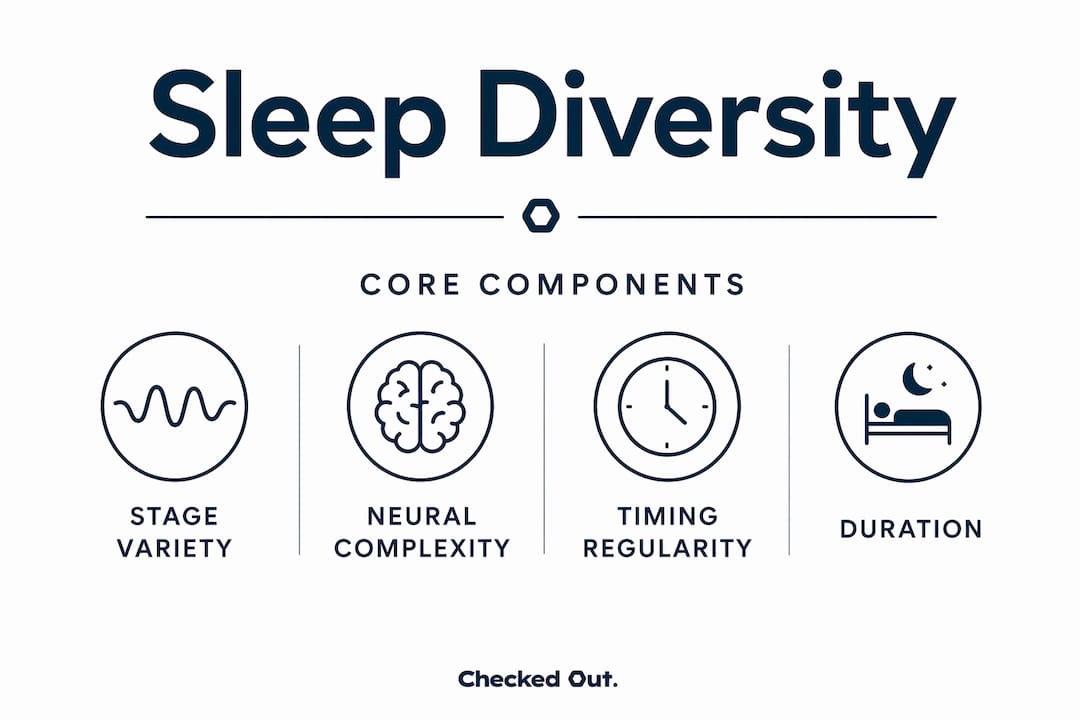
Sleep duration, by contrast, measures only one thing: total hours. You can log eight hours of fragmented, stage-poor sleep and still miss most of what diversity provides. Think of it this way: duration is the container; diversity is what fills it.
Why sleep diversity is important for your brain and body
The polyfunctional view of sleep is now well-supported: sleep doesn’t serve one master function. It serves many, and different stages carry different responsibilities.
-
Deep NREM (N3): Glymphatic clearance removes metabolic byproducts, including amyloid-beta. Protein synthesis and tissue repair peak here. This is where deep sleep earns its reputation.
-
REM sleep: Memory consolidation, emotional regulation, and creative problem-solving depend heavily on REM. Chronic REM suppression — from alcohol, certain medications, or fragmented schedules — impairs these functions measurably.
-
EEG signal complexity: Research shows EEG diversity drops progressively from wake through light NREM into deep NREM, then recovers in REM. The brain’s capacity to shift between high- and low-complexity states is itself a marker of healthy function.
Sleep deprivation selectively erodes synaptome diversity, leaving less specialized excitatory synapses that impair complex cognition even without reducing total synapse count. You can sleep eight hours and still lose the synaptic architecture that makes nuanced thinking possible.
Statistic callout: A 2026 Nature Communications study found correlations between sleep timing consistency and taxonomic changes in the gut microbiome, suggesting that irregular sleep patterns ripple outward to affect gut ecology and metabolic health.
Computational models add another layer. Diversity-induced resonance research shows that heterogeneous neuronal networks produce more stable sleep-wake cycles than uniform ones. The implication: supporting broad system balance — nutrition, light, activity timing — is more effective than targeting a single hormone.
How age and context change what healthy variability looks like
Sleep diversity isn’t a fixed target. What counts as healthy variability shifts across the lifespan, and ignoring that leads to advice that helps some people and harms others.

A microlongitudinal 14-day study comparing younger and older adults found that intraindividual variability in activity timing predicted sleep outcomes differently by age group. Younger adults generally experienced worse sleep when their daily timing varied. Older adults, however, sometimes showed adaptive benefits from variability in non-light-related activities.
Light exposure is the exception that applies to everyone. Variability in going outside — and therefore in morning light exposure — was associated with worse sleep outcomes across both age groups. That finding holds regardless of where you are in life.
Context matters too. Shiftwork, caregiving, and social jetlag create timing variability that no individual habit can fully override. These situations call for structural solutions: strategic napping, controlled light exposure, and consistent sleep opportunity windows even when the clock shifts.
Pro Tip: Before experimenting with deliberate schedule flexibility, lock in consistent light exposure timing first. Morning light anchors your circadian clock more reliably than any supplement, and its absence undermines everything else.
Practical steps to protect your sleep architecture
Protecting sleep diversity means protecting both the stages and the timing that allow them to unfold fully. These steps are grounded in the same evidence base the research above draws from.
Timing and light:
- Set a consistent wake time, even on weekends. This single habit stabilizes your circadian anchor more than any other.
- Get morning light within 30–60 minutes of waking. Natural light exposure is the most reliable circadian signal available.
- Dim artificial light in the two hours before bed to support melatonin production through your body’s own tryptophan-to-serotonin-to-melatonin pathway.
Protecting stage windows:
- Avoid alcohol within three hours of sleep. It suppresses REM in the first half of the night.
- Skip intense exercise within two hours of your target sleep time if it delays sleep onset for you.
- Keep the sleep environment dark and cool. A contoured blackout mask eliminates light intrusion without pressure on the eyes, supporting uninterrupted deep and REM cycles.
Behavioral supports:
- Strategic napping (10–20 minutes before 3 PM) can restore alertness without disrupting nighttime architecture.
- Meal timing matters. Late, heavy meals elevate core body temperature and delay the drop that triggers deep NREM.
- Mouth taping, when appropriate, supports nasal breathing, which is associated with better sleep quality and reduced fragmentation.
Pro Tip: When trialing any new sleep support, test it on non-consecutive nights for at least two weeks. Single-night impressions are unreliable. Track subjective recovery and, if you use a wearable, watch for trends in sleep consistency metrics rather than individual stage readouts.
For a deeper look at science-backed sleep steps that align with these principles, Checkedoutwellness has a dedicated resource worth bookmarking.
What can your sleep tracker actually measure?
Consumer wearables have made sleep tracking accessible, but their precision has real limits. Knowing what your device can and can’t tell you changes how you use the data.
| Method |
Sleep stages |
Timing regularity |
EEG complexity |
Molecular markers |
| Polysomnography (PSG) |
✓ Gold standard |
✓ |
✓ Direct measure |
Indirect only |
| Medical-grade home EEG |
✓ Reliable |
✓ |
✓ Limited |
No |
| Consumer wearables |
Estimated only |
✓ Strong |
No |
No |
| Sleep diary |
No |
✓ Subjective |
No |
No |
The MESA cohort analysis found that regular timing and duration combined predicted mortality outcomes better than either measure alone, which means regularity metrics — midpoint standard deviation, duration standard deviation across nights — are among the most clinically meaningful numbers your wearable can give you. Focus there, not on a single night’s stage breakdown.
If you want EEG-level data, clinical polysomnography or a validated home EEG system is the only reliable path. Consumer devices estimate stages from movement and heart rate variability. Useful for trends. Not a substitute for clinical assessment.
When should you see a sleep specialist?
Lifestyle changes and better habits resolve a lot. But some patterns signal something deeper, and waiting too long costs you.
Seek professional evaluation if you notice:
- Excessive daytime sleepiness that persists despite seven or more hours of sleep opportunity
- Loud, chronic snoring with gasping or choking episodes (a hallmark of obstructive sleep apnea)
- Cognitive decline — memory lapses, difficulty concentrating — that doesn’t improve with better sleep habits
- Persistent fragmented sleep lasting more than three to four weeks despite consistent timing and environment changes
- Unexplained weight changes, mood shifts, or metabolic symptoms alongside disrupted sleep
A clinician can offer diagnostic polysomnography, cognitive behavioral therapy for insomnia (CBT-I), and targeted medical treatment. Irregular sleep timing is linked to poorer glycemic control and cardiovascular risk markers — these aren’t just quality-of-life concerns.
Key Takeaways
Sleep diversity — spanning stage variety, neural complexity, and timing regularity — is the most complete framework for understanding what your sleep actually does for you.
| Point |
Details |
| Diversity beats duration alone |
Stage variety and timing regularity predict health outcomes better than total hours in bed. |
| EEG complexity is measurable |
Signal diversity drops from wake to deep NREM and recovers in REM; this arc reflects healthy brain function. |
| Age personalizes the advice |
Younger adults need timing consistency; older adults may benefit from some non-light activity variability. |
| Consumer devices have limits |
Wearables reliably track timing regularity but cannot measure EEG complexity or molecular markers. |
| Checkedoutwellness approach |
Drug-free, stage-preserving supports like blackout masks and circadian-friendly patches align with the science here. |
Sleep diversity and how product design should follow the science
Most sleep products on the market target a single variable: melatonin dose, white noise, or sedation. That’s a duration-only mindset applied to a polyfunctional problem.
At Checkedoutwellness, the design philosophy starts from a different place. If sleep serves multiple distinct functions across different stages, then a product that blunts REM to help you fall asleep faster is solving the wrong problem. The goal is to support the body’s own processes — the tryptophan-to-serotonin-to-melatonin conversion, the glymphatic clearance that peaks in deep NREM, the circadian timing that anchors everything.
Products manufactured under ISO 22716 GMP pharmaceutical standards, with cofactors like magnesium, B6, B12, and GABA, are designed to support those natural pathways rather than override them. The science behind these formulations is publicly available for anyone who wants to read the evidence directly.
This article is general information, not medical advice. For persistent sleep concerns, consult a qualified clinician or sleep specialist.
Sleep supports that work with your biology, not against it
Better sleep architecture doesn’t require a prescription. It requires the right inputs at the right time.

Checkedoutwellness builds drug-free sleep supports specifically for people who understand the difference between sedation and genuine recovery. The transdermal sleep patches deliver magnesium, B6, B12, and GABA transdermally, supporting your body’s own melatonin production without synthetic hormones or next-morning grogginess. The contoured blackout mask eliminates light intrusion without eye pressure, protecting the uninterrupted darkness that deep and REM sleep need. Mouth tape supports nasal breathing through the night, reducing fragmentation. All products are manufactured in South Korea under ISO 22716 GMP standards, cruelty-free, and formulated to preserve stage diversity rather than suppress it.
If you’re ready to support your sleep architecture with something your body can actually use, explore the full product range at Checkedoutwellness.
Select sources and further reading
These are the primary and peer-reviewed sources that informed this article. Consumer devices are useful for tracking timing trends; for stage-level or EEG-complexity data, clinical assessment remains the standard.
-
National Sleep Foundation consensus statement on sleep regularity — Expert panel consensus on why timing regularity matters for health outcomes.
- Sleep timing, sleep consistency, and health in adults: systematic review — Review of 41 studies (92,340 participants) linking later timing and variability to worse health.
- MESA cohort: regular sleep patterns and mortality — Prospective cohort showing regular-optimal sleep predicts lower all-cause mortality.
- Fluctuations in sleep duration and cardiometabolic risk — Links day-to-day sleep variability to glycemic and cardiovascular risk markers.
- EEG signal diversity varies with sleep stage — Empirical EEG study showing complexity drops from wake to deep NREM and recovers in REM.
- Polyfunctional view of sleep — Theoretical and review work establishing multi-system roles for distinct sleep stages.
- Synaptome diversity and sleep deprivation — Molecular evidence that sleep loss erodes specialized synaptic architecture.
- Age differences in activity variability and sleep outcomes — 14-day microlongitudinal study showing age-dependent effects of timing variability on sleep.
- Diversity-induced resonance in neuronal systems — Computational models showing heterogeneous neuronal networks produce more stable sleep-wake cycles.
- Microbiome and sleep bidirectional relationships — 2026 research linking sleep timing consistency to gut microbiome composition.
-
American Psychological Association: why sleep matters — Accessible overview of sleep’s role in health and wellbeing from a trusted clinical authority.
Recommended

Why Sleep Diversity Is Important for Better Recovery
Sleep diversity — the presence of varied sleep stages, timing patterns, and neural complexity — matters more than total hours in bed. Your brain and body don’t run a single overnight program. They run several, each stage doing work the others can’t.
Here’s what the science says, fast:
Table of Contents
What does “sleep diversity” actually mean?
Sleep diversity is not a clinical term you’ll find in a diagnostic manual. It’s a useful shorthand for three overlapping dimensions of sleep health: stage variety, intra-night neural complexity, and day-to-day timing regularity.
Stage variety refers to the full cycling of NREM stages (N1, N2, N3) and REM across a night. Neural complexity describes how much the brain’s electrical activity shifts between states, measurable via EEG. Timing regularity captures whether you fall asleep and wake at consistent times across days.
Sleep duration, by contrast, measures only one thing: total hours. You can log eight hours of fragmented, stage-poor sleep and still miss most of what diversity provides. Think of it this way: duration is the container; diversity is what fills it.
Why sleep diversity is important for your brain and body
The polyfunctional view of sleep is now well-supported: sleep doesn’t serve one master function. It serves many, and different stages carry different responsibilities.
Sleep deprivation selectively erodes synaptome diversity, leaving less specialized excitatory synapses that impair complex cognition even without reducing total synapse count. You can sleep eight hours and still lose the synaptic architecture that makes nuanced thinking possible.
Computational models add another layer. Diversity-induced resonance research shows that heterogeneous neuronal networks produce more stable sleep-wake cycles than uniform ones. The implication: supporting broad system balance — nutrition, light, activity timing — is more effective than targeting a single hormone.
How age and context change what healthy variability looks like
Sleep diversity isn’t a fixed target. What counts as healthy variability shifts across the lifespan, and ignoring that leads to advice that helps some people and harms others.
A microlongitudinal 14-day study comparing younger and older adults found that intraindividual variability in activity timing predicted sleep outcomes differently by age group. Younger adults generally experienced worse sleep when their daily timing varied. Older adults, however, sometimes showed adaptive benefits from variability in non-light-related activities.
Light exposure is the exception that applies to everyone. Variability in going outside — and therefore in morning light exposure — was associated with worse sleep outcomes across both age groups. That finding holds regardless of where you are in life.
Context matters too. Shiftwork, caregiving, and social jetlag create timing variability that no individual habit can fully override. These situations call for structural solutions: strategic napping, controlled light exposure, and consistent sleep opportunity windows even when the clock shifts.
Pro Tip: Before experimenting with deliberate schedule flexibility, lock in consistent light exposure timing first. Morning light anchors your circadian clock more reliably than any supplement, and its absence undermines everything else.
Practical steps to protect your sleep architecture
Protecting sleep diversity means protecting both the stages and the timing that allow them to unfold fully. These steps are grounded in the same evidence base the research above draws from.
Timing and light:
Protecting stage windows:
Behavioral supports:
Pro Tip: When trialing any new sleep support, test it on non-consecutive nights for at least two weeks. Single-night impressions are unreliable. Track subjective recovery and, if you use a wearable, watch for trends in sleep consistency metrics rather than individual stage readouts.
For a deeper look at science-backed sleep steps that align with these principles, Checkedoutwellness has a dedicated resource worth bookmarking.
What can your sleep tracker actually measure?
Consumer wearables have made sleep tracking accessible, but their precision has real limits. Knowing what your device can and can’t tell you changes how you use the data.
The MESA cohort analysis found that regular timing and duration combined predicted mortality outcomes better than either measure alone, which means regularity metrics — midpoint standard deviation, duration standard deviation across nights — are among the most clinically meaningful numbers your wearable can give you. Focus there, not on a single night’s stage breakdown.
If you want EEG-level data, clinical polysomnography or a validated home EEG system is the only reliable path. Consumer devices estimate stages from movement and heart rate variability. Useful for trends. Not a substitute for clinical assessment.
When should you see a sleep specialist?
Lifestyle changes and better habits resolve a lot. But some patterns signal something deeper, and waiting too long costs you.
Seek professional evaluation if you notice:
A clinician can offer diagnostic polysomnography, cognitive behavioral therapy for insomnia (CBT-I), and targeted medical treatment. Irregular sleep timing is linked to poorer glycemic control and cardiovascular risk markers — these aren’t just quality-of-life concerns.
Key Takeaways
Sleep diversity — spanning stage variety, neural complexity, and timing regularity — is the most complete framework for understanding what your sleep actually does for you.
Sleep diversity and how product design should follow the science
Most sleep products on the market target a single variable: melatonin dose, white noise, or sedation. That’s a duration-only mindset applied to a polyfunctional problem.
At Checkedoutwellness, the design philosophy starts from a different place. If sleep serves multiple distinct functions across different stages, then a product that blunts REM to help you fall asleep faster is solving the wrong problem. The goal is to support the body’s own processes — the tryptophan-to-serotonin-to-melatonin conversion, the glymphatic clearance that peaks in deep NREM, the circadian timing that anchors everything.
Products manufactured under ISO 22716 GMP pharmaceutical standards, with cofactors like magnesium, B6, B12, and GABA, are designed to support those natural pathways rather than override them. The science behind these formulations is publicly available for anyone who wants to read the evidence directly.
This article is general information, not medical advice. For persistent sleep concerns, consult a qualified clinician or sleep specialist.
Sleep supports that work with your biology, not against it
Better sleep architecture doesn’t require a prescription. It requires the right inputs at the right time.
Checkedoutwellness builds drug-free sleep supports specifically for people who understand the difference between sedation and genuine recovery. The transdermal sleep patches deliver magnesium, B6, B12, and GABA transdermally, supporting your body’s own melatonin production without synthetic hormones or next-morning grogginess. The contoured blackout mask eliminates light intrusion without eye pressure, protecting the uninterrupted darkness that deep and REM sleep need. Mouth tape supports nasal breathing through the night, reducing fragmentation. All products are manufactured in South Korea under ISO 22716 GMP standards, cruelty-free, and formulated to preserve stage diversity rather than suppress it.
If you’re ready to support your sleep architecture with something your body can actually use, explore the full product range at Checkedoutwellness.
Select sources and further reading
These are the primary and peer-reviewed sources that informed this article. Consumer devices are useful for tracking timing trends; for stage-level or EEG-complexity data, clinical assessment remains the standard.
Recommended