Overnight recovery is defined as the body’s active physiological process of repairing tissue, releasing hormones, and restoring energy during sleep. It is not passive rest. 70% of daily growth hormone release happens during slow-wave deep sleep, primarily in the first half of the night. That single fact explains why people who sleep six fragmented hours feel worse than those who sleep seven solid ones. Knowing how to enhance overnight recovery gives you a direct lever on your energy, mental clarity, and physical output every single day.
How does sleep duration and timing affect overnight recovery?
Sleep duration and timing are the two most controllable variables in your recovery equation. The American Academy of Sleep Medicine recommends 7–9 hours for adults, and that window is not arbitrary. It maps directly onto the hormonal architecture of a full night: growth hormone peaks in the first half, testosterone consolidates in the second.
Timing matters as much as total hours. Sleeping between 10pm and midnight aligns your deep sleep phases with the body’s natural growth hormone pulses. Miss that window consistently, and you are borrowing against recovery you cannot repay.
The cost of cutting sleep short is measurable and steep:
- One week at 5 hours per night reduces testosterone by 10–15%.
- A single night of total sleep deprivation drops muscle protein synthesis by 18%.
-
Lost deep sleep is very difficult to recover, making daily consistency non-negotiable.
- Irregular sleep timing fragments the hormonal rhythms that drive training adaptations.
Consistent wake time anchors your circadian rhythm more reliably than consistent bedtime. Your body calibrates cortisol, testosterone, and growth hormone release from the moment you wake. Shift that anchor point and everything downstream shifts with it.
Pro Tip: Fix your wake time first, even on weekends. Sleeping in by two or more hours on Saturday disrupts Monday’s hormonal output as reliably as a late flight would.
What environmental factors enhance quality overnight recovery?
Your bedroom environment directly controls how fast and how deep you sleep. Optimal bedroom temperature sits between 60°F and 67°F, because your core body temperature must drop 1–2 degrees to initiate and sustain deep sleep cycles. A warm room fights that process every minute of the night.

Darkness is the second critical variable. Light, especially blue-spectrum light from screens, suppresses melatonin production and delays sleep onset. Blue-light blocking glasses worn 90 minutes before bed reduce melatonin suppression by 50–58%. That is a significant gain for one simple habit.
Environmental changes that produce the fastest initial recovery improvements include:
- Cooling the room with a fan, programmable thermostat, or cooling mattress pad (avoid direct airflow on skin, which can disrupt sleep).
- Using blackout curtains or a contoured sleep mask to eliminate ambient light.
- Removing electronic devices that emit standby light or notification sounds.
- Managing noise with white noise machines or earplugs if your environment is unpredictable.
A warm shower or bath taken 90 minutes before bed works through a counterintuitive mechanism. Hot water shifts blood flow to the extremities, which triggers a rapid core temperature drop when you step out. That drop signals the brain to initiate deep sleep faster. It is one of the most evidence-supported pre-sleep habits available, and it costs nothing.
Pro Tip: Build your nighttime environment routine before you address supplements or nutrition. Sleep environment improvements yield the fastest and most significant initial recovery gains.
How can nutrition and hydration strategies boost overnight recovery?
Pre-sleep nutrition is one of the most underused tools for people who want to recover faster overnight. Consuming 30–40g of slow-digesting casein protein or cottage cheese 30–60 minutes before bed increases overnight muscle protein synthesis by 22%. Casein digests slowly across 6–8 hours, delivering a steady amino acid supply during the exact window when your body is rebuilding.
Keep that pre-sleep meal to 150–200 calories. Larger meals raise core body temperature and delay sleep onset, which defeats the purpose entirely.
Carbohydrate timing also matters for sleep quality. Eating a moderate carbohydrate meal 2–3 hours before bed improves tryptophan availability. Tryptophan is the amino acid precursor to serotonin, which converts to melatonin. That tryptophan-to-serotonin-to-melatonin conversion pathway is why a small carb portion paired with your protein snack can meaningfully improve both sleep depth and recovery.
Hydration follows a front-loading principle. Mild dehydration of just 1–2% body water loss impairs sleep quality by raising heart rate and cortisol. Drink well throughout the day, then taper intake in the final hour before bed to reduce nighttime awakenings.
| Nutrition strategy |
Timing |
Recovery benefit |
| Casein protein or cottage cheese (30–40g) |
30–60 min before bed |
+22% overnight muscle protein synthesis |
| Moderate carbohydrate meal |
2–3 hours before bed |
Improved tryptophan and melatonin production |
| Full hydration |
Throughout the day |
Prevents cortisol spike from dehydration |
| Taper fluid intake |
Final 60 min before bed |
Reduces sleep fragmentation from awakenings |
| Avoid large, fatty, or spicy meals |
Within 2 hours of bed |
Prevents thermogenic disruption to sleep onset |
Pro Tip: Pair your casein snack with a small portion of complex carbs, like a few oat crackers or a banana. The combination improves both sleep onset and the quality of muscle repair during the night.
What pre-sleep routines and training timing improve overnight recovery?
Exercise timing is a recovery variable most people ignore until it starts costing them sleep. Intense late-evening training raises cortisol and core body temperature, both of which delay sleep onset and suppress deep sleep. Finishing hard training at least two hours before bed gives your physiology time to normalize.
If late training is unavoidable, a structured cooldown makes a real difference. Light walking, gentle stretching, and a cool shower after a late session all accelerate physiological deceleration. The body reads these signals as permission to shift from performance mode into repair mode.
A 30–60 minute wind-down routine before bed is one of the highest-return habits you can build. The routine does not need to be elaborate. Dim the lights, step away from screens, do light reading or breathing work, and let your nervous system decelerate naturally. This is where science-backed sleep improvement meets daily discipline.
Key behavioral habits that support better overnight repair:
- Finish intense exercise at least two hours before bed.
- Use walking or stretching as a cooldown after late sessions.
- Dim household lights one hour before your target sleep time.
- Wear blue-light blocking glasses if screen use is unavoidable in the evening.
- Keep your wake time fixed, even after a poor night of sleep.
Late-night caffeine, alcohol, and nicotine each disrupt sleep architecture in distinct ways. Caffeine blocks adenosine receptors for up to 8 hours. Alcohol fragments REM sleep in the second half of the night. Nicotine is a stimulant that raises heart rate and delays sleep onset.
Pro Tip: Cut caffeine by 2pm if your target bedtime is 10pm. That 8-hour buffer is not conservative. It is what the half-life of caffeine actually requires.
What supplements support enhanced overnight recovery?
Supplements work best as the final layer of a recovery system, not the foundation. Supplements are ineffective when circadian rhythm and sleep environment remain disrupted. Fix timing and environment first. Then add evidence-backed supplements where genuine gaps exist.
Magnesium glycinate is the most supported starting point. 200–400mg before bed improves sleep efficiency in people who are marginally deficient, which describes a large portion of active adults. Magnesium enhances GABA receptor activity, which promotes sleep initiation and reduces nighttime arousal.
Ashwagandha addresses the cortisol side of poor recovery. Chronically elevated cortisol from stress or overtraining suppresses both sleep quality and testosterone. Ashwagandha’s adaptogenic effect on the HPA axis makes it a useful complement to magnesium for people dealing with high-stress periods. For evidence-backed supplement picks, the research consistently points to clinically supported doses rather than proprietary blends.
Melatonin is frequently misused. It is most effective for resetting disrupted sleep schedules, such as jet lag or shift work, rather than as a nightly sleep aid. Timing and dose matter: low doses (0.5–1mg) taken 60–90 minutes before the target sleep time are more effective than the 5–10mg doses commonly sold.
Pro Tip: Choose magnesium glycinate specifically, not magnesium oxide. The glycinate form has significantly better absorption and a gentler effect on digestion.
Key Takeaways
Enhancing overnight recovery requires fixing sleep timing and environment before nutrition, and nutrition before supplements, in that exact order.
| Point |
Details |
| Sleep timing is foundational |
Sleeping between 10pm and midnight aligns deep sleep with peak growth hormone release. |
| Environment drives deep sleep |
A 60–67°F room and full darkness produce the fastest initial recovery improvements. |
| Pre-sleep protein accelerates repair |
30–40g of casein 30–60 minutes before bed raises overnight muscle protein synthesis by 22%. |
| Wake time anchors hormonal rhythm |
A fixed wake time stabilizes cortisol, testosterone, and growth hormone patterns daily. |
| Supplements come last |
Magnesium glycinate and ashwagandha support recovery only after timing and environment are stable. |
What I’ve learned about recovery that most people get backwards
Here is the uncomfortable truth I have seen play out repeatedly: most people reach for a supplement before they have fixed their bedroom temperature or their wake time. The supplement feels like doing something. Changing your environment feels too simple to matter. But the research does not support that instinct. Sleep environment improvements yield the fastest and most significant initial recovery gains, before any pill or powder enters the picture.
The body keeps score quietly. You can train hard, eat well, and still feel flat if your deep sleep is fragmented. Growth hormone does not release on demand. It releases during slow-wave sleep, in a window that your lifestyle either protects or erodes. That is not motivational language. It is physiology.
What I encourage is treating recovery with the same discipline you bring to training. You would not skip a workout because it felt inconvenient. Apply that same standard to your wind-down routine, your bedroom setup, and your wake time. Incremental changes compound. A fixed wake time this week, a cooler room next week, a casein snack the week after. Each layer builds on the last.
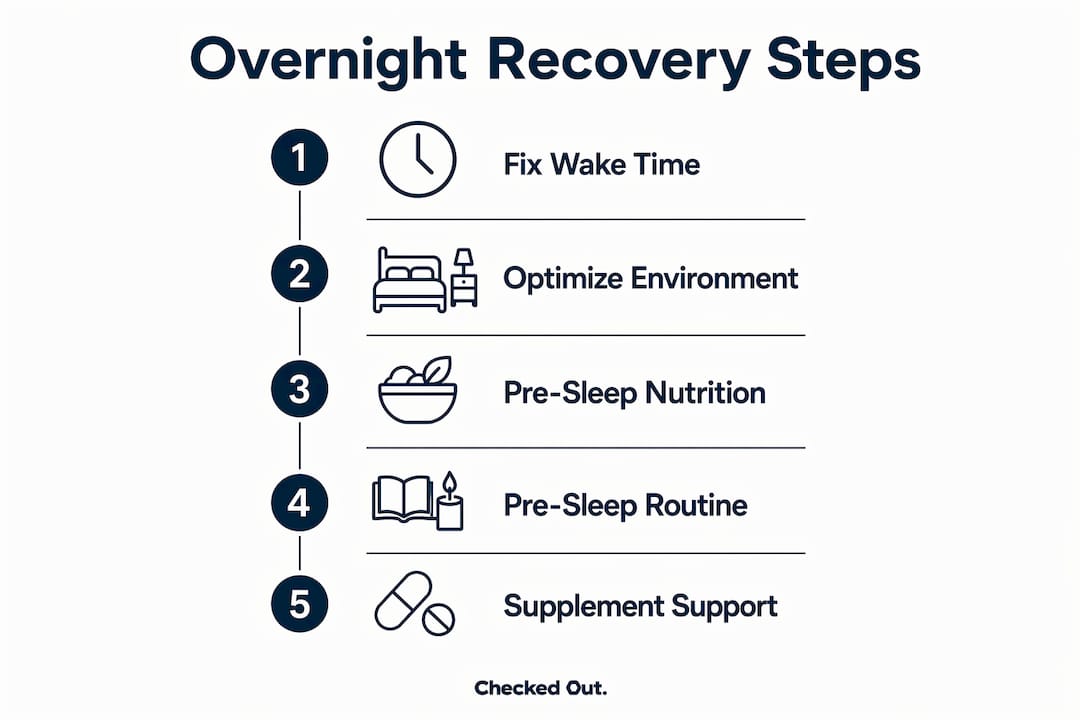
The hierarchy matters: circadian rhythm first, environment second, nutrition third, supplements last. Respect that order and the results follow. Skip it and you are spending money on supplements to compensate for problems that a thermostat and a consistent alarm could solve.
— Geeta
Checkedoutwellness products that support natural overnight repair
If you have the fundamentals in place and want to go further, the right tools make a real difference.

Checkedoutwellness offers natural sleep patches and mouth tape designed to support your body’s own recovery processes without synthetic melatonin or dependency-forming ingredients. The transdermal sleep patches deliver cofactors like magnesium, GABA, B6, and B12 directly through the skin, supporting the tryptophan-to-melatonin conversion your body already knows how to run. Every product is manufactured under ISO 22716 GMP pharmaceutical standards in South Korea. For people who have fixed their environment and timing and want a clean, drug-free edge, the Sleep Patch is worth exploring.
FAQ
What is overnight recovery?
Overnight recovery is the body’s active process of repairing muscle tissue, releasing hormones like growth hormone and testosterone, and restoring energy during sleep. It is physiologically driven, not passive, and depends heavily on deep sleep quality and duration.
How many hours of sleep does overnight recovery require?
The American Academy of Sleep Medicine recommends 7–9 hours for adults. One week at 5 hours per night reduces testosterone by 10–15% and a single night of deprivation drops muscle protein synthesis by 18%.
What is the best pre-sleep food for muscle recovery?
30–40g of casein protein or cottage cheese consumed 30–60 minutes before bed increases overnight muscle protein synthesis by 22%. Keep the meal to 150–200 calories to avoid disrupting sleep onset.
Does bedroom temperature really affect recovery?
A bedroom temperature between 60°F and 67°F is required for the core body temperature drop that initiates and sustains deep sleep. A warm room actively prevents the physiological conditions needed for restorative sleep.
When should I take magnesium for sleep?
Take 200–400mg of magnesium glycinate 30–60 minutes before bed. It enhances GABA receptor activity to support sleep initiation, but works best only after sleep timing and environment are already stable.
Recommended

How to Enhance Overnight Recovery for Peak Performance
Overnight recovery is defined as the body’s active physiological process of repairing tissue, releasing hormones, and restoring energy during sleep. It is not passive rest. 70% of daily growth hormone release happens during slow-wave deep sleep, primarily in the first half of the night. That single fact explains why people who sleep six fragmented hours feel worse than those who sleep seven solid ones. Knowing how to enhance overnight recovery gives you a direct lever on your energy, mental clarity, and physical output every single day.
How does sleep duration and timing affect overnight recovery?
Sleep duration and timing are the two most controllable variables in your recovery equation. The American Academy of Sleep Medicine recommends 7–9 hours for adults, and that window is not arbitrary. It maps directly onto the hormonal architecture of a full night: growth hormone peaks in the first half, testosterone consolidates in the second.
Timing matters as much as total hours. Sleeping between 10pm and midnight aligns your deep sleep phases with the body’s natural growth hormone pulses. Miss that window consistently, and you are borrowing against recovery you cannot repay.
The cost of cutting sleep short is measurable and steep:
Consistent wake time anchors your circadian rhythm more reliably than consistent bedtime. Your body calibrates cortisol, testosterone, and growth hormone release from the moment you wake. Shift that anchor point and everything downstream shifts with it.
Pro Tip: Fix your wake time first, even on weekends. Sleeping in by two or more hours on Saturday disrupts Monday’s hormonal output as reliably as a late flight would.
What environmental factors enhance quality overnight recovery?
Your bedroom environment directly controls how fast and how deep you sleep. Optimal bedroom temperature sits between 60°F and 67°F, because your core body temperature must drop 1–2 degrees to initiate and sustain deep sleep cycles. A warm room fights that process every minute of the night.
Darkness is the second critical variable. Light, especially blue-spectrum light from screens, suppresses melatonin production and delays sleep onset. Blue-light blocking glasses worn 90 minutes before bed reduce melatonin suppression by 50–58%. That is a significant gain for one simple habit.
Environmental changes that produce the fastest initial recovery improvements include:
A warm shower or bath taken 90 minutes before bed works through a counterintuitive mechanism. Hot water shifts blood flow to the extremities, which triggers a rapid core temperature drop when you step out. That drop signals the brain to initiate deep sleep faster. It is one of the most evidence-supported pre-sleep habits available, and it costs nothing.
Pro Tip: Build your nighttime environment routine before you address supplements or nutrition. Sleep environment improvements yield the fastest and most significant initial recovery gains.
How can nutrition and hydration strategies boost overnight recovery?
Pre-sleep nutrition is one of the most underused tools for people who want to recover faster overnight. Consuming 30–40g of slow-digesting casein protein or cottage cheese 30–60 minutes before bed increases overnight muscle protein synthesis by 22%. Casein digests slowly across 6–8 hours, delivering a steady amino acid supply during the exact window when your body is rebuilding.
Keep that pre-sleep meal to 150–200 calories. Larger meals raise core body temperature and delay sleep onset, which defeats the purpose entirely.
Carbohydrate timing also matters for sleep quality. Eating a moderate carbohydrate meal 2–3 hours before bed improves tryptophan availability. Tryptophan is the amino acid precursor to serotonin, which converts to melatonin. That tryptophan-to-serotonin-to-melatonin conversion pathway is why a small carb portion paired with your protein snack can meaningfully improve both sleep depth and recovery.
Hydration follows a front-loading principle. Mild dehydration of just 1–2% body water loss impairs sleep quality by raising heart rate and cortisol. Drink well throughout the day, then taper intake in the final hour before bed to reduce nighttime awakenings.
Pro Tip: Pair your casein snack with a small portion of complex carbs, like a few oat crackers or a banana. The combination improves both sleep onset and the quality of muscle repair during the night.
What pre-sleep routines and training timing improve overnight recovery?
Exercise timing is a recovery variable most people ignore until it starts costing them sleep. Intense late-evening training raises cortisol and core body temperature, both of which delay sleep onset and suppress deep sleep. Finishing hard training at least two hours before bed gives your physiology time to normalize.
If late training is unavoidable, a structured cooldown makes a real difference. Light walking, gentle stretching, and a cool shower after a late session all accelerate physiological deceleration. The body reads these signals as permission to shift from performance mode into repair mode.
A 30–60 minute wind-down routine before bed is one of the highest-return habits you can build. The routine does not need to be elaborate. Dim the lights, step away from screens, do light reading or breathing work, and let your nervous system decelerate naturally. This is where science-backed sleep improvement meets daily discipline.
Key behavioral habits that support better overnight repair:
Late-night caffeine, alcohol, and nicotine each disrupt sleep architecture in distinct ways. Caffeine blocks adenosine receptors for up to 8 hours. Alcohol fragments REM sleep in the second half of the night. Nicotine is a stimulant that raises heart rate and delays sleep onset.
Pro Tip: Cut caffeine by 2pm if your target bedtime is 10pm. That 8-hour buffer is not conservative. It is what the half-life of caffeine actually requires.
What supplements support enhanced overnight recovery?
Supplements work best as the final layer of a recovery system, not the foundation. Supplements are ineffective when circadian rhythm and sleep environment remain disrupted. Fix timing and environment first. Then add evidence-backed supplements where genuine gaps exist.
Magnesium glycinate is the most supported starting point. 200–400mg before bed improves sleep efficiency in people who are marginally deficient, which describes a large portion of active adults. Magnesium enhances GABA receptor activity, which promotes sleep initiation and reduces nighttime arousal.
Ashwagandha addresses the cortisol side of poor recovery. Chronically elevated cortisol from stress or overtraining suppresses both sleep quality and testosterone. Ashwagandha’s adaptogenic effect on the HPA axis makes it a useful complement to magnesium for people dealing with high-stress periods. For evidence-backed supplement picks, the research consistently points to clinically supported doses rather than proprietary blends.
Melatonin is frequently misused. It is most effective for resetting disrupted sleep schedules, such as jet lag or shift work, rather than as a nightly sleep aid. Timing and dose matter: low doses (0.5–1mg) taken 60–90 minutes before the target sleep time are more effective than the 5–10mg doses commonly sold.
Pro Tip: Choose magnesium glycinate specifically, not magnesium oxide. The glycinate form has significantly better absorption and a gentler effect on digestion.
Key Takeaways
Enhancing overnight recovery requires fixing sleep timing and environment before nutrition, and nutrition before supplements, in that exact order.
What I’ve learned about recovery that most people get backwards
Here is the uncomfortable truth I have seen play out repeatedly: most people reach for a supplement before they have fixed their bedroom temperature or their wake time. The supplement feels like doing something. Changing your environment feels too simple to matter. But the research does not support that instinct. Sleep environment improvements yield the fastest and most significant initial recovery gains, before any pill or powder enters the picture.
The body keeps score quietly. You can train hard, eat well, and still feel flat if your deep sleep is fragmented. Growth hormone does not release on demand. It releases during slow-wave sleep, in a window that your lifestyle either protects or erodes. That is not motivational language. It is physiology.
What I encourage is treating recovery with the same discipline you bring to training. You would not skip a workout because it felt inconvenient. Apply that same standard to your wind-down routine, your bedroom setup, and your wake time. Incremental changes compound. A fixed wake time this week, a cooler room next week, a casein snack the week after. Each layer builds on the last.
The hierarchy matters: circadian rhythm first, environment second, nutrition third, supplements last. Respect that order and the results follow. Skip it and you are spending money on supplements to compensate for problems that a thermostat and a consistent alarm could solve.
Checkedoutwellness products that support natural overnight repair
If you have the fundamentals in place and want to go further, the right tools make a real difference.
Checkedoutwellness offers natural sleep patches and mouth tape designed to support your body’s own recovery processes without synthetic melatonin or dependency-forming ingredients. The transdermal sleep patches deliver cofactors like magnesium, GABA, B6, and B12 directly through the skin, supporting the tryptophan-to-melatonin conversion your body already knows how to run. Every product is manufactured under ISO 22716 GMP pharmaceutical standards in South Korea. For people who have fixed their environment and timing and want a clean, drug-free edge, the Sleep Patch is worth exploring.
FAQ
What is overnight recovery?
Overnight recovery is the body’s active process of repairing muscle tissue, releasing hormones like growth hormone and testosterone, and restoring energy during sleep. It is physiologically driven, not passive, and depends heavily on deep sleep quality and duration.
How many hours of sleep does overnight recovery require?
The American Academy of Sleep Medicine recommends 7–9 hours for adults. One week at 5 hours per night reduces testosterone by 10–15% and a single night of deprivation drops muscle protein synthesis by 18%.
What is the best pre-sleep food for muscle recovery?
30–40g of casein protein or cottage cheese consumed 30–60 minutes before bed increases overnight muscle protein synthesis by 22%. Keep the meal to 150–200 calories to avoid disrupting sleep onset.
Does bedroom temperature really affect recovery?
A bedroom temperature between 60°F and 67°F is required for the core body temperature drop that initiates and sustains deep sleep. A warm room actively prevents the physiological conditions needed for restorative sleep.
When should I take magnesium for sleep?
Take 200–400mg of magnesium glycinate 30–60 minutes before bed. It enhances GABA receptor activity to support sleep initiation, but works best only after sleep timing and environment are already stable.
Recommended