REM sleep, short for rapid eye movement sleep, is the stage where your brain lights up like it’s wide awake, even though your body is completely still. During this phase, your eyes dart rapidly beneath closed lids, your heart rate climbs, and your breathing quickens. Your muscles enter a state of temporary paralysis called atonia, which prevents you from physically acting out the vivid dreams unfolding in your mind. REM sleep makes up about 25% of total sleep time in healthy adults, cycling through roughly every 90–120 minutes across the night.
What makes REM genuinely different from other sleep stages isn’t just the dreaming. It’s the fact that your brain’s electrical activity during this phase closely resembles wakefulness, while your body remains essentially paralyzed. That paradox is exactly why researchers once called it “paradoxical sleep.” The work your brain does during REM, processing memories, regulating emotions, pruning unnecessary neural connections, is irreplaceable. No other sleep stage does it quite the same way.
Key characteristics of REM sleep at a glance:
- Rapid, involuntary eye movements beneath closed eyelids
-
Brain activity mimicking wakefulness, driven by surging cholinergic neuron activity
- Temporary muscle atonia preventing dream enactment
- Elevated heart rate and irregular breathing patterns
- Vivid, narrative dreaming more common here than in any other stage
- Longer REM episodes as the night progresses, concentrated in the second half
How REM sleep fits within the full sleep cycle
Sleep isn’t a single uniform state. It moves through two broad phases: non-REM (NREM) sleep and REM sleep, alternating in cycles that last roughly 90–120 minutes each. Most people complete four to six of these cycles per night.

NREM sleep itself has three distinct stages. Stage 1 is the lightest, a brief transition from wakefulness. Stage 2 deepens slightly, with the brain producing sleep spindles and K-complexes that help consolidate memories. Stage 3, often called slow-wave or deep sleep, is the most physically restorative, when tissue repair and immune function peak. After moving through these three NREM stages, the brain shifts into REM.
Here’s what most people don’t realize: NREM dominates the first half of the night, while REM accumulates heavily in the second half. Your first REM episode might last only a few minutes. By the final cycle before you wake, you could spend up to 30 minutes in REM. Cut your sleep short by even an hour, and you disproportionately lose REM, not deep sleep.
How REM and NREM differ physiologically:
-
Brain waves: REM shows fast, desynchronized activity; NREM Stage 3 shows slow, high-amplitude delta waves
-
Muscle tone: Near-zero during REM (atonia); moderate during NREM
-
Eye movements: Rapid and frequent in REM; absent in NREM
-
Dreaming: Vivid and narrative in REM; rare or fragmented in NREM
-
Primary function: Cognitive and emotional repair in REM; physical restoration in NREM
Understanding deep sleep’s distinct role alongside REM helps clarify why both stages are non-negotiable for full recovery.
Why REM sleep is critical for your brain and long-term health
The brain doesn’t rest during REM. It consolidates what you learned, strips away emotional charge from difficult memories, and clears cellular waste that accumulates during waking hours. This isn’t a passive process. It’s active, metabolically demanding, and deeply tied to your long-term cognitive health.

The dementia research alone should give you pause. Each 1% reduction in REM sleep is associated with a 9% higher risk of developing dementia, according to research published in the journal Neurology. That’s not a marginal finding. It suggests that chronically shortchanging your REM sleep isn’t just leaving you groggy the next morning; it may be quietly accelerating neurological decline over years.
REM and NREM serve complementary functions, not competing ones. NREM handles physical repair; REM handles the cognitive and emotional architecture. You need both, in sufficient amounts, every night. Treating one as optional is like skipping either the foundation or the roof when building a house.
How much REM sleep do you actually need?
The short answer: about 25% of your total sleep time. For an adult sleeping eight hours, a substantial portion of that time is spent in REM sleep, supporting cognitive and emotional maintenance. But the distribution matters as much as the total.
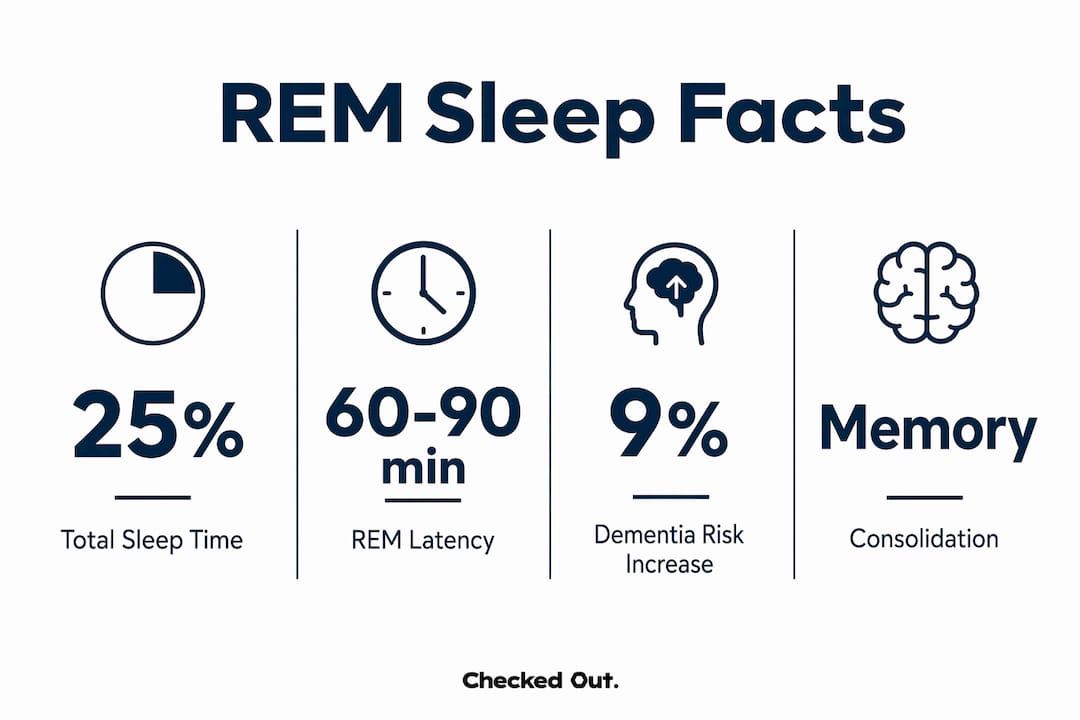
REM latency, the time between falling asleep and entering your first REM episode, typically runs 60–90 minutes. That first episode is brief. Each successive cycle extends it, so the bulk of your REM accumulates in the hours just before you naturally wake. This is why sleeping from midnight to 6:00 AM delivers far less REM than sleeping from 11:00 PM to 7:00 AM, even though the difference is just one hour.
| Age group |
Approximate REM per night |
Notes |
| Newborns |
— |
Supports rapid neural development |
| Infants (6–12 months) |
25% |
Brain plasticity at its peak |
| Children (3–12 years) |
25% |
Consolidates learning and motor skills |
| Adults |
25% |
Cognitive and emotional maintenance |
| Older adults (65+) |
Tends to decrease with age |
REM fragmentation becomes more common |
What affects REM timing and duration:
- Sleep duration: shorter nights cut REM disproportionately, since it concentrates late in the cycle
- Sleep timing: earlier sleep onset preserves more REM-rich late-cycle hours
- Age: infants need the most REM; older adults naturally get less
- Alcohol and sedatives: suppress REM even when total sleep time appears normal
What REM sleep does for memory, learning, and emotional balance
Think of REM as your brain’s overnight editor. During this stage, it decides what to keep, what to discard, and how to file the emotional weight attached to the day’s experiences. The result, when REM is sufficient, is sharper recall, better problem-solving, and a more stable mood.
REM sleep supports memory consolidation, emotional processing, and brain development, particularly in infants and children whose neural architecture is still forming. For adults, the benefits are equally concrete: REM is when procedural memories (how to play a chord, how to execute a new skill) get locked in, and when the emotional sting of difficult experiences gets metabolically processed rather than left raw.
Core cognitive and emotional benefits of REM sleep:
- Consolidates declarative memory (facts, events) and procedural memory (skills, habits)
- Processes emotional memories, reducing their psychological intensity over time
- Supports creative thinking and novel problem-solving by linking disparate ideas
- Drives neural development and brain plasticity, especially in early life
- Stabilizes mood by regulating the amygdala’s response to emotional stimuli
- Strengthens the immune system’s memory response after vaccination or illness
The connection between REM and emotional regulation is one of the most underappreciated aspects of sleep science. People who consistently get adequate REM tend to recover from stressful events faster and show lower baseline anxiety. The body keeps score quietly, and REM is part of how it settles the ledger.
Expert-backed natural strategies to improve REM sleep quality
The most reliable way to protect your REM sleep is also the least glamorous: consistency. Your circadian rhythm governs when your body expects to enter each sleep stage, and maintaining a consistent circadian rhythm is the single most effective way to preserve healthy REM architecture night after night.
Alcohol is one of the most common REM disruptors, and it’s worth understanding why. A drink or two in the evening may help you fall asleep faster, but it suppresses REM in the first half of the night. As the alcohol metabolizes, the brain rebounds into fragmented, lighter sleep, often with vivid or anxious dreams. The net result is less total REM and worse sleep quality overall.
Practical steps to support REM sleep naturally:
- Keep wake and sleep times consistent, even on weekends, to anchor your circadian rhythm
- Avoid caffeine after 2:00 PM and alcohol within three hours of bedtime
- Keep your bedroom cool (around 65–68°F), dark, and quiet
- Treat underlying conditions like obstructive sleep apnea, which fragments REM severely
- Reduce screen exposure in the hour before bed to support natural melatonin production
- Exercise regularly, but finish intense workouts at least three hours before sleep
Pro Tip: If you’ve had a run of poor sleep, resist the urge to “catch up” with a single long weekend sleep-in. People cannot fully recover missed REM through naps or irregular extended sleep. Consistent nightly habits rebuild REM architecture far more effectively than sporadic attempts to compensate.
When REM is lost, the brain does attempt to recover it through a process called REM rebound. REM rebound occurs after deprivation, with the body entering REM earlier and staying in it longer during subsequent sleep. This can trigger unusually vivid or intense dreams as the brain processes accumulated emotional material. It’s a useful compensatory mechanism, but it’s not a substitute for consistent sleep.
For a deeper look at science-backed sleep strategies that support REM and overall sleep quality, the evidence points clearly toward behavioral consistency over any single intervention.
Common REM sleep disorders and how they affect your health
Not everyone moves through REM sleep without incident. Several well-documented disorders specifically disrupt this stage, with consequences ranging from disruptive to dangerous.
REM sleep behavior disorder (RBD) is one of the most striking. Normally, muscle atonia prevents any physical movement during REM. In RBD, that paralysis fails. People physically act out their dreams, sometimes violently, punching, kicking, or shouting while asleep. RBD is strongly associated with neurodegenerative conditions; research has linked it to an elevated risk of developing Parkinson’s disease and Lewy body dementia years before other symptoms appear. It’s diagnosed through polysomnography (PSG), the gold-standard sleep study, and managed with medications like clonazepam or melatonin under physician supervision.
Narcolepsy disrupts the boundary between REM and wakefulness in a different way. People with narcolepsy experience sudden, uncontrollable episodes of sleep during the day, often entering REM almost immediately rather than after the normal 60–90 minute latency period. Many also experience cataplexy, a sudden loss of muscle tone triggered by strong emotion, which reflects the inappropriate activation of REM’s sleep-paralysis mechanism while the person is awake. The condition stems from the loss of hypocretin-producing neurons in the hypothalamus and requires long-term medical management.
Sleep paralysis, while alarming, is generally benign. It occurs when the brain transitions out of REM but muscle atonia lingers briefly, leaving a person temporarily unable to move while conscious. Episodes typically last seconds to a few minutes and resolve on their own. Stress, sleep deprivation, and irregular sleep schedules increase its frequency.
Each of these disorders underscores the same point: REM sleep is a precisely regulated state, and when its mechanisms go wrong, the effects reach far beyond a bad night’s rest.
How age, medication, and lifestyle shape your REM sleep
REM sleep isn’t static across a lifetime. It shifts dramatically from birth through old age, and it responds to nearly every major lifestyle variable you can name.
Age is the most consistent factor. Newborns spend close to half their sleep time in REM, which reflects the extraordinary pace of neural development in early life. That proportion drops steadily through childhood and adolescence. By adulthood, REM stabilizes at about 25% of total sleep. In older adults, REM tends to fragment and decrease further, partly due to changes in cholinergic neuron activity, the same neurochemical system that drives REM in the first place.
Medications are a frequently overlooked disruptor. Certain antidepressants and sleep aids suppress REM sleep, sometimes dramatically, even when total sleep duration appears normal. Selective serotonin reuptake inhibitors (SSRIs), tricyclic antidepressants, and many over-the-counter sleep aids all carry this effect. People taking these medications often report sleeping a full eight hours but waking unrefreshed, which is a recognizable signature of REM suppression. Anyone experiencing this pattern should discuss it with their prescribing physician rather than simply increasing sleep duration.
Lifestyle factors compound over time in ways that aren’t always obvious. Chronic stress elevates cortisol, which disrupts the neurochemical balance that governs REM onset. Alcohol, as noted earlier, suppresses REM in the first sleep cycles. Irregular schedules fragment the circadian rhythm that REM depends on. Even shift work, which forces sleep at biologically misaligned times, reduces REM efficiency. The good news is that most lifestyle-driven REM disruption is reversible. Rebuilding consistent sleep habits, addressing stress, and reviewing medications with a doctor can restore healthy REM proportions within weeks.

Understanding REM sleep is one thing. Giving your body the conditions to actually achieve it is another. Checkedoutwellness was built for exactly this: people who take their sleep as seriously as their training, their nutrition, and their long-term health. The natural sleep patch delivers key cofactors including magnesium, B6, B12, and GABA transdermally overnight, supporting your body’s own melatonin production without synthetic additives or dependency. Pair it with a contoured blackout mask to eliminate the light disruption that fragments late-cycle REM, and you’ve addressed two of the most common environmental barriers to quality sleep.
Every product is manufactured in South Korea under ISO 22716 GMP pharmaceutical standards, drug-free, cruelty-free, and built around the science of how sleep actually works. Explore the full range at Checkedoutwellness.
Key Takeaways
REM sleep makes up roughly 25% of total sleep time and is the stage most critical for memory consolidation, emotional regulation, and long-term brain health.
| Point |
Details |
| REM share of sleep |
REM comprises about 25% of total sleep, cycling every 90–120 minutes throughout the night. |
| Dementia risk link |
Each 1% reduction in REM sleep is associated with a 9% higher risk of developing dementia. |
| REM timing |
REM concentrates in the second half of the night; cutting sleep short disproportionately reduces it. |
| Age and REM |
Infants need the most REM for neural development; adults average about 25% of total sleep time. |
| Best way to protect REM |
Consistent sleep and wake times, limiting alcohol and caffeine, and treating sleep disorders preserve healthy REM architecture. |
Recommended

What Is REM Sleep and Why It Matters for Your Health
REM sleep, short for rapid eye movement sleep, is the stage where your brain lights up like it’s wide awake, even though your body is completely still. During this phase, your eyes dart rapidly beneath closed lids, your heart rate climbs, and your breathing quickens. Your muscles enter a state of temporary paralysis called atonia, which prevents you from physically acting out the vivid dreams unfolding in your mind. REM sleep makes up about 25% of total sleep time in healthy adults, cycling through roughly every 90–120 minutes across the night.
What makes REM genuinely different from other sleep stages isn’t just the dreaming. It’s the fact that your brain’s electrical activity during this phase closely resembles wakefulness, while your body remains essentially paralyzed. That paradox is exactly why researchers once called it “paradoxical sleep.” The work your brain does during REM, processing memories, regulating emotions, pruning unnecessary neural connections, is irreplaceable. No other sleep stage does it quite the same way.
Key characteristics of REM sleep at a glance:
How REM sleep fits within the full sleep cycle
Sleep isn’t a single uniform state. It moves through two broad phases: non-REM (NREM) sleep and REM sleep, alternating in cycles that last roughly 90–120 minutes each. Most people complete four to six of these cycles per night.
NREM sleep itself has three distinct stages. Stage 1 is the lightest, a brief transition from wakefulness. Stage 2 deepens slightly, with the brain producing sleep spindles and K-complexes that help consolidate memories. Stage 3, often called slow-wave or deep sleep, is the most physically restorative, when tissue repair and immune function peak. After moving through these three NREM stages, the brain shifts into REM.
Here’s what most people don’t realize: NREM dominates the first half of the night, while REM accumulates heavily in the second half. Your first REM episode might last only a few minutes. By the final cycle before you wake, you could spend up to 30 minutes in REM. Cut your sleep short by even an hour, and you disproportionately lose REM, not deep sleep.
How REM and NREM differ physiologically:
Understanding deep sleep’s distinct role alongside REM helps clarify why both stages are non-negotiable for full recovery.
Why REM sleep is critical for your brain and long-term health
The brain doesn’t rest during REM. It consolidates what you learned, strips away emotional charge from difficult memories, and clears cellular waste that accumulates during waking hours. This isn’t a passive process. It’s active, metabolically demanding, and deeply tied to your long-term cognitive health.
The dementia research alone should give you pause. Each 1% reduction in REM sleep is associated with a 9% higher risk of developing dementia, according to research published in the journal Neurology. That’s not a marginal finding. It suggests that chronically shortchanging your REM sleep isn’t just leaving you groggy the next morning; it may be quietly accelerating neurological decline over years.
REM and NREM serve complementary functions, not competing ones. NREM handles physical repair; REM handles the cognitive and emotional architecture. You need both, in sufficient amounts, every night. Treating one as optional is like skipping either the foundation or the roof when building a house.
How much REM sleep do you actually need?
The short answer: about 25% of your total sleep time. For an adult sleeping eight hours, a substantial portion of that time is spent in REM sleep, supporting cognitive and emotional maintenance. But the distribution matters as much as the total.
REM latency, the time between falling asleep and entering your first REM episode, typically runs 60–90 minutes. That first episode is brief. Each successive cycle extends it, so the bulk of your REM accumulates in the hours just before you naturally wake. This is why sleeping from midnight to 6:00 AM delivers far less REM than sleeping from 11:00 PM to 7:00 AM, even though the difference is just one hour.
What affects REM timing and duration:
What REM sleep does for memory, learning, and emotional balance
Think of REM as your brain’s overnight editor. During this stage, it decides what to keep, what to discard, and how to file the emotional weight attached to the day’s experiences. The result, when REM is sufficient, is sharper recall, better problem-solving, and a more stable mood.
REM sleep supports memory consolidation, emotional processing, and brain development, particularly in infants and children whose neural architecture is still forming. For adults, the benefits are equally concrete: REM is when procedural memories (how to play a chord, how to execute a new skill) get locked in, and when the emotional sting of difficult experiences gets metabolically processed rather than left raw.
Core cognitive and emotional benefits of REM sleep:
The connection between REM and emotional regulation is one of the most underappreciated aspects of sleep science. People who consistently get adequate REM tend to recover from stressful events faster and show lower baseline anxiety. The body keeps score quietly, and REM is part of how it settles the ledger.
Expert-backed natural strategies to improve REM sleep quality
The most reliable way to protect your REM sleep is also the least glamorous: consistency. Your circadian rhythm governs when your body expects to enter each sleep stage, and maintaining a consistent circadian rhythm is the single most effective way to preserve healthy REM architecture night after night.
Alcohol is one of the most common REM disruptors, and it’s worth understanding why. A drink or two in the evening may help you fall asleep faster, but it suppresses REM in the first half of the night. As the alcohol metabolizes, the brain rebounds into fragmented, lighter sleep, often with vivid or anxious dreams. The net result is less total REM and worse sleep quality overall.
Practical steps to support REM sleep naturally:
Pro Tip: If you’ve had a run of poor sleep, resist the urge to “catch up” with a single long weekend sleep-in. People cannot fully recover missed REM through naps or irregular extended sleep. Consistent nightly habits rebuild REM architecture far more effectively than sporadic attempts to compensate.
When REM is lost, the brain does attempt to recover it through a process called REM rebound. REM rebound occurs after deprivation, with the body entering REM earlier and staying in it longer during subsequent sleep. This can trigger unusually vivid or intense dreams as the brain processes accumulated emotional material. It’s a useful compensatory mechanism, but it’s not a substitute for consistent sleep.
For a deeper look at science-backed sleep strategies that support REM and overall sleep quality, the evidence points clearly toward behavioral consistency over any single intervention.
Common REM sleep disorders and how they affect your health
Not everyone moves through REM sleep without incident. Several well-documented disorders specifically disrupt this stage, with consequences ranging from disruptive to dangerous.
REM sleep behavior disorder (RBD) is one of the most striking. Normally, muscle atonia prevents any physical movement during REM. In RBD, that paralysis fails. People physically act out their dreams, sometimes violently, punching, kicking, or shouting while asleep. RBD is strongly associated with neurodegenerative conditions; research has linked it to an elevated risk of developing Parkinson’s disease and Lewy body dementia years before other symptoms appear. It’s diagnosed through polysomnography (PSG), the gold-standard sleep study, and managed with medications like clonazepam or melatonin under physician supervision.
Narcolepsy disrupts the boundary between REM and wakefulness in a different way. People with narcolepsy experience sudden, uncontrollable episodes of sleep during the day, often entering REM almost immediately rather than after the normal 60–90 minute latency period. Many also experience cataplexy, a sudden loss of muscle tone triggered by strong emotion, which reflects the inappropriate activation of REM’s sleep-paralysis mechanism while the person is awake. The condition stems from the loss of hypocretin-producing neurons in the hypothalamus and requires long-term medical management.
Sleep paralysis, while alarming, is generally benign. It occurs when the brain transitions out of REM but muscle atonia lingers briefly, leaving a person temporarily unable to move while conscious. Episodes typically last seconds to a few minutes and resolve on their own. Stress, sleep deprivation, and irregular sleep schedules increase its frequency.
Each of these disorders underscores the same point: REM sleep is a precisely regulated state, and when its mechanisms go wrong, the effects reach far beyond a bad night’s rest.
How age, medication, and lifestyle shape your REM sleep
REM sleep isn’t static across a lifetime. It shifts dramatically from birth through old age, and it responds to nearly every major lifestyle variable you can name.
Age is the most consistent factor. Newborns spend close to half their sleep time in REM, which reflects the extraordinary pace of neural development in early life. That proportion drops steadily through childhood and adolescence. By adulthood, REM stabilizes at about 25% of total sleep. In older adults, REM tends to fragment and decrease further, partly due to changes in cholinergic neuron activity, the same neurochemical system that drives REM in the first place.
Medications are a frequently overlooked disruptor. Certain antidepressants and sleep aids suppress REM sleep, sometimes dramatically, even when total sleep duration appears normal. Selective serotonin reuptake inhibitors (SSRIs), tricyclic antidepressants, and many over-the-counter sleep aids all carry this effect. People taking these medications often report sleeping a full eight hours but waking unrefreshed, which is a recognizable signature of REM suppression. Anyone experiencing this pattern should discuss it with their prescribing physician rather than simply increasing sleep duration.
Lifestyle factors compound over time in ways that aren’t always obvious. Chronic stress elevates cortisol, which disrupts the neurochemical balance that governs REM onset. Alcohol, as noted earlier, suppresses REM in the first sleep cycles. Irregular schedules fragment the circadian rhythm that REM depends on. Even shift work, which forces sleep at biologically misaligned times, reduces REM efficiency. The good news is that most lifestyle-driven REM disruption is reversible. Rebuilding consistent sleep habits, addressing stress, and reviewing medications with a doctor can restore healthy REM proportions within weeks.
Support your REM sleep with science-backed tools
Understanding REM sleep is one thing. Giving your body the conditions to actually achieve it is another. Checkedoutwellness was built for exactly this: people who take their sleep as seriously as their training, their nutrition, and their long-term health. The natural sleep patch delivers key cofactors including magnesium, B6, B12, and GABA transdermally overnight, supporting your body’s own melatonin production without synthetic additives or dependency. Pair it with a contoured blackout mask to eliminate the light disruption that fragments late-cycle REM, and you’ve addressed two of the most common environmental barriers to quality sleep.
Every product is manufactured in South Korea under ISO 22716 GMP pharmaceutical standards, drug-free, cruelty-free, and built around the science of how sleep actually works. Explore the full range at Checkedoutwellness.
Key Takeaways
REM sleep makes up roughly 25% of total sleep time and is the stage most critical for memory consolidation, emotional regulation, and long-term brain health.
Recommended