Sleep consistency is the practice of going to bed and waking up at roughly the same times every day, and it is one of the most powerful levers you can pull for your physical and mental health. Most people focus on how many hours they sleep. The research tells a different story. Sleep regularity can be a stronger predictor of health and alertness than total sleep duration alone. Your body runs on a precise internal clock, and every time you shift your schedule, you force that clock to recalibrate. The cost of that recalibration shows up in your heart, your metabolism, your mood, and your memory.
Why sleep consistency matters for your circadian rhythm
Your circadian rhythm is your body’s 24-hour internal clock. It governs when cortisol rises to wake you, when melatonin falls to keep you alert, when your core temperature dips to prepare you for deep sleep, and when your immune system does its most active repair work. Every one of these processes depends on predictable timing.
When your sleep schedule shifts even by an hour or two, the circadian clock loses its anchor. Sleep disruption raises stress hormones and adrenaline, which places direct strain on the cardiovascular system and throws off metabolic regulation. Think of it like a conductor who shows up late. Every section of the orchestra waits, then rushes, and the whole performance suffers.
Consistent sleep timing produces measurable biological benefits across multiple systems:
-
Hormonal balance: Stable sleep schedules support the tryptophan-to-serotonin-to-melatonin conversion pathway, keeping mood and sleep onset predictable.
-
Cardiovascular health: Regular timing reduces autonomic nervous system stress, which stabilizes blood pressure and heart rate variability.
-
Memory consolidation: The brain cycles through REM and non-REM stages in a fixed sequence. Irregular sleep compresses or skips stages, reducing the quality of memory storage.
-
Immune function: The immune system releases cytokines during specific sleep stages. Shifting those stages weakens the immune response.
Consistent sleep supports steadier release of mood-regulating hormones and better progression through sleep stages. That means fewer mornings where you wake up foggy, and fewer afternoons where your energy crashes without warning.
Pro Tip: Set both a bedtime alarm and a wake alarm. Most people only set one. The bedtime alarm is the cue your body needs to begin winding down before your head hits the pillow.

What does the science say about regular sleep patterns?
The evidence linking sleep consistency to long-term health is not subtle. A 10-year cohort study found that individuals aged 40–60 with irregular bedtimes had twice the risk of heart problems compared to those with consistent schedules when sleeping fewer than 8 hours per night. That is not a marginal difference. It is the kind of risk elevation that cardiologists now track alongside blood pressure and cholesterol.
The cardiovascular connection runs deeper than most people realize. Experts recommend a 30–60 minute bedtime window as the optimal range for heart health and mood stability. Falling asleep within that same interval each night is linked to better blood pressure control and improved heart rate variability. Both markers are strong predictors of long-term cardiac health.
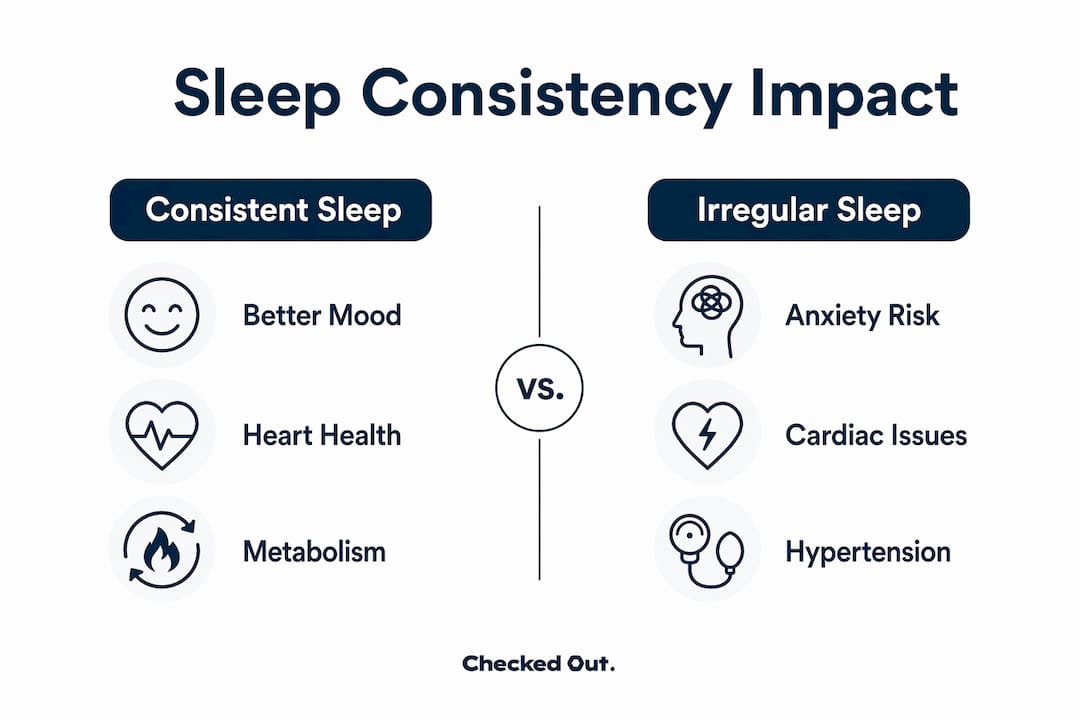
The metabolic picture is equally clear. People who sleep fewer than 6 hours consistently face higher risks of hypertension, obesity, and type 2 diabetes. Timing and consistency compound those risks beyond what duration alone explains. Your body’s insulin sensitivity, appetite hormones like ghrelin and leptin, and fat storage signals all reset during sleep. Disrupt the timing, and those resets become unreliable. You can read more about the metabolic consequences of chronic sleep disruption and why they accumulate faster than most people expect.
Sleep also functions as what researchers describe as a “housekeeping mode.” Hormonal repair and memory consolidation rely heavily on regular timing to complete their cycles. When you shift your schedule, the housekeeping gets interrupted mid-task. The body keeps score quietly, and the bill arrives years later.

The mental health data reinforces the same conclusion. Irregular sleep patterns correlate with higher rates of anxiety, depression, and cognitive decline. The mechanism is direct: cortisol dysregulation from inconsistent sleep keeps the nervous system in a low-grade stress state, which erodes emotional resilience over time. For anyone tracking their sleep and longevity, consistency is not optional. It is the foundation everything else rests on.
Why is wake-up time more important than bedtime?
Most people trying to fix their sleep focus on when they go to bed. The research points in a different direction. Maintaining a fixed wake time anchors the internal clock more strongly than bedtime consistency. Wake time sets the timing of cortisol release, which determines when melatonin onset begins that evening. Get the wake time right, and the bedtime often follows naturally.
Morning light is the key mechanism. When light hits your retina within the first 30 minutes of waking, it sends a direct signal to the suprachiasmatic nucleus, the brain’s master clock. That signal locks in the timing of every subsequent hormonal event for the next 24 hours. Skipping morning light or waking at inconsistent times means the clock never gets a clean signal to lock onto.
This has a practical implication that most sleep advice ignores. You can allow yourself some flexibility in when you fall asleep on a given night, particularly on weekends, without major consequences. What you cannot afford is a variable wake time. Anchor the morning, and the rest of the schedule stabilizes around it. For additional context on how natural sleep hormones respond to light and timing cues, the biology is worth understanding in detail.
Pro Tip: Get outside within 30 minutes of waking, even on cloudy days. Outdoor light is 10 to 50 times brighter than indoor lighting and delivers a far stronger circadian signal to your brain.
How to build and maintain a consistent sleep routine
Building sleep consistency does not require perfection. It requires patience and a few well-placed habits. Behavioral adaptation to a new sleep routine takes about three days to initiate, with noticeable mood and alertness benefits appearing after one week. That timeline matters because most people quit before the benefits arrive.
Here is a practical framework for establishing a stable sleep schedule:
-
Fix your wake time first. Choose a time you can hold seven days a week, including weekends, and commit to it for at least two weeks before adjusting anything else.
-
Shift gradually. If your current wake time is 9:00 AM and your target is 6:30 AM, move in 15-minute increments every two to three days. Sudden shifts create more disruption than they solve.
-
Cap weekend sleep-ins. Sleeping more than 30 minutes later on weekends disrupts the circadian rhythm and worsens sleep quality across the following week. A small indulgence becomes a weekly reset you have to undo.
-
Build a wind-down window. Spend 30 to 45 minutes before bed doing low-stimulation activities. Reading, light stretching, and dim lighting all signal the nervous system to downshift.
-
Minimize screens before sleep. Blue light from phones and laptops suppresses melatonin production. The effect is dose-dependent, so even reducing screen time by 30 minutes makes a measurable difference.
Beyond the schedule itself, your sleep environment reinforces or undermines your routine. A dark, cool room removes the two most common barriers to falling asleep on time. Blackout conditions eliminate light-based circadian disruption, which is especially relevant for anyone sleeping during daylight hours or in urban environments with significant light pollution.
Social jet lag is the most underestimated threat to sleep consistency. It describes the gap between your biological sleep timing and your social schedule, and it affects a large portion of the working population. The fix is not eliminating social life. It is moderating the deviation. Keep weekend shifts under 30 minutes, prioritize morning light on Monday, and your clock recovers within a day rather than dragging through the whole week. Resources on sleep tips for light sleepers offer additional environment and behavioral strategies worth applying here.
Pro Tip: Prepare your sleep environment before your wind-down begins, not after. Lowering the thermostat, laying out your sleep mask, and dimming lights 45 minutes early removes friction at the moment your willpower is lowest.
Key Takeaways
Sleep regularity is a stronger predictor of long-term health than total sleep duration, making consistent timing the single most important variable in any sleep improvement plan.
| Point |
Details |
| Consistency beats duration |
Sleep regularity predicts health outcomes more reliably than total hours slept each night. |
| Wake time is the anchor |
Fixing your wake time stabilizes cortisol and melatonin timing across the full 24-hour cycle. |
| Heart risk doubles with irregularity |
Adults aged 40–60 with shifting bedtimes face twice the cardiac risk when sleeping under 8 hours. |
| Weekend sleep-ins cost more than they give |
Sleeping in more than 30 minutes on weekends disrupts the circadian clock and degrades the following week’s sleep. |
| Adaptation takes one week |
Mood and alertness improvements from a new consistent schedule become noticeable after approximately seven days. |
What I have learned from watching people fix their sleep
By Geeta
The clients I have worked with who struggle most with sleep are rarely the ones who sleep too little. They are the ones who sleep inconsistently. Seven hours on Monday, five on Tuesday, nine on Saturday. The body cannot build anything stable on that foundation.
What surprises most people is how quickly things shift when they commit to a fixed wake time. Not a perfect bedtime, not a strict wind-down ritual, just one anchor point in the morning. Within a week, they report feeling more alert by mid-morning and less wired at midnight. The circadian clock is remarkably responsive once you stop fighting it.
The harder conversation is about weekends. People resist giving up their Saturday sleep-in because it feels like the one recovery tool they have. But that sleep-in is often what makes Monday feel so brutal. The body spent two days recalibrating to a later schedule and then got yanked back. The tiredness on Monday is not from the week. It is from the weekend.
My honest observation after years of this work: small, repeated habits build the health outcomes that dramatic interventions never quite deliver. You do not need a perfect sleep stack or a $500 tracker. You need a consistent wake time, morning light, and a dark room. Start there. The rest builds on top of that foundation. External resources like The Mentor Well’s sleep and wellness content offer thoughtful perspectives on the emotional side of building these habits, which is often the piece people underestimate.
— Geeta
Supporting your sleep routine with Checkedoutwellness
Behavioral consistency is the foundation. The right sleep environment and targeted nutritional support make that foundation easier to hold.

Checkedoutwellness designs drug-free sleep aids built specifically for people who take their recovery as seriously as their training and nutrition. The natural sleep patches deliver magnesium, B6, B12, and GABA transdermally overnight, supporting your body’s own melatonin production without synthetic hormones or dependency risk. The contoured blackout sleep mask eliminates light intrusion completely, removing one of the most common barriers to falling asleep at a consistent time. Both products are manufactured under ISO 22716 GMP pharmaceutical standards in South Korea. They are built to complement the habits you are already building, not replace them.
FAQ
What is sleep consistency?
Sleep consistency is the practice of going to bed and waking up at approximately the same times every day. Experts recommend staying within a 30–60 minute window each night for the strongest health benefits.
How does sleep consistency affect heart health?
Adults aged 40–60 with irregular bedtimes face twice the risk of cardiac events compared to those with stable schedules. Consistent sleep timing reduces stress hormones and supports healthy blood pressure and heart rate variability.
Is wake time or bedtime more important for sleep consistency?
Wake time is more important. A fixed wake time anchors the circadian clock by triggering morning cortisol release and setting the timing of melatonin onset later that evening.
How long does it take to adjust to a new sleep schedule?
Behavioral adaptation begins within about three days of starting a new routine. Noticeable improvements in mood and alertness typically appear after one full week of consistent timing.
What is social jet lag and why does it matter?
Social jet lag is the gap between your biological sleep timing and your social schedule, most commonly caused by sleeping in on weekends. Shifting your wake time by more than 30 minutes on weekends disrupts the circadian rhythm and degrades sleep quality for the days that follow.
Recommended

Why Sleep Consistency Matters for Your Health
Sleep consistency is the practice of going to bed and waking up at roughly the same times every day, and it is one of the most powerful levers you can pull for your physical and mental health. Most people focus on how many hours they sleep. The research tells a different story. Sleep regularity can be a stronger predictor of health and alertness than total sleep duration alone. Your body runs on a precise internal clock, and every time you shift your schedule, you force that clock to recalibrate. The cost of that recalibration shows up in your heart, your metabolism, your mood, and your memory.
Why sleep consistency matters for your circadian rhythm
Your circadian rhythm is your body’s 24-hour internal clock. It governs when cortisol rises to wake you, when melatonin falls to keep you alert, when your core temperature dips to prepare you for deep sleep, and when your immune system does its most active repair work. Every one of these processes depends on predictable timing.
When your sleep schedule shifts even by an hour or two, the circadian clock loses its anchor. Sleep disruption raises stress hormones and adrenaline, which places direct strain on the cardiovascular system and throws off metabolic regulation. Think of it like a conductor who shows up late. Every section of the orchestra waits, then rushes, and the whole performance suffers.
Consistent sleep timing produces measurable biological benefits across multiple systems:
Consistent sleep supports steadier release of mood-regulating hormones and better progression through sleep stages. That means fewer mornings where you wake up foggy, and fewer afternoons where your energy crashes without warning.
Pro Tip: Set both a bedtime alarm and a wake alarm. Most people only set one. The bedtime alarm is the cue your body needs to begin winding down before your head hits the pillow.
What does the science say about regular sleep patterns?
The evidence linking sleep consistency to long-term health is not subtle. A 10-year cohort study found that individuals aged 40–60 with irregular bedtimes had twice the risk of heart problems compared to those with consistent schedules when sleeping fewer than 8 hours per night. That is not a marginal difference. It is the kind of risk elevation that cardiologists now track alongside blood pressure and cholesterol.
The cardiovascular connection runs deeper than most people realize. Experts recommend a 30–60 minute bedtime window as the optimal range for heart health and mood stability. Falling asleep within that same interval each night is linked to better blood pressure control and improved heart rate variability. Both markers are strong predictors of long-term cardiac health.
The metabolic picture is equally clear. People who sleep fewer than 6 hours consistently face higher risks of hypertension, obesity, and type 2 diabetes. Timing and consistency compound those risks beyond what duration alone explains. Your body’s insulin sensitivity, appetite hormones like ghrelin and leptin, and fat storage signals all reset during sleep. Disrupt the timing, and those resets become unreliable. You can read more about the metabolic consequences of chronic sleep disruption and why they accumulate faster than most people expect.
Sleep also functions as what researchers describe as a “housekeeping mode.” Hormonal repair and memory consolidation rely heavily on regular timing to complete their cycles. When you shift your schedule, the housekeeping gets interrupted mid-task. The body keeps score quietly, and the bill arrives years later.
The mental health data reinforces the same conclusion. Irregular sleep patterns correlate with higher rates of anxiety, depression, and cognitive decline. The mechanism is direct: cortisol dysregulation from inconsistent sleep keeps the nervous system in a low-grade stress state, which erodes emotional resilience over time. For anyone tracking their sleep and longevity, consistency is not optional. It is the foundation everything else rests on.
Why is wake-up time more important than bedtime?
Most people trying to fix their sleep focus on when they go to bed. The research points in a different direction. Maintaining a fixed wake time anchors the internal clock more strongly than bedtime consistency. Wake time sets the timing of cortisol release, which determines when melatonin onset begins that evening. Get the wake time right, and the bedtime often follows naturally.
Morning light is the key mechanism. When light hits your retina within the first 30 minutes of waking, it sends a direct signal to the suprachiasmatic nucleus, the brain’s master clock. That signal locks in the timing of every subsequent hormonal event for the next 24 hours. Skipping morning light or waking at inconsistent times means the clock never gets a clean signal to lock onto.
This has a practical implication that most sleep advice ignores. You can allow yourself some flexibility in when you fall asleep on a given night, particularly on weekends, without major consequences. What you cannot afford is a variable wake time. Anchor the morning, and the rest of the schedule stabilizes around it. For additional context on how natural sleep hormones respond to light and timing cues, the biology is worth understanding in detail.
Pro Tip: Get outside within 30 minutes of waking, even on cloudy days. Outdoor light is 10 to 50 times brighter than indoor lighting and delivers a far stronger circadian signal to your brain.
How to build and maintain a consistent sleep routine
Building sleep consistency does not require perfection. It requires patience and a few well-placed habits. Behavioral adaptation to a new sleep routine takes about three days to initiate, with noticeable mood and alertness benefits appearing after one week. That timeline matters because most people quit before the benefits arrive.
Here is a practical framework for establishing a stable sleep schedule:
Beyond the schedule itself, your sleep environment reinforces or undermines your routine. A dark, cool room removes the two most common barriers to falling asleep on time. Blackout conditions eliminate light-based circadian disruption, which is especially relevant for anyone sleeping during daylight hours or in urban environments with significant light pollution.
Social jet lag is the most underestimated threat to sleep consistency. It describes the gap between your biological sleep timing and your social schedule, and it affects a large portion of the working population. The fix is not eliminating social life. It is moderating the deviation. Keep weekend shifts under 30 minutes, prioritize morning light on Monday, and your clock recovers within a day rather than dragging through the whole week. Resources on sleep tips for light sleepers offer additional environment and behavioral strategies worth applying here.
Pro Tip: Prepare your sleep environment before your wind-down begins, not after. Lowering the thermostat, laying out your sleep mask, and dimming lights 45 minutes early removes friction at the moment your willpower is lowest.
Key Takeaways
Sleep regularity is a stronger predictor of long-term health than total sleep duration, making consistent timing the single most important variable in any sleep improvement plan.
What I have learned from watching people fix their sleep
By Geeta
The clients I have worked with who struggle most with sleep are rarely the ones who sleep too little. They are the ones who sleep inconsistently. Seven hours on Monday, five on Tuesday, nine on Saturday. The body cannot build anything stable on that foundation.
What surprises most people is how quickly things shift when they commit to a fixed wake time. Not a perfect bedtime, not a strict wind-down ritual, just one anchor point in the morning. Within a week, they report feeling more alert by mid-morning and less wired at midnight. The circadian clock is remarkably responsive once you stop fighting it.
The harder conversation is about weekends. People resist giving up their Saturday sleep-in because it feels like the one recovery tool they have. But that sleep-in is often what makes Monday feel so brutal. The body spent two days recalibrating to a later schedule and then got yanked back. The tiredness on Monday is not from the week. It is from the weekend.
My honest observation after years of this work: small, repeated habits build the health outcomes that dramatic interventions never quite deliver. You do not need a perfect sleep stack or a $500 tracker. You need a consistent wake time, morning light, and a dark room. Start there. The rest builds on top of that foundation. External resources like The Mentor Well’s sleep and wellness content offer thoughtful perspectives on the emotional side of building these habits, which is often the piece people underestimate.
Supporting your sleep routine with Checkedoutwellness
Behavioral consistency is the foundation. The right sleep environment and targeted nutritional support make that foundation easier to hold.
Checkedoutwellness designs drug-free sleep aids built specifically for people who take their recovery as seriously as their training and nutrition. The natural sleep patches deliver magnesium, B6, B12, and GABA transdermally overnight, supporting your body’s own melatonin production without synthetic hormones or dependency risk. The contoured blackout sleep mask eliminates light intrusion completely, removing one of the most common barriers to falling asleep at a consistent time. Both products are manufactured under ISO 22716 GMP pharmaceutical standards in South Korea. They are built to complement the habits you are already building, not replace them.
FAQ
What is sleep consistency?
Sleep consistency is the practice of going to bed and waking up at approximately the same times every day. Experts recommend staying within a 30–60 minute window each night for the strongest health benefits.
How does sleep consistency affect heart health?
Adults aged 40–60 with irregular bedtimes face twice the risk of cardiac events compared to those with stable schedules. Consistent sleep timing reduces stress hormones and supports healthy blood pressure and heart rate variability.
Is wake time or bedtime more important for sleep consistency?
Wake time is more important. A fixed wake time anchors the circadian clock by triggering morning cortisol release and setting the timing of melatonin onset later that evening.
How long does it take to adjust to a new sleep schedule?
Behavioral adaptation begins within about three days of starting a new routine. Noticeable improvements in mood and alertness typically appear after one full week of consistent timing.
What is social jet lag and why does it matter?
Social jet lag is the gap between your biological sleep timing and your social schedule, most commonly caused by sleeping in on weekends. Shifting your wake time by more than 30 minutes on weekends disrupts the circadian rhythm and degrades sleep quality for the days that follow.
Recommended