A bedtime routine is a structured sequence of calming activities performed consistently before sleep to prepare your body and mind for deep, restorative rest. Sleep hygiene practices like these are not optional extras for the wellness-obsessed. They are the biological prep work your nervous system depends on to shift out of alertness and into recovery mode. The Sleep Foundation and Cleveland Clinic both confirm that consistent nightly rituals improve sleep onset, stabilize your circadian rhythm, and reduce the kind of morning grogginess that no amount of coffee fully fixes. If you have ever stared at the ceiling at midnight wondering why your brain will not quiet down, the answer is almost always the absence of a deliberate wind-down sequence.
What are the essential elements of an effective bedtime routine?
A bedtime routine guide is only as strong as its components. The right elements work together to send your brain one clear signal: sleep is coming. Miss one or two, and the signal gets noisy.
Consistent timing and sequence
Anchor points, meaning specific actions performed in a fixed nightly order, act as subconscious Pavlovian triggers that prime your brain for sleep. This is not metaphor. It is conditioned physiology. When you brush your teeth, dim the lights, and reach for a book in the same order every night, your brain begins releasing sleep-promoting neurochemicals before you even lie down. Skipping the sequence, or shuffling it randomly, weakens that signal over time.

Screen management and blue light
Electronic devices suppress melatonin by emitting blue light that tricks your brain into thinking it is still daytime. This is one of the most common and most damaging mistakes in modern sleep hygiene. The fix is not complicated. Dim your phone screen, switch to night mode, and stop scrolling at least 60 minutes before bed. Better yet, leave the phone in another room entirely.
Bedroom environment
A calm, comfortable bedroom with cool temperature, minimal light, and low noise is not a luxury. It is a physiological requirement. Your core body temperature needs to drop slightly to initiate sleep, which is why a room set between 65 and 68 degrees Fahrenheit outperforms a warm one every time. Blackout curtains, white noise, and a quality pillow are not indulgences. They are tools.
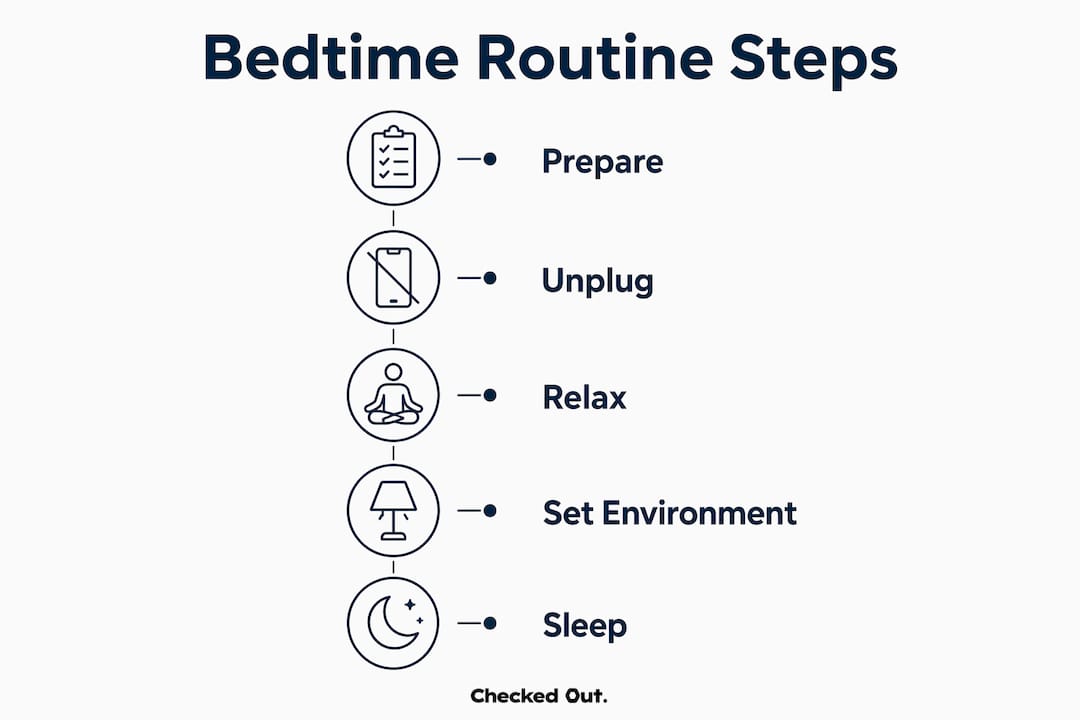
Calming activities that actually work
Meditation, gentle stretching, and reading during the wind-down period measurably lower cortisol and prepare the mind for sleep. Journaling is equally effective, particularly for people whose minds race with unfinished thoughts. A five-minute brain dump of tomorrow’s to-do list has been shown to shorten sleep onset by offloading cognitive load from working memory. Warm baths or showers work through a different mechanism: the rapid skin cooling that follows raises sleep pressure and accelerates the transition to drowsiness.
What to avoid in the final hour
- Caffeine consumed within six hours of bedtime stays active in your bloodstream and delays sleep onset
- Alcohol fragments sleep cycles despite its initial sedative effect, reducing restorative deep sleep
- Heavy meals spike insulin and digestion activity, both of which compete with sleep physiology
- Intense exercise within one to two hours of bed releases adrenaline and cortisol that keep you wired
Pro Tip: Build a “closing ritual” for your day the same way you have an opening ritual for your morning. Treat the hour before bed as protected time, not leftover time.
How long should your bedtime routine last?
Most people dramatically underestimate how long the body needs to wind down. You cannot sprint through a high-stimulus evening and expect to fall asleep the moment your head hits the pillow. The nervous system does not work that way.
The Sleep Foundation recommends 30 to 60 minutes as the optimal window for a nightly wind-down. This duration allows your cortisol levels to drop, your melatonin to rise naturally, and your heart rate to slow without forcing the transition. Thirty minutes is the floor, not the target. If you are dealing with chronic stress or a history of poor sleep, leaning toward the full 60 minutes will serve you better.
Timing consistency matters as much as duration. Fixed sleep and wake times train your circadian rhythm to anticipate sleep at a predictable hour, which means you fall asleep faster and wake up feeling more restored. Varying your bedtime by more than 30 minutes on weekends is enough to create what researchers call “social jet lag,” a measurable disruption to your internal clock that bleeds into the workweek.
Start your routine at the same time each night, not just when you feel tired. Waiting until you feel exhausted is already too late. The goal is to catch the natural sleep pressure wave before it passes. You can explore science-backed sleep improvement steps to understand the full biology behind this timing.
Pro Tip: Set a “bedtime alarm” 60 minutes before your target sleep time. Most people set alarms to wake up. Almost nobody sets one to wind down. That single habit change can shift your sleep quality faster than any supplement.
How to customize your routine based on your life
No two people have identical schedules, stress loads, or sensory preferences. A bedtime routine for adults in high-performance careers looks different from one designed for a parent managing a kids bedtime routine alongside their own. The structure is universal. The content is personal.
Here is a practical framework for building a routine that actually fits your life:
-
Identify your non-negotiables. Pick two or three activities you genuinely enjoy and that reliably calm you. Forcing yourself through a 20-minute meditation when you hate sitting still will raise your cortisol, not lower it. Yoga nidra, light reading, or even a slow skincare ritual all qualify.
-
Map your real schedule. Work backward from your target sleep time. If you need to be asleep by 10:30 PM, your wind-down starts at 9:30 PM at the latest. Block it in your calendar like a meeting.
-
Address bedtime anxiety directly. If your mind races the moment you lie down, the bed has become associated with wakefulness rather than rest. Journaling before bed, practicing box breathing (four counts in, hold four, out four, hold four), or listening to a wellness routine focused audio can interrupt that pattern.
-
Know when to leave the bed. If you cannot fall asleep within 20 to 30 minutes, leaving the bedroom and doing a quiet, low-stimulation activity until you feel sleepy again is the clinically recommended approach. Lying there frustrated deepens the negative association and makes the next night harder.
-
Protect your routine on weekends. Flexibility is fine within a 30-minute window. Beyond that, you are essentially giving yourself weekly jet lag. The body does not distinguish between a Tuesday and a Saturday.
Calming bedtime activities like these are not about perfection. They are about building a consistent enough signal that your body learns to trust the sequence.
Common mistakes that undermine your routine
Even well-intentioned routines fail when a few key errors go uncorrected. The most damaging ones are also the most common.
-
Irregular timing. Starting your routine at 9 PM one night and midnight the next tells your circadian rhythm nothing useful. Consistency is the mechanism, not the method.
-
Screen use right up to lights out. Dimming lights and using night mode an hour before bed supports melatonin production. Watching a stimulating show until 11:59 PM and expecting to fall asleep at midnight is a physiological contradiction.
-
Overloading the routine with too many steps. A 12-step wind-down that takes 90 minutes becomes a source of stress, not calm. Start with three steps. Build from there.
-
Expecting instant results. Circadian rhythm adaptation takes time. Most people need two to three weeks of consistent practice before the routine feels natural and sleep quality measurably improves.
-
Using alcohol as a sleep aid. It shortens time to fall asleep but fragments the sleep architecture that makes rest restorative. You wake up more tired, not less.
The deeper issue with most failed routines is that people treat them as a quick fix rather than a practice. Sleep hygiene is prep work that protects your natural sleep-wake cycle, not a switch you flip. The body responds to repetition, not intention.
Pro Tip: If your routine keeps falling apart, shrink it. A two-step routine you actually do every night beats a ten-step routine you abandon by Thursday. Habit research consistently shows that simplicity drives consistency.
Key takeaways
A bedtime routine works because consistent, sequenced calming activities train your circadian rhythm to anticipate sleep, reducing onset time and improving the depth of overnight recovery.
| Point |
Details |
| Optimal routine duration |
Spend 30 to 60 minutes winding down each night to allow cortisol to drop and melatonin to rise naturally. |
| Sequence over perfection |
Fixed anchor points performed in the same order each night trigger subconscious sleep preparation more reliably than varied activities. |
| Screen management |
Avoid blue light exposure for at least 60 minutes before bed to protect natural melatonin production. |
| Leave the bed if needed |
If you cannot sleep within 20 to 30 minutes, exit the bedroom and return only when genuinely sleepy to prevent bedtime anxiety. |
| Start small and stay consistent |
A two-step routine practiced nightly outperforms a complex routine abandoned by midweek. |
Geeta’s perspective:
I spent years treating sleep as the thing that happened after everything else was done. The last item on the list. The reward for finishing. What I eventually learned, the hard way, is that sleep is not a reward. It is the foundation everything else is built on.
What changed my thinking was not a new supplement or a fancy tracker. It was the realization that my body was already trying to sleep. I was just making it impossible by flooding my evenings with screens, late meals, and unfinished mental loops. The routine did not create sleep. It got out of sleep’s way.
The psychological benefit of a nightly ritual goes beyond rest duration. People who practice consistent evening wind-downs report lower anxiety, better emotional regulation the next day, and a stronger sense of agency over their own health. That last part matters more than people realize. When you feel like you have control over your sleep, you stop dreading bedtime. And that shift alone changes everything.
I also want to say this plainly: you do not need a perfect routine. You need a real one. One that fits your actual life, not the idealized version. Start with two things you can do tonight. Do them again tomorrow. The body keeps score quietly, and it rewards consistency more than complexity.
— Geeta
How Checkedoutwellness supports your nightly wind-down

Building a strong nightly ritual is the foundation. The right tools make it easier to maintain and deepen. Checkedoutwellness designs drug-free sleep solutions that slot directly into your existing routine without adding complexity. The transdermal sleep patch delivers magnesium, B6, GABA, and other cofactors that support your body’s own melatonin production, without synthetic melatonin or dependency risk. Pair it with mouth tape to encourage nasal breathing overnight, and a contoured blackout sleep mask to eliminate light disruption entirely. All products are manufactured under ISO 22716 GMP pharmaceutical standards in South Korea. They are not shortcuts. They are the last layer of a routine that is already working.
FAQ
What is a bedtime routine and why does it matter?
A bedtime routine is a consistent sequence of calming activities performed before sleep to prepare your body and mind for rest. It works by signaling your circadian rhythm that sleep is approaching, which accelerates melatonin release and reduces sleep onset time.
How long should a bedtime routine be?
The Sleep Foundation recommends 30 to 60 minutes as the optimal wind-down window. This duration allows cortisol levels to fall and melatonin to rise without forcing the transition.
What are the best calming activities for a bedtime routine?
Reading, gentle stretching, meditation, journaling, and warm showers are all clinically supported options. The best activity is one you genuinely enjoy and can practice consistently every night.
What should you avoid before bed?
Avoid screens, caffeine within six hours of sleep, alcohol, heavy meals, and intense exercise within one to two hours of bedtime. Each of these disrupts either melatonin production or sleep architecture.
What should you do if you cannot fall asleep?
If you have not fallen asleep within 20 to 30 minutes, leave the bedroom and do a quiet, low-stimulation activity until you feel sleepy. Returning to bed only when drowsy helps break the cycle of bedtime anxiety and restores the bed’s association with sleep.
Recommended

Your Bedtime Routine Guide to Better Sleep Every Night
A bedtime routine is a structured sequence of calming activities performed consistently before sleep to prepare your body and mind for deep, restorative rest. Sleep hygiene practices like these are not optional extras for the wellness-obsessed. They are the biological prep work your nervous system depends on to shift out of alertness and into recovery mode. The Sleep Foundation and Cleveland Clinic both confirm that consistent nightly rituals improve sleep onset, stabilize your circadian rhythm, and reduce the kind of morning grogginess that no amount of coffee fully fixes. If you have ever stared at the ceiling at midnight wondering why your brain will not quiet down, the answer is almost always the absence of a deliberate wind-down sequence.
What are the essential elements of an effective bedtime routine?
A bedtime routine guide is only as strong as its components. The right elements work together to send your brain one clear signal: sleep is coming. Miss one or two, and the signal gets noisy.
Consistent timing and sequence
Anchor points, meaning specific actions performed in a fixed nightly order, act as subconscious Pavlovian triggers that prime your brain for sleep. This is not metaphor. It is conditioned physiology. When you brush your teeth, dim the lights, and reach for a book in the same order every night, your brain begins releasing sleep-promoting neurochemicals before you even lie down. Skipping the sequence, or shuffling it randomly, weakens that signal over time.
Screen management and blue light
Electronic devices suppress melatonin by emitting blue light that tricks your brain into thinking it is still daytime. This is one of the most common and most damaging mistakes in modern sleep hygiene. The fix is not complicated. Dim your phone screen, switch to night mode, and stop scrolling at least 60 minutes before bed. Better yet, leave the phone in another room entirely.
Bedroom environment
A calm, comfortable bedroom with cool temperature, minimal light, and low noise is not a luxury. It is a physiological requirement. Your core body temperature needs to drop slightly to initiate sleep, which is why a room set between 65 and 68 degrees Fahrenheit outperforms a warm one every time. Blackout curtains, white noise, and a quality pillow are not indulgences. They are tools.
Calming activities that actually work
Meditation, gentle stretching, and reading during the wind-down period measurably lower cortisol and prepare the mind for sleep. Journaling is equally effective, particularly for people whose minds race with unfinished thoughts. A five-minute brain dump of tomorrow’s to-do list has been shown to shorten sleep onset by offloading cognitive load from working memory. Warm baths or showers work through a different mechanism: the rapid skin cooling that follows raises sleep pressure and accelerates the transition to drowsiness.
What to avoid in the final hour
Pro Tip: Build a “closing ritual” for your day the same way you have an opening ritual for your morning. Treat the hour before bed as protected time, not leftover time.
How long should your bedtime routine last?
Most people dramatically underestimate how long the body needs to wind down. You cannot sprint through a high-stimulus evening and expect to fall asleep the moment your head hits the pillow. The nervous system does not work that way.
The Sleep Foundation recommends 30 to 60 minutes as the optimal window for a nightly wind-down. This duration allows your cortisol levels to drop, your melatonin to rise naturally, and your heart rate to slow without forcing the transition. Thirty minutes is the floor, not the target. If you are dealing with chronic stress or a history of poor sleep, leaning toward the full 60 minutes will serve you better.
Timing consistency matters as much as duration. Fixed sleep and wake times train your circadian rhythm to anticipate sleep at a predictable hour, which means you fall asleep faster and wake up feeling more restored. Varying your bedtime by more than 30 minutes on weekends is enough to create what researchers call “social jet lag,” a measurable disruption to your internal clock that bleeds into the workweek.
Start your routine at the same time each night, not just when you feel tired. Waiting until you feel exhausted is already too late. The goal is to catch the natural sleep pressure wave before it passes. You can explore science-backed sleep improvement steps to understand the full biology behind this timing.
Pro Tip: Set a “bedtime alarm” 60 minutes before your target sleep time. Most people set alarms to wake up. Almost nobody sets one to wind down. That single habit change can shift your sleep quality faster than any supplement.
How to customize your routine based on your life
No two people have identical schedules, stress loads, or sensory preferences. A bedtime routine for adults in high-performance careers looks different from one designed for a parent managing a kids bedtime routine alongside their own. The structure is universal. The content is personal.
Here is a practical framework for building a routine that actually fits your life:
Calming bedtime activities like these are not about perfection. They are about building a consistent enough signal that your body learns to trust the sequence.
Common mistakes that undermine your routine
Even well-intentioned routines fail when a few key errors go uncorrected. The most damaging ones are also the most common.
The deeper issue with most failed routines is that people treat them as a quick fix rather than a practice. Sleep hygiene is prep work that protects your natural sleep-wake cycle, not a switch you flip. The body responds to repetition, not intention.
Pro Tip: If your routine keeps falling apart, shrink it. A two-step routine you actually do every night beats a ten-step routine you abandon by Thursday. Habit research consistently shows that simplicity drives consistency.
Key takeaways
A bedtime routine works because consistent, sequenced calming activities train your circadian rhythm to anticipate sleep, reducing onset time and improving the depth of overnight recovery.
Why routines are the most underrated performance tool
Geeta’s perspective:
I spent years treating sleep as the thing that happened after everything else was done. The last item on the list. The reward for finishing. What I eventually learned, the hard way, is that sleep is not a reward. It is the foundation everything else is built on.
What changed my thinking was not a new supplement or a fancy tracker. It was the realization that my body was already trying to sleep. I was just making it impossible by flooding my evenings with screens, late meals, and unfinished mental loops. The routine did not create sleep. It got out of sleep’s way.
The psychological benefit of a nightly ritual goes beyond rest duration. People who practice consistent evening wind-downs report lower anxiety, better emotional regulation the next day, and a stronger sense of agency over their own health. That last part matters more than people realize. When you feel like you have control over your sleep, you stop dreading bedtime. And that shift alone changes everything.
I also want to say this plainly: you do not need a perfect routine. You need a real one. One that fits your actual life, not the idealized version. Start with two things you can do tonight. Do them again tomorrow. The body keeps score quietly, and it rewards consistency more than complexity.
How Checkedoutwellness supports your nightly wind-down
Building a strong nightly ritual is the foundation. The right tools make it easier to maintain and deepen. Checkedoutwellness designs drug-free sleep solutions that slot directly into your existing routine without adding complexity. The transdermal sleep patch delivers magnesium, B6, GABA, and other cofactors that support your body’s own melatonin production, without synthetic melatonin or dependency risk. Pair it with mouth tape to encourage nasal breathing overnight, and a contoured blackout sleep mask to eliminate light disruption entirely. All products are manufactured under ISO 22716 GMP pharmaceutical standards in South Korea. They are not shortcuts. They are the last layer of a routine that is already working.
FAQ
What is a bedtime routine and why does it matter?
A bedtime routine is a consistent sequence of calming activities performed before sleep to prepare your body and mind for rest. It works by signaling your circadian rhythm that sleep is approaching, which accelerates melatonin release and reduces sleep onset time.
How long should a bedtime routine be?
The Sleep Foundation recommends 30 to 60 minutes as the optimal wind-down window. This duration allows cortisol levels to fall and melatonin to rise without forcing the transition.
What are the best calming activities for a bedtime routine?
Reading, gentle stretching, meditation, journaling, and warm showers are all clinically supported options. The best activity is one you genuinely enjoy and can practice consistently every night.
What should you avoid before bed?
Avoid screens, caffeine within six hours of sleep, alcohol, heavy meals, and intense exercise within one to two hours of bedtime. Each of these disrupts either melatonin production or sleep architecture.
What should you do if you cannot fall asleep?
If you have not fallen asleep within 20 to 30 minutes, leave the bedroom and do a quiet, low-stimulation activity until you feel sleepy. Returning to bed only when drowsy helps break the cycle of bedtime anxiety and restores the bed’s association with sleep.
Recommended