A workflow for restful sleep is a structured set of routines and environmental adjustments designed to enhance sleep quality and ease falling asleep consistently. Sleep specialists call this collection of practices sleep hygiene, and the evidence behind it is solid. Cognitive Behavioral Therapy for Insomnia (CBT-I) builds on these same principles and produces significant, lasting improvements in 7–8 out of 10 people. That number tells you something important: better sleep is not luck. It is a skill you can build, one deliberate habit at a time.
What does a workflow for restful sleep actually include?
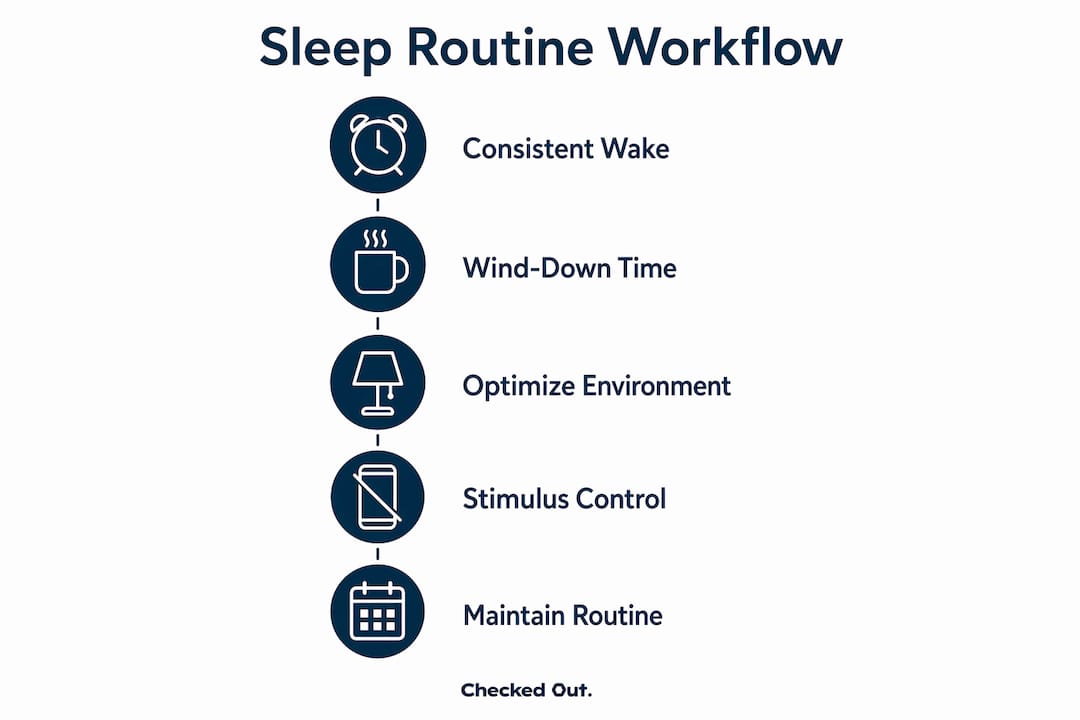
A restful sleep workflow has three moving parts: a consistent schedule, a calming wind-down period, and an optimized sleep environment. Most people focus on one and ignore the others. That partial approach is why so many bedtime rituals fail. The body does not switch off like a light. It needs a sequence of cues, repeated night after night, to learn that sleep is coming.
The good news is that you do not need to overhaul your entire life. Starting with 1–2 changes and practicing them consistently builds reliable routines through cue learning. Gradual layering supports long-term adherence far better than an overwhelming overhaul on day one.

Why does a consistent sleep schedule matter?
Your circadian rhythm is a roughly 24-hour internal clock that governs when you feel alert and when you feel drowsy. Disrupting it, even once or twice a week, creates what researchers call social jetlag. The symptoms feel exactly like crossing time zones: grogginess, poor concentration, and difficulty falling asleep the next night.
Wake time stability anchors the sleep cycle more effectively than bedtime consistency alone. That is the counterintuitive part. Most people try to control when they fall asleep. The science says to control when you wake up instead. Pick a fixed wake time and protect it, including on weekends.
Common obstacles to schedule consistency include:
-
Late-night social events that push bedtime past midnight
-
Weekend sleep-ins that shift your rhythm by 1–2 hours
-
Variable work shifts that make a fixed schedule feel impossible
-
Scrolling in bed that delays sleep onset without you noticing
Each of these is solvable. Late nights happen, but returning to your fixed wake time the next morning resets the clock faster than sleeping in does.
Pro Tip: Set a morning alarm and pair it with five minutes of natural light exposure. Step outside or sit near a bright window. Light is the strongest external signal your circadian clock receives, and it accelerates rhythm stabilization.
How do you build a 30–60 minute wind-down routine?
Wind-down routines function as nervous system transitions, not instant sleep triggers. Your brain needs advance notice. Think of it less like flipping a switch and more like slowing a car from highway speed to a neighborhood crawl. That deceleration takes time and intention.
A practical wind-down sequence looks like this:
-
60 minutes before bed: Dim the lights throughout your home. This boosts melatonin production and signals the body to prepare for sleep. Reducing blue light exposure during this window is especially important.
-
45 minutes before bed: Put screens away or switch to night mode on all devices. Blue light from phones and laptops suppresses melatonin by up to two hours in some studies.
-
30 minutes before bed: Choose one calming activity. Options include gentle yoga, reading fiction, journaling, listening to quiet music, or taking a warm bath. A warm bath works partly because the subsequent drop in body temperature mimics the natural cooling that precedes sleep.
-
15 minutes before bed: Move to your bedroom. Keep the space dark, cool, and quiet. Do not check your phone again.
The recommended activities share one quality: they are low stimulation. Avoid anything that triggers problem-solving, emotional arousal, or competitive thinking. Work emails, news, and intense conversations all belong outside the wind-down window.
Pro Tip: Start with just one activity from the list above and repeat it every night for two weeks before adding another. Sequence and repetition matter more than variety. Your brain learns to associate that single cue with sleep readiness.
Does your sleep environment affect sleep quality?
The bedroom environment is not a background detail. It is an active participant in your sleep quality. Three variables matter most: temperature, light, and noise.
| Environmental Factor |
Recommendation |
Why It Matters |
| Room temperature |
60–67°F |
Cooler air helps the body reach the lower core temperature needed for deep sleep |
| Lighting |
Full darkness or blackout mask |
Light signals wakefulness to the brain even through closed eyelids |
| Noise |
Below 40 decibels or white noise |
Sudden sounds fragment sleep even without full awakening |
| Bedding |
Breathable, temperature-regulating materials |
Overheating is a leading cause of nighttime waking |
| Air quality |
Fresh, clean, low-humidity air |
Poor air quality raises cortisol and disrupts breathing during sleep |
Optimal bedroom temperature for sleep sits at approximately 60–67°F. Most people keep their bedrooms too warm. Dropping the thermostat by even two or three degrees can produce a noticeable improvement in how quickly you fall asleep.
Darkness is equally non-negotiable. Streetlights, phone chargers, and standby LEDs all emit enough light to interfere with melatonin release. Blackout curtains or a contoured blackout sleep mask solve this without requiring a room renovation. For noise, a white noise machine or a simple fan creates a consistent sound floor that masks disruptive spikes.
Pro Tip: Invest in a fiberglass-free mattress if you wake up hot or uncomfortable. Mattress materials affect breathability more than most people realize, and a cooler sleep surface directly supports the body’s natural temperature drop at sleep onset.
How does stimulus control help with insomnia?
Stimulus control is one of the most evidence-backed techniques in CBT-I, and it is also one of the most misunderstood. The core idea is simple: your bed should be a cue for sleep, not for wakefulness. Every hour you spend lying awake in bed, watching TV, scrolling, or worrying, trains your brain to associate the bed with arousal instead of rest.
Breaking that association requires a counterintuitive step. If you cannot fall asleep within 15–20 minutes, get out of bed. Go to another room and do something quiet and low stimulation until you feel genuinely drowsy. Then return to bed. Repeat as needed.
Here is what makes stimulus control work over time:
-
Restricting bed use to sleep and sex only preserves the bed as a conditioned sleep context
-
Leaving the bed when awake prevents wakefulness from leaking into the sleep environment
-
Returning only when drowsy strengthens the sleep cue rather than the arousal cue
-
Consistency across nights accelerates the reconditioning process
The first few nights feel uncomfortable. You may spend more time out of bed than in it. That discomfort is the process working. Preventing wakefulness from leaking into bed improves sleep continuity and depth, especially for people with fragmented sleep patterns. Give it two weeks before judging the results.
How do you sustain your sleep routine long-term?
Building a sleep routine is one thing. Keeping it through a stressful week, a work trip, or a late-night event is another. The people who succeed long-term treat their sleep workflow the way athletes treat training: as a non-negotiable practice with room for occasional adjustment, not perfection.
Practical strategies for long-term adherence include:
-
Track your sleep using a sleep diary or an app like Sleep Cycle or Oura. Patterns you cannot see, you cannot fix.
-
Set realistic timelines. Habit formation takes weeks, not days. Expect gradual improvement, not overnight transformation.
-
Identify your two biggest disruptors and address those first. Trying to fix everything simultaneously usually fixes nothing.
-
Use habit stacking. Attach your wind-down cue to something you already do every night, like brushing your teeth. That existing habit becomes the trigger for your new routine.
Pro Tip: After a disrupted night, resist the urge to compensate with a long nap or an early bedtime. Both shift your circadian rhythm and make the next night harder. Stick to your fixed wake time and let natural sleep pressure rebuild overnight.
For deeper reading on proven nightly habits and how to layer them effectively, the Checkedoutwellness blog covers the clinical research behind each step in plain language.
Key takeaways
A restful sleep workflow succeeds when consistent timing, a structured wind-down, and an optimized environment work together as a system, not as isolated habits.
| Point |
Details |
| Fix your wake time first |
A stable wake time anchors your circadian rhythm more effectively than controlling bedtime alone. |
| Wind down 30–60 minutes early |
Dim lights, avoid screens, and choose one low-stimulation activity to transition your nervous system. |
| Cool and darken your bedroom |
Keep room temperature at 60–67°F and eliminate light sources to support faster sleep onset. |
| Apply stimulus control |
Leave the bed after 15–20 minutes of wakefulness to break negative associations and rebuild sleep cues. |
| Layer habits gradually |
Start with 1–2 changes, track progress with a sleep diary, and add new habits only after the first ones stick. |
What i have learned about building a sleep workflow that sticks
I spent years thinking I just needed a better bedtime ritual. A calming tea, a good book, maybe some lavender on the pillow. And those things helped, a little. But the real shift came when I stopped treating sleep as something that happened to me and started treating it as something I prepared for, systematically, starting hours before I ever got into bed.
The biggest misconception I see is that a wind-down routine is the whole workflow. It is not. Evidence shows that both the timing of wind-down and environment setup begin much earlier in the evening. The choices you make at 6 PM, including your dinner, your light exposure, your screen time, shape what happens at 11 PM.
Self-compassion matters here too. A disrupted night does not undo weeks of progress. The body is resilient. What erodes a sleep workflow is not one bad night but the anxiety spiral that follows it. Treat setbacks as data, not failure. Adjust one variable, observe the result, and keep going.
The routines that last are the ones you actually enjoy. If journaling feels like homework, swap it for quiet music. If 10 PM feels impossible, start with 10:30. Customize relentlessly. The goal is a workflow that fits your life, not a clinical protocol you abandon by week three.
— Geeta
If you have built the behavioral foundation and want to go further, Checkedoutwellness offers a range of drug-free sleep aids designed to complement the routines above.

The Sleep Patch by Checked Out delivers magnesium, B6, B12, and GABA transdermally, supporting your body’s own melatonin production without synthetic additives or dependency risk. Manufactured in South Korea under ISO 22716 GMP pharmaceutical standards, every product is built for people who take sleep as seriously as their nutrition. Pair it with a contoured blackout mask and mouth tape for a complete natural sleep system that works with your workflow, not around it.
FAQ
What is a restful sleep workflow?
A restful sleep workflow is a structured set of nightly routines and environmental adjustments, including consistent sleep timing, a wind-down period, and bedroom optimization, designed to improve sleep quality consistently.
How long does it take to see results from a sleep routine?
Most people notice meaningful improvement within two to four weeks of consistent practice. CBT-I research shows significant results in 7–8 out of 10 people who follow structured sleep schedules and stimulus control techniques.
What is the best bedroom temperature for sleep?
The optimal range is 60–67°F. Cooler temperatures help the body reach the lower core temperature required for deep, restorative sleep stages.
Should i stay in bed if i cannot fall asleep?
No. Stimulus control, a core CBT-I technique, recommends leaving the bed after 15–20 minutes of wakefulness and returning only when drowsy. This breaks the association between your bed and wakefulness.
How do i improve sleep without medication?
Science-backed sleep improvement relies on consistent wake times, a 30–60 minute wind-down routine, a cool and dark bedroom, and stimulus control. These behavioral changes outperform sleep medication in long-term outcomes for most adults with insomnia.
Recommended

Workflow for Restful Sleep: Your Nightly Routine Guide
A workflow for restful sleep is a structured set of routines and environmental adjustments designed to enhance sleep quality and ease falling asleep consistently. Sleep specialists call this collection of practices sleep hygiene, and the evidence behind it is solid. Cognitive Behavioral Therapy for Insomnia (CBT-I) builds on these same principles and produces significant, lasting improvements in 7–8 out of 10 people. That number tells you something important: better sleep is not luck. It is a skill you can build, one deliberate habit at a time.
What does a workflow for restful sleep actually include?
A restful sleep workflow has three moving parts: a consistent schedule, a calming wind-down period, and an optimized sleep environment. Most people focus on one and ignore the others. That partial approach is why so many bedtime rituals fail. The body does not switch off like a light. It needs a sequence of cues, repeated night after night, to learn that sleep is coming.
The good news is that you do not need to overhaul your entire life. Starting with 1–2 changes and practicing them consistently builds reliable routines through cue learning. Gradual layering supports long-term adherence far better than an overwhelming overhaul on day one.
Why does a consistent sleep schedule matter?
Your circadian rhythm is a roughly 24-hour internal clock that governs when you feel alert and when you feel drowsy. Disrupting it, even once or twice a week, creates what researchers call social jetlag. The symptoms feel exactly like crossing time zones: grogginess, poor concentration, and difficulty falling asleep the next night.
Wake time stability anchors the sleep cycle more effectively than bedtime consistency alone. That is the counterintuitive part. Most people try to control when they fall asleep. The science says to control when you wake up instead. Pick a fixed wake time and protect it, including on weekends.
Common obstacles to schedule consistency include:
Each of these is solvable. Late nights happen, but returning to your fixed wake time the next morning resets the clock faster than sleeping in does.
Pro Tip: Set a morning alarm and pair it with five minutes of natural light exposure. Step outside or sit near a bright window. Light is the strongest external signal your circadian clock receives, and it accelerates rhythm stabilization.
How do you build a 30–60 minute wind-down routine?
Wind-down routines function as nervous system transitions, not instant sleep triggers. Your brain needs advance notice. Think of it less like flipping a switch and more like slowing a car from highway speed to a neighborhood crawl. That deceleration takes time and intention.
A practical wind-down sequence looks like this:
The recommended activities share one quality: they are low stimulation. Avoid anything that triggers problem-solving, emotional arousal, or competitive thinking. Work emails, news, and intense conversations all belong outside the wind-down window.
Pro Tip: Start with just one activity from the list above and repeat it every night for two weeks before adding another. Sequence and repetition matter more than variety. Your brain learns to associate that single cue with sleep readiness.
Does your sleep environment affect sleep quality?
The bedroom environment is not a background detail. It is an active participant in your sleep quality. Three variables matter most: temperature, light, and noise.
Optimal bedroom temperature for sleep sits at approximately 60–67°F. Most people keep their bedrooms too warm. Dropping the thermostat by even two or three degrees can produce a noticeable improvement in how quickly you fall asleep.
Darkness is equally non-negotiable. Streetlights, phone chargers, and standby LEDs all emit enough light to interfere with melatonin release. Blackout curtains or a contoured blackout sleep mask solve this without requiring a room renovation. For noise, a white noise machine or a simple fan creates a consistent sound floor that masks disruptive spikes.
Pro Tip: Invest in a fiberglass-free mattress if you wake up hot or uncomfortable. Mattress materials affect breathability more than most people realize, and a cooler sleep surface directly supports the body’s natural temperature drop at sleep onset.
How does stimulus control help with insomnia?
Stimulus control is one of the most evidence-backed techniques in CBT-I, and it is also one of the most misunderstood. The core idea is simple: your bed should be a cue for sleep, not for wakefulness. Every hour you spend lying awake in bed, watching TV, scrolling, or worrying, trains your brain to associate the bed with arousal instead of rest.
Breaking that association requires a counterintuitive step. If you cannot fall asleep within 15–20 minutes, get out of bed. Go to another room and do something quiet and low stimulation until you feel genuinely drowsy. Then return to bed. Repeat as needed.
Here is what makes stimulus control work over time:
The first few nights feel uncomfortable. You may spend more time out of bed than in it. That discomfort is the process working. Preventing wakefulness from leaking into bed improves sleep continuity and depth, especially for people with fragmented sleep patterns. Give it two weeks before judging the results.
How do you sustain your sleep routine long-term?
Building a sleep routine is one thing. Keeping it through a stressful week, a work trip, or a late-night event is another. The people who succeed long-term treat their sleep workflow the way athletes treat training: as a non-negotiable practice with room for occasional adjustment, not perfection.
Practical strategies for long-term adherence include:
Pro Tip: After a disrupted night, resist the urge to compensate with a long nap or an early bedtime. Both shift your circadian rhythm and make the next night harder. Stick to your fixed wake time and let natural sleep pressure rebuild overnight.
For deeper reading on proven nightly habits and how to layer them effectively, the Checkedoutwellness blog covers the clinical research behind each step in plain language.
Key takeaways
A restful sleep workflow succeeds when consistent timing, a structured wind-down, and an optimized environment work together as a system, not as isolated habits.
What i have learned about building a sleep workflow that sticks
I spent years thinking I just needed a better bedtime ritual. A calming tea, a good book, maybe some lavender on the pillow. And those things helped, a little. But the real shift came when I stopped treating sleep as something that happened to me and started treating it as something I prepared for, systematically, starting hours before I ever got into bed.
The biggest misconception I see is that a wind-down routine is the whole workflow. It is not. Evidence shows that both the timing of wind-down and environment setup begin much earlier in the evening. The choices you make at 6 PM, including your dinner, your light exposure, your screen time, shape what happens at 11 PM.
Self-compassion matters here too. A disrupted night does not undo weeks of progress. The body is resilient. What erodes a sleep workflow is not one bad night but the anxiety spiral that follows it. Treat setbacks as data, not failure. Adjust one variable, observe the result, and keep going.
The routines that last are the ones you actually enjoy. If journaling feels like homework, swap it for quiet music. If 10 PM feels impossible, start with 10:30. Customize relentlessly. The goal is a workflow that fits your life, not a clinical protocol you abandon by week three.
Tools that support your sleep workflow naturally
If you have built the behavioral foundation and want to go further, Checkedoutwellness offers a range of drug-free sleep aids designed to complement the routines above.
The Sleep Patch by Checked Out delivers magnesium, B6, B12, and GABA transdermally, supporting your body’s own melatonin production without synthetic additives or dependency risk. Manufactured in South Korea under ISO 22716 GMP pharmaceutical standards, every product is built for people who take sleep as seriously as their nutrition. Pair it with a contoured blackout mask and mouth tape for a complete natural sleep system that works with your workflow, not around it.
FAQ
What is a restful sleep workflow?
A restful sleep workflow is a structured set of nightly routines and environmental adjustments, including consistent sleep timing, a wind-down period, and bedroom optimization, designed to improve sleep quality consistently.
How long does it take to see results from a sleep routine?
Most people notice meaningful improvement within two to four weeks of consistent practice. CBT-I research shows significant results in 7–8 out of 10 people who follow structured sleep schedules and stimulus control techniques.
What is the best bedroom temperature for sleep?
The optimal range is 60–67°F. Cooler temperatures help the body reach the lower core temperature required for deep, restorative sleep stages.
Should i stay in bed if i cannot fall asleep?
No. Stimulus control, a core CBT-I technique, recommends leaving the bed after 15–20 minutes of wakefulness and returning only when drowsy. This breaks the association between your bed and wakefulness.
How do i improve sleep without medication?
Science-backed sleep improvement relies on consistent wake times, a 30–60 minute wind-down routine, a cool and dark bedroom, and stimulus control. These behavioral changes outperform sleep medication in long-term outcomes for most adults with insomnia.
Recommended