Most people assume subscription sleep products are just a recurring charge for something you already own. That assumption is costing them better sleep. The truth is that understanding why subscription sleep products deliver real value requires looking past the hardware and into what actually changes sleep behavior: consistent access, personalized coaching, and data that improves over time. This article breaks down the real mechanics of sleep subscriptions so you can decide whether they belong in your wellness toolkit or not.
Table of Contents
Key Takeaways
| Point |
Details |
| Subscriptions build consistency |
Automatic replenishment and curated delivery remove the friction that breaks sleep routines. |
| You are paying for interpretation |
Most subscription value lives in analytics, coaching, and trend data, not the physical product alone. |
| Total cost requires calculation |
Upfront device price plus multi-year subscription fees can far exceed what most buyers anticipate. |
| Calibration time affects accuracy |
Early subscription insights are less reliable; meaningful data accumulates over weeks and months. |
| Engagement determines effectiveness |
A subscription that collects data you never act on delivers no measurable sleep improvement. |
Why subscription sleep products support daily routines
The most underrated benefit of subscription sleep products has nothing to do with the product itself. It is the system around the product. When your sleep aids arrive automatically, when your app opens to a fresh nightly summary, when your routine is baked into a delivery cycle, you stop having to think about it. And when something stops requiring willpower, it actually gets done.
Consider what happens without that structure. You run out of sleep patches, tell yourself you will reorder tomorrow, and two weeks pass. Your mouth tape sits forgotten in a drawer. Your tracker data goes unchecked. None of these things are failures of character. They are just what happens when there is no system holding the habit in place.
Subscription models exist precisely to close that gap. Here is how they support the kind of routine adherence that actually changes sleep quality:
-
Automatic replenishment removes the “I’ll deal with it later” moment that kills routines. Products arrive before you run out, keeping your sleep practice uninterrupted.
-
Curated bundles reduce decision fatigue. Instead of researching what to pair with what, a well-designed sleep product bundle arrives ready to use together.
-
App-based coaching and tracking included in many subscriptions create accountability without requiring a human coach on call.
-
Streaks, trend data, and personalized scores in subscription apps reward consistency and make the habit feel rewarding rather than effortful.
Pro Tip: Set a recurring calendar reminder the day your subscription ships to do a quick sleep audit. Pairing physical delivery with a brief reflection on your recent sleep quality turns a passive habit into an active one.
The role of subscription wellness is not just logistical. It is behavioral. The friction-reduction these models provide has a measurable downstream effect on whether people actually stick to their sleep practices long enough to see results.
What you are actually paying for
Here is something most subscription marketing never says plainly: with many sleep tech products, subscriptions unlock analytics rather than the hardware itself. The ring or tracker still functions. But the readiness scores, trend graphs, and personalized insights that make the data meaningful? Those live behind the paywall.

This is not predatory. It is actually a fairly honest model once you understand it. The hardware collects signals. The subscription interprets them. Think of it like getting a blood panel versus getting a doctor to explain what the numbers mean in the context of your lifestyle and goals.
The four core things your subscription fee is typically buying:
-
Translated biometric data. Raw heart rate variability or sleep stage data means little to most people. Subscription-driven interpretation converts those signals into sleep debt scores, readiness ratings, and recovery labels that are immediately usable.
-
Longitudinal trend analysis. A single night of data is noise. Three months of data starts to reveal patterns: how alcohol affects your deep sleep, how late workouts shift your heart rate, how stress accumulates across the week.
-
Personalized coaching content. Services like Loftie Rest and Hatch+ bundle wind-down routines and sleep lessons behind their monthly fees, adding behavioral tools alongside the tracking.
-
Ongoing calibration and model refinement. Over time, subscription-backed algorithms learn your personal baseline rather than comparing you to population averages. That shift from generic to personalized is where real insight lives.
“Subscriptions’ most significant value derives downstream from enough nights of data for calibration; early insights without data history are less accurate.” This is the honest truth that most brands bury in fine print. Patience is part of what you are subscribing to.
The science behind sleep improvement confirms what subscription models are designed around: behavior change requires repeated feedback loops, not a single night of data.
Cost considerations: subscription sleep bundles
Before you commit to any subscription, do one calculation that most buyers skip: total cost of ownership across two to three years, not just the monthly fee.
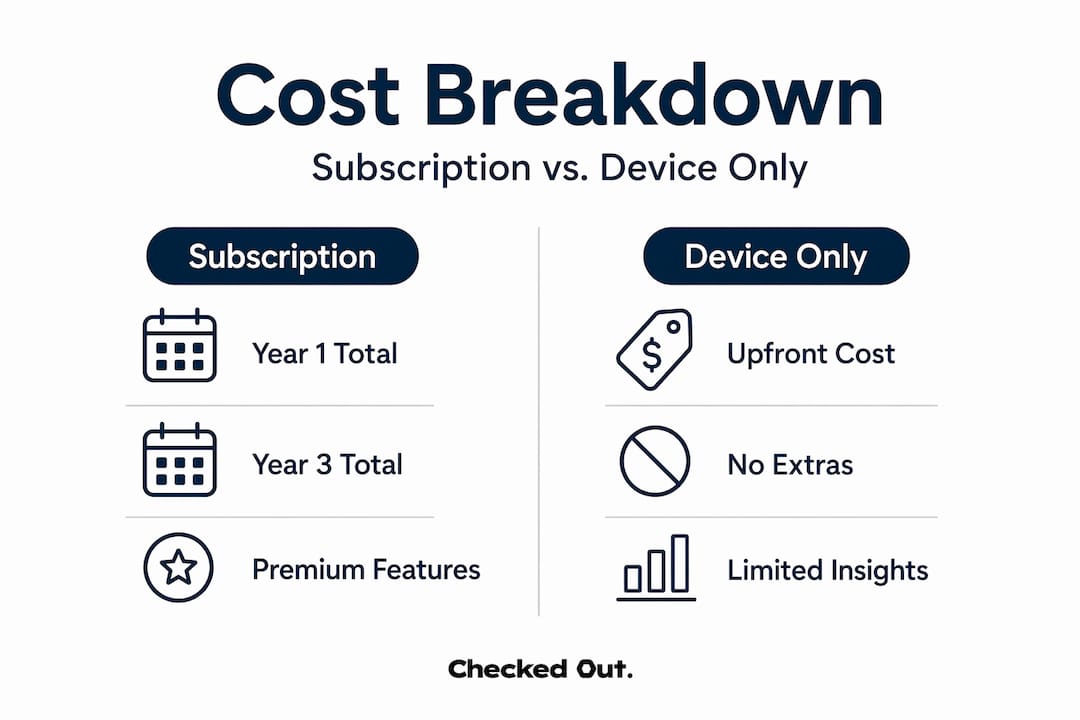
Sleep trackers typically cost between $100 and $400 upfront. That number feels manageable. But add a subscription, and the math shifts quickly. An Oura Ring subscription runs $5.99/month or $69.99/year on top of the device price. Over three years, that annual plan adds roughly $210 to what looked like a one-time purchase.
| Scenario |
Year 1 Cost |
Year 3 Total |
| Device only (no subscription) |
$250 |
$250 |
| Device + monthly subscription ($5.99/mo) |
$321.88 |
$465.64 |
| Device + annual subscription ($69.99/yr) |
$319.99 |
$459.97 |
| Subscription sleep bundle (no device) |
$60 to $100/yr |
$180 to $300 |
Three things to check before subscribing, beyond the price:
What features disappear if you cancel? Without ongoing payment, trend and insight access often restricts significantly, which can interrupt the continuity of your sleep data history. Understand exactly what you lose before you stop paying.
Does the cancellation policy meet current standards? The FTC’s 2024 Negative Option Rule now requires easy, same-method cancellation for any subscription product, protecting you from being trapped by unclear processes. Look for services that make cancellation as straightforward as signup.
Are annual plans genuinely discounted? Run the math rather than trusting the marketing. Some annual plans offer meaningful savings; others barely justify the commitment.
Pro Tip: Before subscribing annually, use the monthly option for 60 days. If you have logged in consistently and changed at least one sleep behavior based on the data, upgrade. If not, the subscription is not working for you yet.
Real effectiveness: what the data actually shows
The wearable sleep tech market is projected to reach $58.21 billion by 2030, growing at roughly 11.7% annually. That growth reflects genuine consumer demand. But demand and effectiveness are different things.
The honest reality is that effectiveness depends on how users engage with the data, not on the sophistication of the device or the richness of the subscription. A subscription that collects beautiful biometric data from someone who glances at it once a week and changes nothing about their behavior produces zero improvement in sleep quality.
A few things that actually determine whether a sleep subscription works for you:
-
Your willingness to act on insights. This is the whole game. Devices aid sleep decisions only when users engage and modify habits based on what they learn. If the app becomes another notification you dismiss, cancel and redirect that money.
-
Your patience through calibration. The first two to four weeks of any sleep tracker subscription are often misleading. Early results reflect noise more than pattern. Commit to at least 30 nights before drawing conclusions.
-
Whether coaching features match your actual lifestyle. A wind-down audio library is useless if you travel frequently and can not maintain a consistent pre-sleep ritual. Match the subscription features to your real life, not your aspirational one.
-
The complementary role of non-tech sleep tools. Subscriptions to physical sleep aids, like patches, mouth tape, and blackout masks, tend to show clearer results more quickly because they work physiologically rather than behaviorally. The body responds to magnesium, GABA, and darkness. It does not always respond to a readiness score.
For people building a sleep practice from the ground up, improving sleep naturally through consistent physical tools often produces faster tangible results than tech-heavy subscriptions, especially in the first few months.
My honest take on choosing sleep subscriptions wisely
Geeta’s perspective:
I have spent years watching people pour money into sleep technology and wake up just as exhausted as before. The problem is almost never the product. It is the relationship to the product.
The transition from hardware ownership to rented coaching is a real psychological shift that most people are not prepared for. When you own something, you feel entitled to results. When you are renting insights, you have to show up as an active participant. I have seen this subscription fatigue take hold within 90 days for people who started with genuine enthusiasm.
My honest position: subscriptions for physical sleep consumables make more intuitive sense than subscriptions for biometric interpretation, especially when you are starting out. A sleep patch that supports your body’s own melatonin production through magnesium and B6 delivery works whether or not you check an app. That is a lower-friction on-ramp to better sleep.
That said, I am not dismissing tech-based subscriptions. When used actively and combined with genuine behavior change efforts, they can be extraordinary tools. The calibration period matters enormously, and the privacy considerations around biometric data deserve real attention before you sign up. Read the data-sharing policy. Know where your sleep data goes.
Start simple. Build consistency first. Add complexity only when you are ready to engage with it.
— Geeta
Better sleep, starting tonight
Ready to build a sleep routine that actually holds? Checkedoutwellness has designed a line of science-backed, drug-free sleep products that support your body’s natural melatonin production without synthetic additives or dependency risk.
Their natural sleep patches deliver key cofactors including magnesium, B6, B12, and GABA through transdermal delivery, manufactured to pharmaceutical-grade ISO 22716 GMP standards in South Korea. Paired with mouth tape and a contoured blackout mask, these products are available as subscription bundles designed to support the consistent routine that makes better sleep stick. No guesswork. No app required to feel the difference.
FAQ
What do subscription sleep products actually include?
Most subscription sleep products include either physical consumables delivered on a schedule, such as patches or mouth tape, or access to app-based analytics and coaching beyond what free hardware use provides. The specific inclusions vary significantly by brand.
Are sleep subscriptions worth the monthly cost?
They are worth it if you actively engage with coaching features and act on the insights, but subscriptions may not justify cost if users collect data without changing behavior. Physical consumable subscriptions tend to deliver value more consistently.
What happens if I cancel my sleep tracker subscription?
Many sleep trackers restrict access to trend data and personalized insights without an active subscription, and long-term data continuity can be affected. The FTC’s 2024 rules now require easy cancellation, so check that your chosen service complies.
How long does it take for sleep subscriptions to show results?
Calibration typically takes several weeks because early tracker results can be misleading before the algorithm learns your personal baseline. Plan for at least 30 nights of consistent use before evaluating accuracy or drawing behavioral conclusions.
Can I improve sleep without a subscription?
Yes. Consistent sleep hygiene, physical sleep aids like patches and masks, and structured wind-down routines can all produce meaningful improvement without ongoing subscription fees. Subscriptions add value through personalization and coaching, not through replacing foundational sleep quality practices.
Recommended

Why Subscription Sleep Products Are Worth It
Most people assume subscription sleep products are just a recurring charge for something you already own. That assumption is costing them better sleep. The truth is that understanding why subscription sleep products deliver real value requires looking past the hardware and into what actually changes sleep behavior: consistent access, personalized coaching, and data that improves over time. This article breaks down the real mechanics of sleep subscriptions so you can decide whether they belong in your wellness toolkit or not.
Table of Contents
Key Takeaways
Why subscription sleep products support daily routines
The most underrated benefit of subscription sleep products has nothing to do with the product itself. It is the system around the product. When your sleep aids arrive automatically, when your app opens to a fresh nightly summary, when your routine is baked into a delivery cycle, you stop having to think about it. And when something stops requiring willpower, it actually gets done.
Consider what happens without that structure. You run out of sleep patches, tell yourself you will reorder tomorrow, and two weeks pass. Your mouth tape sits forgotten in a drawer. Your tracker data goes unchecked. None of these things are failures of character. They are just what happens when there is no system holding the habit in place.
Subscription models exist precisely to close that gap. Here is how they support the kind of routine adherence that actually changes sleep quality:
Pro Tip: Set a recurring calendar reminder the day your subscription ships to do a quick sleep audit. Pairing physical delivery with a brief reflection on your recent sleep quality turns a passive habit into an active one.
The role of subscription wellness is not just logistical. It is behavioral. The friction-reduction these models provide has a measurable downstream effect on whether people actually stick to their sleep practices long enough to see results.
What you are actually paying for
Here is something most subscription marketing never says plainly: with many sleep tech products, subscriptions unlock analytics rather than the hardware itself. The ring or tracker still functions. But the readiness scores, trend graphs, and personalized insights that make the data meaningful? Those live behind the paywall.
This is not predatory. It is actually a fairly honest model once you understand it. The hardware collects signals. The subscription interprets them. Think of it like getting a blood panel versus getting a doctor to explain what the numbers mean in the context of your lifestyle and goals.
The four core things your subscription fee is typically buying:
The science behind sleep improvement confirms what subscription models are designed around: behavior change requires repeated feedback loops, not a single night of data.
Cost considerations: subscription sleep bundles
Before you commit to any subscription, do one calculation that most buyers skip: total cost of ownership across two to three years, not just the monthly fee.
Sleep trackers typically cost between $100 and $400 upfront. That number feels manageable. But add a subscription, and the math shifts quickly. An Oura Ring subscription runs $5.99/month or $69.99/year on top of the device price. Over three years, that annual plan adds roughly $210 to what looked like a one-time purchase.
Three things to check before subscribing, beyond the price:
What features disappear if you cancel? Without ongoing payment, trend and insight access often restricts significantly, which can interrupt the continuity of your sleep data history. Understand exactly what you lose before you stop paying.
Does the cancellation policy meet current standards? The FTC’s 2024 Negative Option Rule now requires easy, same-method cancellation for any subscription product, protecting you from being trapped by unclear processes. Look for services that make cancellation as straightforward as signup.
Are annual plans genuinely discounted? Run the math rather than trusting the marketing. Some annual plans offer meaningful savings; others barely justify the commitment.
Pro Tip: Before subscribing annually, use the monthly option for 60 days. If you have logged in consistently and changed at least one sleep behavior based on the data, upgrade. If not, the subscription is not working for you yet.
Real effectiveness: what the data actually shows
The wearable sleep tech market is projected to reach $58.21 billion by 2030, growing at roughly 11.7% annually. That growth reflects genuine consumer demand. But demand and effectiveness are different things.
The honest reality is that effectiveness depends on how users engage with the data, not on the sophistication of the device or the richness of the subscription. A subscription that collects beautiful biometric data from someone who glances at it once a week and changes nothing about their behavior produces zero improvement in sleep quality.
A few things that actually determine whether a sleep subscription works for you:
For people building a sleep practice from the ground up, improving sleep naturally through consistent physical tools often produces faster tangible results than tech-heavy subscriptions, especially in the first few months.
My honest take on choosing sleep subscriptions wisely
Geeta’s perspective:
I have spent years watching people pour money into sleep technology and wake up just as exhausted as before. The problem is almost never the product. It is the relationship to the product.
The transition from hardware ownership to rented coaching is a real psychological shift that most people are not prepared for. When you own something, you feel entitled to results. When you are renting insights, you have to show up as an active participant. I have seen this subscription fatigue take hold within 90 days for people who started with genuine enthusiasm.
My honest position: subscriptions for physical sleep consumables make more intuitive sense than subscriptions for biometric interpretation, especially when you are starting out. A sleep patch that supports your body’s own melatonin production through magnesium and B6 delivery works whether or not you check an app. That is a lower-friction on-ramp to better sleep.
That said, I am not dismissing tech-based subscriptions. When used actively and combined with genuine behavior change efforts, they can be extraordinary tools. The calibration period matters enormously, and the privacy considerations around biometric data deserve real attention before you sign up. Read the data-sharing policy. Know where your sleep data goes.
Start simple. Build consistency first. Add complexity only when you are ready to engage with it.
Better sleep, starting tonight
Ready to build a sleep routine that actually holds? Checkedoutwellness has designed a line of science-backed, drug-free sleep products that support your body’s natural melatonin production without synthetic additives or dependency risk.
Their natural sleep patches deliver key cofactors including magnesium, B6, B12, and GABA through transdermal delivery, manufactured to pharmaceutical-grade ISO 22716 GMP standards in South Korea. Paired with mouth tape and a contoured blackout mask, these products are available as subscription bundles designed to support the consistent routine that makes better sleep stick. No guesswork. No app required to feel the difference.
FAQ
What do subscription sleep products actually include?
Most subscription sleep products include either physical consumables delivered on a schedule, such as patches or mouth tape, or access to app-based analytics and coaching beyond what free hardware use provides. The specific inclusions vary significantly by brand.
Are sleep subscriptions worth the monthly cost?
They are worth it if you actively engage with coaching features and act on the insights, but subscriptions may not justify cost if users collect data without changing behavior. Physical consumable subscriptions tend to deliver value more consistently.
What happens if I cancel my sleep tracker subscription?
Many sleep trackers restrict access to trend data and personalized insights without an active subscription, and long-term data continuity can be affected. The FTC’s 2024 rules now require easy cancellation, so check that your chosen service complies.
How long does it take for sleep subscriptions to show results?
Calibration typically takes several weeks because early tracker results can be misleading before the algorithm learns your personal baseline. Plan for at least 30 nights of consistent use before evaluating accuracy or drawing behavioral conclusions.
Can I improve sleep without a subscription?
Yes. Consistent sleep hygiene, physical sleep aids like patches and masks, and structured wind-down routines can all produce meaningful improvement without ongoing subscription fees. Subscriptions add value through personalization and coaching, not through replacing foundational sleep quality practices.
Recommended