Optical darkness is defined as the near-total absence of light reaching the eye, and it is the primary trigger for melatonin production in the human brain. Without it, the pineal gland stays suppressed, your circadian rhythm drifts, and restorative sleep becomes harder to reach. The Sleep Foundation’s 2026 guidelines confirm that bedroom light below 1 lux is the threshold for protecting deep sleep stages. Understanding why optical darkness improves sleep is not just academic. It is the foundation of every effective sleep hygiene protocol.
Why optical darkness improves sleep at the biological level
The pineal gland releases melatonin only when the eyes detect darkness. This is not a passive process. It is a tightly regulated neuroendocrine response. Melatonin production is stimulated by darkness and suppressed by light, particularly blue wavelength light from LED screens and overhead lighting, according to Dr. Eileen Wong’s 2026 neurophysiological findings. Blue light mimics the spectral signature of midday sun, telling the brain it is not yet time to sleep.
The circadian rhythm, your body’s internal 24-hour clock, depends on light and dark cues to stay calibrated. Light exposure in the evening delays the onset of melatonin secretion. Darkness accelerates it. When the two signals align with your actual schedule, you fall asleep faster, stay asleep longer, and cycle through the deep and REM stages your body needs for recovery.
Most people assume closing their eyes is enough. It is not. The retina contains specialized photoreceptors called intrinsically photosensitive retinal ganglion cells, or ipRGCs, that respond to ambient light even through closed eyelids. These cells feed directly into the suprachiasmatic nucleus, the brain’s master clock. Even low-level ambient light keeps this system partially activated.
Here is what the biological chain looks like in practice:
-
Darkness detected by ipRGCs sends a signal to the suprachiasmatic nucleus
-
The suprachiasmatic nucleus instructs the pineal gland to begin melatonin secretion
-
Rising melatonin levels lower core body temperature and reduce alertness
-
Blue light interruption at any point in this chain delays or halts the entire cascade
-
Sustained darkness allows melatonin to peak and maintain the sleep-promoting environment
Pro Tip: Dim your lights to warm amber or red tones at least 60 minutes before bed. Red spectrum light has minimal effect on melatonin suppression, making it the safest option for evening wind-down routines.
What does the research say about darkness and sleep quality?
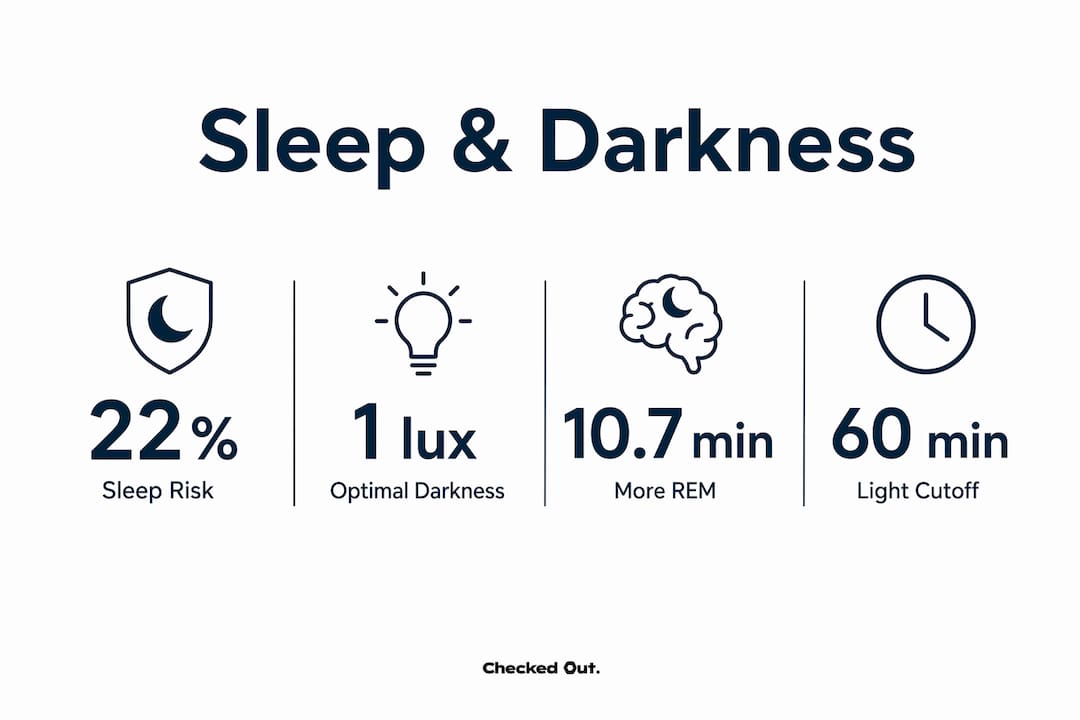
The evidence connecting bedroom darkness to measurable sleep outcomes is now substantial. A 2022 meta-analysis of seven studies found that higher night-light exposure increases the risk of sleep problems by 22%. That number matters because it comes from real bedroom environments, not laboratory conditions.
A 2026 observational study published in JMIR mHealth found that each hour of daytime sunlight adds approximately 10.7 minutes of total sleep time. The implication is significant. Light exposure is not only a nighttime concern. The contrast between bright days and dark nights is what sharpens the circadian signal most effectively.
The health consequences of nocturnal light exposure extend well beyond poor sleep. Dr. Jonathan Cedernaes has documented that artificial light at night disrupts neurophysiology, raising heart rate and impairing insulin sensitivity even in people who report no perceived sleep problems. The body keeps score quietly. Metabolic and cardiac risks accumulate before you notice them in your daily energy or mood.
| Light Level |
Lux Range |
Effect on Sleep |
| Total darkness |
Below 1 lux |
Optimal melatonin production, deep sleep protected |
| Dim ambient light |
1–10 lux |
Partial melatonin suppression, increased fragmentation |
| Typical bedroom lamp |
100–300 lux |
Significant melatonin delay, reduced REM time |
| Bright overhead light |
300–500+ lux |
Near-complete melatonin suppression |
The Sleep Foundation’s 2026 guidelines set the optimal sleep light level at below 1 lux. To put that in context, a single LED indicator light on a power strip can emit 1–3 lux at close range. The standard most people sleep in is far above what the research recommends.
Common myths about light exposure and sleep
The most persistent myth is that closing your eyes creates sufficient darkness. Eyelids allow enough light through to suppress melatonin, which means the physiological effects of ambient light continue even after you fall asleep. This is why a streetlight through thin curtains or a TV left on in the background can fragment your sleep architecture without waking you.
A second misconception is that all artificial light is equally disruptive. It is not. Blue wavelengths from LED and screen backlights are the most potent melatonin suppressors. Red and amber wavelengths have a much smaller effect. Switching your bedroom lamp to a warm bulb below 2700K is a meaningful change, not just an aesthetic one.
People also confuse dimness with darkness. Even very low light levels can disrupt sleep cycles and suppress melatonin. True optical darkness is more effective than mere dimness for restorative sleep. The difference between a room that feels dark and a room that measures below 1 lux is often larger than people expect.
Here is a practical checklist for assessing your bedroom:
-
The hand test: Hold your hand at arm’s length. If you can see your fingers, the room exceeds 1 lux and is too bright for optimal melatonin production.
-
LED indicators: Cover or unplug all standby lights on chargers, TVs, and routers.
-
Window light: Test your curtains or blinds at 2 a.m. by checking for visible light seams around the edges.
-
Screen glow: Even a phone face-down on a nightstand can emit light through its edges.
Pro Tip: Use warm red lights before sleep as a gradual transition tool. Shifting from bright white to red spectrum lighting over 30–60 minutes eases the adjustment to full darkness and reduces melatonin suppression during your wind-down window.
How to create true darkness in your bedroom
Creating a sleep environment below 1 lux requires deliberate action across multiple light sources. Blackout curtains are the highest-impact single change most people can make. Standard curtains, even heavy ones, rarely block enough light to reach the 1 lux threshold. Look for curtains rated as total blackout, not just room-darkening.
Follow these steps to build a genuinely dark sleep environment:
-
Install blackout curtains or blinds rated for total light blockage. Check for light leaks around the frame and seal them with adhesive blackout tape if needed.
-
Cover all LED indicators on electronics using blackout stickers or electrical tape. A single router light can disrupt the room’s lux level.
-
Use a contoured sleep mask for travel or rooms where full blackout is not possible. A well-fitted mask brings personal lux levels to near zero regardless of the room.
-
Establish a lighting wind-down routine. Switch to red or amber bulbs in the bedroom and living areas 60–90 minutes before sleep. Morning light exposure the following day reinforces the circadian contrast that makes nighttime darkness more effective.
-
Audit your phone habits. Charging your phone outside the bedroom removes both blue light and the temptation to check it. If it stays in the room, enable night mode and place it face-down.
-
Check for hallway and bathroom light bleed. A gap under a door can raise bedroom lux levels measurably. A door draft stopper or rolled towel solves this without renovation.
For people who find complete darkness disorienting at first, the gradual lighting reduction approach works well. Start with warm amber lighting, then shift to red, then to darkness over one to two weeks. The body adapts, and most people report the transition feels natural within days. You can also read more about proven sleep strategies that pair well with darkness optimization.
Key Takeaways
Optical darkness is the single most direct environmental trigger for melatonin production, and achieving below 1 lux in your bedroom is the threshold that separates restorative sleep from fragmented rest.
| Point |
Details |
| Darkness triggers melatonin |
The pineal gland only releases melatonin when ipRGCs detect near-total darkness. |
| 1 lux is the threshold |
Sleep Foundation guidelines set below 1 lux as the minimum for protecting deep sleep stages. |
| Eyelids are not enough |
Light penetrates closed eyelids and continues to suppress melatonin throughout the night. |
| Blue light is the main disruptor |
LED and screen backlights carry blue wavelengths that most aggressively delay melatonin onset. |
| Daytime light matters too |
Each hour of daytime sunlight adds roughly 10.7 minutes of total sleep time by sharpening the circadian contrast. |
What I’ve learned from treating darkness as a non-negotiable
I spent years treating sleep as a scheduling problem. I would wind down, dim the lights slightly, and wonder why I still woke up at 3 a.m. feeling like I had never fully gone under. The room was not dark. It was just less bright. That distinction took me longer to understand than I would like to admit.
The shift that changed things was not a supplement or a new mattress. It was covering every LED in the room and installing real blackout curtains. The first night felt strange. The second felt like I had found something I had been missing for years. Sleep quality is not just about duration. It is about depth, and depth requires the right biological conditions.
What I see most often is people who are doing everything else right but sleeping in rooms that measure 5–10 lux. They have the magnesium, the consistent schedule, the sleep health awareness. But the light environment is quietly undermining all of it. The body cannot fake the darkness signal. You either give it the cue or you do not.
The other thing worth saying is that technology has made this harder without us noticing. Homes now contain dozens of light-emitting devices that did not exist 20 years ago. Every router, smart speaker, and charging cable adds to the ambient lux count. Treating your bedroom as a light-controlled environment, the way a photographer treats a darkroom, is not extreme. It is just accurate.
— Geeta
Sleep tools that work with your body’s darkness response
Darkness alone is a powerful sleep tool. Pairing it with products that support your body’s own melatonin pathway takes the results further.

Checkedoutwellness builds sleep solutions specifically for people who take recovery as seriously as their training and nutrition. The contoured blackout sleep mask creates near-zero lux conditions regardless of your environment, making it effective for travel, shift work, or any bedroom that cannot be fully blacked out. The natural sleep patch supports the tryptophan-to-serotonin-to-melatonin conversion pathway using cofactors like magnesium, B6, and GABA, without synthetic melatonin or dependency risk. For a complete approach, the Sleep Duo bundle combines both tools into one consistent nightly protocol. Manufactured under ISO 22716 GMP pharmaceutical standards in South Korea, every product reflects the same commitment to science that this article does.
FAQ
What is optical darkness and why does it matter for sleep?
Optical darkness is the near-total absence of light reaching the retina, typically defined as below 1 lux. It matters because it is the direct trigger for melatonin secretion by the pineal gland, which initiates and sustains restorative sleep cycles.
Does sleeping with a night light really affect sleep quality?
Yes. A 2022 meta-analysis found that higher night-light exposure increases sleep problem risk by 22%, and even low ambient light suppresses melatonin and increases sleep fragmentation.
Can a sleep mask replace blackout curtains?
A well-fitted contoured sleep mask brings personal lux levels to near zero and is effective for travel or rooms where full blackout installation is not possible. For home use, combining both provides the most consistent results. Learn more about sleep mask benefits and how to choose the right one.
What type of light is least disruptive before bed?
Red and amber spectrum light below 2700K has the least effect on melatonin suppression. Blue wavelengths from LEDs and screens are the most disruptive and should be eliminated at least 60 minutes before sleep.
How do I know if my bedroom is dark enough?
Hold your hand at arm’s length in your bedroom with lights off. If you can see your fingers, the room exceeds 1 lux and is too bright for optimal sleep. A lux meter app on your phone can also give a rough reading to confirm.
Recommended

Why Optical Darkness Improves Sleep: The Science Explained
Optical darkness is defined as the near-total absence of light reaching the eye, and it is the primary trigger for melatonin production in the human brain. Without it, the pineal gland stays suppressed, your circadian rhythm drifts, and restorative sleep becomes harder to reach. The Sleep Foundation’s 2026 guidelines confirm that bedroom light below 1 lux is the threshold for protecting deep sleep stages. Understanding why optical darkness improves sleep is not just academic. It is the foundation of every effective sleep hygiene protocol.
Why optical darkness improves sleep at the biological level
The pineal gland releases melatonin only when the eyes detect darkness. This is not a passive process. It is a tightly regulated neuroendocrine response. Melatonin production is stimulated by darkness and suppressed by light, particularly blue wavelength light from LED screens and overhead lighting, according to Dr. Eileen Wong’s 2026 neurophysiological findings. Blue light mimics the spectral signature of midday sun, telling the brain it is not yet time to sleep.
The circadian rhythm, your body’s internal 24-hour clock, depends on light and dark cues to stay calibrated. Light exposure in the evening delays the onset of melatonin secretion. Darkness accelerates it. When the two signals align with your actual schedule, you fall asleep faster, stay asleep longer, and cycle through the deep and REM stages your body needs for recovery.
Most people assume closing their eyes is enough. It is not. The retina contains specialized photoreceptors called intrinsically photosensitive retinal ganglion cells, or ipRGCs, that respond to ambient light even through closed eyelids. These cells feed directly into the suprachiasmatic nucleus, the brain’s master clock. Even low-level ambient light keeps this system partially activated.
Here is what the biological chain looks like in practice:
Pro Tip: Dim your lights to warm amber or red tones at least 60 minutes before bed. Red spectrum light has minimal effect on melatonin suppression, making it the safest option for evening wind-down routines.
What does the research say about darkness and sleep quality?
The evidence connecting bedroom darkness to measurable sleep outcomes is now substantial. A 2022 meta-analysis of seven studies found that higher night-light exposure increases the risk of sleep problems by 22%. That number matters because it comes from real bedroom environments, not laboratory conditions.
A 2026 observational study published in JMIR mHealth found that each hour of daytime sunlight adds approximately 10.7 minutes of total sleep time. The implication is significant. Light exposure is not only a nighttime concern. The contrast between bright days and dark nights is what sharpens the circadian signal most effectively.
The health consequences of nocturnal light exposure extend well beyond poor sleep. Dr. Jonathan Cedernaes has documented that artificial light at night disrupts neurophysiology, raising heart rate and impairing insulin sensitivity even in people who report no perceived sleep problems. The body keeps score quietly. Metabolic and cardiac risks accumulate before you notice them in your daily energy or mood.
The Sleep Foundation’s 2026 guidelines set the optimal sleep light level at below 1 lux. To put that in context, a single LED indicator light on a power strip can emit 1–3 lux at close range. The standard most people sleep in is far above what the research recommends.
Common myths about light exposure and sleep
The most persistent myth is that closing your eyes creates sufficient darkness. Eyelids allow enough light through to suppress melatonin, which means the physiological effects of ambient light continue even after you fall asleep. This is why a streetlight through thin curtains or a TV left on in the background can fragment your sleep architecture without waking you.
A second misconception is that all artificial light is equally disruptive. It is not. Blue wavelengths from LED and screen backlights are the most potent melatonin suppressors. Red and amber wavelengths have a much smaller effect. Switching your bedroom lamp to a warm bulb below 2700K is a meaningful change, not just an aesthetic one.
People also confuse dimness with darkness. Even very low light levels can disrupt sleep cycles and suppress melatonin. True optical darkness is more effective than mere dimness for restorative sleep. The difference between a room that feels dark and a room that measures below 1 lux is often larger than people expect.
Here is a practical checklist for assessing your bedroom:
Pro Tip: Use warm red lights before sleep as a gradual transition tool. Shifting from bright white to red spectrum lighting over 30–60 minutes eases the adjustment to full darkness and reduces melatonin suppression during your wind-down window.
How to create true darkness in your bedroom
Creating a sleep environment below 1 lux requires deliberate action across multiple light sources. Blackout curtains are the highest-impact single change most people can make. Standard curtains, even heavy ones, rarely block enough light to reach the 1 lux threshold. Look for curtains rated as total blackout, not just room-darkening.
Follow these steps to build a genuinely dark sleep environment:
For people who find complete darkness disorienting at first, the gradual lighting reduction approach works well. Start with warm amber lighting, then shift to red, then to darkness over one to two weeks. The body adapts, and most people report the transition feels natural within days. You can also read more about proven sleep strategies that pair well with darkness optimization.
Key Takeaways
Optical darkness is the single most direct environmental trigger for melatonin production, and achieving below 1 lux in your bedroom is the threshold that separates restorative sleep from fragmented rest.
What I’ve learned from treating darkness as a non-negotiable
I spent years treating sleep as a scheduling problem. I would wind down, dim the lights slightly, and wonder why I still woke up at 3 a.m. feeling like I had never fully gone under. The room was not dark. It was just less bright. That distinction took me longer to understand than I would like to admit.
The shift that changed things was not a supplement or a new mattress. It was covering every LED in the room and installing real blackout curtains. The first night felt strange. The second felt like I had found something I had been missing for years. Sleep quality is not just about duration. It is about depth, and depth requires the right biological conditions.
What I see most often is people who are doing everything else right but sleeping in rooms that measure 5–10 lux. They have the magnesium, the consistent schedule, the sleep health awareness. But the light environment is quietly undermining all of it. The body cannot fake the darkness signal. You either give it the cue or you do not.
The other thing worth saying is that technology has made this harder without us noticing. Homes now contain dozens of light-emitting devices that did not exist 20 years ago. Every router, smart speaker, and charging cable adds to the ambient lux count. Treating your bedroom as a light-controlled environment, the way a photographer treats a darkroom, is not extreme. It is just accurate.
Sleep tools that work with your body’s darkness response
Darkness alone is a powerful sleep tool. Pairing it with products that support your body’s own melatonin pathway takes the results further.
Checkedoutwellness builds sleep solutions specifically for people who take recovery as seriously as their training and nutrition. The contoured blackout sleep mask creates near-zero lux conditions regardless of your environment, making it effective for travel, shift work, or any bedroom that cannot be fully blacked out. The natural sleep patch supports the tryptophan-to-serotonin-to-melatonin conversion pathway using cofactors like magnesium, B6, and GABA, without synthetic melatonin or dependency risk. For a complete approach, the Sleep Duo bundle combines both tools into one consistent nightly protocol. Manufactured under ISO 22716 GMP pharmaceutical standards in South Korea, every product reflects the same commitment to science that this article does.
FAQ
What is optical darkness and why does it matter for sleep?
Optical darkness is the near-total absence of light reaching the retina, typically defined as below 1 lux. It matters because it is the direct trigger for melatonin secretion by the pineal gland, which initiates and sustains restorative sleep cycles.
Does sleeping with a night light really affect sleep quality?
Yes. A 2022 meta-analysis found that higher night-light exposure increases sleep problem risk by 22%, and even low ambient light suppresses melatonin and increases sleep fragmentation.
Can a sleep mask replace blackout curtains?
A well-fitted contoured sleep mask brings personal lux levels to near zero and is effective for travel or rooms where full blackout installation is not possible. For home use, combining both provides the most consistent results. Learn more about sleep mask benefits and how to choose the right one.
What type of light is least disruptive before bed?
Red and amber spectrum light below 2700K has the least effect on melatonin suppression. Blue wavelengths from LEDs and screens are the most disruptive and should be eliminated at least 60 minutes before sleep.
How do I know if my bedroom is dark enough?
Hold your hand at arm’s length in your bedroom with lights off. If you can see your fingers, the room exceeds 1 lux and is too bright for optimal sleep. A lux meter app on your phone can also give a rough reading to confirm.
Recommended