Sleep medication is defined as any pharmacological agent, including benzodiazepines, Z-drugs like zolpidem, and over-the-counter antihistamine-based aids, prescribed or sold to induce or maintain sleep. The core reason to understand why avoid sleep medication comes down to a stark risk-to-benefit imbalance: these drugs increase sleep by only 23 minutes on average compared to placebo, yet carry serious risks including dependence, cognitive impairment, and increased mortality. The American Academy of Sleep Medicine and leading researchers now recommend Cognitive Behavioral Therapy for Insomnia (CBT-I) as the first-line treatment, not pills. If you are weighing your options, the evidence points clearly toward natural sleep alternatives as both safer and more sustainable.
What are the main risks and side effects of sleep medications?
The dangers of sleep medications extend well beyond a groggy morning. They touch your brain, your body, and your long-term health in ways most people never anticipate when they first fill a prescription.
Common side effects of sleeping pills include daytime drowsiness, dizziness, headaches, and impaired coordination. These are not minor inconveniences. Drowsiness the morning after a dose raises your risk of car accidents and workplace injuries in ways that are measurable and documented. For older adults, the stakes are even higher: sedative-hypnotics more than double the risk of falls and fractures, and they are also linked to confusion and memory impairment. A broken hip from a nighttime fall can be life-altering. That risk deserves serious weight before you open the medicine cabinet.

Over-the-counter options are not a safe workaround. OTC sleep aids often contain antihistamines with anticholinergic effects, meaning they block a key neurotransmitter involved in memory and cognition. Regular use is associated with urinary retention, dry mouth, and, in older adults, accelerated cognitive decline. The “natural” label on the box does not make diphenhydramine or doxylamine safe for nightly use.
The mortality risk most people never hear about
The risks of sleep aids go beyond falls and foggy mornings. Z-drug use is linked to a 60% higher risk of all-cause mortality compared to non-users, according to a published meta-analysis. That figure means people taking zolpidem, zaleplon, or eszopiclone are not just sleeping worse in the long run. They are dying sooner at a statistically significant rate. This finding alone reframes the conversation about what “safe” means when a doctor hands you a prescription.
Dependence, withdrawal, and rebound insomnia
Physical dependence develops faster than most users expect. Stopping sleep medication abruptly causes rebound insomnia, a condition where sleep quality drops below your original baseline. Your brain, accustomed to chemical sedation, loses its ability to self-regulate sleep onset. The result is a cycle: you sleep poorly without the pill, so you take the pill again, which deepens the dependence. Sleep medication withdrawal is not just uncomfortable. It can feel impossible to manage without medical support.
-
Daytime drowsiness and impaired coordination increase accident risk at home and on the road
-
Cognitive impairment ranges from short-term memory gaps to longer-term decline with sustained use
-
Rebound insomnia traps users in a dependency cycle after stopping
-
Anticholinergic effects from OTC antihistamines pose particular danger to older adults
-
Elevated mortality risk with Z-drugs documented in peer-reviewed meta-analysis data
How effective are sleep medications compared to natural sleep methods?
Effectiveness is where the case against sleep medication becomes undeniable. The numbers tell a story that most prescribers do not share at the point of care.
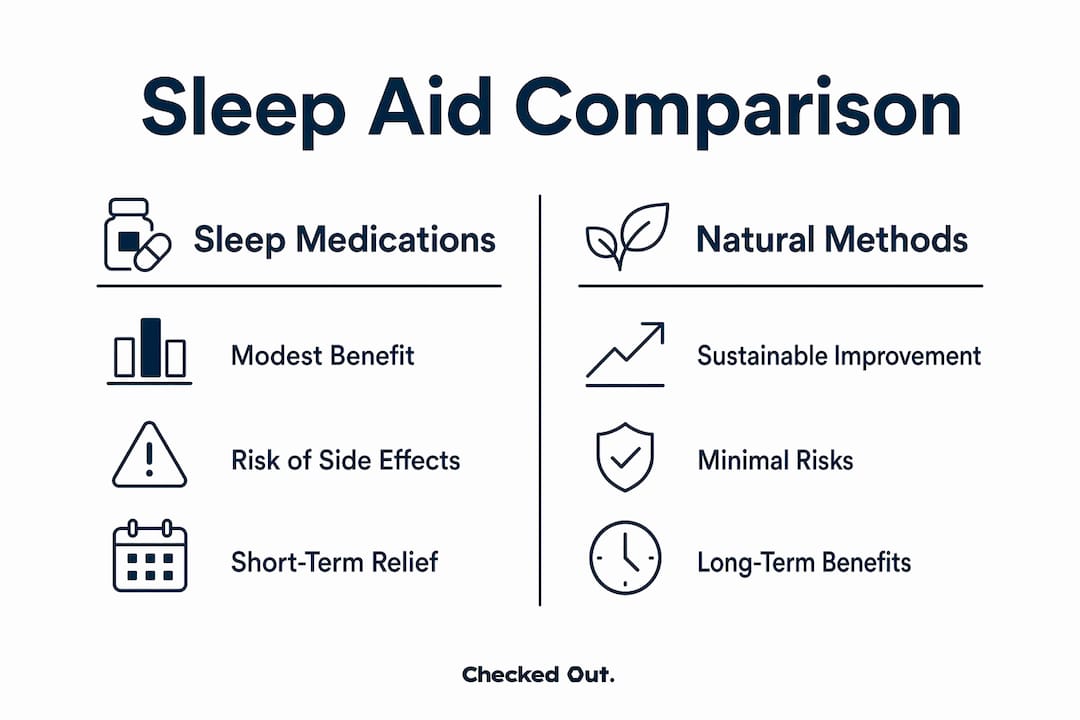
Sleep medications have a Number Needed to Treat of 13 and a Number Needed to Harm of 6. That means for every 13 people who take a sleep drug, only one person benefits with meaningfully improved sleep. For every 6 people who take it, one suffers a documented harm. You are statistically more likely to be harmed than helped. That is not a fringe finding. It is the kind of data that should change how you think about reaching for a pill at 2 a.m.
The modest 23-minute average gain in sleep time does not reflect restorative sleep either. Sleep drugs do not reconstruct normal sleep architecture, meaning the sedation they produce suppresses the deep slow-wave and REM stages your brain needs for memory consolidation, emotional regulation, and physical recovery. You may spend more time unconscious, but you wake up less restored. That distinction matters enormously for high performers and anyone tracking their health seriously.
CBT-I vs. sleep medications: a direct comparison
CBT-I retrains the brain’s natural sleep architecture by addressing the root behavioral and cognitive causes of insomnia. It does not sedate. It rebuilds. Programs like Sleepio and the Somryst digital therapeutic deliver CBT-I protocols without requiring in-person therapy, making access easier than ever.
| Factor |
Sleep medications |
CBT-I and natural methods |
| Average sleep improvement |
~23 minutes |
Sustained, lasting gains |
| Addresses root cause |
No |
Yes |
| Risk of dependence |
High |
None |
| Long-term safety |
Poor |
Excellent |
| Recommended as first-line |
No |
Yes |
Pro Tip: If you cannot access a CBT-I therapist directly, the American College of Physicians endorses digital CBT-I programs as a legitimate first-line option. Apps like Sleepio have published clinical trial data supporting their efficacy.
What natural, non-drug alternatives can improve sleep quality?
Natural sleep alternatives work because they support the body’s own sleep systems rather than overriding them. The tryptophan-to-serotonin-to-melatonin conversion pathway, your circadian rhythm, and your adenosine pressure system are all designed to produce sleep. The goal is to stop interfering with them and start supporting them.
Here are the most evidence-backed approaches to improve sleep naturally:
-
Establish a consistent sleep-wake schedule. Your circadian rhythm is a biological clock. Irregular bedtimes disrupt cortisol and melatonin timing, making it harder to fall and stay asleep. Anchor your wake time first, even on weekends.
-
Reduce blue light exposure after sunset. Blue light from screens suppresses melatonin production by signaling daylight to your brain. Blue-light-blocking glasses or screen curfews 60–90 minutes before bed measurably improve sleep onset latency.
-
Practice relaxation techniques before bed. Progressive muscle relaxation, diaphragmatic breathing, and body scan meditation activate the parasympathetic nervous system. Research on natural methods like relaxation and sleep hygiene shows lasting improvements without the side effects of medications.
-
Optimize your sleep environment. A room temperature between 65°F and 68°F, complete darkness, and low noise are the three physical conditions most strongly linked to deep sleep. Blackout masks are a practical, drug-free tool when you cannot control ambient light.
-
Consider targeted cofactor supplementation. Magnesium glycinate, vitamin B6, and GABA support the tryptophan-to-melatonin conversion pathway without suppressing natural production. These are not sedatives. They are building blocks your body already uses. For a deeper look at what actually works, the evidence-backed supplement picks from Checkedoutwellness break down the research clearly.
-
Use transdermal delivery for better absorption. Sleep patches deliver cofactors like magnesium and B12 through the skin overnight, bypassing digestive absorption issues that reduce the effectiveness of oral supplements taken at bedtime.
Pro Tip: Track your sleep with a wearable like Oura Ring or WHOOP for two weeks before making changes. Baseline data reveals whether your problem is sleep onset, sleep maintenance, or early waking, and each responds to different interventions.
How should you approach sleep medication use if it becomes necessary?
There are situations where short-term sleep medication use is medically appropriate. Acute grief, post-surgical recovery, or a severe circadian disruption from shift work or long-haul travel can justify a brief prescription. The key word is brief. Sleep medications should function as temporary support during acute crises, never as the foundation of a long-term sleep strategy.
If you are currently taking sleep medication and want to stop, these principles protect you:
-
Never stop abruptly. Tapering under medical supervision prevents the rebound insomnia cycle and reduces withdrawal severity.
-
Work with your prescriber on a taper plan. A gradual reduction over weeks or months, combined with CBT-I, produces the best outcomes for long-term cessation.
-
Avoid combining sleep aids with alcohol or other CNS depressants. The interaction amplifies sedation unpredictably and raises the risk of respiratory depression.
-
Be cautious with off-label sedating medications. Drugs like quetiapine are sometimes prescribed off-label for sleep, but off-label sedatives degrade daytime cognitive performance and fail to produce restorative sleep architecture.
-
Ask your doctor specifically about CBT-I as a concurrent or replacement therapy. Many prescribers default to medication because patients ask for it. Asking for a behavioral referral changes the conversation.
Polypharmacy is a real concern, particularly for adults over 60 who may already take medications for blood pressure, diabetes, or mood. Adding a sedative-hypnotic to that mix multiplies interaction risks in ways that are difficult to predict without a comprehensive medication review.
Key takeaways
Sleep medications carry a risk-to-benefit profile that makes them a poor long-term solution: they harm more users than they help, suppress restorative sleep architecture, and create dependency cycles that are hard to break without professional support.
| Point |
Details |
| Modest sleep benefit |
Sleep meds add only about 23 minutes of sleep and do not improve sleep quality. |
| High harm probability |
The NNH of 6 means one in six users suffers a documented harm from sleep medication. |
| Mortality risk with Z-drugs |
Z-drug users face a 60% higher all-cause mortality risk compared to non-users. |
| CBT-I is the gold standard |
Cognitive Behavioral Therapy for Insomnia addresses root causes and produces lasting results without dependency. |
| Natural methods work |
Consistent sleep schedules, targeted cofactors, and environmental optimization support the body’s own sleep systems safely. |
What I’ve learned after years of watching people chase sleep in a pill
By Geeta
The most common thing I hear from people who finally step away from sleep medication is some version of: “I had no idea it was making things worse.” That sentence carries so much in it. The hope they placed in that prescription. The months or years of foggy mornings they normalized. The moment they realized the pill was not solving anything.
What I have come to understand is that sleep medication does not fail because it is poorly made. It fails because it was never designed to fix what most people with insomnia actually have. Insomnia is not a drug deficiency. It is a pattern, a habit, a nervous system that has learned the wrong cues. Sedating that nervous system does not undo the pattern. It just delays the reckoning.
I have seen people transform their sleep through CBT-I, magnesium, a consistent wake time, and a blackout mask. Not overnight. But durably. The body keeps score quietly, and when you give it the right inputs consistently, it responds. That is not wishful thinking. It is biology.
The hardest part is the transition. If you are tapering off medication, the first two weeks feel like evidence that you cannot sleep without it. You can. Your brain needs time to remember how. Be patient with that process. Work with a provider. And trust that the discomfort is temporary while the gains are lasting.
The science behind natural sleep is not soft or speculative. It is the same biology that kept humans sleeping well for millennia before the first prescription pad existed. You are not broken. You just need better tools.
— Geeta
Drug-free sleep support from Checkedoutwellness
If you are ready to move away from sleep medication and toward something that works with your biology, Checkedoutwellness builds products specifically for that transition.

The natural sleep patch delivers magnesium, B6, B12, and GABA transdermally overnight, supporting your body’s own melatonin production without synthetic hormones or sedating chemicals. It is manufactured in South Korea under ISO 22716 GMP pharmaceutical standards. For complete light control, the contoured blackout sleep mask blocks ambient light without pressure on your eyes. Both products are drug-free, cruelty-free, and built for people who take sleep as seriously as their training and nutrition. Explore the full range at Checkedoutwellness and find the combination that fits your recovery goals.
FAQ
Why avoid sleep medication for long-term use?
Long-term sleep medication use leads to tolerance, physical dependence, and worsened sleep architecture. The drugs sedate the nervous system without addressing the root behavioral causes of insomnia, making them ineffective as a permanent solution.
What are the most serious side effects of sleeping pills?
The most serious side effects include a 60% higher all-cause mortality risk with Z-drugs, more than doubled fall and fracture risk in older adults, cognitive impairment, and rebound insomnia after stopping. OTC antihistamine-based aids also carry anticholinergic risks including confusion and memory decline.
What is the safest natural alternative to sleep medication?
CBT-I is the most evidence-backed natural alternative, recommended as first-line treatment by the American College of Physicians. Lifestyle changes including consistent sleep schedules, reduced blue light exposure, and targeted cofactor supplementation also produce lasting improvements without dependency.
Can you stop sleep medication on your own?
Stopping sleep medication abruptly is not recommended because it triggers rebound insomnia, where sleep quality drops below your original baseline. A medically supervised taper combined with behavioral therapy produces the safest and most successful outcomes.
How much does sleep medication actually improve sleep?
Sleep medications increase total sleep time by an average of only about 23 minutes compared to placebo. That modest gain comes with a Number Needed to Harm of 6, meaning one in six users experiences a documented adverse effect.
Recommended

Why Avoid Sleep Medication: Risks and Better Options
Sleep medication is defined as any pharmacological agent, including benzodiazepines, Z-drugs like zolpidem, and over-the-counter antihistamine-based aids, prescribed or sold to induce or maintain sleep. The core reason to understand why avoid sleep medication comes down to a stark risk-to-benefit imbalance: these drugs increase sleep by only 23 minutes on average compared to placebo, yet carry serious risks including dependence, cognitive impairment, and increased mortality. The American Academy of Sleep Medicine and leading researchers now recommend Cognitive Behavioral Therapy for Insomnia (CBT-I) as the first-line treatment, not pills. If you are weighing your options, the evidence points clearly toward natural sleep alternatives as both safer and more sustainable.
What are the main risks and side effects of sleep medications?
The dangers of sleep medications extend well beyond a groggy morning. They touch your brain, your body, and your long-term health in ways most people never anticipate when they first fill a prescription.
Physical side effects you feel immediately
Common side effects of sleeping pills include daytime drowsiness, dizziness, headaches, and impaired coordination. These are not minor inconveniences. Drowsiness the morning after a dose raises your risk of car accidents and workplace injuries in ways that are measurable and documented. For older adults, the stakes are even higher: sedative-hypnotics more than double the risk of falls and fractures, and they are also linked to confusion and memory impairment. A broken hip from a nighttime fall can be life-altering. That risk deserves serious weight before you open the medicine cabinet.
Over-the-counter options are not a safe workaround. OTC sleep aids often contain antihistamines with anticholinergic effects, meaning they block a key neurotransmitter involved in memory and cognition. Regular use is associated with urinary retention, dry mouth, and, in older adults, accelerated cognitive decline. The “natural” label on the box does not make diphenhydramine or doxylamine safe for nightly use.
The mortality risk most people never hear about
The risks of sleep aids go beyond falls and foggy mornings. Z-drug use is linked to a 60% higher risk of all-cause mortality compared to non-users, according to a published meta-analysis. That figure means people taking zolpidem, zaleplon, or eszopiclone are not just sleeping worse in the long run. They are dying sooner at a statistically significant rate. This finding alone reframes the conversation about what “safe” means when a doctor hands you a prescription.
Dependence, withdrawal, and rebound insomnia
Physical dependence develops faster than most users expect. Stopping sleep medication abruptly causes rebound insomnia, a condition where sleep quality drops below your original baseline. Your brain, accustomed to chemical sedation, loses its ability to self-regulate sleep onset. The result is a cycle: you sleep poorly without the pill, so you take the pill again, which deepens the dependence. Sleep medication withdrawal is not just uncomfortable. It can feel impossible to manage without medical support.
How effective are sleep medications compared to natural sleep methods?
Effectiveness is where the case against sleep medication becomes undeniable. The numbers tell a story that most prescribers do not share at the point of care.
Sleep medications have a Number Needed to Treat of 13 and a Number Needed to Harm of 6. That means for every 13 people who take a sleep drug, only one person benefits with meaningfully improved sleep. For every 6 people who take it, one suffers a documented harm. You are statistically more likely to be harmed than helped. That is not a fringe finding. It is the kind of data that should change how you think about reaching for a pill at 2 a.m.
The modest 23-minute average gain in sleep time does not reflect restorative sleep either. Sleep drugs do not reconstruct normal sleep architecture, meaning the sedation they produce suppresses the deep slow-wave and REM stages your brain needs for memory consolidation, emotional regulation, and physical recovery. You may spend more time unconscious, but you wake up less restored. That distinction matters enormously for high performers and anyone tracking their health seriously.
CBT-I vs. sleep medications: a direct comparison
CBT-I retrains the brain’s natural sleep architecture by addressing the root behavioral and cognitive causes of insomnia. It does not sedate. It rebuilds. Programs like Sleepio and the Somryst digital therapeutic deliver CBT-I protocols without requiring in-person therapy, making access easier than ever.
Pro Tip: If you cannot access a CBT-I therapist directly, the American College of Physicians endorses digital CBT-I programs as a legitimate first-line option. Apps like Sleepio have published clinical trial data supporting their efficacy.
What natural, non-drug alternatives can improve sleep quality?
Natural sleep alternatives work because they support the body’s own sleep systems rather than overriding them. The tryptophan-to-serotonin-to-melatonin conversion pathway, your circadian rhythm, and your adenosine pressure system are all designed to produce sleep. The goal is to stop interfering with them and start supporting them.
Here are the most evidence-backed approaches to improve sleep naturally:
Establish a consistent sleep-wake schedule. Your circadian rhythm is a biological clock. Irregular bedtimes disrupt cortisol and melatonin timing, making it harder to fall and stay asleep. Anchor your wake time first, even on weekends.
Reduce blue light exposure after sunset. Blue light from screens suppresses melatonin production by signaling daylight to your brain. Blue-light-blocking glasses or screen curfews 60–90 minutes before bed measurably improve sleep onset latency.
Practice relaxation techniques before bed. Progressive muscle relaxation, diaphragmatic breathing, and body scan meditation activate the parasympathetic nervous system. Research on natural methods like relaxation and sleep hygiene shows lasting improvements without the side effects of medications.
Optimize your sleep environment. A room temperature between 65°F and 68°F, complete darkness, and low noise are the three physical conditions most strongly linked to deep sleep. Blackout masks are a practical, drug-free tool when you cannot control ambient light.
Consider targeted cofactor supplementation. Magnesium glycinate, vitamin B6, and GABA support the tryptophan-to-melatonin conversion pathway without suppressing natural production. These are not sedatives. They are building blocks your body already uses. For a deeper look at what actually works, the evidence-backed supplement picks from Checkedoutwellness break down the research clearly.
Use transdermal delivery for better absorption. Sleep patches deliver cofactors like magnesium and B12 through the skin overnight, bypassing digestive absorption issues that reduce the effectiveness of oral supplements taken at bedtime.
Pro Tip: Track your sleep with a wearable like Oura Ring or WHOOP for two weeks before making changes. Baseline data reveals whether your problem is sleep onset, sleep maintenance, or early waking, and each responds to different interventions.
How should you approach sleep medication use if it becomes necessary?
There are situations where short-term sleep medication use is medically appropriate. Acute grief, post-surgical recovery, or a severe circadian disruption from shift work or long-haul travel can justify a brief prescription. The key word is brief. Sleep medications should function as temporary support during acute crises, never as the foundation of a long-term sleep strategy.
If you are currently taking sleep medication and want to stop, these principles protect you:
Polypharmacy is a real concern, particularly for adults over 60 who may already take medications for blood pressure, diabetes, or mood. Adding a sedative-hypnotic to that mix multiplies interaction risks in ways that are difficult to predict without a comprehensive medication review.
Key takeaways
Sleep medications carry a risk-to-benefit profile that makes them a poor long-term solution: they harm more users than they help, suppress restorative sleep architecture, and create dependency cycles that are hard to break without professional support.
What I’ve learned after years of watching people chase sleep in a pill
By Geeta
The most common thing I hear from people who finally step away from sleep medication is some version of: “I had no idea it was making things worse.” That sentence carries so much in it. The hope they placed in that prescription. The months or years of foggy mornings they normalized. The moment they realized the pill was not solving anything.
What I have come to understand is that sleep medication does not fail because it is poorly made. It fails because it was never designed to fix what most people with insomnia actually have. Insomnia is not a drug deficiency. It is a pattern, a habit, a nervous system that has learned the wrong cues. Sedating that nervous system does not undo the pattern. It just delays the reckoning.
I have seen people transform their sleep through CBT-I, magnesium, a consistent wake time, and a blackout mask. Not overnight. But durably. The body keeps score quietly, and when you give it the right inputs consistently, it responds. That is not wishful thinking. It is biology.
The hardest part is the transition. If you are tapering off medication, the first two weeks feel like evidence that you cannot sleep without it. You can. Your brain needs time to remember how. Be patient with that process. Work with a provider. And trust that the discomfort is temporary while the gains are lasting.
The science behind natural sleep is not soft or speculative. It is the same biology that kept humans sleeping well for millennia before the first prescription pad existed. You are not broken. You just need better tools.
Drug-free sleep support from Checkedoutwellness
If you are ready to move away from sleep medication and toward something that works with your biology, Checkedoutwellness builds products specifically for that transition.
The natural sleep patch delivers magnesium, B6, B12, and GABA transdermally overnight, supporting your body’s own melatonin production without synthetic hormones or sedating chemicals. It is manufactured in South Korea under ISO 22716 GMP pharmaceutical standards. For complete light control, the contoured blackout sleep mask blocks ambient light without pressure on your eyes. Both products are drug-free, cruelty-free, and built for people who take sleep as seriously as their training and nutrition. Explore the full range at Checkedoutwellness and find the combination that fits your recovery goals.
FAQ
Why avoid sleep medication for long-term use?
Long-term sleep medication use leads to tolerance, physical dependence, and worsened sleep architecture. The drugs sedate the nervous system without addressing the root behavioral causes of insomnia, making them ineffective as a permanent solution.
What are the most serious side effects of sleeping pills?
The most serious side effects include a 60% higher all-cause mortality risk with Z-drugs, more than doubled fall and fracture risk in older adults, cognitive impairment, and rebound insomnia after stopping. OTC antihistamine-based aids also carry anticholinergic risks including confusion and memory decline.
What is the safest natural alternative to sleep medication?
CBT-I is the most evidence-backed natural alternative, recommended as first-line treatment by the American College of Physicians. Lifestyle changes including consistent sleep schedules, reduced blue light exposure, and targeted cofactor supplementation also produce lasting improvements without dependency.
Can you stop sleep medication on your own?
Stopping sleep medication abruptly is not recommended because it triggers rebound insomnia, where sleep quality drops below your original baseline. A medically supervised taper combined with behavioral therapy produces the safest and most successful outcomes.
How much does sleep medication actually improve sleep?
Sleep medications increase total sleep time by an average of only about 23 minutes compared to placebo. That modest gain comes with a Number Needed to Harm of 6, meaning one in six users experiences a documented adverse effect.
Recommended