Better sleep when traveling is defined by three pillars: environment control, routine consistency, and targeted physiological support. Most travelers lose one to two nights of quality sleep per trip, not because travel is inherently punishing, but because they walk into unfamiliar rooms with no plan. The good news is that the ways to sleep better when traveling are well-documented, practical, and mostly free. This guide pulls from 2026 clinical guidance and real-world travel experience to give you a system that works whether you’re crossing two time zones or twelve.
1. Ways to sleep better when traveling start with your room environment
The single most overlooked factor in travel sleep is the room itself. Most hotel rooms are sensory chaos: blinking LED chargers, thin curtains, HVAC hum, and hallway noise at 2 a.m. Fixing this takes less than ten minutes and costs almost nothing.
Temperature is your first lever. The CDC recommends 65–68°F as the optimal ambient temperature for sleep. Most hotel rooms default to warmer settings, so adjust the thermostat the moment you check in, before you unpack.
Light is the second lever, and it’s more disruptive than most people realize. Covering LED lights with black electrical tape is a small, widely overlooked travel essential. It blocks the sleep-waking light emissions from TV standby indicators, smoke detectors, and charging ports without leaving residue on surfaces. Pack a small roll in your carry-on.
- Pull blackout curtains fully closed and overlap them at the center seam
- Use a contoured sleep mask as a backup when curtains fail
- Request a room away from elevators, ice machines, and street-facing walls
- Use a mini travel fan for both airflow and a consistent white noise floor
Pro Tip: If the room is still too bright after curtains and tape, hang a dark t-shirt or scarf over the curtain gap using the existing hooks or hangers. It sounds low-tech because it is, and it works.
2. Use white noise to protect sleep from unpredictable sounds
Silence is not actually ideal for sleep in unfamiliar places. White noise reduces the brain’s tendency to scan for irregular sounds, which is exactly what your nervous system does in a new environment. A consistent sound floor masks the unpredictable: slamming doors, ice machines, and early-morning housekeeping carts.
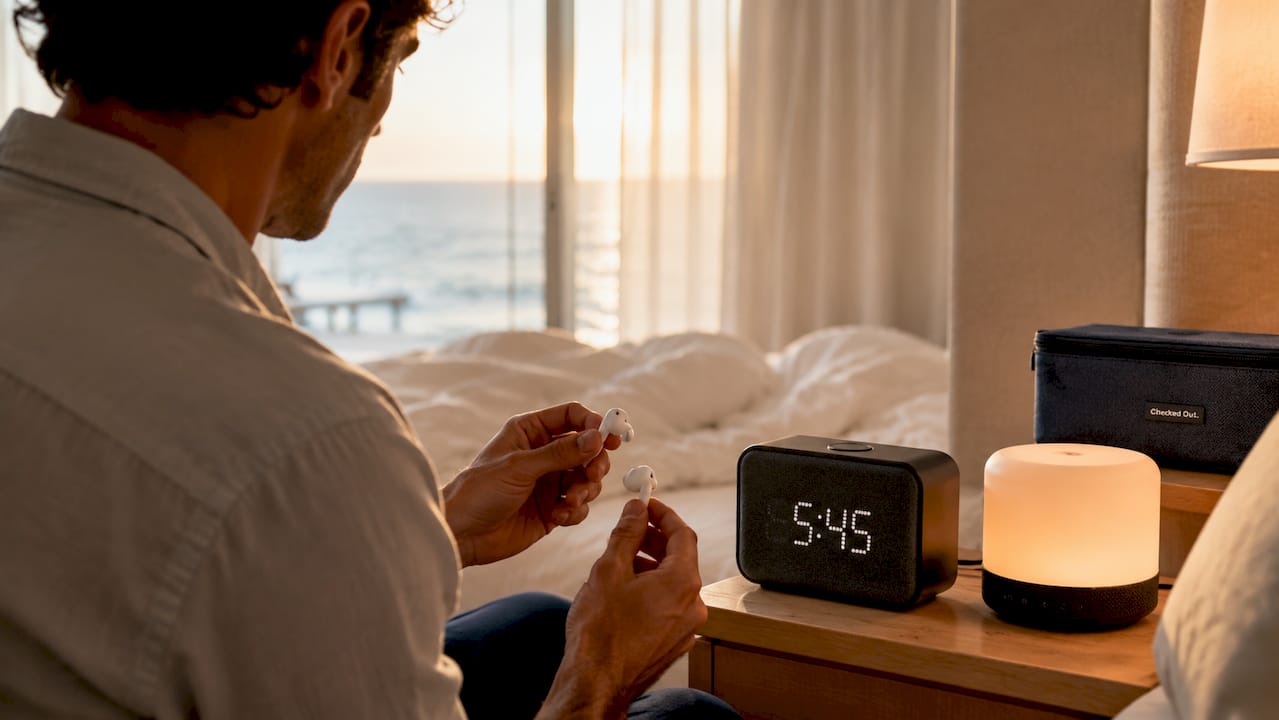
Apps like Calm, Endel, and Sleep Pillow offer white noise, brown noise, and rain sounds that you can run through earbuds or a small Bluetooth speaker. A compact travel fan like the Vornado Flippi V6 doubles as both an airflow source and a mechanical white noise generator, which makes it one of the most efficient items you can pack.
The key is consistency. Run the sound from the moment you get into bed, not just when noise wakes you up. Your brain habituates to a steady sound floor faster than it habituates to silence interrupted by noise.
3. Shift your sleep schedule before you leave home
Jet lag is not a mystery. It is a mismatch between your internal circadian clock and the local time at your destination. The most effective way to reduce that mismatch is to start closing the gap before you board the plane.
Experts recommend shifting your sleep and wake times by 15 to 30 minutes per day, starting three to five days before departure. For eastward travel, go to bed and wake up earlier. For westward travel, push both later. This gradual pre-adjustment means your body arrives at the destination already partially adapted, which shortens the recovery window significantly.
- Identify your destination’s local bedtime and work backward from your departure date
- Shift your alarm and lights-out time by 20 minutes each day
- Adjust meal timing alongside sleep timing, since digestion also anchors circadian rhythm
- On the day of travel, set your watch or phone to destination time immediately after boarding
Pro Tip: Pair your schedule shift with light exposure. On days you’re shifting earlier, get outside within 30 minutes of your new wake time. On days you’re shifting later, avoid bright light in the morning and seek it in the evening.
4. Prioritize morning light exposure at your destination
Natural morning light is the single most effective non-pharmaceutical way to regulate circadian rhythm and combat jet lag. Even 10 to 20 minutes of outdoor exposure within the first hour of waking sends a powerful signal to your suprachiasmatic nucleus, the brain’s master clock, that it is time to be awake. This anchors your melatonin production to the correct local cycle.
The mistake most travelers make is staying indoors on arrival day. They check in, draw the curtains, and try to nap. That choice delays circadian adaptation by up to 24 hours. Instead, take a short walk outside, eat breakfast near a window, or sit on a hotel balcony. The light does not need to be intense. Overcast morning sky still delivers far more lux than indoor lighting.
For a natural jet lag recovery protocol that pairs light exposure with targeted supplementation, the timing of both matters as much as the dose.
5. Protect your bedtime routine even away from home
A familiar bedtime routine provides neurological cues that enhance relaxation and sleep onset, even in new environments. Your nervous system does not care whether you are in Seoul or San Francisco. It responds to sequence. The same 20-minute wind-down you do at home, whether that is a warm shower, a few pages of a book, or a brief breathing practice, signals your brain that sleep is coming.
The failure mode here is travelers who abandon their routine entirely because the environment feels different. That is exactly when the routine matters most. Pack the small items that anchor your ritual: your preferred lip balm, a familiar herbal tea bag, a sleep playlist, or a journal. These are not luxuries. They are neurological anchors.
Avoid screens for at least 60 minutes before bed. Blue light from phones and laptops suppresses melatonin production at the pineal gland, which delays sleep onset. This is especially damaging when your melatonin timing is already disrupted by travel. Use the Kindle’s warm light setting, switch your phone to Night Shift or Grayscale, or simply read a physical book. For more on building consistent sleep habits that hold up under travel conditions, the principles are the same whether you are home or away.
6. Use melatonin strategically, not habitually
Melatonin is a natural hormone that helps regulate sleep-wake cycles and is the preferred mild over-the-counter aid for travel-related sleep issues. The critical word is “strategically.” Most travelers either skip it entirely or take too much of it too early.
The evidence-based protocol is simple: take 0.5 to 1 mg at your destination’s local bedtime for two to five nights after arrival. This low dose mimics the body’s natural melatonin output rather than overwhelming it. Higher doses, the 5 to 10 mg tablets common in U.S. pharmacies, are pharmacological rather than physiological and often cause next-day grogginess without improving sleep architecture.
Avoid sedating antihistamines like diphenhydramine (the active ingredient in ZzzQuil and Unisom SleepTabs) as a travel sleep aid. They suppress REM sleep, cause rebound insomnia after two to three nights, and leave most users feeling foggy the next morning. That is the opposite of what a traveler needs.
Pro Tip: If you prefer a drug-free approach, transdermal sleep patches that deliver cofactors like magnesium, B6, and GABA support your body’s own melatonin production rather than replacing it. Checkedoutwellness builds this exact mechanism into their sleep patch formula.
7. Pack the right sleep accessories
The best travel sleep products are the ones you actually use consistently. Here is what earns its weight in your bag:
-
Contoured sleep mask: A 3D contoured mask creates a blackout seal without pressing on your eyelids, which matters for REM sleep quality. Silk masks add a tactile comfort layer that helps with sleep onset.
-
Foam or silicone earplugs: Rated at 33 dB noise reduction, these are the most cost-effective sleep aid in existence. Pack at least four pairs per trip.
-
White noise app or device: Calm, Endel, and the Lectrofan Micro2 are all proven options. The app is lighter; the device is more reliable on international data plans.
-
Self-warming eye mask: Brands like Kao MegRhythm offer disposable steam eye masks that combine darkness with gentle warmth, which activates the parasympathetic nervous system and accelerates sleep onset.
-
Lavender essential oil roll-on: A small roll-on applied to the wrists or temples before bed has measurable effects on cortisol and sleep latency in peer-reviewed studies.
For a deeper look at how sleep masks improve rest beyond simple light blocking, the science behind contoured designs is worth understanding before you buy.
8. Manage hydration and nutrition to support sleep on the road
Hydration is critical for reducing travel fatigue and supporting sleep. Airplane cabin humidity typically sits below 20%, compared to the 30 to 65% range your body is accustomed to. That dryness accelerates dehydration, which raises cortisol, impairs thermoregulation, and makes sleep fragmented. Drink water consistently throughout the flight, not just when you feel thirsty.
One in five travelers report post-flight cold symptoms, which directly disrupts sleep quality for days after arrival. Micro-nourishment matters here. Zinc, vitamin C, and magnesium taken during travel support immune function and reduce the inflammatory load that makes post-flight sleep so poor.
- Avoid alcohol on flights. It may induce drowsiness but fragments sleep architecture and worsens dehydration.
- Limit caffeine after 2 p.m. local destination time to protect adenosine buildup and natural sleep pressure.
- Eat light meals aligned with destination meal times to help anchor your circadian rhythm through digestive cues.
- Avoid heavy, spicy, or high-fat meals within two hours of your intended sleep time. Digestion raises core body temperature, which delays sleep onset.
9. Manage expectations about airplane sleep
Accepting limited airplane sleep quality and focusing on temperature and noise control helps manage expectations and reduce stress. The anxiety about not sleeping on a plane often causes more cortisol dysregulation than the sleep loss itself. A long-haul flight in economy is not a sleep environment. It is a holding environment where rest is possible but deep sleep is unlikely.
Shift your goal from “sleep well on the plane” to “arrive less depleted.” That means reclining as fully as possible, using a neck pillow that keeps your airway open, wearing compression socks to reduce circulatory strain, and staying off screens for the final 90 minutes of the flight. Guided meditations through apps like Headspace or Insight Timer can move you into a restorative rest state even without full sleep.
For science-backed context on why travelers need sleep support beyond just the flight itself, the physiological case is compelling and often underestimated.
Key takeaways
Better sleep when traveling requires a system, not a single fix. Environment, timing, routine, and targeted support all work together.
| Point |
Details |
| Control your room environment |
Set temperature to 65–68°F, block LED lights with black tape, and use a contoured sleep mask. |
| Shift your schedule before you leave |
Adjust sleep and wake times by 20–30 minutes daily starting three to five days before departure. |
| Use morning light strategically |
Ten to twenty minutes of outdoor light within the first hour of waking resets your circadian clock at the destination. |
| Choose melatonin doses carefully |
Take 0.5–1 mg at local bedtime for two to five nights. Higher doses cause grogginess without improving sleep quality. |
| Hydrate and eat with intention |
Prioritize water over alcohol and caffeine, and align meal timing with destination local time to anchor circadian adaptation. |
What I’ve learned about sleep and travel after years of getting it wrong
I used to treat travel sleep as something that just happened to me. I would land exhausted, collapse into a hotel bed, stare at the ceiling for two hours, and blame the time zone. It took a long time to realize I was the variable, not the destination.
The shift that changed everything was accepting that I could not control the hotel mattress or the neighbor’s 6 a.m. alarm call. What I could control was the 20 minutes before I got into bed. That window is where sleep is won or lost. A consistent wind-down sequence, a dark room, a sound floor, and a body that is hydrated and not fighting a cortisol spike from a late espresso. Those are the levers.
I also stopped chasing perfect sleep on travel days. Travelers who aim for familiar sleep cues rather than perfect sleep adapt faster and carry less anxiety about sleep loss. That reframe alone reduced my pre-trip stress noticeably. The body is more resilient than we give it credit for. It wants to sleep. Our job is to stop getting in its way.
The one thing I wish I had known earlier: the morning after arrival matters more than the night of arrival. Get outside. Get light. Eat breakfast at local time. Your body will follow. It just needs the signal.
— Geeta
Upgrade your travel sleep with Checkedoutwellness

If you want a drug-free system that travels with you, Checkedoutwellness builds exactly that. Their Sleep Patch delivers magnesium, B6, B12, and GABA transdermally overnight, supporting your body’s own melatonin production without synthetic hormones or next-day grogginess. Manufactured under ISO 22716 GMP pharmaceutical standards in South Korea, it is built for the traveler who takes recovery as seriously as performance. Pair it with their contoured blackout sleep mask for complete light elimination, or explore the Sleep Duo bundle combining the patch with mouth tape for deeper, more restorative overnight breathing. Your next trip does not have to cost you a week of recovery.
FAQ
What is the fastest way to adjust to a new time zone?
Morning natural light exposure for 10 to 20 minutes within the first hour of waking is the most effective non-pharmaceutical method for resetting your circadian rhythm at a new destination.
How much melatonin should I take for jet lag?
A dose of 0.5 to 1 mg taken at local bedtime for two to five nights is the evidence-based protocol. Higher doses do not improve sleep quality and often cause morning grogginess.
Does white noise actually help you sleep in hotels?
Yes. White noise prevents the brain from scanning for irregular sounds, which is a primary cause of fragmented sleep in unfamiliar environments. Apps like Calm or a compact device like the Lectrofan Micro2 both work well.
Should I sleep on the plane to beat jet lag?
It depends on direction of travel and arrival time. If you arrive in the evening, sleeping on the plane helps. If you arrive in the morning, staying awake and pushing through to local bedtime accelerates adaptation. Accepting that airplane sleep quality is limited reduces the anxiety that makes in-flight rest even harder.
What should I pack for better sleep while traveling?
The core kit includes a contoured sleep mask, foam earplugs, a white noise app or device, black electrical tape for LED lights, and a low-dose melatonin supplement or a drug-free sleep patch. These five items address the most common causes of disrupted sleep in travel environments.
Recommended

Ways to Sleep Better When Traveling: 2026 Guide
Better sleep when traveling is defined by three pillars: environment control, routine consistency, and targeted physiological support. Most travelers lose one to two nights of quality sleep per trip, not because travel is inherently punishing, but because they walk into unfamiliar rooms with no plan. The good news is that the ways to sleep better when traveling are well-documented, practical, and mostly free. This guide pulls from 2026 clinical guidance and real-world travel experience to give you a system that works whether you’re crossing two time zones or twelve.
1. Ways to sleep better when traveling start with your room environment
The single most overlooked factor in travel sleep is the room itself. Most hotel rooms are sensory chaos: blinking LED chargers, thin curtains, HVAC hum, and hallway noise at 2 a.m. Fixing this takes less than ten minutes and costs almost nothing.
Temperature is your first lever. The CDC recommends 65–68°F as the optimal ambient temperature for sleep. Most hotel rooms default to warmer settings, so adjust the thermostat the moment you check in, before you unpack.
Light is the second lever, and it’s more disruptive than most people realize. Covering LED lights with black electrical tape is a small, widely overlooked travel essential. It blocks the sleep-waking light emissions from TV standby indicators, smoke detectors, and charging ports without leaving residue on surfaces. Pack a small roll in your carry-on.
Pro Tip: If the room is still too bright after curtains and tape, hang a dark t-shirt or scarf over the curtain gap using the existing hooks or hangers. It sounds low-tech because it is, and it works.
2. Use white noise to protect sleep from unpredictable sounds
Silence is not actually ideal for sleep in unfamiliar places. White noise reduces the brain’s tendency to scan for irregular sounds, which is exactly what your nervous system does in a new environment. A consistent sound floor masks the unpredictable: slamming doors, ice machines, and early-morning housekeeping carts.
Apps like Calm, Endel, and Sleep Pillow offer white noise, brown noise, and rain sounds that you can run through earbuds or a small Bluetooth speaker. A compact travel fan like the Vornado Flippi V6 doubles as both an airflow source and a mechanical white noise generator, which makes it one of the most efficient items you can pack.
The key is consistency. Run the sound from the moment you get into bed, not just when noise wakes you up. Your brain habituates to a steady sound floor faster than it habituates to silence interrupted by noise.
3. Shift your sleep schedule before you leave home
Jet lag is not a mystery. It is a mismatch between your internal circadian clock and the local time at your destination. The most effective way to reduce that mismatch is to start closing the gap before you board the plane.
Experts recommend shifting your sleep and wake times by 15 to 30 minutes per day, starting three to five days before departure. For eastward travel, go to bed and wake up earlier. For westward travel, push both later. This gradual pre-adjustment means your body arrives at the destination already partially adapted, which shortens the recovery window significantly.
Pro Tip: Pair your schedule shift with light exposure. On days you’re shifting earlier, get outside within 30 minutes of your new wake time. On days you’re shifting later, avoid bright light in the morning and seek it in the evening.
4. Prioritize morning light exposure at your destination
Natural morning light is the single most effective non-pharmaceutical way to regulate circadian rhythm and combat jet lag. Even 10 to 20 minutes of outdoor exposure within the first hour of waking sends a powerful signal to your suprachiasmatic nucleus, the brain’s master clock, that it is time to be awake. This anchors your melatonin production to the correct local cycle.
The mistake most travelers make is staying indoors on arrival day. They check in, draw the curtains, and try to nap. That choice delays circadian adaptation by up to 24 hours. Instead, take a short walk outside, eat breakfast near a window, or sit on a hotel balcony. The light does not need to be intense. Overcast morning sky still delivers far more lux than indoor lighting.
For a natural jet lag recovery protocol that pairs light exposure with targeted supplementation, the timing of both matters as much as the dose.
5. Protect your bedtime routine even away from home
A familiar bedtime routine provides neurological cues that enhance relaxation and sleep onset, even in new environments. Your nervous system does not care whether you are in Seoul or San Francisco. It responds to sequence. The same 20-minute wind-down you do at home, whether that is a warm shower, a few pages of a book, or a brief breathing practice, signals your brain that sleep is coming.
The failure mode here is travelers who abandon their routine entirely because the environment feels different. That is exactly when the routine matters most. Pack the small items that anchor your ritual: your preferred lip balm, a familiar herbal tea bag, a sleep playlist, or a journal. These are not luxuries. They are neurological anchors.
Avoid screens for at least 60 minutes before bed. Blue light from phones and laptops suppresses melatonin production at the pineal gland, which delays sleep onset. This is especially damaging when your melatonin timing is already disrupted by travel. Use the Kindle’s warm light setting, switch your phone to Night Shift or Grayscale, or simply read a physical book. For more on building consistent sleep habits that hold up under travel conditions, the principles are the same whether you are home or away.
6. Use melatonin strategically, not habitually
Melatonin is a natural hormone that helps regulate sleep-wake cycles and is the preferred mild over-the-counter aid for travel-related sleep issues. The critical word is “strategically.” Most travelers either skip it entirely or take too much of it too early.
The evidence-based protocol is simple: take 0.5 to 1 mg at your destination’s local bedtime for two to five nights after arrival. This low dose mimics the body’s natural melatonin output rather than overwhelming it. Higher doses, the 5 to 10 mg tablets common in U.S. pharmacies, are pharmacological rather than physiological and often cause next-day grogginess without improving sleep architecture.
Avoid sedating antihistamines like diphenhydramine (the active ingredient in ZzzQuil and Unisom SleepTabs) as a travel sleep aid. They suppress REM sleep, cause rebound insomnia after two to three nights, and leave most users feeling foggy the next morning. That is the opposite of what a traveler needs.
Pro Tip: If you prefer a drug-free approach, transdermal sleep patches that deliver cofactors like magnesium, B6, and GABA support your body’s own melatonin production rather than replacing it. Checkedoutwellness builds this exact mechanism into their sleep patch formula.
7. Pack the right sleep accessories
The best travel sleep products are the ones you actually use consistently. Here is what earns its weight in your bag:
For a deeper look at how sleep masks improve rest beyond simple light blocking, the science behind contoured designs is worth understanding before you buy.
8. Manage hydration and nutrition to support sleep on the road
Hydration is critical for reducing travel fatigue and supporting sleep. Airplane cabin humidity typically sits below 20%, compared to the 30 to 65% range your body is accustomed to. That dryness accelerates dehydration, which raises cortisol, impairs thermoregulation, and makes sleep fragmented. Drink water consistently throughout the flight, not just when you feel thirsty.
One in five travelers report post-flight cold symptoms, which directly disrupts sleep quality for days after arrival. Micro-nourishment matters here. Zinc, vitamin C, and magnesium taken during travel support immune function and reduce the inflammatory load that makes post-flight sleep so poor.
9. Manage expectations about airplane sleep
Accepting limited airplane sleep quality and focusing on temperature and noise control helps manage expectations and reduce stress. The anxiety about not sleeping on a plane often causes more cortisol dysregulation than the sleep loss itself. A long-haul flight in economy is not a sleep environment. It is a holding environment where rest is possible but deep sleep is unlikely.
Shift your goal from “sleep well on the plane” to “arrive less depleted.” That means reclining as fully as possible, using a neck pillow that keeps your airway open, wearing compression socks to reduce circulatory strain, and staying off screens for the final 90 minutes of the flight. Guided meditations through apps like Headspace or Insight Timer can move you into a restorative rest state even without full sleep.
For science-backed context on why travelers need sleep support beyond just the flight itself, the physiological case is compelling and often underestimated.
Key takeaways
Better sleep when traveling requires a system, not a single fix. Environment, timing, routine, and targeted support all work together.
What I’ve learned about sleep and travel after years of getting it wrong
I used to treat travel sleep as something that just happened to me. I would land exhausted, collapse into a hotel bed, stare at the ceiling for two hours, and blame the time zone. It took a long time to realize I was the variable, not the destination.
The shift that changed everything was accepting that I could not control the hotel mattress or the neighbor’s 6 a.m. alarm call. What I could control was the 20 minutes before I got into bed. That window is where sleep is won or lost. A consistent wind-down sequence, a dark room, a sound floor, and a body that is hydrated and not fighting a cortisol spike from a late espresso. Those are the levers.
I also stopped chasing perfect sleep on travel days. Travelers who aim for familiar sleep cues rather than perfect sleep adapt faster and carry less anxiety about sleep loss. That reframe alone reduced my pre-trip stress noticeably. The body is more resilient than we give it credit for. It wants to sleep. Our job is to stop getting in its way.
The one thing I wish I had known earlier: the morning after arrival matters more than the night of arrival. Get outside. Get light. Eat breakfast at local time. Your body will follow. It just needs the signal.
Upgrade your travel sleep with Checkedoutwellness
If you want a drug-free system that travels with you, Checkedoutwellness builds exactly that. Their Sleep Patch delivers magnesium, B6, B12, and GABA transdermally overnight, supporting your body’s own melatonin production without synthetic hormones or next-day grogginess. Manufactured under ISO 22716 GMP pharmaceutical standards in South Korea, it is built for the traveler who takes recovery as seriously as performance. Pair it with their contoured blackout sleep mask for complete light elimination, or explore the Sleep Duo bundle combining the patch with mouth tape for deeper, more restorative overnight breathing. Your next trip does not have to cost you a week of recovery.
FAQ
What is the fastest way to adjust to a new time zone?
Morning natural light exposure for 10 to 20 minutes within the first hour of waking is the most effective non-pharmaceutical method for resetting your circadian rhythm at a new destination.
How much melatonin should I take for jet lag?
A dose of 0.5 to 1 mg taken at local bedtime for two to five nights is the evidence-based protocol. Higher doses do not improve sleep quality and often cause morning grogginess.
Does white noise actually help you sleep in hotels?
Yes. White noise prevents the brain from scanning for irregular sounds, which is a primary cause of fragmented sleep in unfamiliar environments. Apps like Calm or a compact device like the Lectrofan Micro2 both work well.
Should I sleep on the plane to beat jet lag?
It depends on direction of travel and arrival time. If you arrive in the evening, sleeping on the plane helps. If you arrive in the morning, staying awake and pushing through to local bedtime accelerates adaptation. Accepting that airplane sleep quality is limited reduces the anxiety that makes in-flight rest even harder.
What should I pack for better sleep while traveling?
The core kit includes a contoured sleep mask, foam earplugs, a white noise app or device, black electrical tape for LED lights, and a low-dose melatonin supplement or a drug-free sleep patch. These five items address the most common causes of disrupted sleep in travel environments.
Recommended