Most people assume swallowing a pill is the most efficient way to get something into their body. That assumption is worth questioning. A transdermal patch is a medication delivery system applied to the skin that releases an active ingredient so it can be absorbed through skin layers and reach systemic circulation, bypassing the digestive system entirely. For the growing community of biohackers, high performers, and sleep-conscious individuals looking for non-habit-forming alternatives to sleeping pills, this technology opens a genuinely different door. This article walks you through how transdermal patches actually work, why the design matters, what the science says, and how to use that knowledge to make smarter choices.
Table of Contents
Key Takeaways
| Point |
Details |
| Skin-based delivery |
Transdermal patches use your skin to release medication steadily, avoiding digestive complications. |
| Patch design matters |
Matrix, reservoir, and adhesive patches differ in how they deliver active ingredients and affect reliability. |
| Absorption is variable |
Effectiveness depends on both the patch technology and your unique skin properties. |
| Evidence gaps remain |
Sleep patches aren’t universally proven; current studies are small and wellness products vary. |
| Non-habit-forming potential |
Many sleep patches aim to avoid dependency, but results may differ from what marketing promises. |
What is a transdermal patch and how does it work?
At its core, a transdermal patch is an adhesive system worn on the skin that slowly releases one or more active ingredients over a defined period, typically several hours to multiple days. Unlike a pill that floods your system in one concentrated wave, or an injection that delivers everything instantly, the patch releases its payload gradually and continuously. That steadiness is the whole point.
When you swallow a pill, it has to survive your stomach acid, get absorbed through your intestinal wall, and pass through your liver before reaching your bloodstream. That first-pass metabolism, as it’s known in pharmacology, can degrade a significant portion of the active compound before it ever reaches your cells. A patch sidesteps all of that. Ingredients move from the patch, through the outer skin layers, into the dermis, and eventually into capillary networks that carry them into general circulation.
Transdermal delivery aims to maintain more stable drug exposure over the wear time versus the peaks and troughs typical of oral dosing, though patch performance can be limited by skin barrier variability and local tolerability at the application site. That stability matters enormously for sleep. A spike in a sedating compound early in the night followed by a crash at 3 a.m. is not what deep recovery needs.
Here’s a quick breakdown of how transdermal patches compare to other delivery methods:
-
Oral pills: Absorbed via the GI tract, subject to first-pass metabolism, create peaks and troughs in blood concentration
-
Injections: Fast and precise but invasive, impractical for nightly use, and require clinical administration
-
Topical creams: Mostly local effect, less predictable systemic absorption, variable spreading
-
Transdermal patches: Controlled, sustained release; bypasses GI tract; consistent delivery over hours; non-invasive
“The skin route offers a controlled, programmable alternative to oral and injectable delivery—particularly valuable when stable plasma levels are the therapeutic goal.”
Pro Tip: Clean, dry, hair-free skin at the application site significantly improves absorption. Avoid applying over broken skin, active rashes, or areas with thick calluses. Rotating your application site nightly also reduces localized skin fatigue.
Understanding the transdermal patch science behind these delivery mechanisms helps you evaluate products with a sharper eye, rather than relying purely on marketing language. For those also curious about how specific compounds interact with sleep biology, exploring evidence-backed sleep supplements is a useful complement to this knowledge.
Types of transdermal patch designs: Matrix vs. reservoir
Not all patches are built the same. The internal architecture of a patch directly determines how fast ingredients release, how consistently they’re delivered, and how long they last. Common patch designs include matrix patches, reservoir patches, and drug-in-adhesive designs, each controlling how the drug is released and how it contacts the skin differently.
Here’s a comparison of the three main designs:
| Feature |
Matrix patch |
Reservoir patch |
Drug-in-adhesive patch |
| Active ingredient location |
Dispersed in polymer matrix |
Stored in a central reservoir |
Mixed directly into adhesive layer |
| Release control |
Polymer matrix controls rate |
Membrane controls rate |
Adhesive layer controls rate |
| Consistency |
High, predictable |
Very precise |
Variable, formulation-dependent |
| Thickness |
Thin and flexible |
Thicker due to reservoir |
Very thin and lightweight |
| Risk of dose dumping |
Low |
Higher if membrane is damaged |
Low |
| Typical applications |
Hormones, wellness |
Nicotine, pain |
Lightweight wellness patches |
Matrix patches disperse the active compound throughout a polymer layer. As the patch sits on your skin, the compound migrates from areas of high concentration toward the skin surface. The rate of release slows gradually as the compound is used up. This is predictable and generally safe, since there’s no centralized reservoir that could rupture.
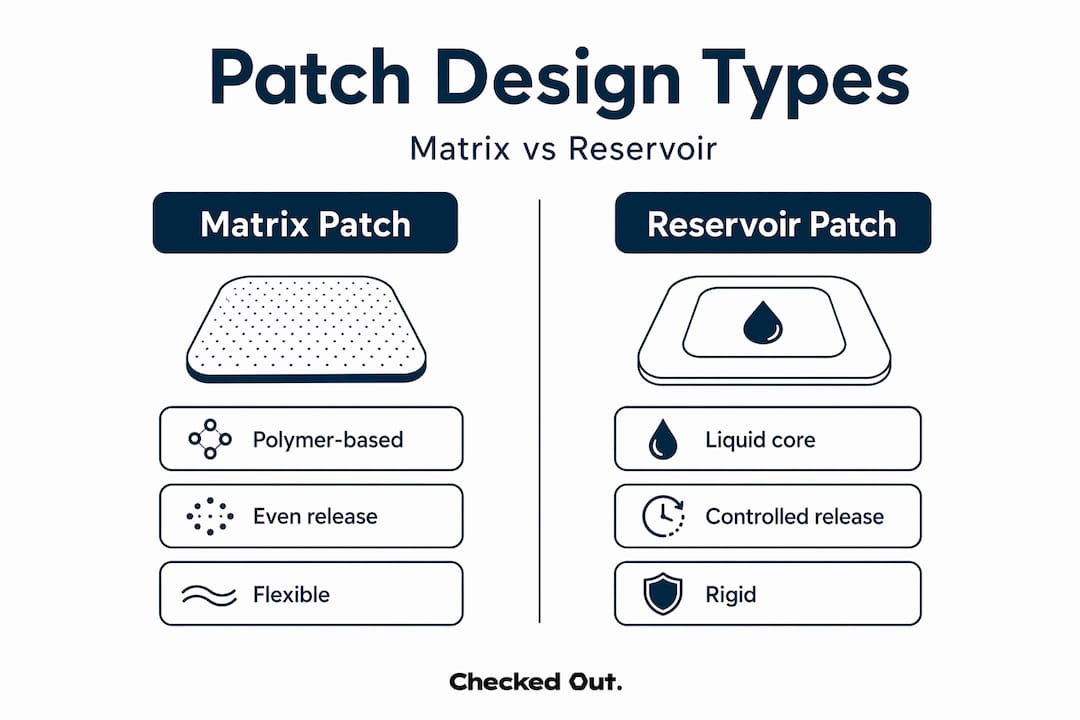
Reservoir patches hold the active compound in a liquid or gel core, sealed by a rate-controlling membrane. The membrane is engineered to allow only a precise amount of the compound to pass per unit of time. Think of it like a carefully calibrated faucet. These patches can be extremely accurate, but if the membrane is compromised, a larger dose can release at once, which is a known safety concern.
Drug-in-adhesive patches blend the active ingredient directly into the adhesive that sticks to your skin. These tend to be the thinnest and lightest format, which makes them popular in wellness applications. The ingredient diffuses from the adhesive into the skin throughout the wear period. Their release rate is more dependent on formulation quality than structural design.
For sleep wellness specifically, lightweight and skin-friendly designs matter. A natural sleep patch designed for overnight wear needs to stay in place comfortably, release ingredients gradually through the night, and come off cleanly in the morning without leaving residue or causing irritation.
Skin barrier challenges: Why absorption varies and what helps
Patch design is only half the story. How well your skin lets ingredients in is just as crucial, and this is where things get genuinely complex. The skin barrier, especially the stratum corneum, largely governs whether a drug can permeate; efficacy depends on drug properties such as molecular size and lipophilicity, as well as overall skin condition.
The stratum corneum is the outermost layer of the skin, roughly 10 to 20 micrometers thick. It’s designed to keep the outside world out. Most of the time, that’s exactly what you want. For transdermal delivery, it’s the primary obstacle. Compounds that absorb most effectively tend to be small in molecular size and somewhat fat-soluble, meaning they can navigate the lipid-rich structure of the stratum corneum. Larger, water-soluble molecules struggle to pass at all.
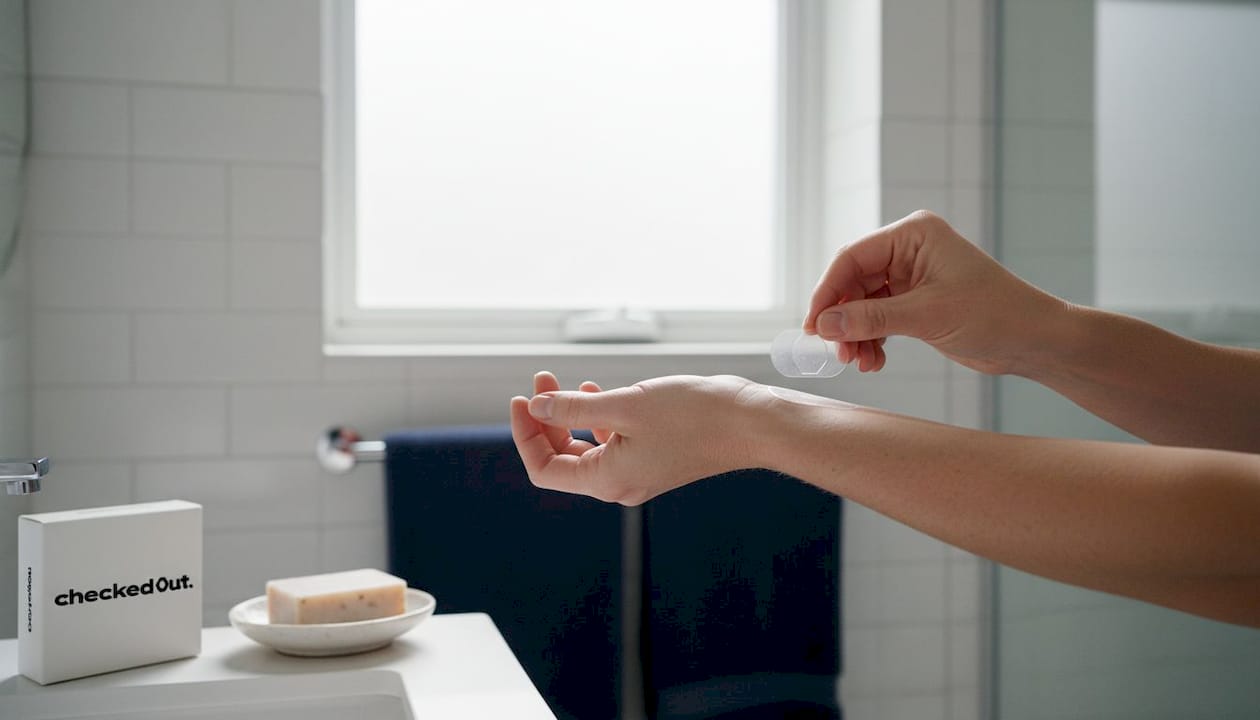
Several factors influence how effectively a patch works for a given individual:
| Factor |
Impact on absorption |
Notes |
| Skin hydration |
Higher hydration increases permeability |
Applying after a warm shower can help |
| Age |
Older skin absorbs less efficiently |
Stratum corneum thickens and dries with age |
| Body site |
Thin skin (inner wrist, neck) absorbs more |
Thick areas (sole of foot) absorb much less |
| Skin condition |
Eczema or dermatitis alters barrier function |
May increase or decrease absorption unpredictably |
| Drug molecular weight |
Smaller molecules absorb better |
Below ~500 daltons is the general guideline |
| Lipophilicity |
Fat-soluble compounds penetrate better |
Very water-soluble compounds often can’t cross |
| Skin temperature |
Warmer skin has higher blood flow and permeability |
Affects both absorption rate and onset |
To get the most out of any transdermal sleep patch, follow these steps:
- Wash the application site gently with mild soap and water, then pat dry completely.
- Avoid applying lotions, oils, or serums to the area before patch placement.
- Choose a site with relatively thin skin and good circulation, like the inner forearm or upper chest.
- Press the patch firmly for 30 seconds to ensure full adhesion across all edges.
- Avoid submerging the area in water for the first hour after application.
- Rotate your application site each night to prevent localized skin reactions.
- Remove the patch gently in the morning by peeling from one edge rather than pulling all at once.
Pro Tip: Lightly misting the skin with warm water before applying your patch can temporarily increase permeability and improve ingredient uptake, especially for magnesium-based formulations. For deeper context on how magnesium interacts with sleep physiology, the evidence behind magnesium sleep benefits is worth reading alongside this. Pairing good patch application habits with effective sleep routines amplifies the results.
Clinical uses, evidence, and limits: What sleep patches can—and can’t—do
Transdermal technology has a strong clinical track record in several well-studied areas. Pain management, hormone replacement therapy, and nicotine dependence all rely on established patch systems that have gone through rigorous trials. Transdermal patches have established clinical use for these conditions but still face challenges such as variable absorption between individuals and potential skin irritation.
Sleep patches occupy a different space. Most products marketed for sleep use supplement-grade ingredients like melatonin, magnesium, GABA, or herbal extracts such as valerian and passionflower, rather than regulated pharmaceutical compounds. For sleep patches marketed for wellness, the evidence base is more limited and varies by product and formulation. Transdermal approaches have been studied experimentally and in some clinical contexts, but robust, broad insomnia-specific trials are not yet well established.
That doesn’t make them ineffective. It means the evidence is still catching up with the innovation. Here’s an honest breakdown of what’s currently in the plus and minus columns:
Potential advantages:
- Sustained, gradual ingredient release throughout the night
- Bypasses GI degradation, which may preserve ingredient potency
- No swallowing required, helpful for those sensitive to oral supplements
- Non-habit-forming when using wellness-grade ingredients
- Convenient and passive, no mid-night dosing
- Compatible with layered sleep routines
Current limitations:
- Skin irritation and redness at the application site can occur
- Absorption varies significantly between individuals based on skin type, age, and application site
- Clinical research specific to sleep wellness patches is limited
- Supplement-grade patches lack the standardized dosing controls of regulated pharmaceutical patches
- Efficacy is hard to verify without robust controlled trials
For anyone serious about their sleep biology, reading a thorough melatonin science review helps calibrate expectations. And pairing any new tool with proven behavioral strategies through natural sleep improvement practices gives the patch the best possible environment in which to work.
The real promise of sleep patches: What most people and marketers miss
Here’s where we want to be honest with you, because we think you deserve that more than a polished sales narrative.
Transdermal patches genuinely represent an elegant delivery innovation. The science of bypassing the GI tract, achieving stable blood levels, and avoiding habit-forming pharmaceutical compounds is real and meaningful. But the wellness industry has a tendency to speak in certainties where science deals in probabilities. That gap is worth naming.
If you see “non-habit-forming sleep patches,” it helps to distinguish between true drug-delivery patches, which are regulated medicines with standardized dosing, and topical wellness products with ingredients that may not have the same standardized dosing, absorption, or outcome evidence. Both can have a role. But they are not the same thing, and pretending otherwise does buyers a disservice.
What we’ve observed, both through the research and through our own experience navigating sleep recovery, is that the best outcomes come from realistic expectations combined with consistent habits. A patch is not a cure. It’s a tool. A well-formulated patch delivering cofactors like magnesium, B6, GABA, and other compounds that support your body’s own melatonin production is doing something thoughtful. It’s working with your biology, not overriding it. That’s a meaningful distinction.
The uncomfortable truth is that a sleep patch worn over a screen-lit, cortisol-spiked, caffeine-saturated evening will underperform. The patch isn’t the variable. Your evening environment is. But when you pair a quality patch with consistent wind-down routines, reduced light exposure, and solid sleep hygiene, you give those ingredients the context they need to actually land. We’ve seen that combination work. That’s why we care about the science behind non-habit-forming sleep aids as much as we care about the products themselves.
Our honest recommendation: approach sleep patches as one piece of a larger architecture. Respect the evidence, acknowledge the gaps, and build your sleep practice around more than any single product. That’s not a caveat. That’s what actually works.
If this deep look into transdermal patches has you curious about what a well-formulated, evidence-informed sleep patch actually looks and feels like, we’d love to show you what we’ve built.

At Checked Out Wellness, our natural sleep patch is manufactured under ISO 22716 GMP pharmaceutical standards in South Korea, using a carefully selected blend of cofactors that support your body’s own melatonin production rather than replacing it. For those who want a complete overnight recovery system, the Sleep Duo bundle pairs our sleep patch with complementary tools for a layered approach. Everything is drug-free, cruelty-free, and built for people who take their sleep as seriously as their training and nutrition. Explore the science on sleep patches and decide for yourself.
Frequently asked questions
How do transdermal patches differ from oral pills for sleep?
Transdermal patches gradually release active ingredients through the skin to maintain stable blood levels throughout the night, while oral pills create peaks and troughs in exposure due to digestive absorption and first-pass metabolism.
Are sleep patches clinically proven to treat insomnia?
Clinical evidence is limited and varies by product. For sleep patches marketed for wellness, most research is preclinical or short-term, and large-scale insomnia-specific trials have not yet been well established.
Can all medications be delivered through a transdermal patch?
No. Only compounds with suitable properties, mainly small, lipophilic molecules below roughly 500 daltons, can permeate the skin reliably; larger and water-soluble compounds are generally excluded from effective transdermal delivery.
What are common side effects of transdermal patches?
The most common side effects include skin irritation, redness, or dryness at the application site, along with inter-individual variability in absorption that can make results inconsistent between users.
Do wellness sleep patches contain regulated medicines or supplements?
Wellness sleep patches typically feature unregulated supplement ingredients like melatonin or herbal extracts. Unlike regulated pharmaceutical patches, their dosing and efficacy often lack standardized controls and broad clinical validation.
Recommended

Transdermal patches: How skin delivery reshapes sleep
Most people assume swallowing a pill is the most efficient way to get something into their body. That assumption is worth questioning. A transdermal patch is a medication delivery system applied to the skin that releases an active ingredient so it can be absorbed through skin layers and reach systemic circulation, bypassing the digestive system entirely. For the growing community of biohackers, high performers, and sleep-conscious individuals looking for non-habit-forming alternatives to sleeping pills, this technology opens a genuinely different door. This article walks you through how transdermal patches actually work, why the design matters, what the science says, and how to use that knowledge to make smarter choices.
Table of Contents
Key Takeaways
What is a transdermal patch and how does it work?
At its core, a transdermal patch is an adhesive system worn on the skin that slowly releases one or more active ingredients over a defined period, typically several hours to multiple days. Unlike a pill that floods your system in one concentrated wave, or an injection that delivers everything instantly, the patch releases its payload gradually and continuously. That steadiness is the whole point.
When you swallow a pill, it has to survive your stomach acid, get absorbed through your intestinal wall, and pass through your liver before reaching your bloodstream. That first-pass metabolism, as it’s known in pharmacology, can degrade a significant portion of the active compound before it ever reaches your cells. A patch sidesteps all of that. Ingredients move from the patch, through the outer skin layers, into the dermis, and eventually into capillary networks that carry them into general circulation.
Transdermal delivery aims to maintain more stable drug exposure over the wear time versus the peaks and troughs typical of oral dosing, though patch performance can be limited by skin barrier variability and local tolerability at the application site. That stability matters enormously for sleep. A spike in a sedating compound early in the night followed by a crash at 3 a.m. is not what deep recovery needs.
Here’s a quick breakdown of how transdermal patches compare to other delivery methods:
Pro Tip: Clean, dry, hair-free skin at the application site significantly improves absorption. Avoid applying over broken skin, active rashes, or areas with thick calluses. Rotating your application site nightly also reduces localized skin fatigue.
Understanding the transdermal patch science behind these delivery mechanisms helps you evaluate products with a sharper eye, rather than relying purely on marketing language. For those also curious about how specific compounds interact with sleep biology, exploring evidence-backed sleep supplements is a useful complement to this knowledge.
Types of transdermal patch designs: Matrix vs. reservoir
Not all patches are built the same. The internal architecture of a patch directly determines how fast ingredients release, how consistently they’re delivered, and how long they last. Common patch designs include matrix patches, reservoir patches, and drug-in-adhesive designs, each controlling how the drug is released and how it contacts the skin differently.
Here’s a comparison of the three main designs:
Matrix patches disperse the active compound throughout a polymer layer. As the patch sits on your skin, the compound migrates from areas of high concentration toward the skin surface. The rate of release slows gradually as the compound is used up. This is predictable and generally safe, since there’s no centralized reservoir that could rupture.
Reservoir patches hold the active compound in a liquid or gel core, sealed by a rate-controlling membrane. The membrane is engineered to allow only a precise amount of the compound to pass per unit of time. Think of it like a carefully calibrated faucet. These patches can be extremely accurate, but if the membrane is compromised, a larger dose can release at once, which is a known safety concern.
Drug-in-adhesive patches blend the active ingredient directly into the adhesive that sticks to your skin. These tend to be the thinnest and lightest format, which makes them popular in wellness applications. The ingredient diffuses from the adhesive into the skin throughout the wear period. Their release rate is more dependent on formulation quality than structural design.
For sleep wellness specifically, lightweight and skin-friendly designs matter. A natural sleep patch designed for overnight wear needs to stay in place comfortably, release ingredients gradually through the night, and come off cleanly in the morning without leaving residue or causing irritation.
Skin barrier challenges: Why absorption varies and what helps
Patch design is only half the story. How well your skin lets ingredients in is just as crucial, and this is where things get genuinely complex. The skin barrier, especially the stratum corneum, largely governs whether a drug can permeate; efficacy depends on drug properties such as molecular size and lipophilicity, as well as overall skin condition.
The stratum corneum is the outermost layer of the skin, roughly 10 to 20 micrometers thick. It’s designed to keep the outside world out. Most of the time, that’s exactly what you want. For transdermal delivery, it’s the primary obstacle. Compounds that absorb most effectively tend to be small in molecular size and somewhat fat-soluble, meaning they can navigate the lipid-rich structure of the stratum corneum. Larger, water-soluble molecules struggle to pass at all.
Several factors influence how effectively a patch works for a given individual:
To get the most out of any transdermal sleep patch, follow these steps:
Pro Tip: Lightly misting the skin with warm water before applying your patch can temporarily increase permeability and improve ingredient uptake, especially for magnesium-based formulations. For deeper context on how magnesium interacts with sleep physiology, the evidence behind magnesium sleep benefits is worth reading alongside this. Pairing good patch application habits with effective sleep routines amplifies the results.
Clinical uses, evidence, and limits: What sleep patches can—and can’t—do
Transdermal technology has a strong clinical track record in several well-studied areas. Pain management, hormone replacement therapy, and nicotine dependence all rely on established patch systems that have gone through rigorous trials. Transdermal patches have established clinical use for these conditions but still face challenges such as variable absorption between individuals and potential skin irritation.
Sleep patches occupy a different space. Most products marketed for sleep use supplement-grade ingredients like melatonin, magnesium, GABA, or herbal extracts such as valerian and passionflower, rather than regulated pharmaceutical compounds. For sleep patches marketed for wellness, the evidence base is more limited and varies by product and formulation. Transdermal approaches have been studied experimentally and in some clinical contexts, but robust, broad insomnia-specific trials are not yet well established.
That doesn’t make them ineffective. It means the evidence is still catching up with the innovation. Here’s an honest breakdown of what’s currently in the plus and minus columns:
Potential advantages:
Current limitations:
For anyone serious about their sleep biology, reading a thorough melatonin science review helps calibrate expectations. And pairing any new tool with proven behavioral strategies through natural sleep improvement practices gives the patch the best possible environment in which to work.
The real promise of sleep patches: What most people and marketers miss
Here’s where we want to be honest with you, because we think you deserve that more than a polished sales narrative.
Transdermal patches genuinely represent an elegant delivery innovation. The science of bypassing the GI tract, achieving stable blood levels, and avoiding habit-forming pharmaceutical compounds is real and meaningful. But the wellness industry has a tendency to speak in certainties where science deals in probabilities. That gap is worth naming.
If you see “non-habit-forming sleep patches,” it helps to distinguish between true drug-delivery patches, which are regulated medicines with standardized dosing, and topical wellness products with ingredients that may not have the same standardized dosing, absorption, or outcome evidence. Both can have a role. But they are not the same thing, and pretending otherwise does buyers a disservice.
What we’ve observed, both through the research and through our own experience navigating sleep recovery, is that the best outcomes come from realistic expectations combined with consistent habits. A patch is not a cure. It’s a tool. A well-formulated patch delivering cofactors like magnesium, B6, GABA, and other compounds that support your body’s own melatonin production is doing something thoughtful. It’s working with your biology, not overriding it. That’s a meaningful distinction.
The uncomfortable truth is that a sleep patch worn over a screen-lit, cortisol-spiked, caffeine-saturated evening will underperform. The patch isn’t the variable. Your evening environment is. But when you pair a quality patch with consistent wind-down routines, reduced light exposure, and solid sleep hygiene, you give those ingredients the context they need to actually land. We’ve seen that combination work. That’s why we care about the science behind non-habit-forming sleep aids as much as we care about the products themselves.
Our honest recommendation: approach sleep patches as one piece of a larger architecture. Respect the evidence, acknowledge the gaps, and build your sleep practice around more than any single product. That’s not a caveat. That’s what actually works.
Explore non-habit-forming sleep solutions from Checked Out Wellness
If this deep look into transdermal patches has you curious about what a well-formulated, evidence-informed sleep patch actually looks and feels like, we’d love to show you what we’ve built.
At Checked Out Wellness, our natural sleep patch is manufactured under ISO 22716 GMP pharmaceutical standards in South Korea, using a carefully selected blend of cofactors that support your body’s own melatonin production rather than replacing it. For those who want a complete overnight recovery system, the Sleep Duo bundle pairs our sleep patch with complementary tools for a layered approach. Everything is drug-free, cruelty-free, and built for people who take their sleep as seriously as their training and nutrition. Explore the science on sleep patches and decide for yourself.
Frequently asked questions
How do transdermal patches differ from oral pills for sleep?
Transdermal patches gradually release active ingredients through the skin to maintain stable blood levels throughout the night, while oral pills create peaks and troughs in exposure due to digestive absorption and first-pass metabolism.
Are sleep patches clinically proven to treat insomnia?
Clinical evidence is limited and varies by product. For sleep patches marketed for wellness, most research is preclinical or short-term, and large-scale insomnia-specific trials have not yet been well established.
Can all medications be delivered through a transdermal patch?
No. Only compounds with suitable properties, mainly small, lipophilic molecules below roughly 500 daltons, can permeate the skin reliably; larger and water-soluble compounds are generally excluded from effective transdermal delivery.
What are common side effects of transdermal patches?
The most common side effects include skin irritation, redness, or dryness at the application site, along with inter-individual variability in absorption that can make results inconsistent between users.
Do wellness sleep patches contain regulated medicines or supplements?
Wellness sleep patches typically feature unregulated supplement ingredients like melatonin or herbal extracts. Unlike regulated pharmaceutical patches, their dosing and efficacy often lack standardized controls and broad clinical validation.
Recommended