B vitamins are defined as essential cofactors for synthesizing the neurotransmitters serotonin, GABA, and melatonin precursors that govern how quickly you fall asleep, how long you stay asleep, and how restorative that sleep actually is. The role of B vitamins in sleep extends beyond simple nutrition. Vitamins B6, B12, and folate each operate inside specific biochemical pathways that regulate your circadian clock and neurological calm. When these pathways run short on fuel, sleep suffers in ways that feel mysterious but are, in fact, measurable and addressable. This article breaks down exactly how these vitamins work, what the latest research confirms, and what you can do about it tonight.
How do B vitamins chemically support sleep processes?
B vitamins act as biochemical enablers, not sedatives. This distinction matters enormously if you are trying to understand why taking a B-complex at the wrong time can leave you wired at midnight instead of drifting off. The neurotransmitter synthesis that governs sleep depends on B6, B12, and folate at nearly every critical step.
Vitamin B6 and the serotonin-to-melatonin chain
Vitamin B6 (pyridoxine) is the rate-limiting cofactor in converting tryptophan into serotonin, and serotonin into melatonin. Without adequate B6, this conversion slows, and your brain produces less of the neurochemical signal that tells your body darkness has arrived. B6 also supports GABA synthesis, the brain’s primary inhibitory neurotransmitter. Low GABA activity increases neuronal excitability, which is the biochemical equivalent of your nervous system refusing to power down.

Vitamin B12, folate, and your circadian clock
B12 and folate operate at a deeper, epigenetic level. Both vitamins are required for the methylation of clock genes, the molecular switches that set the timing of your sleep-wake cycle. When methylation of clock genes is disrupted by low B12 or folate, your circadian rhythm drifts. You may feel tired at the wrong times, alert when you should be winding down, or unable to consolidate sleep into a single restorative block. This is not a mood problem. It is a timing problem rooted in nutritional biochemistry.
Pro Tip: If you consistently wake between 2 and 4 a.m. feeling alert, consider asking your doctor to check serum B12 and homocysteine levels before reaching for a sleep aid. The cause may be upstream of melatonin entirely.
Folate and B12 also work together to regulate homocysteine, an amino acid that accumulates when these vitamins are insufficient. Elevated homocysteine is increasingly recognized as a marker of sleep disruption, not just cardiovascular risk. The supplements role in sleep conversation has evolved significantly as researchers map these pathways with greater precision.
What does recent research reveal about B vitamins and sleep quality?
The evidence base for B vitamins and sleep has strengthened considerably in 2025 and 2026, moving from mechanistic theory into large population studies with clinically meaningful findings.
A 2025 study published in Frontiers in Nutrition examined dietary B-complex vitamin intake alongside sleep quality scores in older adults. The findings showed that higher B6, B12, and folate intake was associated with significantly reduced risk of poor sleep quality, with adjusted odds ratios confirming the relationship held after controlling for age, sex, and comorbidities. The same study found that poor sleep quality and low B-vitamin intake together created a synergistic increase in cognitive impairment risk, meaning the two deficits amplify each other rather than simply adding up.
“Poor sleep can reduce absorption and uptake of B vitamins, potentially creating a feedback loop worsening nutrient status and sleep quality.” — Frontiers in Nutrition, 2025
This feedback loop is one of the most underappreciated dynamics in sleep science. You sleep poorly because B vitamins are low. Low B vitamins worsen sleep. Worse sleep reduces nutrient absorption. The cycle compounds quietly over months before most people connect the dots.
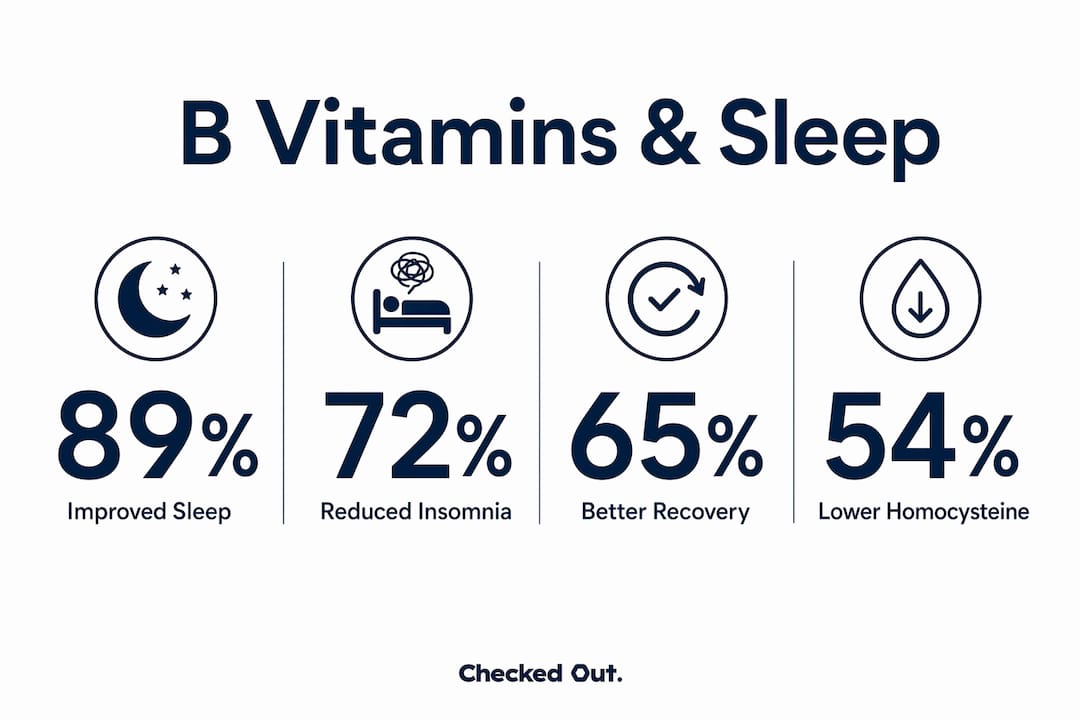
The 2026 EPISONO study added another layer by linking homocysteine levels to periodic limb movements during sleep (PLMS). Each 1 µmol/L increase in blood homocysteine raised the odds of PLMS by 1.09-fold, and this association was directly influenced by cobalamin (B12) and folate status. PLMS is a clinically recognized sleep disorder that causes involuntary leg movements during sleep, fragmenting sleep architecture without the sleeper always being aware. This finding positions B-vitamin assessment as a legitimate diagnostic consideration for people with unexplained nighttime restlessness.
| Research finding |
Clinical implication |
| Higher B6, B12, folate intake linked to better sleep quality |
Dietary optimization may reduce sleep disruption risk in adults |
| Low B vitamins plus poor sleep synergistically raise cognitive risk |
Addressing both factors together yields greater benefit than either alone |
| Each 1 µmol/L rise in homocysteine raises PLMS odds by 1.09-fold |
B12 and folate status should be assessed in periodic limb movement disorder |
| B12 and folate methylate clock genes |
Epigenetic circadian regulation is nutritionally modifiable |
The synergistic effect on cognition is particularly relevant for high performers and biohackers who track both sleep metrics and cognitive output. Optimizing B vitamins is not just a sleep strategy. It is a cognitive longevity strategy.
How does timing and dosing of B12 affect sleep?
This is where most people go wrong. B vitamins are water-soluble and widely considered safe, so the assumption is that more is better and timing is irrelevant. Both assumptions are incorrect.
Here is what the evidence actually shows about B12 timing and dosing:
-
High-dose or evening B12 can suppress melatonin. Evening B12 intake may reduce nighttime melatonin production, increasing alertness at exactly the time your body needs to wind down. This effect is dose-dependent and more pronounced in older adults whose melatonin production is already lower.
-
Morning dosing is the evidence-based default. Taking B12 in the morning aligns supplementation with natural cortisol rhythms and avoids the nighttime alertness effect. If you are currently taking a B-complex in the evening and struggling to fall asleep, this single change is worth testing for two weeks before adding anything else.
-
Correcting a deficiency produces different effects than adding excess. When B12 is genuinely low, correcting the deficiency tends to normalize sleep by restoring melatonin production and circadian methylation. Adding B12 on top of already-adequate levels does not produce the same benefit and may introduce the stimulant effect instead.
-
Age and medications alter B12 absorption significantly. Women over 40, individuals taking proton pump inhibitors (PPIs) like omeprazole, and those on metformin for blood sugar management face higher risk of B12 deficiency and insomnia because these factors reduce gastric acid and intrinsic factor, both of which are required to absorb B12 from food.
Pro Tip: If you take metformin or a PPI daily, ask for a serum B12 test at your next annual checkup. These medications are among the most common causes of subclinical B12 depletion, and the sleep consequences often appear before other symptoms.
The relationship between melatonin and B12 is explored in depth at Checkedoutwellness, particularly around melatonin production timing and how nutritional cofactors influence your body’s own synthesis rather than requiring synthetic supplementation.
What practical steps can you take to optimize B vitamins for better sleep?
Getting your B vitamin status right for sleep does not require a complicated protocol. It requires knowing where to look, what to eat, and when to supplement.
Dietary sources worth prioritizing
The richest food sources of sleep-relevant B vitamins are:
-
B6: Salmon, tuna, chicken breast, chickpeas, bananas, and fortified cereals. A 3-ounce serving of cooked salmon delivers roughly 0.9 mg of B6, close to the 1.3 mg daily recommended intake for adults under 50.
-
B12: Beef liver, clams, sardines, eggs, and dairy products. B12 is found almost exclusively in animal products, making vegans and vegetarians particularly vulnerable to deficiency.
-
Folate: Dark leafy greens like spinach and romaine, lentils, black beans, and asparagus. Folate from food is generally better absorbed than folic acid from fortified sources, though both contribute.
Signs that deficiency may be affecting your sleep
Watch for this cluster of symptoms, which often precede a formal deficiency diagnosis:
- Difficulty falling asleep despite feeling physically tired
- Waking frequently between 2 and 4 a.m. without an obvious cause
- Tingling or restless sensations in the legs at night (a potential PLMS signal)
- Persistent fatigue that does not resolve with more sleep
- Brain fog or memory lapses that worsen after poor nights
Any three of these together warrants a conversation with your doctor and a blood panel that includes serum B12, folate, and homocysteine. These are standard tests, inexpensive, and highly informative.
Supplement timing strategy
For those who supplement, the B vitamin complex timing recommendation is consistent: take B-complex or standalone B12 with breakfast, not dinner. If you use a multivitamin that contains B vitamins, check whether it is formulated for morning or evening use. Evening multivitamins sometimes omit or reduce B12 for exactly this reason.
For natural sleep improvement, pairing optimized B vitamin intake with consistent sleep timing, light exposure management, and magnesium support creates a nutritional environment where your body’s own melatonin synthesis can function as designed.
Key takeaways
B vitamins support sleep by enabling neurotransmitter synthesis and circadian gene methylation, and deficiency in B6, B12, or folate directly disrupts sleep latency, architecture, and cognitive recovery.
| Point |
Details |
| B vitamins as cofactors |
B6, B12, and folate enable serotonin, GABA, and melatonin production required for restorative sleep. |
| Timing matters with B12 |
Take B12 in the morning to avoid suppressing nighttime melatonin and increasing alertness. |
| Deficiency vs. excess |
Correcting a true deficiency improves sleep; supplementing beyond adequate levels may worsen it. |
| Homocysteine as a marker |
Elevated homocysteine from low B12 or folate is linked to periodic limb movements and sleep fragmentation. |
| Synergistic cognitive risk |
Low B vitamins combined with poor sleep increase cognitive impairment risk beyond either factor alone. |
What I’ve learned about B vitamins and sleep after years of getting it wrong
By Geeta
I spent a long time thinking about sleep as a willpower problem. I would optimize my evening routine, dim the lights, avoid screens, and still lie awake with a restless, buzzing quality to my mind that no amount of chamomile tea touched. It took a blood panel showing subclinical B12 and elevated homocysteine to shift my thinking entirely.
What surprised me most was not that B vitamins mattered. It was how they mattered. Not as sedatives. Not as relaxants. But as the quiet infrastructure that allows your brain to produce its own calming signals on schedule. When that infrastructure is depleted, no amount of sleep hygiene compensates. You are asking a factory to run without raw materials.
The timing piece changed my practice completely. I had been taking a B-complex in the evening, assuming it was neutral. Moving it to breakfast made a noticeable difference within two weeks. I am not claiming causation from a personal experiment, but the mechanism is sound and the research supports it.
My honest view is that most people chasing better sleep with supplements are skipping the foundational step: knowing their actual B vitamin status. A $40 blood test tells you more than a $200 supplement stack. Start there. Then build from evidence, not assumption. The science-backed sleep steps that actually move the needle are almost always simpler than we expect, and more nutritional than we assume.
— Geeta
If you are working to optimize your B vitamin status and want sleep support that works with your body’s own chemistry, Checkedoutwellness was built for exactly this.

The natural sleep patch from Checkedoutwellness delivers cofactors including B6, B12, magnesium, and GABA transdermally overnight, bypassing the digestive absorption issues that make oral supplementation unreliable for many people. Manufactured in South Korea under ISO 22716 GMP pharmaceutical standards, these patches are melatonin-free and designed to support your body’s own synthesis pathways rather than replacing them. Explore the full range of drug-free sleep solutions at Checkedoutwellness, including mouth tape and blackout masks built for high performers who treat sleep as a non-negotiable performance input.
FAQ
What is the role of B vitamins in sleep regulation?
B vitamins, particularly B6, B12, and folate, act as cofactors in synthesizing serotonin, GABA, and melatonin precursors that regulate sleep onset, duration, and architecture. They also methylate clock genes that control circadian timing, making them foundational to restorative sleep rather than optional additions.
Do B vitamin deficiencies cause insomnia?
Yes. B12 deficiency in particular disrupts melatonin production and circadian rhythm, contributing to insomnia, especially in women over 40 and individuals taking PPIs or metformin. Low B6 reduces GABA and serotonin synthesis, increasing neuronal excitability and making it harder to fall and stay asleep.
What are the best B vitamins for sleep quality?
B6 is the most directly linked to sleep through its role in serotonin and GABA synthesis. B12 and folate support circadian clock gene methylation and homocysteine regulation. All three work synergistically, and deficiency in any one of them can disrupt the others’ effectiveness.
Can taking B vitamins at night disrupt sleep?
High-dose or evening B12 supplementation can suppress nighttime melatonin production and increase alertness, making it harder to fall asleep. The evidence-based recommendation is to take B-complex supplements in the morning to align with natural cortisol rhythms and avoid this stimulant effect.
How does homocysteine connect B vitamins to sleep disorders?
Elevated homocysteine, a byproduct of insufficient B12 and folate, is associated with periodic limb movements during sleep. Each 1 µmol/L increase in homocysteine raises the odds of this sleep movement disorder by 1.09-fold, according to the 2026 EPISONO study. Assessing homocysteine alongside B12 and folate offers a targeted diagnostic window for unexplained nighttime restlessness.
Recommended

The Role of B Vitamins in Sleep Quality and Recovery
B vitamins are defined as essential cofactors for synthesizing the neurotransmitters serotonin, GABA, and melatonin precursors that govern how quickly you fall asleep, how long you stay asleep, and how restorative that sleep actually is. The role of B vitamins in sleep extends beyond simple nutrition. Vitamins B6, B12, and folate each operate inside specific biochemical pathways that regulate your circadian clock and neurological calm. When these pathways run short on fuel, sleep suffers in ways that feel mysterious but are, in fact, measurable and addressable. This article breaks down exactly how these vitamins work, what the latest research confirms, and what you can do about it tonight.
How do B vitamins chemically support sleep processes?
B vitamins act as biochemical enablers, not sedatives. This distinction matters enormously if you are trying to understand why taking a B-complex at the wrong time can leave you wired at midnight instead of drifting off. The neurotransmitter synthesis that governs sleep depends on B6, B12, and folate at nearly every critical step.
Vitamin B6 and the serotonin-to-melatonin chain
Vitamin B6 (pyridoxine) is the rate-limiting cofactor in converting tryptophan into serotonin, and serotonin into melatonin. Without adequate B6, this conversion slows, and your brain produces less of the neurochemical signal that tells your body darkness has arrived. B6 also supports GABA synthesis, the brain’s primary inhibitory neurotransmitter. Low GABA activity increases neuronal excitability, which is the biochemical equivalent of your nervous system refusing to power down.
Vitamin B12, folate, and your circadian clock
B12 and folate operate at a deeper, epigenetic level. Both vitamins are required for the methylation of clock genes, the molecular switches that set the timing of your sleep-wake cycle. When methylation of clock genes is disrupted by low B12 or folate, your circadian rhythm drifts. You may feel tired at the wrong times, alert when you should be winding down, or unable to consolidate sleep into a single restorative block. This is not a mood problem. It is a timing problem rooted in nutritional biochemistry.
Pro Tip: If you consistently wake between 2 and 4 a.m. feeling alert, consider asking your doctor to check serum B12 and homocysteine levels before reaching for a sleep aid. The cause may be upstream of melatonin entirely.
Folate and B12 also work together to regulate homocysteine, an amino acid that accumulates when these vitamins are insufficient. Elevated homocysteine is increasingly recognized as a marker of sleep disruption, not just cardiovascular risk. The supplements role in sleep conversation has evolved significantly as researchers map these pathways with greater precision.
What does recent research reveal about B vitamins and sleep quality?
The evidence base for B vitamins and sleep has strengthened considerably in 2025 and 2026, moving from mechanistic theory into large population studies with clinically meaningful findings.
A 2025 study published in Frontiers in Nutrition examined dietary B-complex vitamin intake alongside sleep quality scores in older adults. The findings showed that higher B6, B12, and folate intake was associated with significantly reduced risk of poor sleep quality, with adjusted odds ratios confirming the relationship held after controlling for age, sex, and comorbidities. The same study found that poor sleep quality and low B-vitamin intake together created a synergistic increase in cognitive impairment risk, meaning the two deficits amplify each other rather than simply adding up.
This feedback loop is one of the most underappreciated dynamics in sleep science. You sleep poorly because B vitamins are low. Low B vitamins worsen sleep. Worse sleep reduces nutrient absorption. The cycle compounds quietly over months before most people connect the dots.
The 2026 EPISONO study added another layer by linking homocysteine levels to periodic limb movements during sleep (PLMS). Each 1 µmol/L increase in blood homocysteine raised the odds of PLMS by 1.09-fold, and this association was directly influenced by cobalamin (B12) and folate status. PLMS is a clinically recognized sleep disorder that causes involuntary leg movements during sleep, fragmenting sleep architecture without the sleeper always being aware. This finding positions B-vitamin assessment as a legitimate diagnostic consideration for people with unexplained nighttime restlessness.
The synergistic effect on cognition is particularly relevant for high performers and biohackers who track both sleep metrics and cognitive output. Optimizing B vitamins is not just a sleep strategy. It is a cognitive longevity strategy.
How does timing and dosing of B12 affect sleep?
This is where most people go wrong. B vitamins are water-soluble and widely considered safe, so the assumption is that more is better and timing is irrelevant. Both assumptions are incorrect.
Here is what the evidence actually shows about B12 timing and dosing:
High-dose or evening B12 can suppress melatonin. Evening B12 intake may reduce nighttime melatonin production, increasing alertness at exactly the time your body needs to wind down. This effect is dose-dependent and more pronounced in older adults whose melatonin production is already lower.
Morning dosing is the evidence-based default. Taking B12 in the morning aligns supplementation with natural cortisol rhythms and avoids the nighttime alertness effect. If you are currently taking a B-complex in the evening and struggling to fall asleep, this single change is worth testing for two weeks before adding anything else.
Correcting a deficiency produces different effects than adding excess. When B12 is genuinely low, correcting the deficiency tends to normalize sleep by restoring melatonin production and circadian methylation. Adding B12 on top of already-adequate levels does not produce the same benefit and may introduce the stimulant effect instead.
Age and medications alter B12 absorption significantly. Women over 40, individuals taking proton pump inhibitors (PPIs) like omeprazole, and those on metformin for blood sugar management face higher risk of B12 deficiency and insomnia because these factors reduce gastric acid and intrinsic factor, both of which are required to absorb B12 from food.
Pro Tip: If you take metformin or a PPI daily, ask for a serum B12 test at your next annual checkup. These medications are among the most common causes of subclinical B12 depletion, and the sleep consequences often appear before other symptoms.
The relationship between melatonin and B12 is explored in depth at Checkedoutwellness, particularly around melatonin production timing and how nutritional cofactors influence your body’s own synthesis rather than requiring synthetic supplementation.
What practical steps can you take to optimize B vitamins for better sleep?
Getting your B vitamin status right for sleep does not require a complicated protocol. It requires knowing where to look, what to eat, and when to supplement.
Dietary sources worth prioritizing
The richest food sources of sleep-relevant B vitamins are:
Signs that deficiency may be affecting your sleep
Watch for this cluster of symptoms, which often precede a formal deficiency diagnosis:
Any three of these together warrants a conversation with your doctor and a blood panel that includes serum B12, folate, and homocysteine. These are standard tests, inexpensive, and highly informative.
Supplement timing strategy
For those who supplement, the B vitamin complex timing recommendation is consistent: take B-complex or standalone B12 with breakfast, not dinner. If you use a multivitamin that contains B vitamins, check whether it is formulated for morning or evening use. Evening multivitamins sometimes omit or reduce B12 for exactly this reason.
For natural sleep improvement, pairing optimized B vitamin intake with consistent sleep timing, light exposure management, and magnesium support creates a nutritional environment where your body’s own melatonin synthesis can function as designed.
Key takeaways
B vitamins support sleep by enabling neurotransmitter synthesis and circadian gene methylation, and deficiency in B6, B12, or folate directly disrupts sleep latency, architecture, and cognitive recovery.
What I’ve learned about B vitamins and sleep after years of getting it wrong
By Geeta
I spent a long time thinking about sleep as a willpower problem. I would optimize my evening routine, dim the lights, avoid screens, and still lie awake with a restless, buzzing quality to my mind that no amount of chamomile tea touched. It took a blood panel showing subclinical B12 and elevated homocysteine to shift my thinking entirely.
What surprised me most was not that B vitamins mattered. It was how they mattered. Not as sedatives. Not as relaxants. But as the quiet infrastructure that allows your brain to produce its own calming signals on schedule. When that infrastructure is depleted, no amount of sleep hygiene compensates. You are asking a factory to run without raw materials.
The timing piece changed my practice completely. I had been taking a B-complex in the evening, assuming it was neutral. Moving it to breakfast made a noticeable difference within two weeks. I am not claiming causation from a personal experiment, but the mechanism is sound and the research supports it.
My honest view is that most people chasing better sleep with supplements are skipping the foundational step: knowing their actual B vitamin status. A $40 blood test tells you more than a $200 supplement stack. Start there. Then build from evidence, not assumption. The science-backed sleep steps that actually move the needle are almost always simpler than we expect, and more nutritional than we assume.
Support your sleep with natural, science-aligned tools
If you are working to optimize your B vitamin status and want sleep support that works with your body’s own chemistry, Checkedoutwellness was built for exactly this.
The natural sleep patch from Checkedoutwellness delivers cofactors including B6, B12, magnesium, and GABA transdermally overnight, bypassing the digestive absorption issues that make oral supplementation unreliable for many people. Manufactured in South Korea under ISO 22716 GMP pharmaceutical standards, these patches are melatonin-free and designed to support your body’s own synthesis pathways rather than replacing them. Explore the full range of drug-free sleep solutions at Checkedoutwellness, including mouth tape and blackout masks built for high performers who treat sleep as a non-negotiable performance input.
FAQ
What is the role of B vitamins in sleep regulation?
B vitamins, particularly B6, B12, and folate, act as cofactors in synthesizing serotonin, GABA, and melatonin precursors that regulate sleep onset, duration, and architecture. They also methylate clock genes that control circadian timing, making them foundational to restorative sleep rather than optional additions.
Do B vitamin deficiencies cause insomnia?
Yes. B12 deficiency in particular disrupts melatonin production and circadian rhythm, contributing to insomnia, especially in women over 40 and individuals taking PPIs or metformin. Low B6 reduces GABA and serotonin synthesis, increasing neuronal excitability and making it harder to fall and stay asleep.
What are the best B vitamins for sleep quality?
B6 is the most directly linked to sleep through its role in serotonin and GABA synthesis. B12 and folate support circadian clock gene methylation and homocysteine regulation. All three work synergistically, and deficiency in any one of them can disrupt the others’ effectiveness.
Can taking B vitamins at night disrupt sleep?
High-dose or evening B12 supplementation can suppress nighttime melatonin production and increase alertness, making it harder to fall asleep. The evidence-based recommendation is to take B-complex supplements in the morning to align with natural cortisol rhythms and avoid this stimulant effect.
How does homocysteine connect B vitamins to sleep disorders?
Elevated homocysteine, a byproduct of insufficient B12 and folate, is associated with periodic limb movements during sleep. Each 1 µmol/L increase in homocysteine raises the odds of this sleep movement disorder by 1.09-fold, according to the 2026 EPISONO study. Assessing homocysteine alongside B12 and folate offers a targeted diagnostic window for unexplained nighttime restlessness.
Recommended