A sleep-friendly environment is defined as a bedroom optimized for darkness, cool temperature, quiet, and physical comfort to support uninterrupted, restorative sleep. Most people focus on sleep duration while ignoring the space where sleep actually happens. The science of sleep hygiene, the clinical term for habits and conditions that support healthy sleep, makes clear that your environment is not a passive backdrop. It is an active trigger. Knowing how to create a sleep-friendly environment means understanding the specific sensory inputs your nervous system needs to shift from alert to rest. Tools like blackout curtains, white noise machines, and breathable bedding are not luxuries. They are inputs your biology responds to every single night.
How to create a sleep-friendly environment that actually works
The cave principle is the foundation: dark, cool, and quiet. Stanford sleep researchers describe this as the most overlooked factor in sleep quality, often undervalued compared to stress management or supplementation. Your bedroom should function like a sensory off-switch. When it does, your brain stops scanning for threats and begins the hormonal cascade that leads to deep, consolidated sleep. Melatonin production, core body temperature drop, and cortisol suppression all depend on environmental cues you can control.
Sleep hygiene, as defined by Cleveland Clinic expert Dr. Foldvary-Schaefer, incorporates daily habits that cumulatively prepare your mind and body for restful sleep. That means your bedroom setup and your pre-bed behavior work together. Neither alone is enough. The good news is that the most effective changes cost very little and take less than a week to implement.
What temperature and bedding choices optimize sleep comfort?
Temperature is not a preference. The core body temperature drop is a physiological requirement for sleep onset, not a comfort variable. Your body needs to shed heat to initiate the sleep cycle, and a warm room actively blocks that process.
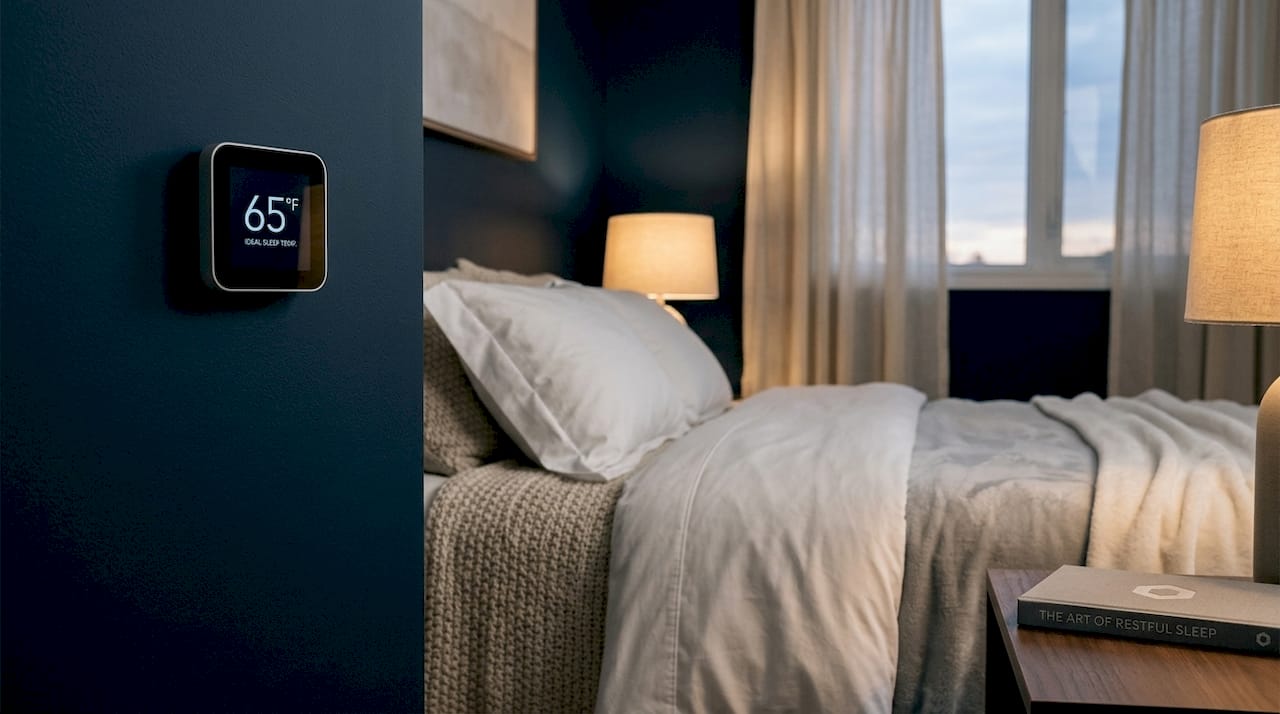
Research from Stanford Lifestyle Medicine identifies the optimal sleep temperature as 60°F to 67°F. That range supports the natural cooling your body performs in the first hour of sleep. Rooms above 70°F increase nighttime awakenings and reduce slow-wave sleep, the most physically restorative stage.
Here is what to prioritize when setting up your sleep temperature and bedding:
-
Thermostat setting: Target 65°F as your starting point. Adjust by one degree every few days rather than making a sudden shift.
-
Sheets: Choose breathable, moisture-wicking materials like percale cotton, linen, or bamboo. These fabrics release body heat instead of trapping it.
-
Mattress: A temperature-regulating mattress, such as the RZ Cool Choice from Guestly Sleep, actively disperses heat and supports spinal alignment simultaneously.
-
Pillows: Latex and buckwheat pillows sleep cooler than memory foam. If you wake up flipping your pillow to the cool side, your pillow is the problem.
-
Partner differences: If you and your partner have different temperature needs, a dual-zone electric blanket or separate top layers solve the conflict without disrupting either person’s sleep.
Pro Tip: Gradually lower your thermostat by one degree every few nights until you find the temperature where you fall asleep fastest. Most people land between 64°F and 66°F, but the process of finding your personal number matters more than hitting the textbook range.
How does controlling light exposure enhance your sleep environment?
Light is the most powerful signal your circadian clock receives. Blue and white light from screens, LED bulbs, and streetlights suppress melatonin production by signaling to your brain that it is still daytime. Even low-level light from a charging phone or a digital clock face is enough to delay sleep onset in sensitive individuals.
Minimizing bedroom light exposure, including removing or covering lit electronics, directly supports melatonin production and circadian alignment. The practical steps for better bedroom lighting for sleep are straightforward:
-
Blackout curtains: Install curtains rated for full light blockage, not just “room darkening.” The difference is significant. A truly dark room at 3 a.m. prevents early morning light from pulling you out of deep sleep prematurely.
-
Eye masks: A contoured blackout mask is the portable version of blackout curtains. It is especially useful for travelers or anyone who cannot control their room’s light sources.
-
Electronics: Remove or cover every light-emitting device in the bedroom. Tape over indicator lights on power strips, turn phone screens face down, and move charging cables out of the room entirely.
-
Pre-bed dimming: Begin lowering light levels 60 to 90 minutes before your target sleep time. Use warm-toned bulbs (2700K or lower) in bedside lamps rather than overhead lighting.
The morning side of this equation matters too. A large study of 39,000 people found that 10 to 20 minutes of natural sunlight shortly after waking improved sleep consistency over a 31-day period. Morning light sets your circadian anchor, which makes it easier for your body to wind down at the same time each night. Light management is a 24-hour practice, not just a bedtime habit.
What role does sound management play in creating a sleep sanctuary?
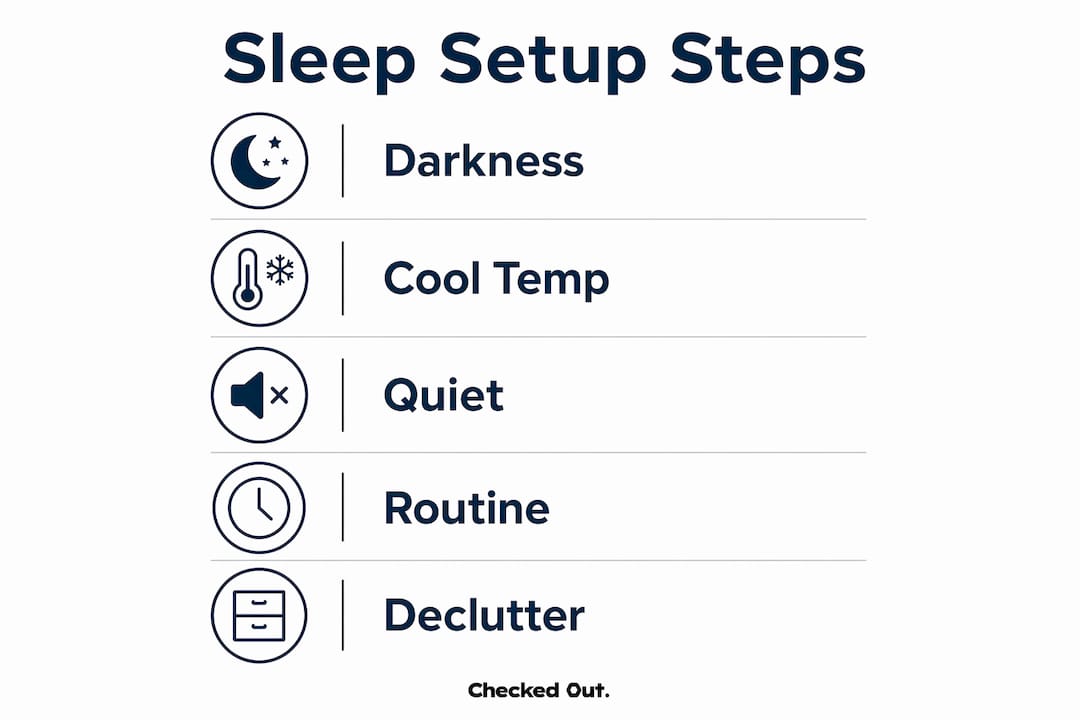
Sudden noise is one of the most common causes of nighttime awakenings, even when you do not fully wake up. The brain continues monitoring sound during sleep, and sharp changes in volume trigger micro-arousals that fragment sleep architecture without you realizing it. A quiet sleep space, or one with consistent background sound, removes that threat.
White noise machines, earplugs, and soundproofing reduce night awakenings by masking sudden noises rather than eliminating sound entirely. The key word is masking. You are not trying to create silence. You are trying to eliminate contrast.
| Sound solution |
Best for |
Limitation |
| White noise machine |
Consistent background masking, partner snoring |
Requires power source |
| Earplugs (foam or silicone) |
Travel, occasional noise events |
Discomfort with extended use |
| Soundproofing curtains |
Street noise, urban environments |
Partial reduction only |
| Box fan |
Budget-friendly white noise alternative |
Limited volume control |
| Adaptive white noise apps |
Variable noise environments |
Requires phone in bedroom |
Adaptive white noise technology is worth understanding. Devices like the LectroFan or apps like Calm automatically increase volume when external noise spikes, then return to baseline. This means a passing truck or a neighbor’s door does not break through the sound layer. For anyone living in an urban environment or sharing a home, this technology closes the gap that standard white noise leaves open.
If your partner’s snoring is the primary disturbance, address it directly. Mouth taping, positional pillows, and nasal strips each target different causes of snoring. Treating the source is more sustainable than masking it indefinitely.
How can a consistent bedtime routine and decluttered bedroom improve sleep quality?
The physical setup of your bedroom sends psychological signals before you even lie down. A room that contains a work laptop, exercise equipment, or a television trains your brain to associate that space with activity and alertness. Removing those associations is one of the highest-return changes you can make.
Keeping the bedroom free of work and exercise equipment builds a strong mental link between the space and rest. This is not minimalism for aesthetics. It is conditioning your nervous system to downshift the moment you walk through the door.
Here is a practical sequence for building a wind-down routine and a sleep-ready bedroom:
-
Set a consistent sleep and wake time. Dr. Foldvary-Schaefer at Cleveland Clinic notes that regular sleep timing trains the body to shift into rest mode predictably. Consistency matters more than duration.
-
Begin your wind-down 20 to 30 minutes before bed. A consistent pre-sleep routine improves sleep quality within two to four weeks. Options include reading physical books, journaling, gentle stretching, or a warm bath or shower.
-
Stop screens 60 minutes before sleep. If that feels impossible, use blue-light-blocking glasses and set your phone to grayscale mode to reduce visual stimulation.
-
Declutter your sleep space. Remove anything from your bedroom that is not related to sleep or intimacy. Visual clutter activates low-level cognitive processing that keeps your brain slightly engaged.
-
Add a calming scent. Lavender has mild scientific support for improving sleep onset. A diffuser, linen spray, or dried lavender sachet near your pillow takes 30 seconds to set up and costs almost nothing.
-
Use the same tools every night. An eye mask, a sound machine, and a consistent room temperature become conditioned cues. Your body learns to associate them with sleep, which accelerates the transition from wakefulness to rest.
Pro Tip: When you travel, bring your sleep tools with you. The same eye mask and a white noise app on your phone recreate your sleep cues in any hotel room. This is one of the most underused strategies for maintaining sleep quality while traveling.
Key takeaways
A sleep-friendly environment requires darkness, a cool temperature between 60°F and 67°F, consistent sound masking, and a bedroom conditioned exclusively for rest.
| Point |
Details |
| Temperature is physiological |
Keep your bedroom at 60°F to 67°F to support the body’s natural cooling required for sleep onset. |
| Darkness drives melatonin |
Use blackout curtains or a contoured eye mask to eliminate light that suppresses melatonin production. |
| Sound masking beats silence |
White noise machines or adaptive apps prevent micro-arousals from sudden noise better than earplugs alone. |
| Routine builds conditioning |
A 20 to 30 minute wind-down routine produces measurable sleep improvements within two to four weeks. |
| Simplicity outperforms complexity |
Sustainable, low-cost changes to your bedroom consistently outperform expensive gadgets for long-term sleep quality. |
What I’ve learned about sleep environments after years of getting it wrong
I spent a long time chasing the perfect sleep supplement while sleeping in a room with a glowing TV standby light, a thermostat set to 72°F, and a phone charging six inches from my head. The environment was working against every supplement I took. That is a pattern I see constantly in people who are serious about their health but have not yet applied that same rigor to the space where they sleep.
The research is clear, but the real lesson is subtler. Over-optimizing with complex gadgets can raise anxiety and paradoxically worsen sleep. I have watched people spend hundreds of dollars on sleep trackers that do nothing except give them new data points to worry about at 2 a.m. The tracker is not the problem. The fixation is.
What actually works is boring and repeatable. A dark room. A cool room. A consistent bedtime. A phone that is not in the bedroom. These are not exciting recommendations. They are the ones that compound over weeks into genuinely better sleep. I think the wellness industry does people a disservice by making sleep optimization feel complicated. It is not. It is mostly about removing things, not adding them.
The one area where I do think targeted support makes sense is in the transition period, those first few weeks when you are retraining your nervous system and your body has not yet caught up to your new environment. That is where a well-formulated, drug-free sleep aid can bridge the gap without creating dependency. Not as a permanent crutch. As a tool for the adjustment window. Read more about natural sleep improvement steps that work alongside environmental changes.
— Geeta
Your environment sets the stage. The right sleep tools make the performance consistent.

Checkedoutwellness designs drug-free sleep support built for people who take recovery as seriously as their training or nutrition. The natural sleep patch delivers magnesium, GABA, B6, and B12 transdermally to support your body’s own melatonin production, without synthetic melatonin or next-day grogginess. The contoured blackout sleep mask creates complete darkness whether you are at home or in a hotel. Both products are manufactured in South Korea under ISO 22716 GMP pharmaceutical standards. They are designed to work with your environment, not replace the work you have already done to optimize it. Explore the full sleep wellness range at Checkedoutwellness.
FAQ
What is the ideal bedroom temperature for sleep?
The optimal bedroom temperature for sleep is between 60°F and 67°F, according to Stanford Lifestyle Medicine. This range supports the core body temperature drop that triggers sleep onset and maintains consolidated sleep through the night.
How do blackout curtains improve sleep quality?
Blackout curtains eliminate light pollution that suppresses melatonin production and disrupts circadian rhythm. Unlike standard room-darkening curtains, true blackout curtains block early morning light that would otherwise pull you out of deep sleep prematurely.
How long does it take for a bedtime routine to improve sleep?
A consistent 20 to 30 minute wind-down routine typically produces measurable improvements in sleep quality within two to four weeks. The key is performing the same sequence at the same time each night so your nervous system learns to treat it as a sleep signal.
Does white noise actually help you sleep better?
White noise reduces nighttime awakenings by masking sudden sound contrasts rather than eliminating noise entirely. Adaptive white noise devices, such as the LectroFan, automatically raise volume during disturbances and return to baseline, providing more consistent protection than static-volume options.
Should your phone be in the bedroom while you sleep?
Phones in the bedroom disrupt sleep through both light emission and the psychological readiness they create. Removing the phone entirely, or at minimum placing it face down and silenced across the room, reduces both blue light exposure and the low-level alertness that comes from knowing notifications may arrive.
Recommended

How to Create a Sleep-Friendly Environment at Home
A sleep-friendly environment is defined as a bedroom optimized for darkness, cool temperature, quiet, and physical comfort to support uninterrupted, restorative sleep. Most people focus on sleep duration while ignoring the space where sleep actually happens. The science of sleep hygiene, the clinical term for habits and conditions that support healthy sleep, makes clear that your environment is not a passive backdrop. It is an active trigger. Knowing how to create a sleep-friendly environment means understanding the specific sensory inputs your nervous system needs to shift from alert to rest. Tools like blackout curtains, white noise machines, and breathable bedding are not luxuries. They are inputs your biology responds to every single night.
How to create a sleep-friendly environment that actually works
The cave principle is the foundation: dark, cool, and quiet. Stanford sleep researchers describe this as the most overlooked factor in sleep quality, often undervalued compared to stress management or supplementation. Your bedroom should function like a sensory off-switch. When it does, your brain stops scanning for threats and begins the hormonal cascade that leads to deep, consolidated sleep. Melatonin production, core body temperature drop, and cortisol suppression all depend on environmental cues you can control.
Sleep hygiene, as defined by Cleveland Clinic expert Dr. Foldvary-Schaefer, incorporates daily habits that cumulatively prepare your mind and body for restful sleep. That means your bedroom setup and your pre-bed behavior work together. Neither alone is enough. The good news is that the most effective changes cost very little and take less than a week to implement.
What temperature and bedding choices optimize sleep comfort?
Temperature is not a preference. The core body temperature drop is a physiological requirement for sleep onset, not a comfort variable. Your body needs to shed heat to initiate the sleep cycle, and a warm room actively blocks that process.
Research from Stanford Lifestyle Medicine identifies the optimal sleep temperature as 60°F to 67°F. That range supports the natural cooling your body performs in the first hour of sleep. Rooms above 70°F increase nighttime awakenings and reduce slow-wave sleep, the most physically restorative stage.
Here is what to prioritize when setting up your sleep temperature and bedding:
Pro Tip: Gradually lower your thermostat by one degree every few nights until you find the temperature where you fall asleep fastest. Most people land between 64°F and 66°F, but the process of finding your personal number matters more than hitting the textbook range.
How does controlling light exposure enhance your sleep environment?
Light is the most powerful signal your circadian clock receives. Blue and white light from screens, LED bulbs, and streetlights suppress melatonin production by signaling to your brain that it is still daytime. Even low-level light from a charging phone or a digital clock face is enough to delay sleep onset in sensitive individuals.
Minimizing bedroom light exposure, including removing or covering lit electronics, directly supports melatonin production and circadian alignment. The practical steps for better bedroom lighting for sleep are straightforward:
The morning side of this equation matters too. A large study of 39,000 people found that 10 to 20 minutes of natural sunlight shortly after waking improved sleep consistency over a 31-day period. Morning light sets your circadian anchor, which makes it easier for your body to wind down at the same time each night. Light management is a 24-hour practice, not just a bedtime habit.
What role does sound management play in creating a sleep sanctuary?
Sudden noise is one of the most common causes of nighttime awakenings, even when you do not fully wake up. The brain continues monitoring sound during sleep, and sharp changes in volume trigger micro-arousals that fragment sleep architecture without you realizing it. A quiet sleep space, or one with consistent background sound, removes that threat.
White noise machines, earplugs, and soundproofing reduce night awakenings by masking sudden noises rather than eliminating sound entirely. The key word is masking. You are not trying to create silence. You are trying to eliminate contrast.
Adaptive white noise technology is worth understanding. Devices like the LectroFan or apps like Calm automatically increase volume when external noise spikes, then return to baseline. This means a passing truck or a neighbor’s door does not break through the sound layer. For anyone living in an urban environment or sharing a home, this technology closes the gap that standard white noise leaves open.
If your partner’s snoring is the primary disturbance, address it directly. Mouth taping, positional pillows, and nasal strips each target different causes of snoring. Treating the source is more sustainable than masking it indefinitely.
How can a consistent bedtime routine and decluttered bedroom improve sleep quality?
The physical setup of your bedroom sends psychological signals before you even lie down. A room that contains a work laptop, exercise equipment, or a television trains your brain to associate that space with activity and alertness. Removing those associations is one of the highest-return changes you can make.
Keeping the bedroom free of work and exercise equipment builds a strong mental link between the space and rest. This is not minimalism for aesthetics. It is conditioning your nervous system to downshift the moment you walk through the door.
Here is a practical sequence for building a wind-down routine and a sleep-ready bedroom:
Pro Tip: When you travel, bring your sleep tools with you. The same eye mask and a white noise app on your phone recreate your sleep cues in any hotel room. This is one of the most underused strategies for maintaining sleep quality while traveling.
Key takeaways
A sleep-friendly environment requires darkness, a cool temperature between 60°F and 67°F, consistent sound masking, and a bedroom conditioned exclusively for rest.
What I’ve learned about sleep environments after years of getting it wrong
I spent a long time chasing the perfect sleep supplement while sleeping in a room with a glowing TV standby light, a thermostat set to 72°F, and a phone charging six inches from my head. The environment was working against every supplement I took. That is a pattern I see constantly in people who are serious about their health but have not yet applied that same rigor to the space where they sleep.
The research is clear, but the real lesson is subtler. Over-optimizing with complex gadgets can raise anxiety and paradoxically worsen sleep. I have watched people spend hundreds of dollars on sleep trackers that do nothing except give them new data points to worry about at 2 a.m. The tracker is not the problem. The fixation is.
What actually works is boring and repeatable. A dark room. A cool room. A consistent bedtime. A phone that is not in the bedroom. These are not exciting recommendations. They are the ones that compound over weeks into genuinely better sleep. I think the wellness industry does people a disservice by making sleep optimization feel complicated. It is not. It is mostly about removing things, not adding them.
The one area where I do think targeted support makes sense is in the transition period, those first few weeks when you are retraining your nervous system and your body has not yet caught up to your new environment. That is where a well-formulated, drug-free sleep aid can bridge the gap without creating dependency. Not as a permanent crutch. As a tool for the adjustment window. Read more about natural sleep improvement steps that work alongside environmental changes.
Sleep tools that complement your new bedroom setup
Your environment sets the stage. The right sleep tools make the performance consistent.
Checkedoutwellness designs drug-free sleep support built for people who take recovery as seriously as their training or nutrition. The natural sleep patch delivers magnesium, GABA, B6, and B12 transdermally to support your body’s own melatonin production, without synthetic melatonin or next-day grogginess. The contoured blackout sleep mask creates complete darkness whether you are at home or in a hotel. Both products are manufactured in South Korea under ISO 22716 GMP pharmaceutical standards. They are designed to work with your environment, not replace the work you have already done to optimize it. Explore the full sleep wellness range at Checkedoutwellness.
FAQ
What is the ideal bedroom temperature for sleep?
The optimal bedroom temperature for sleep is between 60°F and 67°F, according to Stanford Lifestyle Medicine. This range supports the core body temperature drop that triggers sleep onset and maintains consolidated sleep through the night.
How do blackout curtains improve sleep quality?
Blackout curtains eliminate light pollution that suppresses melatonin production and disrupts circadian rhythm. Unlike standard room-darkening curtains, true blackout curtains block early morning light that would otherwise pull you out of deep sleep prematurely.
How long does it take for a bedtime routine to improve sleep?
A consistent 20 to 30 minute wind-down routine typically produces measurable improvements in sleep quality within two to four weeks. The key is performing the same sequence at the same time each night so your nervous system learns to treat it as a sleep signal.
Does white noise actually help you sleep better?
White noise reduces nighttime awakenings by masking sudden sound contrasts rather than eliminating noise entirely. Adaptive white noise devices, such as the LectroFan, automatically raise volume during disturbances and return to baseline, providing more consistent protection than static-volume options.
Should your phone be in the bedroom while you sleep?
Phones in the bedroom disrupt sleep through both light emission and the psychological readiness they create. Removing the phone entirely, or at minimum placing it face down and silenced across the room, reduces both blue light exposure and the low-level alertness that comes from knowing notifications may arrive.
Recommended