Your lifestyle is the single greatest determinant of your sleep health. Every choice you make during the day, from what you eat to how you manage stress, directly shapes how well your brain and body recover at night. The role of lifestyle in sleep health is not a soft wellness concept. Harvard researchers now frame sleep as a vital sign, placing it alongside blood pressure and heart rate as a measurable indicator of overall health. Physical activity, nutrition, stress habits, and your bedroom environment all work together to either support or sabotage your sleep architecture. The good news is that each of these factors is modifiable.
How does physical activity influence sleep quality?
Exercise and sleep share a bidirectional relationship. When you move more, you sleep better. When you sleep better, you perform and recover more effectively. Physical activity and sleep reinforce each other in a cycle that also improves metabolic and mental health. Breaking that cycle in either direction creates a downward spiral that many high performers recognize all too well.
Moderate aerobic exercise, such as a 30-minute walk, a swim, or a cycling session, consistently improves both sleep quality and total sleep duration. The mechanism is straightforward: exercise lowers cortisol over time, raises core body temperature during activity, and then triggers a compensatory drop in temperature afterward. That temperature drop signals the brain that it is time to sleep.

Timing matters more than most people realize. Vigorous exercise within two hours of bedtime can delay sleep onset by keeping your heart rate and core temperature elevated. Morning exercise, on the other hand, pairs naturally with sunlight exposure to reinforce your circadian rhythm. Short morning activity combined with natural light is one of the most underused tools for anchoring your sleep-wake cycle.
Key lifestyle habits for quality sleep through physical activity:
- Aim for at least 150 minutes of moderate activity per week, spread across most days
- Prioritize morning or early afternoon sessions when possible
- Pair outdoor exercise with natural light exposure for a stronger circadian signal
- Treat rest days as active recovery, not complete inactivity, to maintain sleep benefits
- Track your sleep quality after intense training blocks to spot recovery deficits early
Pro Tip: If you can only do one thing in the morning, take a 10-minute walk outside within an hour of waking. The combination of movement and natural light is more effective for sleep timing than either alone.
What role does diet play in sleep health?

Diet quality directly shapes sleep architecture, not just how long you sleep. Frequent junk food consumption predicts longer total sleep time but poorer sleep architecture, with more time spent in light, non-restorative sleep stages. You can sleep nine hours and wake up exhausted if your diet is pushing you out of deep sleep. That distinction between sleep quantity and sleep quality is one the wellness world consistently underestimates.
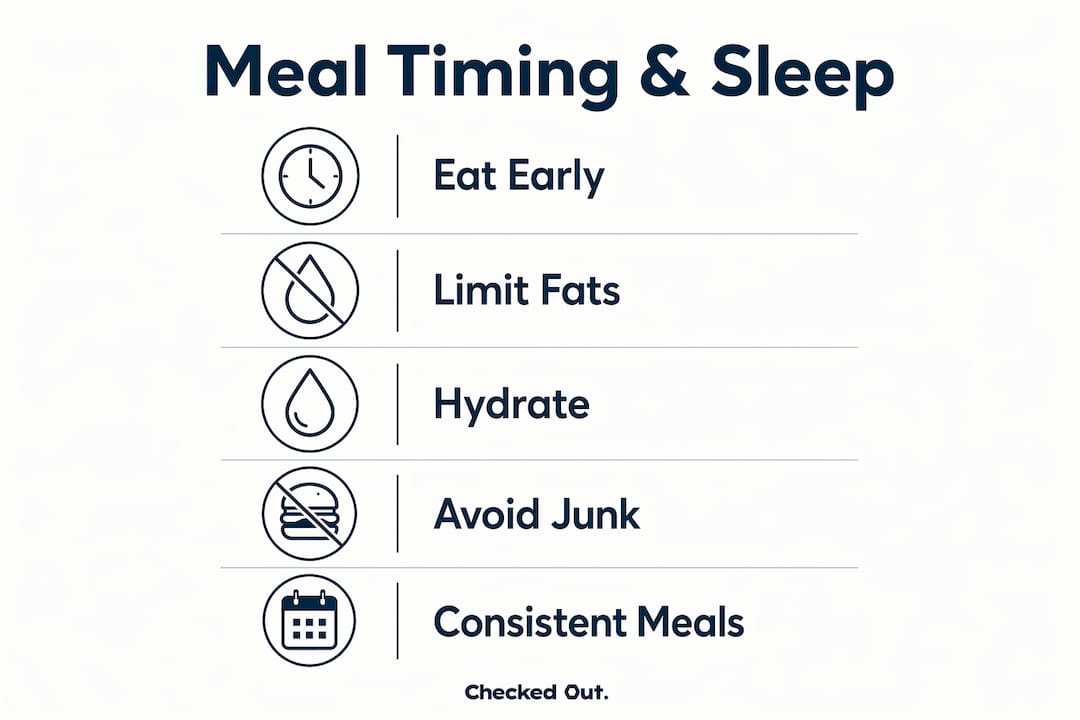
Circadian-aligned nutrition is the practice of timing your meals to support your body’s internal clock. Eating large, high-fat meals late at night forces your digestive system to work during a period when it is biologically winding down. This disrupts the hormonal cascade that prepares your body for deep sleep, including the tryptophan-to-serotonin-to-melatonin conversion your brain depends on. Circadian-aligned nutrition is a core pillar of lifestyle medicine for sleep health.
| Dietary habit |
Effect on sleep |
| Late-night high-fat meals |
Disrupts melatonin production and delays sleep onset |
| Frequent junk food intake |
Increases light sleep, reduces deep restorative stages |
| Adequate magnesium intake |
Supports GABA activity and natural relaxation before bed |
| Consistent meal timing |
Reinforces circadian rhythm and improves sleep continuity |
| Alcohol before bed |
Fragments sleep architecture and suppresses REM sleep |
Hydration also matters, though it is easy to get wrong. Drinking too little water during the day concentrates cortisol and can increase nighttime waking. Drinking too much in the evening leads to disruptive bathroom trips. The practical fix is front-loading your fluid intake earlier in the day and tapering off in the two hours before bed.
Pro Tip: Eat your last substantial meal at least three hours before your target bedtime. This single timing shift can meaningfully improve how quickly you fall asleep and how deeply you stay there. For more on how diet and circadian biology interact, the science behind natural sleep is worth reading.
How does stress influence sleep patterns?
Stress is the most underestimated disruptor of sleep onset and maintenance. When your brain perceives a threat, real or imagined, it triggers a cortisol and adrenaline release that raises alertness, increases heart rate, and suppresses melatonin. The body does not distinguish between a work deadline and a physical danger. Both activate the same arousal system that makes falling asleep feel impossible.
The good news is that deliberate wind-down routines can interrupt this cycle. The goal is not to eliminate stress entirely but to create a clear physiological boundary between your active day and your sleep window. Here is a practical sequence that works:
- Stop all work-related tasks at least 60 minutes before bed. Your brain needs a transition period, not an abrupt shutdown.
- Dim the lights in your home after 8:00 PM. Bright overhead lighting signals daytime to your brain and suppresses melatonin production.
- Write down any unresolved problems in a notebook. Offloading stress onto a notebook with a clear next step prevents the cognitive arousal that keeps you awake. Write the problem, write one concrete action you will take tomorrow, then close the notebook.
- Practice four to six minutes of slow, diaphragmatic breathing. This activates the parasympathetic nervous system and lowers heart rate measurably.
- Avoid emotionally charged conversations or content in the final hour before sleep. Your nervous system will carry that activation into bed with you.
The journaling step deserves special attention. The technique works when you write a problem and a concrete next step, then stop. Continuing to write, analyze, or process extends cognitive engagement and defeats the purpose. The body keeps score quietly, and giving it a clear signal that tomorrow’s problems are handled is one of the fastest ways to lower pre-sleep arousal.
What sleep environment changes improve sleep quality?
Your bedroom environment sends constant signals to your nervous system. Getting those signals right is one of the fastest lifestyle changes for better sleep you can make, because the effects are immediate rather than cumulative.
Temperature is the most overlooked variable. The optimal bedroom temperature for sleep is 60°F to 68°F. Your core body temperature needs to drop by one to two degrees to initiate and maintain deep sleep. A warm room fights that process directly. If you cannot control your room temperature, cooling your feet or using a lighter blanket produces a similar effect.
Light exposure before bed is equally critical. Blue light from screens suppresses melatonin production by signaling to your brain that it is still daytime. Limiting screen time in the 60 to 90 minutes before bed supports the natural melatonin rise your body needs. A quality blackout mask eliminates ambient light entirely, which is particularly valuable for shift workers, travelers, or anyone in an urban environment with light pollution.
The behavioral principle of stimulus control is also worth applying. Using your bed exclusively for sleep strengthens the brain’s association between the bed and sleep. When you work, scroll, or watch content in bed, your brain learns to treat the bed as an activation zone rather than a rest zone. That association is surprisingly powerful and surprisingly easy to break with two to three weeks of consistent behavior.
| Sleep environment factor |
Recommended standard |
Why it matters |
| Bedroom temperature |
60°F–68°F |
Supports core body temperature drop for deep sleep |
| Light exposure before bed |
Minimize 60–90 min prior |
Protects natural melatonin production |
| Bed use |
Sleep only |
Strengthens brain’s sleep association |
| Wake time consistency |
Same time daily |
Anchors circadian rhythm more than bedtime does |
Consistent sleep hygiene practices compound over time. One good night matters less than a stable pattern your body can predict. For a deeper look at alternative approaches to supporting sleep beyond environment alone, sleep supplement alternatives offer useful context on non-pharmacologic options.
Key Takeaways
Lifestyle choices directly determine sleep quality, and targeted changes to physical activity, diet, stress management, and the sleep environment produce measurable improvements without medication.
| Point |
Details |
| Exercise improves sleep |
Moderate daily movement lowers cortisol and supports the temperature drop needed for deep sleep. |
| Diet quality over quantity |
Junk food increases total sleep time but reduces restorative deep sleep stages. |
| Stress disrupts sleep onset |
A structured wind-down routine with journaling and breathing lowers pre-sleep arousal effectively. |
| Environment signals matter |
Keeping your bedroom at 60°F–68°F and dark accelerates sleep onset and protects sleep depth. |
| Consistency beats complexity |
A fixed wake time anchors your circadian rhythm better than elaborate multi-step bedtime rituals. |
What I’ve learned about sleep routines that actually stick
I used to believe that better sleep required a perfect system. The right supplements, the right temperature, the right wind-down playlist, all executed in the right order. What I found, after years of working with sleep health and living through my own burnout, is that complexity is the enemy of consistency.
Targeting too many sleep behaviors at once increases stress and actually reduces how well any single change works. That finding stopped me cold when I first read it, because it described exactly what I had been doing. Piling on new habits created performance anxiety around sleep, which is one of the fastest ways to make insomnia worse.
What actually works is identifying your specific problem and addressing that one thing first. If you struggle to fall asleep, your issue is sleep onset, and your priority is the wind-down routine and light environment. If you wake frequently, your issue is sleep maintenance, and diet timing and temperature deserve your attention first. Generic behavior changes mismatch specific sleep complaints, and that mismatch is why so many people try sleep hygiene and give up after two weeks.
My honest recommendation: anchor your wake time first. Consistent wake times do more for sleep pattern stability than any bedtime ritual. Once that anchor holds, add one other change and give it three weeks before judging it. Sleep is not a problem you solve in a weekend. It is a practice you build, quietly, one consistent morning at a time.
— Geeta
Natural sleep support that works with your lifestyle
Lifestyle changes build the foundation. Sometimes your body needs a little extra support while that foundation sets, especially if you travel frequently, work irregular hours, or are recovering from a period of chronic stress.

Checkedoutwellness designs drug-free sleep tools built specifically for that gap. The natural sleep patch delivers magnesium, B6, B12, and GABA transdermally overnight, supporting your body’s own melatonin production without synthetic hormones or dependency risk. The contoured blackout sleep mask eliminates light pollution completely, reinforcing the dark environment your circadian rhythm depends on. Every product is manufactured in South Korea under ISO 22716 GMP pharmaceutical standards. These are tools that complement the lifestyle work you are already doing, not shortcuts around it. Visit Checkedoutwellness to see the full range.
FAQ
What lifestyle factors affect sleep health the most?
Physical activity, diet quality, stress management, and bedroom environment are the four lifestyle factors with the strongest evidence for influencing sleep quality and architecture. Behavioral risk factors like inactivity and poor diet impair sleep health cumulatively over years.
How does diet affect sleep quality?
Diet quality shapes sleep architecture directly. Frequent junk food consumption increases total sleep time but reduces deep, restorative sleep stages, meaning you can sleep longer and still wake up unrefreshed.
What is the best bedroom temperature for sleep?
The optimal bedroom temperature for sleep is 60°F to 68°F. This range supports the core body temperature drop your brain needs to initiate and sustain deep sleep.
Does exercise before bed hurt sleep?
Vigorous exercise within two hours of bedtime can delay sleep onset by keeping your heart rate and core temperature elevated. Morning exercise paired with natural light exposure produces stronger sleep benefits for most people.
How many lifestyle changes should I make at once for better sleep?
Start with one change and give it three weeks. Targeting too many behaviors simultaneously increases stress and reduces the effectiveness of each individual change. A fixed wake time is the highest-leverage starting point.
Recommended

How Lifestyle Shapes Your Sleep Health and Rest
Your lifestyle is the single greatest determinant of your sleep health. Every choice you make during the day, from what you eat to how you manage stress, directly shapes how well your brain and body recover at night. The role of lifestyle in sleep health is not a soft wellness concept. Harvard researchers now frame sleep as a vital sign, placing it alongside blood pressure and heart rate as a measurable indicator of overall health. Physical activity, nutrition, stress habits, and your bedroom environment all work together to either support or sabotage your sleep architecture. The good news is that each of these factors is modifiable.
How does physical activity influence sleep quality?
Exercise and sleep share a bidirectional relationship. When you move more, you sleep better. When you sleep better, you perform and recover more effectively. Physical activity and sleep reinforce each other in a cycle that also improves metabolic and mental health. Breaking that cycle in either direction creates a downward spiral that many high performers recognize all too well.
Moderate aerobic exercise, such as a 30-minute walk, a swim, or a cycling session, consistently improves both sleep quality and total sleep duration. The mechanism is straightforward: exercise lowers cortisol over time, raises core body temperature during activity, and then triggers a compensatory drop in temperature afterward. That temperature drop signals the brain that it is time to sleep.
Timing matters more than most people realize. Vigorous exercise within two hours of bedtime can delay sleep onset by keeping your heart rate and core temperature elevated. Morning exercise, on the other hand, pairs naturally with sunlight exposure to reinforce your circadian rhythm. Short morning activity combined with natural light is one of the most underused tools for anchoring your sleep-wake cycle.
Key lifestyle habits for quality sleep through physical activity:
Pro Tip: If you can only do one thing in the morning, take a 10-minute walk outside within an hour of waking. The combination of movement and natural light is more effective for sleep timing than either alone.
What role does diet play in sleep health?
Diet quality directly shapes sleep architecture, not just how long you sleep. Frequent junk food consumption predicts longer total sleep time but poorer sleep architecture, with more time spent in light, non-restorative sleep stages. You can sleep nine hours and wake up exhausted if your diet is pushing you out of deep sleep. That distinction between sleep quantity and sleep quality is one the wellness world consistently underestimates.
Circadian-aligned nutrition is the practice of timing your meals to support your body’s internal clock. Eating large, high-fat meals late at night forces your digestive system to work during a period when it is biologically winding down. This disrupts the hormonal cascade that prepares your body for deep sleep, including the tryptophan-to-serotonin-to-melatonin conversion your brain depends on. Circadian-aligned nutrition is a core pillar of lifestyle medicine for sleep health.
Hydration also matters, though it is easy to get wrong. Drinking too little water during the day concentrates cortisol and can increase nighttime waking. Drinking too much in the evening leads to disruptive bathroom trips. The practical fix is front-loading your fluid intake earlier in the day and tapering off in the two hours before bed.
Pro Tip: Eat your last substantial meal at least three hours before your target bedtime. This single timing shift can meaningfully improve how quickly you fall asleep and how deeply you stay there. For more on how diet and circadian biology interact, the science behind natural sleep is worth reading.
How does stress influence sleep patterns?
Stress is the most underestimated disruptor of sleep onset and maintenance. When your brain perceives a threat, real or imagined, it triggers a cortisol and adrenaline release that raises alertness, increases heart rate, and suppresses melatonin. The body does not distinguish between a work deadline and a physical danger. Both activate the same arousal system that makes falling asleep feel impossible.
The good news is that deliberate wind-down routines can interrupt this cycle. The goal is not to eliminate stress entirely but to create a clear physiological boundary between your active day and your sleep window. Here is a practical sequence that works:
The journaling step deserves special attention. The technique works when you write a problem and a concrete next step, then stop. Continuing to write, analyze, or process extends cognitive engagement and defeats the purpose. The body keeps score quietly, and giving it a clear signal that tomorrow’s problems are handled is one of the fastest ways to lower pre-sleep arousal.
What sleep environment changes improve sleep quality?
Your bedroom environment sends constant signals to your nervous system. Getting those signals right is one of the fastest lifestyle changes for better sleep you can make, because the effects are immediate rather than cumulative.
Temperature is the most overlooked variable. The optimal bedroom temperature for sleep is 60°F to 68°F. Your core body temperature needs to drop by one to two degrees to initiate and maintain deep sleep. A warm room fights that process directly. If you cannot control your room temperature, cooling your feet or using a lighter blanket produces a similar effect.
Light exposure before bed is equally critical. Blue light from screens suppresses melatonin production by signaling to your brain that it is still daytime. Limiting screen time in the 60 to 90 minutes before bed supports the natural melatonin rise your body needs. A quality blackout mask eliminates ambient light entirely, which is particularly valuable for shift workers, travelers, or anyone in an urban environment with light pollution.
The behavioral principle of stimulus control is also worth applying. Using your bed exclusively for sleep strengthens the brain’s association between the bed and sleep. When you work, scroll, or watch content in bed, your brain learns to treat the bed as an activation zone rather than a rest zone. That association is surprisingly powerful and surprisingly easy to break with two to three weeks of consistent behavior.
Consistent sleep hygiene practices compound over time. One good night matters less than a stable pattern your body can predict. For a deeper look at alternative approaches to supporting sleep beyond environment alone, sleep supplement alternatives offer useful context on non-pharmacologic options.
Key Takeaways
Lifestyle choices directly determine sleep quality, and targeted changes to physical activity, diet, stress management, and the sleep environment produce measurable improvements without medication.
What I’ve learned about sleep routines that actually stick
I used to believe that better sleep required a perfect system. The right supplements, the right temperature, the right wind-down playlist, all executed in the right order. What I found, after years of working with sleep health and living through my own burnout, is that complexity is the enemy of consistency.
Targeting too many sleep behaviors at once increases stress and actually reduces how well any single change works. That finding stopped me cold when I first read it, because it described exactly what I had been doing. Piling on new habits created performance anxiety around sleep, which is one of the fastest ways to make insomnia worse.
What actually works is identifying your specific problem and addressing that one thing first. If you struggle to fall asleep, your issue is sleep onset, and your priority is the wind-down routine and light environment. If you wake frequently, your issue is sleep maintenance, and diet timing and temperature deserve your attention first. Generic behavior changes mismatch specific sleep complaints, and that mismatch is why so many people try sleep hygiene and give up after two weeks.
My honest recommendation: anchor your wake time first. Consistent wake times do more for sleep pattern stability than any bedtime ritual. Once that anchor holds, add one other change and give it three weeks before judging it. Sleep is not a problem you solve in a weekend. It is a practice you build, quietly, one consistent morning at a time.
Natural sleep support that works with your lifestyle
Lifestyle changes build the foundation. Sometimes your body needs a little extra support while that foundation sets, especially if you travel frequently, work irregular hours, or are recovering from a period of chronic stress.
Checkedoutwellness designs drug-free sleep tools built specifically for that gap. The natural sleep patch delivers magnesium, B6, B12, and GABA transdermally overnight, supporting your body’s own melatonin production without synthetic hormones or dependency risk. The contoured blackout sleep mask eliminates light pollution completely, reinforcing the dark environment your circadian rhythm depends on. Every product is manufactured in South Korea under ISO 22716 GMP pharmaceutical standards. These are tools that complement the lifestyle work you are already doing, not shortcuts around it. Visit Checkedoutwellness to see the full range.
FAQ
What lifestyle factors affect sleep health the most?
Physical activity, diet quality, stress management, and bedroom environment are the four lifestyle factors with the strongest evidence for influencing sleep quality and architecture. Behavioral risk factors like inactivity and poor diet impair sleep health cumulatively over years.
How does diet affect sleep quality?
Diet quality shapes sleep architecture directly. Frequent junk food consumption increases total sleep time but reduces deep, restorative sleep stages, meaning you can sleep longer and still wake up unrefreshed.
What is the best bedroom temperature for sleep?
The optimal bedroom temperature for sleep is 60°F to 68°F. This range supports the core body temperature drop your brain needs to initiate and sustain deep sleep.
Does exercise before bed hurt sleep?
Vigorous exercise within two hours of bedtime can delay sleep onset by keeping your heart rate and core temperature elevated. Morning exercise paired with natural light exposure produces stronger sleep benefits for most people.
How many lifestyle changes should I make at once for better sleep?
Start with one change and give it three weeks. Targeting too many behaviors simultaneously increases stress and reduces the effectiveness of each individual change. A fixed wake time is the highest-leverage starting point.
Recommended