Blue light exposure means contact with visible light in the roughly 400 to 490 nanometer range, and you get it from the sun, LED bulbs, and every screen you own. Two things matter most: the blue light you get during the day sharpens alertness and steadies your body clock, while the blue light hitting your eyes at night can suppress melatonin and delay sleep. We built our whole approach around that split.
Here’s what to actually do with that information:
- Get real daylight within an hour of waking. It anchors your circadian rhythm for the whole day.
- Dim screens and overhead lights 2 to 3 hours before bed. This is the single highest-leverage change most people can make.
- Practice basic eye care: blink often, rest your eyes, and don’t blame the light for everything.
Quick fact: One trial found that two hours of nighttime blue light exposure was enough to halt melatonin release entirely.
Table of Contents
What Is Blue Light Exposure, Exactly?
Visible light spans a spectrum, and blue light occupies the short-wavelength end, generally cited between 400 and 490 nanometers. Shorter wavelengths carry more energy, which is part of why blue light has such an outsized effect on your eyes and your internal clock compared to warmer red and amber tones.
You encounter it constantly. Sunlight is by far the biggest source, delivering far more blue-spectrum intensity than any screen ever will. Beyond that, you’re getting smaller doses from LED and fluorescent room lighting, smartphones, laptops, televisions, and digital billboards. Some outdoor and retail lighting adds to the load too, though at lower intensity than direct sun exposure.
Here’s a detail most people never think about: white LED light isn’t naturally white. Manufacturers pair a blue LED chip with a yellow phosphor coating to produce something your eye reads as white light. That engineering choice means most LED white light peaks around 450 to 470 nanometers, squarely inside the blue band. It’s why energy-efficient bulbs and nearly every modern screen emit blue-rich light by design, not by accident.
Quick fact: Experimental models show that wavelengths in the 400 to 460 nanometer range are the most phototoxic to retinal tissue under lab conditions, which is why some newer LED designs shift their peak slightly higher.
How Does Blue Light Affect Your Sleep?
Your eyes contain specialized cells called intrinsically photosensitive retinal ganglion cells, or ipRGCs, that aren’t for seeing images at all. They contain a photopigment called melanopsin, which is most sensitive to light around the blue region of the spectrum. When these cells detect blue light, they signal your brain’s master clock to suppress melatonin production, the hormone that tells your body it’s time to wind down.
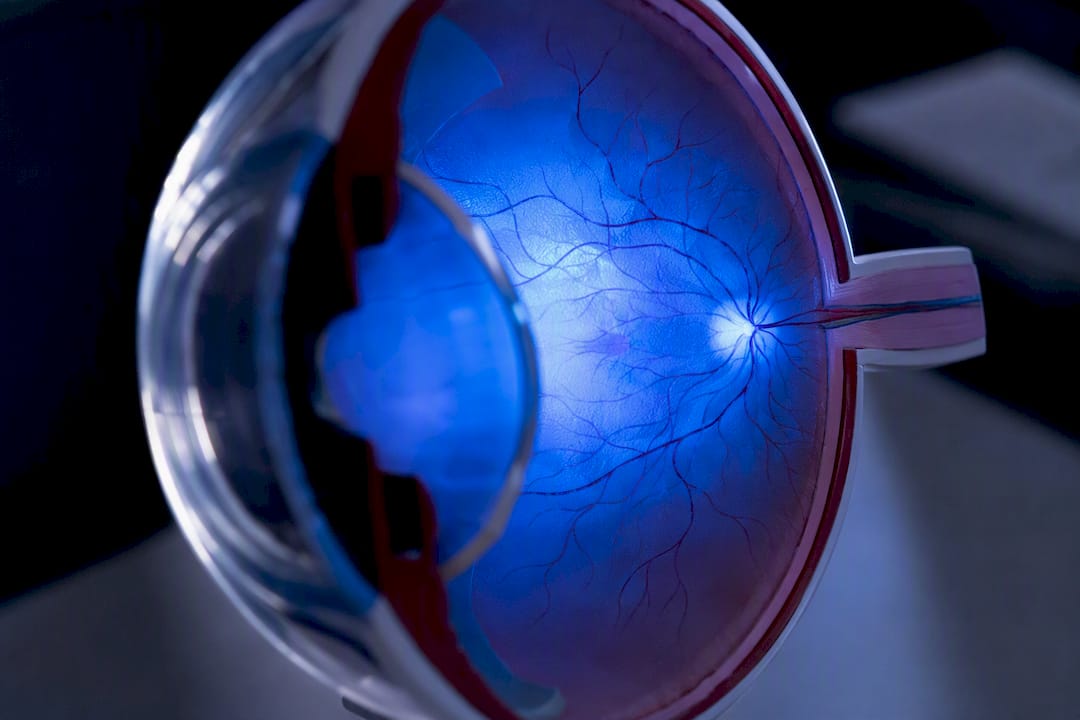
Timing determines the damage. Research has found that three hours of blue light exposure shifted circadian rhythm roughly twice as much as the same duration of green light. In one trial, an amber filter improved sleep onset delay compared to no filter.
What this means practically:
- Bright, blue-rich light in the 2 to 3 hours before bed is the window that matters most.
- Daytime light exposure doesn’t carry the same risk. It actually reinforces a healthy circadian rhythm.
- Consistency beats intensity. A dim, warm evening every night does more than one perfect night ever will.
Pro Tip: Swap your bedside lamp for a warm, amber-toned bulb. It’s a five-dollar fix that removes the guesswork from evening lighting.
Digital Eye Strain vs. Real Retinal Damage: What’s the Difference?
Most of what people blame on blue light is actually digital eye strain, and the two get confused constantly. Staring at a screen drops your blink rate and keeps your eyes locked at close focus for hours, which produces dryness, blurred vision, headaches, and that gritty, tired feeling by evening. None of that is blue light doing damage. It’s mechanical fatigue with an easy fix: take breaks, blink deliberately, and use artificial tears if your eyes feel dry.
The scarier claim, that screen exposure causes permanent retinal damage or macular degeneration, doesn’t hold up under scrutiny. The American Academy of Ophthalmology states plainly that there’s no rigorous evidence linking digital device use to permanent eye damage in humans. Lab studies do show photochemical retinal stress in animal and cell models under intense, prolonged blue light, but that’s a different exposure level entirely from checking your phone before bed.
Pro Tip: If eye discomfort persists after a week of breaks and blinking exercises, or if you notice any actual vision changes, see an optometrist. That’s not something to self-diagnose.
Is Blue Light Ever Good for You?
Blue light isn’t the villain headlines make it out to be. During the day, it’s doing real work for you.
- It sharpens alertness and reaction time, which is why bright morning light helps you feel awake faster than coffee alone.
- It supports mood regulation and is used clinically in bright light therapy for Seasonal Affective Disorder.
- It entrains your circadian rhythm, keeping your sleep and wake times consistent.
The entire strategy comes down to timing: load up on blue light early, and taper it off sharply as evening approaches.
Does the Amount of Blue Light Exposure Matter?
Intensity, duration, and timing all interact, and most media coverage flattens that nuance into “blue light bad.” Lab studies that show retinal stress typically use light intensities far beyond what your phone or laptop produces during normal use. A screen at arm’s length simply isn’t comparable to the controlled, high-lux conditions researchers use to study phototoxicity.
Timing outweighs almost everything else. The same blue light that’s harmless, even helpful, at 9 a.m. becomes disruptive at 11 p.m. because your circadian system is primed differently at each point in the day. A practical threshold: keep evening screens dimmed and avoid bright overhead lighting in the 2 to 3 hours before bed, but don’t lose sleep over occasional bright exposure earlier in the day. Long-term retinal effects from everyday device use remain unproven, and current guidance reflects that uncertainty rather than alarm.
How Can You Reduce Blue Light Exposure at Night?
Start with what costs nothing and works immediately, then layer in device settings if you want more control.
- Put screens away 2 to 3 hours before bed. This single change does more than any app or gadget.
- Switch to dim, warm lighting in the evening, ideally under 50 lux, instead of bright overhead lights.
- Get outside for real daylight within the first hour of waking to reinforce your circadian signal.
- Turn on night mode or a color-temperature app on your phone and laptop, and lower brightness manually after sunset.
- Practice the 20-20-20 rule during the day: every 20 minutes, look at something 20 feet away for 20 seconds.
- Set up your desk ergonomically and blink deliberately, using artificial tears if dryness persists.
Blue-blocking glasses have shown benefit in specific clinical situations, like shift workers or people with diagnosed insomnia, but they’re not a substitute for the basics above if you’re a generally healthy sleeper. For a deeper walkthrough of building these habits into a nightly routine, see our guide to sleep hygiene.
Pro Tip: Set a recurring phone alarm labeled “dim the lights” for three hours before your target bedtime. Willpower fades by 9 p.m.; a reminder doesn’t.
What Do Health Authorities Actually Say About Blue Light?
The consensus is more nuanced than most headlines suggest, and that nuance matters. Major reviews acknowledge that artificial light at night is associated with sleep disruption and metabolic dysregulation in epidemiological studies, even though the exact causal pathways are still being worked out. At the same time, the AAO is unambiguous that device-based blue light hasn’t been shown to cause permanent eye damage.
“Screen time is not causing damage to your eyes,” summarizes the current position from ophthalmology researchers, who instead point to reduced blinking and near-focus strain as the real source of digital eye discomfort.
Most existing studies rely on small samples, lab-intensity light levels far above real-world screen exposure, or animal models that don’t map cleanly onto humans. That’s exactly why recommendations lean toward sleep hygiene rather than mass adoption of blue-blocking glasses. Worry about your bedtime routine. Don’t worry about your phone screen causing blindness.
Blue light’s effect on sleep depends almost entirely on timing, not total daily exposure, and reducing it in the evening remains the single most evidence-backed intervention.
| Point |
Details |
| Timing beats total exposure |
Evening blue light disrupts melatonin far more than the same light earlier in the day. |
| Two hours can matter |
One trial found two hours of nighttime blue light exposure halted melatonin release entirely. |
| Eye strain isn’t eye damage |
Dry, tired eyes come from reduced blinking, not permanent retinal harm, according to the AAO. |
| Daylight has a job to do |
Morning blue-enriched light supports alertness and keeps your circadian rhythm on schedule. |
| Simple fixes work best |
A blackout sleep mask from Checkedoutwellness pairs well with screen curfews and dim evening lighting to reinforce a dark sleep environment. |
Where Can You Learn More About Blue Light and Sleep?
A few sources are worth bookmarking if you want to check claims yourself instead of trusting whatever headline crosses your feed.
A note on where we stand
We built Checkedoutwellness around one idea: sleep problems usually have nonpharmacologic fixes, and timing your light exposure is one of the most evidence-backed levers you have. Our approach starts with the environment, not a pill.
Dimming screens and lowering lights handles most of your evening light exposure, but ambient light from streetlights, hallway fixtures, or an early sunrise can still creep in. That’s where a physical blackout tool earns its place alongside the behavioral changes covered above.

Checkedoutwellness makes a contoured blackout sleep mask designed to block ambient light without pressing on your eyes, which matters if you’ve tried flat masks and given up on them. It’s not a replacement for dimming your phone before bed. It’s the last five percent of light control that habits alone can’t reach. If your bedroom never gets fully dark no matter what you do, check out the full product line at Checkedoutwellness and see which option fits your setup.
Frequently Asked Questions
What is blue light exposure, in simple terms?
It’s contact with visible light in the 400 to 490 nanometer range, coming from the sun, LED lighting, and virtually every screen you use daily. What matters most is when that exposure happens relative to your bedtime.
Is blue light harmful to my eyes?
Not in the way most people assume. The AAO has found no rigorous evidence that screen-based blue light causes permanent retinal damage. Most discomfort is digital eye strain from reduced blinking, which responds well to breaks and the 20-20-20 rule.
How does blue light affect sleep specifically?
It suppresses melatonin by activating ipRGCs in your retina, delaying the signal your brain needs to feel sleepy. Evening exposure has a far larger effect than daytime exposure on this process.
What causes the most blue light exposure in daily life?
Sunlight delivers the highest intensity by a wide margin. Screens and LED bulbs contribute smaller but more relevant doses because you’re often exposed to them right before bed.
Do blue light filters or glasses actually help?
They’ve shown benefit in specific groups like shift workers and people with insomnia. For most healthy sleepers, dimming lights and setting a screen curfew accomplishes more than glasses alone.
How can I reduce blue light exposure without giving up my phone?
Turn on night mode, lower brightness after sunset, and physically dim your room’s lighting. Combine that with a consistent screen curfew 2 to 3 hours before bed for the biggest impact.
Sources
Recommended

What Blue Light Exposure Means for Your Sleep and Eyes
Blue light exposure means contact with visible light in the roughly 400 to 490 nanometer range, and you get it from the sun, LED bulbs, and every screen you own. Two things matter most: the blue light you get during the day sharpens alertness and steadies your body clock, while the blue light hitting your eyes at night can suppress melatonin and delay sleep. We built our whole approach around that split.
Here’s what to actually do with that information:
Quick fact: One trial found that two hours of nighttime blue light exposure was enough to halt melatonin release entirely.
Table of Contents
What Is Blue Light Exposure, Exactly?
Visible light spans a spectrum, and blue light occupies the short-wavelength end, generally cited between 400 and 490 nanometers. Shorter wavelengths carry more energy, which is part of why blue light has such an outsized effect on your eyes and your internal clock compared to warmer red and amber tones.
You encounter it constantly. Sunlight is by far the biggest source, delivering far more blue-spectrum intensity than any screen ever will. Beyond that, you’re getting smaller doses from LED and fluorescent room lighting, smartphones, laptops, televisions, and digital billboards. Some outdoor and retail lighting adds to the load too, though at lower intensity than direct sun exposure.
Here’s a detail most people never think about: white LED light isn’t naturally white. Manufacturers pair a blue LED chip with a yellow phosphor coating to produce something your eye reads as white light. That engineering choice means most LED white light peaks around 450 to 470 nanometers, squarely inside the blue band. It’s why energy-efficient bulbs and nearly every modern screen emit blue-rich light by design, not by accident.
Quick fact: Experimental models show that wavelengths in the 400 to 460 nanometer range are the most phototoxic to retinal tissue under lab conditions, which is why some newer LED designs shift their peak slightly higher.
How Does Blue Light Affect Your Sleep?
Your eyes contain specialized cells called intrinsically photosensitive retinal ganglion cells, or ipRGCs, that aren’t for seeing images at all. They contain a photopigment called melanopsin, which is most sensitive to light around the blue region of the spectrum. When these cells detect blue light, they signal your brain’s master clock to suppress melatonin production, the hormone that tells your body it’s time to wind down.
Timing determines the damage. Research has found that three hours of blue light exposure shifted circadian rhythm roughly twice as much as the same duration of green light. In one trial, an amber filter improved sleep onset delay compared to no filter.
What this means practically:
Pro Tip: Swap your bedside lamp for a warm, amber-toned bulb. It’s a five-dollar fix that removes the guesswork from evening lighting.
Digital Eye Strain vs. Real Retinal Damage: What’s the Difference?
Most of what people blame on blue light is actually digital eye strain, and the two get confused constantly. Staring at a screen drops your blink rate and keeps your eyes locked at close focus for hours, which produces dryness, blurred vision, headaches, and that gritty, tired feeling by evening. None of that is blue light doing damage. It’s mechanical fatigue with an easy fix: take breaks, blink deliberately, and use artificial tears if your eyes feel dry.
The scarier claim, that screen exposure causes permanent retinal damage or macular degeneration, doesn’t hold up under scrutiny. The American Academy of Ophthalmology states plainly that there’s no rigorous evidence linking digital device use to permanent eye damage in humans. Lab studies do show photochemical retinal stress in animal and cell models under intense, prolonged blue light, but that’s a different exposure level entirely from checking your phone before bed.
Pro Tip: If eye discomfort persists after a week of breaks and blinking exercises, or if you notice any actual vision changes, see an optometrist. That’s not something to self-diagnose.
Is Blue Light Ever Good for You?
Blue light isn’t the villain headlines make it out to be. During the day, it’s doing real work for you.
The entire strategy comes down to timing: load up on blue light early, and taper it off sharply as evening approaches.
Does the Amount of Blue Light Exposure Matter?
Intensity, duration, and timing all interact, and most media coverage flattens that nuance into “blue light bad.” Lab studies that show retinal stress typically use light intensities far beyond what your phone or laptop produces during normal use. A screen at arm’s length simply isn’t comparable to the controlled, high-lux conditions researchers use to study phototoxicity.
Timing outweighs almost everything else. The same blue light that’s harmless, even helpful, at 9 a.m. becomes disruptive at 11 p.m. because your circadian system is primed differently at each point in the day. A practical threshold: keep evening screens dimmed and avoid bright overhead lighting in the 2 to 3 hours before bed, but don’t lose sleep over occasional bright exposure earlier in the day. Long-term retinal effects from everyday device use remain unproven, and current guidance reflects that uncertainty rather than alarm.
How Can You Reduce Blue Light Exposure at Night?
Start with what costs nothing and works immediately, then layer in device settings if you want more control.
Blue-blocking glasses have shown benefit in specific clinical situations, like shift workers or people with diagnosed insomnia, but they’re not a substitute for the basics above if you’re a generally healthy sleeper. For a deeper walkthrough of building these habits into a nightly routine, see our guide to sleep hygiene.
Pro Tip: Set a recurring phone alarm labeled “dim the lights” for three hours before your target bedtime. Willpower fades by 9 p.m.; a reminder doesn’t.
What Do Health Authorities Actually Say About Blue Light?
The consensus is more nuanced than most headlines suggest, and that nuance matters. Major reviews acknowledge that artificial light at night is associated with sleep disruption and metabolic dysregulation in epidemiological studies, even though the exact causal pathways are still being worked out. At the same time, the AAO is unambiguous that device-based blue light hasn’t been shown to cause permanent eye damage.
Most existing studies rely on small samples, lab-intensity light levels far above real-world screen exposure, or animal models that don’t map cleanly onto humans. That’s exactly why recommendations lean toward sleep hygiene rather than mass adoption of blue-blocking glasses. Worry about your bedtime routine. Don’t worry about your phone screen causing blindness.
Blue light’s effect on sleep depends almost entirely on timing, not total daily exposure, and reducing it in the evening remains the single most evidence-backed intervention.
Where Can You Learn More About Blue Light and Sleep?
A few sources are worth bookmarking if you want to check claims yourself instead of trusting whatever headline crosses your feed.
A note on where we stand
We built Checkedoutwellness around one idea: sleep problems usually have nonpharmacologic fixes, and timing your light exposure is one of the most evidence-backed levers you have. Our approach starts with the environment, not a pill.
A Simple Tool for the Dark Half of the Equation
Dimming screens and lowering lights handles most of your evening light exposure, but ambient light from streetlights, hallway fixtures, or an early sunrise can still creep in. That’s where a physical blackout tool earns its place alongside the behavioral changes covered above.
Checkedoutwellness makes a contoured blackout sleep mask designed to block ambient light without pressing on your eyes, which matters if you’ve tried flat masks and given up on them. It’s not a replacement for dimming your phone before bed. It’s the last five percent of light control that habits alone can’t reach. If your bedroom never gets fully dark no matter what you do, check out the full product line at Checkedoutwellness and see which option fits your setup.
Frequently Asked Questions
What is blue light exposure, in simple terms? It’s contact with visible light in the 400 to 490 nanometer range, coming from the sun, LED lighting, and virtually every screen you use daily. What matters most is when that exposure happens relative to your bedtime.
Is blue light harmful to my eyes? Not in the way most people assume. The AAO has found no rigorous evidence that screen-based blue light causes permanent retinal damage. Most discomfort is digital eye strain from reduced blinking, which responds well to breaks and the 20-20-20 rule.
How does blue light affect sleep specifically? It suppresses melatonin by activating ipRGCs in your retina, delaying the signal your brain needs to feel sleepy. Evening exposure has a far larger effect than daytime exposure on this process.
What causes the most blue light exposure in daily life? Sunlight delivers the highest intensity by a wide margin. Screens and LED bulbs contribute smaller but more relevant doses because you’re often exposed to them right before bed.
Do blue light filters or glasses actually help? They’ve shown benefit in specific groups like shift workers and people with insomnia. For most healthy sleepers, dimming lights and setting a screen curfew accomplishes more than glasses alone.
How can I reduce blue light exposure without giving up my phone? Turn on night mode, lower brightness after sunset, and physically dim your room’s lighting. Combine that with a consistent screen curfew 2 to 3 hours before bed for the biggest impact.
Sources
Recommended