Most people assume a little ambient light at night is harmless. It isn’t. The science behind sleep masks reveals something that should make you rethink every streetlight seeping through your curtains and every LED standby light blinking in the corner of your room. Even low lux light levels of just 5 to 10 lux can suppress melatonin production in sensitive individuals, quietly sabotaging the sleep your body desperately needs to recover. This article breaks down what actually happens in your brain and body when light hits your eyes at night, why blocking it matters more than you think, and how to choose a mask that does the job properly.
Table of Contents
Key takeaways
| Point |
Details |
| Light disrupts melatonin fast |
Even dim indoor light can suppress melatonin by up to 70%, delaying natural sleep onset. |
| Research validates sleep masks |
Clinical studies link opaque mask use to faster sleep onset, deeper sleep, and better alertness. |
| Material and fit determine results |
High-opacity silk with a proper nose bridge seal outperforms thick but poorly fitted alternatives. |
| Masks work psychologically too |
Consistent nightly use trains the brain to associate the mask with safe, restful sleep. |
| Best candidates for masks |
Shift workers, travelers, and light-sensitive sleepers gain the most measurable benefits. |
The science behind sleep masks and light biology
To understand how sleep masks work, you need to understand what light does to your brain after dark. Your circadian rhythm, the internal 24-hour clock that governs nearly every biological function, is regulated primarily by a tiny region of the brain called the suprachiasmatic nucleus. This region receives direct input from specialized retinal cells called intrinsically photosensitive retinal ganglion cells, or ipRGCs. These cells are particularly sensitive to short-wavelength blue light, which is abundant in LED screens, overhead lighting, and even moonlight.
When these cells detect light, they send a suppression signal to the pineal gland, telling it to slow or halt melatonin production. Melatonin is the hormone that initiates the physiological cascade of sleep: dropping core body temperature, reducing alertness, and triggering drowsiness. Without it, your sleep-wake cycle drifts. You lie awake longer, sleep lighter, and wake less restored.
Here is the part most people get wrong. You don’t need bright light to trigger this suppression. Typical indoor lighting suppresses melatonin production by 50 to 70%, making the dim glow of a nightlight or a partner’s phone screen far more damaging than it appears. The physiology of sleep masks becomes relevant exactly here. By creating near-total darkness at the eye level, a well-fitted mask removes the optical input that triggers melatonin suppression, allowing your pineal gland to produce melatonin on its natural schedule.
The consequences of circadian disruption go well beyond feeling groggy. Chronic light exposure at night correlates with impaired glucose metabolism, elevated cortisol, mood dysregulation, and compromised immune function. Sleep masks and circadian rhythms are more tightly connected than most people realize. Understanding the melatonin production pathway makes it clear why physical light blocking is so much more reliable than hoping your curtains are thick enough.
-
Blue light (wavelength 480nm) is the primary driver of melatonin suppression through ipRGC activation
-
Even 5 to 10 lux of light exposure can significantly impact melatonin-sensitive individuals
-
Indoor lighting typically runs between 100 and 500 lux, well above the suppression threshold
-
Sleep masks and melatonin protection work by eliminating the optical signal entirely, not reducing it
Pro Tip: If you wear a sleep mask but still feel like sleep onset is slow, check for light leakage around the nose bridge. That small gap is often enough to partially suppress melatonin even when the rest of your face is covered.
What research says about sleep mask benefits
The effect of sleep masks on sleep quality is not anecdotal. It is measurable. A 2024 analysis of 47,765 women found that indoor light at night strongly linked to trouble falling and staying asleep, and that use of high-quality opaque sleep masks meaningfully improved sleep quality outcomes. That is not a small pilot study. That is large-scale epidemiological evidence pointing in a very clear direction.
On the clinical side, studies comparing sleep with and without masks show improvements across multiple metrics: reduced sleep latency (how long it takes to fall asleep), longer deep sleep duration, improved REM sleep cycles, and better morning alertness and cognitive performance. REM sleep is when memory consolidation and emotional processing happen. Protecting it has real consequences for how well you function the next day.
“Wearing a sleep mask creates a psychological association between the mask and safe, relaxed sleep, activating the parasympathetic nervous system and helping you fall asleep faster.” — Dr. Samuel Gurevich, as cited by Cleveland Clinic
That quote deserves more attention than it usually gets. Sleep masks condition the brain through consistent use, creating a Pavlovian cue for sleep onset. Over time, simply putting the mask on becomes part of the signal that tells your nervous system it is safe to let go of alertness. This is not a placebo effect. It is a documented psychophysiological response, and it is one reason why sleep masks for better rest are often more effective after several weeks of consistent use than on the first night.
The stress reduction dimension is worth noting separately. The act of blocking visual input quiets the default mode network, which is the part of the brain responsible for rumination and anxious thought loops. Less visual noise means a faster descent into the pre-sleep hypnagogic state. For high performers dealing with elevated cognitive load, that benefit alone can justify adding a mask to the nightly routine.
Material and design: what actually blocks light
Not all sleep masks block light equally. The science of light blocking at the mask level comes down to two variables: optical density of the material and the integrity of the seal around your face. A thick fabric that lets light through the weave fails on the first count. A dense fabric that gaps at the nose bridge fails on the second. Both undermine the melatonin protection you are trying to achieve.
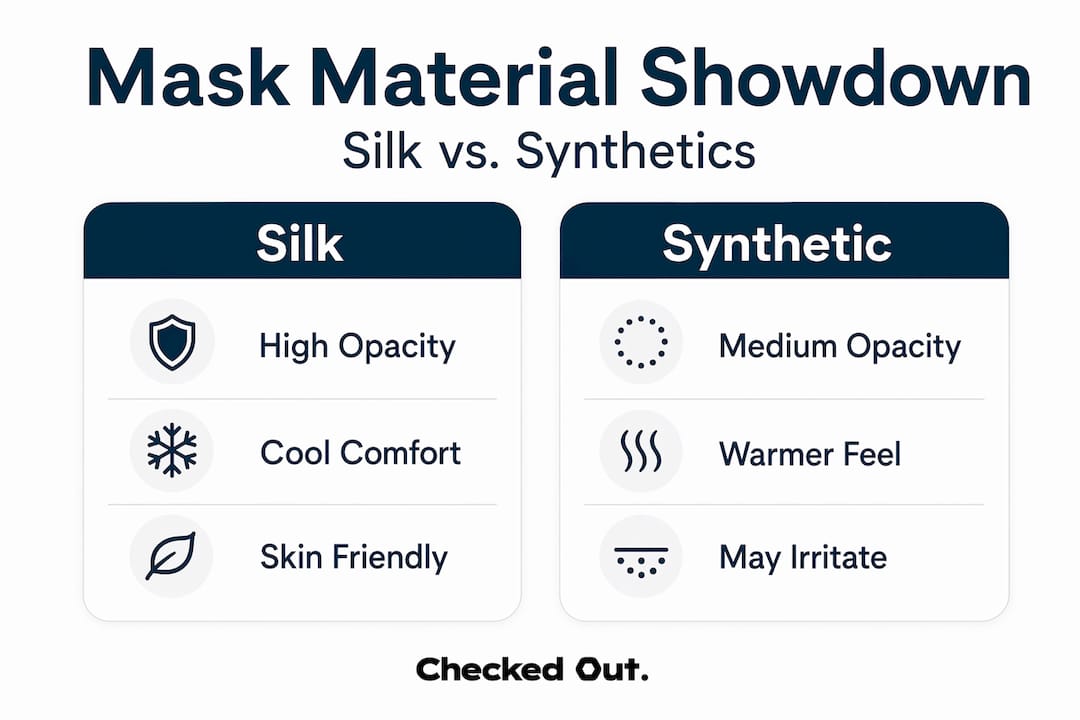
| Feature |
Mulberry silk (22 momme) |
Synthetic fabrics |
| Light blocking |
High opacity with proper lining |
Variable; often allows light leakage |
| Breathability |
Excellent; regulates temperature naturally |
Lower; can trap heat and humidity |
| Skin friction |
Smooth; reduces facial creasing |
Rough fibers cause irritation and pressure |
| Durability |
Long-lasting with proper care |
Degrades faster with washing |
| Thermoregulation |
Adapts to body temperature |
Retains heat; can disrupt sleep |
Mulberry silk at 22 momme weight provides the best combination of light blocking and breathability, preventing the heat buildup that can disrupt sleep even when light is fully blocked. Temperature regulation matters because your core body temperature needs to drop 1 to 2 degrees Fahrenheit to initiate and maintain deep sleep. A mask that traps heat around your face works against that process.
Dermatologist Dr. Simon Ourian has noted that poorly fitted or rough masks cause friction, irritation, and potential long-term skin creasing. Silk and satin minimize contact pressure on the delicate periorbital skin. For anyone sleeping 7 to 8 hours per night, that is 2,500 hours of facial contact per year. The material choice matters more than most people consider.
Light leakage around the nose bridge is the most common design failure in sleep masks. Small gaps allow even low-lux environmental light to reach the retina, partially activating ipRGCs and undermining melatonin synthesis. A contoured 3D design that cups around the eyes without pressing on the eyelids addresses both the seal and the comfort issue simultaneously.
Pro Tip: When testing a new sleep mask, do your fit check in a dark room with a small light source at floor level. If any light reaches your eyes, the nose bridge seal is insufficient and the mask will not deliver full melatonin protection.
How to use sleep masks effectively
Understanding how sleep masks work is one thing. Building a practice around them is another. The following steps apply whether you’re a light-sensitive sleeper, a cross-timezone traveler, or a shift worker trying to reclaim recovery sleep during daylight hours.
-
Start with the right environment. Combine your mask with other light-blocking measures. Pull your curtains and turn off all standby lights. The mask handles direct orbital light exposure; your room environment handles ambient spillover that the mask may not seal completely.
-
Build a consistent pre-sleep ritual. Put the mask on at the same point in your bedtime routine every night, ideally 10 to 15 minutes before your target sleep time. This is how you build the psychological conditioning that accelerates sleep onset over time.
-
Clean your mask regularly. Silk masks should be hand-washed in cool water with a gentle, fragrance-free cleanser every 3 to 4 days. Residue from skincare products accumulates on the contact surface and can cause skin irritation. Combining a silk mask with clean skin practices and avoiding heavy skincare residue at contact points prevents long-term discomfort.
-
For travelers and shift workers specifically, use your mask as an anchor cue. Wearing it at the same point in your sleep preparation, regardless of the time zone or time of day, gives your circadian system a behavioral signal when the light environment cannot be controlled. Consistent mask use benefits shift workers and travelers by mitigating circadian disruption from environmental light that would otherwise drive cortisol up and melatonin down.
-
Pair with sleep-supportive practices. A mask works best as part of a broader sleep routine that includes consistent sleep timing, reduced screen exposure 60 minutes before bed, and temperature-appropriate bedding. The mask is a powerful tool, not a standalone fix.
Pro Tip: For long-haul flights, a contoured 3D mask that does not press on your eyelids makes a measurable difference in whether you can achieve REM sleep in-transit. Flat foam masks that compress your eyes tend to cause discomfort that prevents deep sleep stages.
My take on what the sleep mask conversation misses
I’ve spent years looking at how high performers approach sleep, and the pattern I keep seeing is the same. People will spend $400 on a recovery supplement stack and sleep with their phone glowing on the nightstand. They will try every biohack and optimization tool available, and never think once about the light entering their eyes at 2am.
The science behind sleep masks is not complicated. But the assumption that it’s a “soft” intervention keeps people from taking it seriously. What I’ve learned is that the most underestimated sleep disruptors are almost always the ones that feel too obvious to address. Light is invisible until you think about it neurologically. Then it becomes one of the most powerful levers you have.
What I find genuinely underappreciated is the conditioning effect. Once I committed to consistent mask use as part of a fixed sleep ritual, the time it took me to fall asleep dropped noticeably, not from the first night, but over the first few weeks. The brain is plastic. Give it a reliable cue and it will respond. A good mask is not just a physical tool. It’s a signal. And signals, repeated consistently, reshape behavior at a neurological level.
The other thing I’d push back on is the idea that any mask will do. Fit and material density are where most cheap masks fail. If you are going to take sleep seriously as a performance variable, choose your mask with the same rigor you apply to anything else that affects your health. The physiology of sleep masks rewards that rigor with measurable results.
— Geeta
Sleep smarter with Checkedoutwellness

The science covered here is exactly what shaped the approach behind Checkedoutwellness’s contoured blackout sleep mask. Designed with a 3D contoured structure to eliminate eye pressure and seal light at the nose bridge, it delivers the near-total optical density that melatonin protection actually requires. For those who want to go deeper on the light-blocking side and support the body’s own sleep chemistry, Checkedoutwellness also offers a drug-free sleep patch formulated with the cofactors your body needs for tryptophan-to-serotonin-to-melatonin conversion, without synthetic melatonin or dependency risk. If you’re building a sleep practice that holds up over time, these two tools work together in a way that covers both the environmental and biochemical sides of the problem. Explore the full sleep mask guide to see how each feature maps to the science.
FAQ
How do sleep masks improve melatonin production?
Sleep masks block the light that activates retinal cells signaling the pineal gland to suppress melatonin. By eliminating that optical input, the body produces melatonin on its natural schedule, supporting faster sleep onset and deeper sleep stages.
Do sleep masks actually improve sleep quality?
Yes. A 2024 analysis of nearly 48,000 women found that opaque sleep masks measurably improved sleep quality in individuals exposed to indoor light at night. Research also shows improvements in sleep latency, deep sleep duration, and morning alertness.
What makes a sleep mask effective at blocking light?
Optical density of the material and a secure seal around the nose bridge are the two critical factors. Even small gaps allow 5 to 10 lux of light to reach the retina, which is enough to partially suppress melatonin and reduce sleep mask effectiveness.
Are silk sleep masks better than synthetic ones?
Mulberry silk at 22 momme weight provides superior light blocking, breathability, and skin protection compared to most synthetic fabrics. Synthetic masks often trap heat and cause friction, both of which can disrupt sleep quality despite blocking light.
Who benefits most from wearing a sleep mask?
Shift workers, frequent travelers, and light-sensitive individuals gain the most measurable benefits from consistent sleep mask use. These groups face the greatest circadian disruption from environmental light and benefit most from a reliable, portable light-blocking solution.
Recommended

The Science Behind Sleep Masks for Better Rest
Most people assume a little ambient light at night is harmless. It isn’t. The science behind sleep masks reveals something that should make you rethink every streetlight seeping through your curtains and every LED standby light blinking in the corner of your room. Even low lux light levels of just 5 to 10 lux can suppress melatonin production in sensitive individuals, quietly sabotaging the sleep your body desperately needs to recover. This article breaks down what actually happens in your brain and body when light hits your eyes at night, why blocking it matters more than you think, and how to choose a mask that does the job properly.
Table of Contents
Key takeaways
The science behind sleep masks and light biology
To understand how sleep masks work, you need to understand what light does to your brain after dark. Your circadian rhythm, the internal 24-hour clock that governs nearly every biological function, is regulated primarily by a tiny region of the brain called the suprachiasmatic nucleus. This region receives direct input from specialized retinal cells called intrinsically photosensitive retinal ganglion cells, or ipRGCs. These cells are particularly sensitive to short-wavelength blue light, which is abundant in LED screens, overhead lighting, and even moonlight.
When these cells detect light, they send a suppression signal to the pineal gland, telling it to slow or halt melatonin production. Melatonin is the hormone that initiates the physiological cascade of sleep: dropping core body temperature, reducing alertness, and triggering drowsiness. Without it, your sleep-wake cycle drifts. You lie awake longer, sleep lighter, and wake less restored.
Here is the part most people get wrong. You don’t need bright light to trigger this suppression. Typical indoor lighting suppresses melatonin production by 50 to 70%, making the dim glow of a nightlight or a partner’s phone screen far more damaging than it appears. The physiology of sleep masks becomes relevant exactly here. By creating near-total darkness at the eye level, a well-fitted mask removes the optical input that triggers melatonin suppression, allowing your pineal gland to produce melatonin on its natural schedule.
The consequences of circadian disruption go well beyond feeling groggy. Chronic light exposure at night correlates with impaired glucose metabolism, elevated cortisol, mood dysregulation, and compromised immune function. Sleep masks and circadian rhythms are more tightly connected than most people realize. Understanding the melatonin production pathway makes it clear why physical light blocking is so much more reliable than hoping your curtains are thick enough.
Pro Tip: If you wear a sleep mask but still feel like sleep onset is slow, check for light leakage around the nose bridge. That small gap is often enough to partially suppress melatonin even when the rest of your face is covered.
What research says about sleep mask benefits
The effect of sleep masks on sleep quality is not anecdotal. It is measurable. A 2024 analysis of 47,765 women found that indoor light at night strongly linked to trouble falling and staying asleep, and that use of high-quality opaque sleep masks meaningfully improved sleep quality outcomes. That is not a small pilot study. That is large-scale epidemiological evidence pointing in a very clear direction.
On the clinical side, studies comparing sleep with and without masks show improvements across multiple metrics: reduced sleep latency (how long it takes to fall asleep), longer deep sleep duration, improved REM sleep cycles, and better morning alertness and cognitive performance. REM sleep is when memory consolidation and emotional processing happen. Protecting it has real consequences for how well you function the next day.
That quote deserves more attention than it usually gets. Sleep masks condition the brain through consistent use, creating a Pavlovian cue for sleep onset. Over time, simply putting the mask on becomes part of the signal that tells your nervous system it is safe to let go of alertness. This is not a placebo effect. It is a documented psychophysiological response, and it is one reason why sleep masks for better rest are often more effective after several weeks of consistent use than on the first night.
The stress reduction dimension is worth noting separately. The act of blocking visual input quiets the default mode network, which is the part of the brain responsible for rumination and anxious thought loops. Less visual noise means a faster descent into the pre-sleep hypnagogic state. For high performers dealing with elevated cognitive load, that benefit alone can justify adding a mask to the nightly routine.
Material and design: what actually blocks light
Not all sleep masks block light equally. The science of light blocking at the mask level comes down to two variables: optical density of the material and the integrity of the seal around your face. A thick fabric that lets light through the weave fails on the first count. A dense fabric that gaps at the nose bridge fails on the second. Both undermine the melatonin protection you are trying to achieve.
Mulberry silk at 22 momme weight provides the best combination of light blocking and breathability, preventing the heat buildup that can disrupt sleep even when light is fully blocked. Temperature regulation matters because your core body temperature needs to drop 1 to 2 degrees Fahrenheit to initiate and maintain deep sleep. A mask that traps heat around your face works against that process.
Dermatologist Dr. Simon Ourian has noted that poorly fitted or rough masks cause friction, irritation, and potential long-term skin creasing. Silk and satin minimize contact pressure on the delicate periorbital skin. For anyone sleeping 7 to 8 hours per night, that is 2,500 hours of facial contact per year. The material choice matters more than most people consider.
Light leakage around the nose bridge is the most common design failure in sleep masks. Small gaps allow even low-lux environmental light to reach the retina, partially activating ipRGCs and undermining melatonin synthesis. A contoured 3D design that cups around the eyes without pressing on the eyelids addresses both the seal and the comfort issue simultaneously.
Pro Tip: When testing a new sleep mask, do your fit check in a dark room with a small light source at floor level. If any light reaches your eyes, the nose bridge seal is insufficient and the mask will not deliver full melatonin protection.
How to use sleep masks effectively
Understanding how sleep masks work is one thing. Building a practice around them is another. The following steps apply whether you’re a light-sensitive sleeper, a cross-timezone traveler, or a shift worker trying to reclaim recovery sleep during daylight hours.
Start with the right environment. Combine your mask with other light-blocking measures. Pull your curtains and turn off all standby lights. The mask handles direct orbital light exposure; your room environment handles ambient spillover that the mask may not seal completely.
Build a consistent pre-sleep ritual. Put the mask on at the same point in your bedtime routine every night, ideally 10 to 15 minutes before your target sleep time. This is how you build the psychological conditioning that accelerates sleep onset over time.
Clean your mask regularly. Silk masks should be hand-washed in cool water with a gentle, fragrance-free cleanser every 3 to 4 days. Residue from skincare products accumulates on the contact surface and can cause skin irritation. Combining a silk mask with clean skin practices and avoiding heavy skincare residue at contact points prevents long-term discomfort.
For travelers and shift workers specifically, use your mask as an anchor cue. Wearing it at the same point in your sleep preparation, regardless of the time zone or time of day, gives your circadian system a behavioral signal when the light environment cannot be controlled. Consistent mask use benefits shift workers and travelers by mitigating circadian disruption from environmental light that would otherwise drive cortisol up and melatonin down.
Pair with sleep-supportive practices. A mask works best as part of a broader sleep routine that includes consistent sleep timing, reduced screen exposure 60 minutes before bed, and temperature-appropriate bedding. The mask is a powerful tool, not a standalone fix.
Pro Tip: For long-haul flights, a contoured 3D mask that does not press on your eyelids makes a measurable difference in whether you can achieve REM sleep in-transit. Flat foam masks that compress your eyes tend to cause discomfort that prevents deep sleep stages.
My take on what the sleep mask conversation misses
I’ve spent years looking at how high performers approach sleep, and the pattern I keep seeing is the same. People will spend $400 on a recovery supplement stack and sleep with their phone glowing on the nightstand. They will try every biohack and optimization tool available, and never think once about the light entering their eyes at 2am.
The science behind sleep masks is not complicated. But the assumption that it’s a “soft” intervention keeps people from taking it seriously. What I’ve learned is that the most underestimated sleep disruptors are almost always the ones that feel too obvious to address. Light is invisible until you think about it neurologically. Then it becomes one of the most powerful levers you have.
What I find genuinely underappreciated is the conditioning effect. Once I committed to consistent mask use as part of a fixed sleep ritual, the time it took me to fall asleep dropped noticeably, not from the first night, but over the first few weeks. The brain is plastic. Give it a reliable cue and it will respond. A good mask is not just a physical tool. It’s a signal. And signals, repeated consistently, reshape behavior at a neurological level.
The other thing I’d push back on is the idea that any mask will do. Fit and material density are where most cheap masks fail. If you are going to take sleep seriously as a performance variable, choose your mask with the same rigor you apply to anything else that affects your health. The physiology of sleep masks rewards that rigor with measurable results.
Sleep smarter with Checkedoutwellness
The science covered here is exactly what shaped the approach behind Checkedoutwellness’s contoured blackout sleep mask. Designed with a 3D contoured structure to eliminate eye pressure and seal light at the nose bridge, it delivers the near-total optical density that melatonin protection actually requires. For those who want to go deeper on the light-blocking side and support the body’s own sleep chemistry, Checkedoutwellness also offers a drug-free sleep patch formulated with the cofactors your body needs for tryptophan-to-serotonin-to-melatonin conversion, without synthetic melatonin or dependency risk. If you’re building a sleep practice that holds up over time, these two tools work together in a way that covers both the environmental and biochemical sides of the problem. Explore the full sleep mask guide to see how each feature maps to the science.
FAQ
How do sleep masks improve melatonin production?
Sleep masks block the light that activates retinal cells signaling the pineal gland to suppress melatonin. By eliminating that optical input, the body produces melatonin on its natural schedule, supporting faster sleep onset and deeper sleep stages.
Do sleep masks actually improve sleep quality?
Yes. A 2024 analysis of nearly 48,000 women found that opaque sleep masks measurably improved sleep quality in individuals exposed to indoor light at night. Research also shows improvements in sleep latency, deep sleep duration, and morning alertness.
What makes a sleep mask effective at blocking light?
Optical density of the material and a secure seal around the nose bridge are the two critical factors. Even small gaps allow 5 to 10 lux of light to reach the retina, which is enough to partially suppress melatonin and reduce sleep mask effectiveness.
Are silk sleep masks better than synthetic ones?
Mulberry silk at 22 momme weight provides superior light blocking, breathability, and skin protection compared to most synthetic fabrics. Synthetic masks often trap heat and cause friction, both of which can disrupt sleep quality despite blocking light.
Who benefits most from wearing a sleep mask?
Shift workers, frequent travelers, and light-sensitive individuals gain the most measurable benefits from consistent sleep mask use. These groups face the greatest circadian disruption from environmental light and benefit most from a reliable, portable light-blocking solution.
Recommended