A travel sleep improvement guide is defined as a structured set of behavioral, environmental, and scheduling strategies that help travelers achieve restorative sleep despite disrupted circadian rhythms, unfamiliar environments, and long-haul transit. Poor sleep on the road compounds fatigue, impairs decision-making, and shortens the window for genuine recovery. The good news is that your body responds predictably to the right cues. With deliberate preparation, smart in-flight habits, and a consistent hotel routine, you can protect your sleep quality no matter how many time zones you cross. Checkedoutwellness was built for exactly this kind of traveler: someone who treats sleep as seriously as training, nutrition, and performance.
How to prepare before travel to optimize your sleep
Pre-trip preparation is the most underrated part of any travel sleep optimization guide. Most travelers pack their bags the night before and board a red-eye already running on fumes. That approach guarantees a rough first few days at the destination.
The single most effective pre-trip move is a gradual schedule shift. Shift your sleep 1 hour earlier or later each day for 2–3 days before departure, depending on your direction of travel. This small daily adjustment moves your internal clock closer to the destination’s time zone before you even board the plane.
Caffeine management matters just as much. Avoid caffeine at least 5–6 hours before your intended sleep window, whether that is on the plane or at your hotel. Caffeine has a half-life of roughly 5 hours in most adults, meaning a 3:00 PM coffee still has significant activity in your system at 8:00 PM.
Pack your sleep kit before anything else. The right gear removes friction at the moment you need rest most:
-
3D contoured sleep mask to block cabin light without pressing on your eyes
-
Foam or silicone earplugs rated for at least 30 dB noise reduction
-
Compact travel pillow that supports the cervical spine in an upright seat
-
Compression socks for long-haul flights
-
Transdermal sleep patch for drug-free support during overnight flights
Pro Tip: Pack your sleep kit in a dedicated pouch at the top of your carry-on. The moment you board, set it up before the flight even takes off. Waiting until you feel tired means you will be fumbling in the dark.
Adopt the mindset of local time from the moment you board. Set your watch to the destination time zone at departure. This small psychological shift primes your brain to start treating meals, light exposure, and activity as signals for the new schedule.
What are the best strategies for improving sleep quality during flights?
In-flight sleep quality depends almost entirely on how well you control your immediate environment. Economy class is not designed for sleep. You have to engineer it yourself.
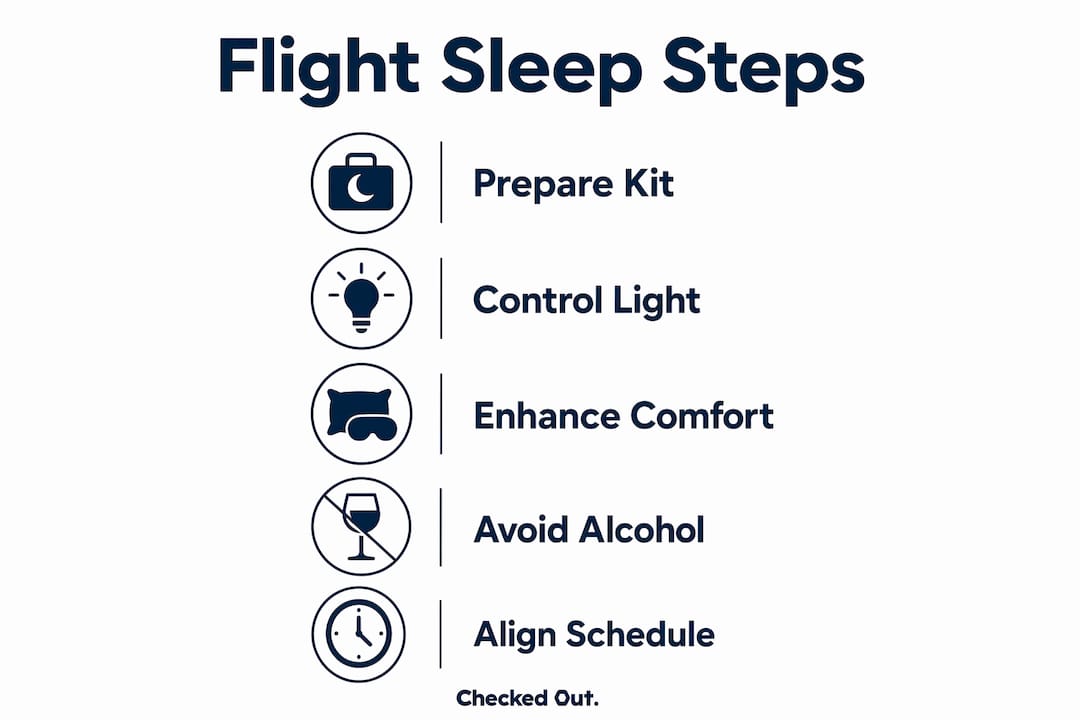
Start with darkness and quiet. A contoured blackout sleep mask paired with earplugs eliminates the two biggest sensory disruptors on any aircraft: cabin lighting and ambient noise. Most travelers skip one or both, then wonder why they cannot fall asleep.
Physical comfort is the next variable. Economy seat headrest wings folded forward 30–45 degrees create a partial cradle effect that reduces neck strain significantly. Neck pain is one of the most commonly overlooked reasons travelers wake up repeatedly on long flights. Loose, layered clothing and compression socks on long flights improve circulation and reduce leg discomfort, both of which affect how deeply you sleep.
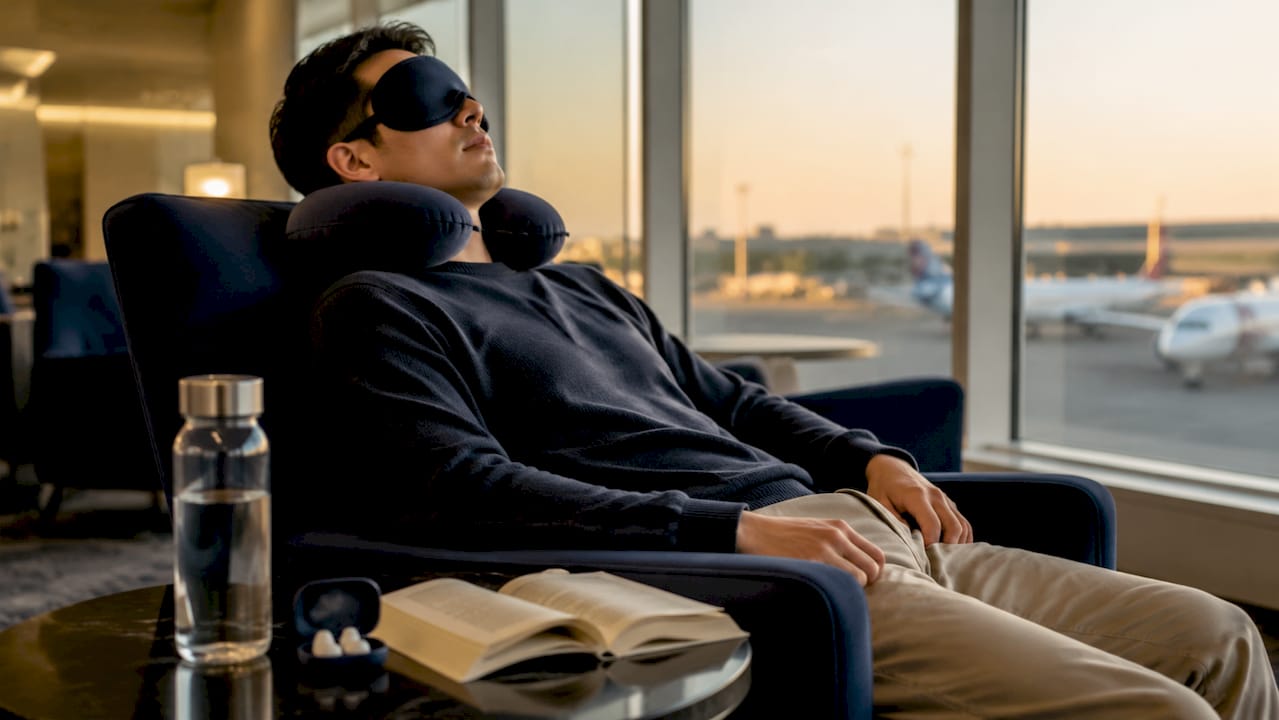
Here is a physical setup checklist for in-flight sleep:
| Item |
Purpose |
Notes |
| 3D contoured sleep mask |
Blocks cabin light |
Choose a contoured fit to avoid eye pressure |
| Earplugs or noise-reducing earbuds |
Reduces ambient noise |
30+ dB reduction recommended |
| Travel neck pillow |
Supports cervical spine |
Position before takeoff |
| Compression socks |
Improves leg circulation |
Put on before boarding |
| Loose, layered clothing |
Regulates body temperature |
Cabin temps vary widely |
Alcohol is a trap. Alcohol fragments sleep and worsens dehydration at altitude. It may help you fall asleep faster, but it reduces sleep quality in the second half of the rest period. Drink water instead.
Screen use before sleep is a real problem, especially in 2026 when bleisure travel and constant connectivity make it tempting to work until the moment you close your eyes. Setting screens to night mode and pausing notifications at least 1 hour before your intended sleep window reduces both blue light exposure and psychological stimulation. Blue light suppresses melatonin production, which is the hormone your body needs to initiate sleep.
Pro Tip: Time your in-flight sleep to align with nighttime at your destination, not your departure city. If you are flying east and it is 10:00 PM in Paris, sleep now, even if it is only 4:00 PM back home.
How to optimize sleep in hotels and unfamiliar accommodations
The “first night effect” is a real, documented phenomenon. Your brain keeps one hemisphere slightly more alert in an unfamiliar environment, acting as a biological watchman. The good news is that familiar routines and comfort items accelerate restful sleep onset and reduce this effect significantly by the second night.
Temperature is the most controllable variable in a hotel room. The body drops its core temperature to initiate sleep, so a cool room actively supports that process. Set the thermostat to the lower end of your comfort range before you wind down for the night.
Light is the second major factor. A cool, dark, and quiet room is the gold standard for sleep quality in any environment. Most hotel blackout curtains leave a gap at the center. Use a binder clip from the front desk, or tuck a rolled towel along the bottom of the curtain to seal it. A contoured sleep mask provides a reliable backup when the room cannot be fully darkened.
Here is a quick comparison of common hotel environment adjustments and their impact:
| Adjustment |
Sleep impact |
Easy fix |
| Blackout curtains |
High |
Seal gaps with a clip or towel |
| Cool room temperature |
High |
Set thermostat before winding down |
| White noise or earplugs |
Medium to high |
Use a free white noise app or foam earplugs |
| Phone notifications off |
Medium |
Enable Do Not Disturb mode at 9:00 PM |
| Familiar bedtime ritual |
Medium |
Replicate your home routine exactly |
Routine is the most underestimated tool in a traveler’s sleep kit. Returning to similar sleep schedules and rituals reduces first-night disruption. A warm shower, 10 minutes of reading, and a consistent lights-out time signal your nervous system that sleep is coming, regardless of the city you are in.
Avoid late meals and screens in the hour before bed. Heavy digestion and blue light both delay melatonin release. If you need deeper sleep strategies beyond environment control, the science of sleep cofactors like magnesium and GABA is worth understanding.
Pro Tip: When booking hotels, request a room away from elevators and ice machines. Noise from hallway traffic is the most common complaint among light sleepers, and it is entirely avoidable with one request at check-in.
How to adjust your circadian rhythm quickly to new time zones
Circadian rhythm adjustment, also called chronobiological resynchronization, is the process of shifting your internal body clock to match a new local time. The circadian rhythm governs sleep, hunger, alertness, and hormone release on a roughly 24-hour cycle. Disrupting it produces jet lag: fatigue, brain fog, and poor sleep at the wrong times.
Light exposure is the strongest cue for resetting the circadian clock. Morning sunlight accelerates eastward adaptation. Avoiding evening light helps westward travelers stay awake longer into the local night. This is not optional advice. It is the mechanism your body uses to recalibrate.
Syncing meals and activity to local time is equally important. Eating breakfast at local time, exercising in the morning, and staying active during the local day all reinforce the new schedule. Your digestive system and body temperature both feed timing signals back to the brain’s master clock.
Follow these steps to synchronize your circadian rhythm after arrival:
-
Get outdoor morning light within 30 minutes of waking on your first day at the destination.
-
Eat meals at local times starting from your first meal after landing.
-
Stay awake through the local day, even if you feel tired from the flight.
-
Take a short nap if needed. Short 20–30 minute naps sustain alertness without delaying nighttime sleep adaptation.
-
Avoid naps longer than 30 minutes. Long naps push your sleep pressure into the next day and delay full adaptation.
-
Dim lights and avoid screens 1 hour before local bedtime.
-
Repeat the same routine on day two. Consistency accelerates adaptation faster than any single intervention.
For travelers who want additional support, natural jet lag recovery protocols that work alongside light and meal timing can shorten the adaptation window. Portable oxygen is another tool some long-haul travelers use to reduce altitude-related fatigue; portable oxygen for travelers addresses the physiological stress that cabin pressure places on the body during extended flights.
Key Takeaways
Consistent pre-trip preparation, controlled sleep environments, and deliberate light exposure are the three pillars of effective travel sleep improvement.
| Point |
Details |
| Shift your schedule before departure |
Adjust sleep 1 hour per day for 2–3 days pre-trip to reduce jet lag on arrival. |
| Control your in-flight environment |
Use a contoured mask, earplugs, and headrest wings to create sleep conditions in economy. |
| Replicate your home routine in hotels |
Familiar rituals and a cool, dark room reduce the first-night effect significantly. |
| Use light as your primary reset tool |
Morning sunlight after eastward travel is the strongest cue for circadian resynchronization. |
| Keep naps short and strategic |
Limit daytime naps to 20–30 minutes to sustain alertness without disrupting nighttime sleep. |
What I have learned about sleep and travel after years on the road
The most common mistake I see travelers make is treating sleep as something that will “sort itself out” once they arrive. It does not. The body keeps score quietly, and by day three of a conference or vacation, the accumulated sleep debt shows up in mood, focus, and physical recovery.
What actually works is treating your sleep routine as non-negotiable, the same way you would a morning workout or a medication schedule. I started packing my sleep kit before my clothes. I set my watch to destination time the moment I board. I skip the in-flight wine, even when it is free, because I know what it does to my second sleep cycle.
The digital boundary piece surprised me the most. I used to answer emails until I fell asleep on the plane. The shift to a hard screen cutoff one hour before sleep made a measurable difference in how rested I felt on arrival. In 2026, with work following us everywhere, that boundary is not a luxury. It is a requirement.
Small adjustments compound. A sleep mask, a consistent bedtime, and morning sunlight are not dramatic interventions. But applied consistently across a five-day trip, they are the difference between arriving sharp and spending two days recovering. Be patient with yourself during adaptation. The circadian clock shifts at roughly one hour per day. Give it the right cues, and it will follow.
— Geeta
Sleep better on your next trip with Checkedoutwellness
Knowing the strategies is one thing. Having the right tools makes them stick.

Checkedoutwellness designs natural sleep aids for travelers who want drug-free support without synthetic melatonin or next-day grogginess. The transdermal sleep patch delivers magnesium, GABA, B6, and B12 through the skin to support your body’s own melatonin production, manufactured under ISO 22716 GMP pharmaceutical standards in South Korea. The 3D contoured sleep mask blocks light completely without pressing on your eyes, making it ideal for both flights and hotel rooms. These are not accessories. They are part of a deliberate sleep protocol built for people who take recovery seriously.
FAQ
What is the most effective way to reduce jet lag?
Syncing light exposure, meals, and activity to local destination time immediately upon arrival is the most effective jet lag mitigation technique. Morning sunlight is the strongest single cue for resetting the circadian clock.
Should I avoid alcohol on overnight flights?
Yes. Alcohol fragments sleep and worsens dehydration at altitude, reducing overall sleep quality even when it helps you fall asleep faster.
How long should I nap after a long-haul flight?
Keep naps to 20–30 minutes. Short naps sustain alertness without interfering with nighttime sleep adaptation. Naps longer than 30 minutes delay full circadian resynchronization.
What sleep aids are safe for frequent travelers?
Drug-free options like transdermal sleep patches, contoured blackout masks, and earplugs support sleep without dependency or next-day grogginess. Checkedoutwellness products use cofactors like magnesium and GABA to support the body’s natural melatonin production.
How do I sleep better in a hotel on the first night?
Maintaining familiar bedtime rituals and comfort items reduces the first-night effect. Keep the room cool and dark, follow your usual wind-down routine, and avoid screens for at least one hour before bed.
Recommended

Travel Sleep Improvement Guide for Frequent Travelers
A travel sleep improvement guide is defined as a structured set of behavioral, environmental, and scheduling strategies that help travelers achieve restorative sleep despite disrupted circadian rhythms, unfamiliar environments, and long-haul transit. Poor sleep on the road compounds fatigue, impairs decision-making, and shortens the window for genuine recovery. The good news is that your body responds predictably to the right cues. With deliberate preparation, smart in-flight habits, and a consistent hotel routine, you can protect your sleep quality no matter how many time zones you cross. Checkedoutwellness was built for exactly this kind of traveler: someone who treats sleep as seriously as training, nutrition, and performance.
How to prepare before travel to optimize your sleep
Pre-trip preparation is the most underrated part of any travel sleep optimization guide. Most travelers pack their bags the night before and board a red-eye already running on fumes. That approach guarantees a rough first few days at the destination.
The single most effective pre-trip move is a gradual schedule shift. Shift your sleep 1 hour earlier or later each day for 2–3 days before departure, depending on your direction of travel. This small daily adjustment moves your internal clock closer to the destination’s time zone before you even board the plane.
Caffeine management matters just as much. Avoid caffeine at least 5–6 hours before your intended sleep window, whether that is on the plane or at your hotel. Caffeine has a half-life of roughly 5 hours in most adults, meaning a 3:00 PM coffee still has significant activity in your system at 8:00 PM.
Pack your sleep kit before anything else. The right gear removes friction at the moment you need rest most:
Pro Tip: Pack your sleep kit in a dedicated pouch at the top of your carry-on. The moment you board, set it up before the flight even takes off. Waiting until you feel tired means you will be fumbling in the dark.
Adopt the mindset of local time from the moment you board. Set your watch to the destination time zone at departure. This small psychological shift primes your brain to start treating meals, light exposure, and activity as signals for the new schedule.
What are the best strategies for improving sleep quality during flights?
In-flight sleep quality depends almost entirely on how well you control your immediate environment. Economy class is not designed for sleep. You have to engineer it yourself.
Start with darkness and quiet. A contoured blackout sleep mask paired with earplugs eliminates the two biggest sensory disruptors on any aircraft: cabin lighting and ambient noise. Most travelers skip one or both, then wonder why they cannot fall asleep.
Physical comfort is the next variable. Economy seat headrest wings folded forward 30–45 degrees create a partial cradle effect that reduces neck strain significantly. Neck pain is one of the most commonly overlooked reasons travelers wake up repeatedly on long flights. Loose, layered clothing and compression socks on long flights improve circulation and reduce leg discomfort, both of which affect how deeply you sleep.
Here is a physical setup checklist for in-flight sleep:
Alcohol is a trap. Alcohol fragments sleep and worsens dehydration at altitude. It may help you fall asleep faster, but it reduces sleep quality in the second half of the rest period. Drink water instead.
Screen use before sleep is a real problem, especially in 2026 when bleisure travel and constant connectivity make it tempting to work until the moment you close your eyes. Setting screens to night mode and pausing notifications at least 1 hour before your intended sleep window reduces both blue light exposure and psychological stimulation. Blue light suppresses melatonin production, which is the hormone your body needs to initiate sleep.
Pro Tip: Time your in-flight sleep to align with nighttime at your destination, not your departure city. If you are flying east and it is 10:00 PM in Paris, sleep now, even if it is only 4:00 PM back home.
How to optimize sleep in hotels and unfamiliar accommodations
The “first night effect” is a real, documented phenomenon. Your brain keeps one hemisphere slightly more alert in an unfamiliar environment, acting as a biological watchman. The good news is that familiar routines and comfort items accelerate restful sleep onset and reduce this effect significantly by the second night.
Temperature is the most controllable variable in a hotel room. The body drops its core temperature to initiate sleep, so a cool room actively supports that process. Set the thermostat to the lower end of your comfort range before you wind down for the night.
Light is the second major factor. A cool, dark, and quiet room is the gold standard for sleep quality in any environment. Most hotel blackout curtains leave a gap at the center. Use a binder clip from the front desk, or tuck a rolled towel along the bottom of the curtain to seal it. A contoured sleep mask provides a reliable backup when the room cannot be fully darkened.
Here is a quick comparison of common hotel environment adjustments and their impact:
Routine is the most underestimated tool in a traveler’s sleep kit. Returning to similar sleep schedules and rituals reduces first-night disruption. A warm shower, 10 minutes of reading, and a consistent lights-out time signal your nervous system that sleep is coming, regardless of the city you are in.
Avoid late meals and screens in the hour before bed. Heavy digestion and blue light both delay melatonin release. If you need deeper sleep strategies beyond environment control, the science of sleep cofactors like magnesium and GABA is worth understanding.
Pro Tip: When booking hotels, request a room away from elevators and ice machines. Noise from hallway traffic is the most common complaint among light sleepers, and it is entirely avoidable with one request at check-in.
How to adjust your circadian rhythm quickly to new time zones
Circadian rhythm adjustment, also called chronobiological resynchronization, is the process of shifting your internal body clock to match a new local time. The circadian rhythm governs sleep, hunger, alertness, and hormone release on a roughly 24-hour cycle. Disrupting it produces jet lag: fatigue, brain fog, and poor sleep at the wrong times.
Light exposure is the strongest cue for resetting the circadian clock. Morning sunlight accelerates eastward adaptation. Avoiding evening light helps westward travelers stay awake longer into the local night. This is not optional advice. It is the mechanism your body uses to recalibrate.
Syncing meals and activity to local time is equally important. Eating breakfast at local time, exercising in the morning, and staying active during the local day all reinforce the new schedule. Your digestive system and body temperature both feed timing signals back to the brain’s master clock.
Follow these steps to synchronize your circadian rhythm after arrival:
For travelers who want additional support, natural jet lag recovery protocols that work alongside light and meal timing can shorten the adaptation window. Portable oxygen is another tool some long-haul travelers use to reduce altitude-related fatigue; portable oxygen for travelers addresses the physiological stress that cabin pressure places on the body during extended flights.
Key Takeaways
Consistent pre-trip preparation, controlled sleep environments, and deliberate light exposure are the three pillars of effective travel sleep improvement.
What I have learned about sleep and travel after years on the road
The most common mistake I see travelers make is treating sleep as something that will “sort itself out” once they arrive. It does not. The body keeps score quietly, and by day three of a conference or vacation, the accumulated sleep debt shows up in mood, focus, and physical recovery.
What actually works is treating your sleep routine as non-negotiable, the same way you would a morning workout or a medication schedule. I started packing my sleep kit before my clothes. I set my watch to destination time the moment I board. I skip the in-flight wine, even when it is free, because I know what it does to my second sleep cycle.
The digital boundary piece surprised me the most. I used to answer emails until I fell asleep on the plane. The shift to a hard screen cutoff one hour before sleep made a measurable difference in how rested I felt on arrival. In 2026, with work following us everywhere, that boundary is not a luxury. It is a requirement.
Small adjustments compound. A sleep mask, a consistent bedtime, and morning sunlight are not dramatic interventions. But applied consistently across a five-day trip, they are the difference between arriving sharp and spending two days recovering. Be patient with yourself during adaptation. The circadian clock shifts at roughly one hour per day. Give it the right cues, and it will follow.
Sleep better on your next trip with Checkedoutwellness
Knowing the strategies is one thing. Having the right tools makes them stick.
Checkedoutwellness designs natural sleep aids for travelers who want drug-free support without synthetic melatonin or next-day grogginess. The transdermal sleep patch delivers magnesium, GABA, B6, and B12 through the skin to support your body’s own melatonin production, manufactured under ISO 22716 GMP pharmaceutical standards in South Korea. The 3D contoured sleep mask blocks light completely without pressing on your eyes, making it ideal for both flights and hotel rooms. These are not accessories. They are part of a deliberate sleep protocol built for people who take recovery seriously.
FAQ
What is the most effective way to reduce jet lag?
Syncing light exposure, meals, and activity to local destination time immediately upon arrival is the most effective jet lag mitigation technique. Morning sunlight is the strongest single cue for resetting the circadian clock.
Should I avoid alcohol on overnight flights?
Yes. Alcohol fragments sleep and worsens dehydration at altitude, reducing overall sleep quality even when it helps you fall asleep faster.
How long should I nap after a long-haul flight?
Keep naps to 20–30 minutes. Short naps sustain alertness without interfering with nighttime sleep adaptation. Naps longer than 30 minutes delay full circadian resynchronization.
What sleep aids are safe for frequent travelers?
Drug-free options like transdermal sleep patches, contoured blackout masks, and earplugs support sleep without dependency or next-day grogginess. Checkedoutwellness products use cofactors like magnesium and GABA to support the body’s natural melatonin production.
How do I sleep better in a hotel on the first night?
Maintaining familiar bedtime rituals and comfort items reduces the first-night effect. Keep the room cool and dark, follow your usual wind-down routine, and avoid screens for at least one hour before bed.
Recommended