The fastest way to recover from travel and disrupted sleep is to realign your circadian rhythm through three coordinated actions: shift your sleep schedule before you leave, use light exposure strategically at your destination, and support your body’s own melatonin production with natural aids. Sleeping pills are not the answer. Your body already knows how to sleep. It just needs the right signals.
Here is what the science says works, distilled from guidance by Mayo Clinic, Johns Hopkins Medicine, and the CDC:
-
Shift your bedtime before departure. Moving your sleep one hour earlier (eastbound) or later (westbound) each night for two to three nights before your trip meaningfully reduces jet lag severity.
-
Use light as your primary reset tool. Morning light accelerates eastbound adaptation; evening light supports westbound. This is the most powerful lever you have.
-
Stay hydrated throughout the flight. Cabin air is notoriously dry. Dehydration compounds every jet lag symptom you are already fighting.
-
Use low-dose melatonin as a timing signal, not a sedative. The goal is to tell your internal clock what time it is, not to knock yourself out.
-
Protect your sleep environment. Darkness, quiet, and comfort are not luxuries on a long trip. They are recovery tools.
Pro Tip: Eastbound travel is consistently harder to adapt to than westbound. If you are flying east, start shifting your bedtime earlier at least three nights before departure. Give yourself an extra day of recovery buffer at your destination.
Table of Contents
How travel disrupts your sleep cycle and what jet lag actually does
Jet lag is a sleep disorder caused by rapid time zone crossing, not simply tiredness from a long flight. Your internal biological clock, the circadian rhythm, governs nearly every body function on a roughly 24-hour cycle. When you cross multiple time zones quickly, that clock falls out of sync with local time. The result is a cascade of physical and cognitive disruption.
Jet lag disrupts circadian rhythm, causing fatigue, difficulty concentrating, gastrointestinal disturbances, and fragmented sleep. A survey of international business travelers found that 68% reported experiencing negative symptoms on a regular basis. Symptoms typically appear after crossing at least two time zones and worsen with each additional zone.
The cabin environment adds its own burden. Low humidity and cabin pressure accelerate dehydration and physical fatigue, compounding what your circadian system is already managing. Alcohol and caffeine in-flight worsen both dehydration and sleep fragmentation.
| Factor |
Effect on Sleep |
Recovery Rate |
| Eastbound travel |
Harder to adapt; clock must advance |
Recovery takes about one day per time zone crossed |
| Westbound travel |
Easier to adapt; clock delays naturally |
Adaptation typically occurs more quickly than eastbound travel |
| 2 time zones crossed |
Mild symptoms, short recovery time |
Faster |
| Multiple time zones crossed |
Greater disruption, longer recovery |
Slower |
| Cabin dehydration |
Worsens fatigue and sleep fragmentation |
Resolved with hydration |
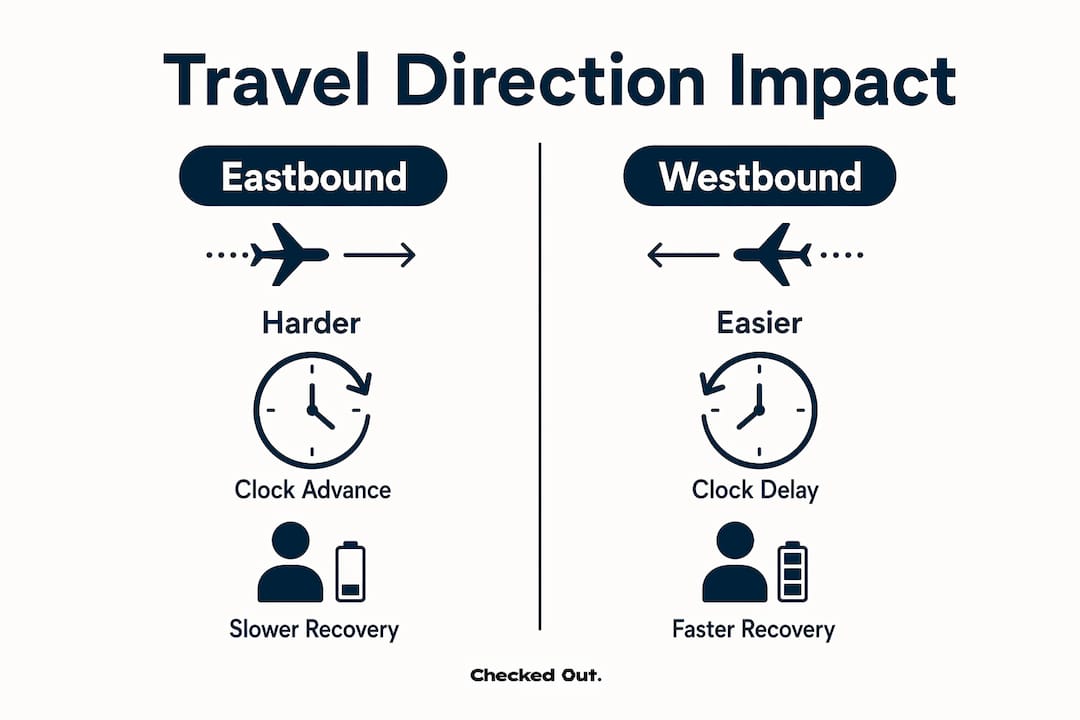
Eastbound flights cause greater disruption because advancing your internal clock is biologically harder than delaying it. The human circadian rhythm runs slightly longer than 24 hours, which is why staying up late feels natural and waking up early feels like a fight. For frequent travelers, chronic circadian disruption raises long-term risks for metabolic, cardiovascular, and mental health disorders. This is not a problem to push through indefinitely.
Natural sleep hygiene strategies that actually work during travel
The body keeps score quietly. Every skipped sleep ritual, every late-night screen, every dehydrating drink at 35,000 feet adds to the debt your nervous system will collect later. The good news: behavioral strategies, applied with intention, can dramatically shorten your recovery window.

Before you leave: pre-trip schedule shifting
Shifting your bedtime one hour earlier or later for three nights before departure is one of the most evidence-backed steps you can take. It reduces the gap between your internal clock and destination time before you even board the plane.
-
Night one: Move bedtime 60 minutes in the target direction.
-
Night two: Shift another 60 minutes.
-
Night three: Hold the new schedule and get morning light at the adjusted wake time.
Pro Tip: Pair each bedtime shift with a corresponding meal time shift. Eating at destination-appropriate times primes your gut clock alongside your brain clock, accelerating overall adaptation.
Light exposure timing depends on travel direction to realign your circadian rhythm. Bright morning light at your destination promotes phase advances for eastbound travelers. Evening light exposure supports the phase delays needed after westbound flights.
| Travel Direction |
When to Seek Light |
When to Avoid Light |
| Eastbound |
Morning at destination |
Evening (first 1–2 days) |
| Westbound |
Evening at destination |
Early morning (first 1–2 days) |
Avoid bright screens and overhead lighting in the hours before your target bedtime at the destination. A quality blackout mask during daytime flights prevents accidental light exposure that could shift your clock in the wrong direction.
Pro Tip: On eastbound flights arriving in the morning, resist the urge to close the window shade. Natural cabin light during the final hours of the flight can begin your phase advance before you land.
Managing your sleep environment in transit
A quality sleep environment requires darkness, quiet, and comfortable temperature. In a hotel room or on a plane, you control more than you think.
- Use a contoured blackout sleep mask to block all ambient light.
- Carry foam or silicone earplugs rated for high noise reduction.
- Request a room away from elevators and ice machines.
- Set the thermostat between 65°F and 68°F, the range most conducive to deep sleep.
- Bring your own pillowcase if texture sensitivity disrupts your sleep.
Pro Tip: Protecting the circadian window from 11 p.m. to 7 a.m. at your destination is critical. Treat that window as non-negotiable, even on the first night.
Meal timing, hydration, and movement
Timing meals according to destination time supports circadian realignment. Your gut has its own clock, and feeding it on destination time sends a powerful synchronization signal.
- Eat your first meal at the destination’s breakfast time, regardless of what your body clock says.
- Avoid heavy meals within two hours of your target sleep time.
- Drink at least 8 ounces of water per hour of flight time.
- Skip alcohol entirely on the day of travel and the first night at your destination.
- Take a 20-minute walk in natural light upon arrival to combine light exposure with gentle movement.
Pro Tip: Short naps of 20–30 minutes during the local day can sustain alertness without undermining nighttime sleep. Anything longer than 30 minutes risks deepening your circadian misalignment.
Relaxation and mindfulness techniques for sleep onset
When your nervous system is still running on home time, forcing sleep rarely works. Slowing your physiological arousal does.
-
4-7-8 breathing: Inhale for 4 counts, hold for 7, exhale for 8. Three cycles lower heart rate measurably.
-
Progressive muscle relaxation: Tense and release each muscle group from feet to face. It interrupts the cortisol dysregulation that travel amplifies.
-
Body scan meditation: A 10-minute guided scan using apps like Calm or Insight Timer can reduce sleep onset time significantly.
-
Journaling: Writing down tomorrow’s priorities for five minutes clears the mental queue that keeps travelers awake.
What melatonin actually does and how to use it safely
Melatonin is not a sleeping pill. It is a timing signal. Your pineal gland secretes it naturally during darkness, with levels rising about two hours before your habitual bedtime and peaking around 3–4 AM. When you cross time zones, that secretion pattern falls out of sync with local time. Supplemental melatonin helps bridge that gap.
Nonprescription melatonin up to 10 mg aids sleep signaling, though light exposure remains the primary reset mechanism. The CDC recommends doses as low as 0.5–1 mg to produce a circadian shift, noting that high doses above 5 mg can leave excess melatonin circulating at the wrong time of day as it metabolizes.
-
Eastbound travel: Take melatonin at your destination’s early evening to advance your clock.
-
Westbound travel: Take it in the morning at your destination to delay your clock.
-
Avoid melatonin when your body clock reads midnight to 5 AM. It is least effective and potentially counterproductive during that window.
- Melatonin is not regulated by the FDA, so label accuracy varies. Source from reputable manufacturers with third-party testing.
- Use melatonin as an adjunct to light exposure and schedule shifting, never as a standalone solution.
Combining melatonin with personalized light therapy yields superior results compared to either approach alone.
Drug-free sleep products for travelers from Checkedoutwellness
The strategies above work. They work even better when your body has the raw materials it needs to produce melatonin on its own. That is where Checkedoutwellness enters the picture.
Transdermal sleep patches
Checkedoutwellness’s transdermal sleep patches deliver magnesium, vitamin B6, vitamin B12, and GABA directly through the skin, bypassing the digestive system for more consistent absorption. These are the cofactors your body uses in the tryptophan-to-serotonin-to-melatonin conversion pathway. Rather than flooding your system with synthetic melatonin, the patches support your own production.
Mouth tape for sleep
Mouth breathing during sleep reduces blood oxygen saturation and increases cortisol. Checkedoutwellness’s mouth tape encourages nasal breathing, which filters air, maintains humidity, and supports deeper, more restorative sleep cycles. For travelers sleeping in dry cabin air or unfamiliar hotel rooms, this is a meaningful upgrade.
Blackout sleep mask
The contoured blackout sleep mask from Checkedoutwellness is designed to preserve the circadian window by eliminating ambient light without pressing on the eyelids. The 3D contoured design allows REM-phase eye movement freely, which matters for sleep quality, not just comfort.
- No synthetic melatonin or habit-forming additives.
- Full ingredient disclosure on every product.
- Manufactured to pharmaceutical-grade quality standards.
- Designed specifically for travelers and individuals with disrupted sleep patterns.
| Product |
Core Benefit |
Best For |
| Transdermal sleep patch |
Supports endogenous melatonin production |
Jet lag recovery, frequent travelers |
| Mouth tape |
Promotes nasal breathing, deeper sleep |
Dry cabin air, light sleepers |
| Blackout sleep mask |
Blocks light, preserves circadian window |
All travel, shift adjustment |
Pro Tip: Use the patch, mouth tape, and blackout mask together on your first night at the destination. The combined effect on sleep architecture is greater than any single product alone.
Sleep better on your next trip with Checkedoutwellness

You have the strategies. You have the science. What Checkedoutwellness gives you is the physical infrastructure to make those strategies work night after night, without reaching for a prescription or waking up groggy from an antihistamine. The full product range is built for people who take sleep as seriously as their training, their nutrition, and their performance. Travelers who want to land ready, not wrecked.
The patches, mouth tape, and blackout mask ship together as a travel-ready bundle. No guesswork on what to pack. Visit Checkedoutwellness to see the science behind the formulations and find the bundle that fits your travel schedule.
Key Takeaways
Drug-free management of travel and disrupted sleep requires pre-trip schedule shifting, direction-specific light exposure, and natural cofactor support for your body’s own melatonin production.
| Point |
Details |
| Pre-trip bedtime shifting |
Move sleep one hour per night for 3 nights before departure to reduce circadian misalignment. |
| Light exposure by direction |
Morning light for eastbound travel; evening light for westbound — the most powerful reset signal available. |
| Low-dose melatonin timing |
Doses of 0.5–1 mg timed to destination evening (east) or morning (west) support circadian shift without excess. |
| Protect the sleep window |
Blocking light and noise during the 11 p.m. to 7 a.m. circadian window at your destination accelerates recovery. |
| Checkedoutwellness products |
Transdermal patches, mouth tape, and a blackout sleep mask support natural sleep architecture without synthetic melatonin. |
Recommended

Travel and Disrupted Sleep: Your Drug-Free Recovery Guide
The fastest way to recover from travel and disrupted sleep is to realign your circadian rhythm through three coordinated actions: shift your sleep schedule before you leave, use light exposure strategically at your destination, and support your body’s own melatonin production with natural aids. Sleeping pills are not the answer. Your body already knows how to sleep. It just needs the right signals.
Here is what the science says works, distilled from guidance by Mayo Clinic, Johns Hopkins Medicine, and the CDC:
Pro Tip: Eastbound travel is consistently harder to adapt to than westbound. If you are flying east, start shifting your bedtime earlier at least three nights before departure. Give yourself an extra day of recovery buffer at your destination.
Table of Contents
How travel disrupts your sleep cycle and what jet lag actually does
Jet lag is a sleep disorder caused by rapid time zone crossing, not simply tiredness from a long flight. Your internal biological clock, the circadian rhythm, governs nearly every body function on a roughly 24-hour cycle. When you cross multiple time zones quickly, that clock falls out of sync with local time. The result is a cascade of physical and cognitive disruption.
Jet lag disrupts circadian rhythm, causing fatigue, difficulty concentrating, gastrointestinal disturbances, and fragmented sleep. A survey of international business travelers found that 68% reported experiencing negative symptoms on a regular basis. Symptoms typically appear after crossing at least two time zones and worsen with each additional zone.
The cabin environment adds its own burden. Low humidity and cabin pressure accelerate dehydration and physical fatigue, compounding what your circadian system is already managing. Alcohol and caffeine in-flight worsen both dehydration and sleep fragmentation.
Eastbound flights cause greater disruption because advancing your internal clock is biologically harder than delaying it. The human circadian rhythm runs slightly longer than 24 hours, which is why staying up late feels natural and waking up early feels like a fight. For frequent travelers, chronic circadian disruption raises long-term risks for metabolic, cardiovascular, and mental health disorders. This is not a problem to push through indefinitely.
Natural sleep hygiene strategies that actually work during travel
The body keeps score quietly. Every skipped sleep ritual, every late-night screen, every dehydrating drink at 35,000 feet adds to the debt your nervous system will collect later. The good news: behavioral strategies, applied with intention, can dramatically shorten your recovery window.
Before you leave: pre-trip schedule shifting
Shifting your bedtime one hour earlier or later for three nights before departure is one of the most evidence-backed steps you can take. It reduces the gap between your internal clock and destination time before you even board the plane.
Pro Tip: Pair each bedtime shift with a corresponding meal time shift. Eating at destination-appropriate times primes your gut clock alongside your brain clock, accelerating overall adaptation.
Light exposure: your most powerful reset tool
Light exposure timing depends on travel direction to realign your circadian rhythm. Bright morning light at your destination promotes phase advances for eastbound travelers. Evening light exposure supports the phase delays needed after westbound flights.
Avoid bright screens and overhead lighting in the hours before your target bedtime at the destination. A quality blackout mask during daytime flights prevents accidental light exposure that could shift your clock in the wrong direction.
Pro Tip: On eastbound flights arriving in the morning, resist the urge to close the window shade. Natural cabin light during the final hours of the flight can begin your phase advance before you land.
Managing your sleep environment in transit
A quality sleep environment requires darkness, quiet, and comfortable temperature. In a hotel room or on a plane, you control more than you think.
Pro Tip: Protecting the circadian window from 11 p.m. to 7 a.m. at your destination is critical. Treat that window as non-negotiable, even on the first night.
Meal timing, hydration, and movement
Timing meals according to destination time supports circadian realignment. Your gut has its own clock, and feeding it on destination time sends a powerful synchronization signal.
Pro Tip: Short naps of 20–30 minutes during the local day can sustain alertness without undermining nighttime sleep. Anything longer than 30 minutes risks deepening your circadian misalignment.
Relaxation and mindfulness techniques for sleep onset
When your nervous system is still running on home time, forcing sleep rarely works. Slowing your physiological arousal does.
What melatonin actually does and how to use it safely
Melatonin is not a sleeping pill. It is a timing signal. Your pineal gland secretes it naturally during darkness, with levels rising about two hours before your habitual bedtime and peaking around 3–4 AM. When you cross time zones, that secretion pattern falls out of sync with local time. Supplemental melatonin helps bridge that gap.
Nonprescription melatonin up to 10 mg aids sleep signaling, though light exposure remains the primary reset mechanism. The CDC recommends doses as low as 0.5–1 mg to produce a circadian shift, noting that high doses above 5 mg can leave excess melatonin circulating at the wrong time of day as it metabolizes.
Combining melatonin with personalized light therapy yields superior results compared to either approach alone.
Drug-free sleep products for travelers from Checkedoutwellness
The strategies above work. They work even better when your body has the raw materials it needs to produce melatonin on its own. That is where Checkedoutwellness enters the picture.
Transdermal sleep patches
Checkedoutwellness’s transdermal sleep patches deliver magnesium, vitamin B6, vitamin B12, and GABA directly through the skin, bypassing the digestive system for more consistent absorption. These are the cofactors your body uses in the tryptophan-to-serotonin-to-melatonin conversion pathway. Rather than flooding your system with synthetic melatonin, the patches support your own production.
Mouth tape for sleep
Mouth breathing during sleep reduces blood oxygen saturation and increases cortisol. Checkedoutwellness’s mouth tape encourages nasal breathing, which filters air, maintains humidity, and supports deeper, more restorative sleep cycles. For travelers sleeping in dry cabin air or unfamiliar hotel rooms, this is a meaningful upgrade.
Blackout sleep mask
The contoured blackout sleep mask from Checkedoutwellness is designed to preserve the circadian window by eliminating ambient light without pressing on the eyelids. The 3D contoured design allows REM-phase eye movement freely, which matters for sleep quality, not just comfort.
Pro Tip: Use the patch, mouth tape, and blackout mask together on your first night at the destination. The combined effect on sleep architecture is greater than any single product alone.
Sleep better on your next trip with Checkedoutwellness
You have the strategies. You have the science. What Checkedoutwellness gives you is the physical infrastructure to make those strategies work night after night, without reaching for a prescription or waking up groggy from an antihistamine. The full product range is built for people who take sleep as seriously as their training, their nutrition, and their performance. Travelers who want to land ready, not wrecked.
The patches, mouth tape, and blackout mask ship together as a travel-ready bundle. No guesswork on what to pack. Visit Checkedoutwellness to see the science behind the formulations and find the bundle that fits your travel schedule.
Key Takeaways
Drug-free management of travel and disrupted sleep requires pre-trip schedule shifting, direction-specific light exposure, and natural cofactor support for your body’s own melatonin production.
Recommended