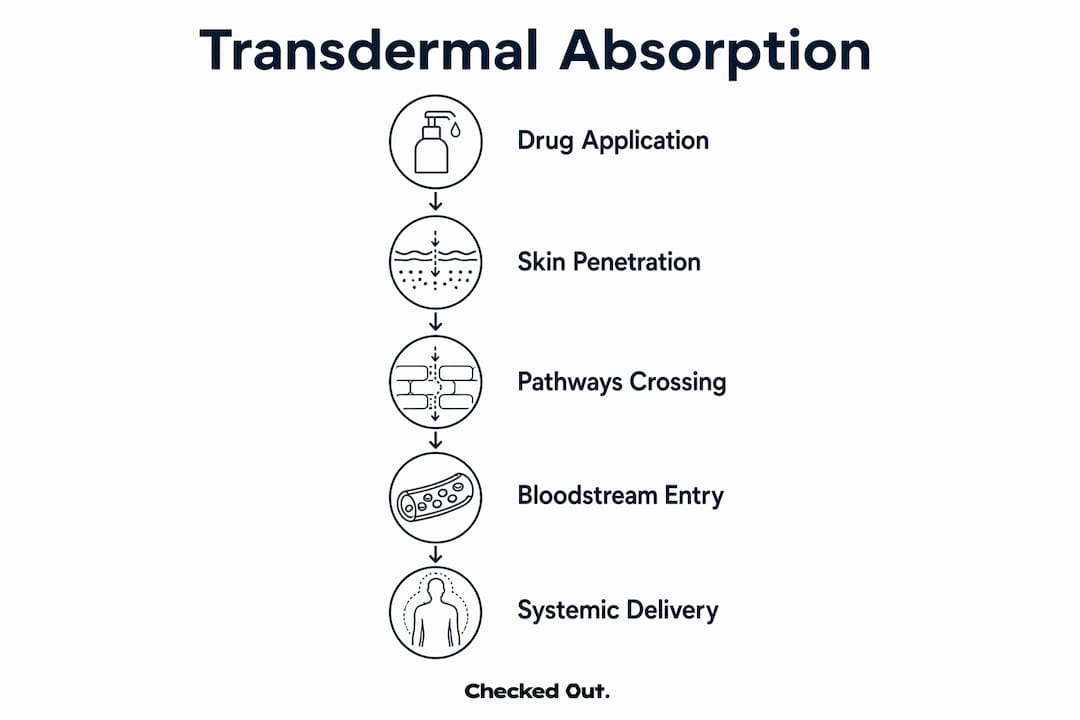
Transdermal absorption is the process by which a substance penetrates through the skin’s layers and enters systemic circulation, reaching the bloodstream without a needle or a pill. It sounds almost counterintuitive. The skin exists to keep things out. Yet under the right conditions, with the right molecules, it becomes a controlled gateway. The multistep process moves from the outermost stratum corneum, through the viable epidermis and dermis, until the drug reaches the dermal microcirculation and distributes throughout the body.
Here is what that journey looks like, step by step:
-
Penetration: The substance enters the stratum corneum, the skin’s outermost layer
-
Partitioning: It shifts from the lipid-rich stratum corneum into the aqueous viable epidermis
-
Diffusion: It travels through the viable epidermis and into the upper dermis
-
Permeation: It crosses from one structurally distinct skin layer into the next
-
Absorption: The dermal microcirculation picks it up and carries it into systemic circulation
Understanding this sequence is the foundation for everything that follows, from why some drugs work beautifully as patches to why others never make it past the first layer.
The skin does not make absorption easy, and that is by design. The stratum corneum, roughly 10–20 micrometers thick, acts as the body’s primary defense against foreign compounds. Its structure resembles a brick wall: dense, protein-filled corneocytes embedded in a lipid matrix, creating a layer that limits passive diffusion for most drug molecules.
Several factors compound the challenge:
-
Lipid-rich environment: The intercellular lipid matrix repels hydrophilic molecules, while highly lipophilic drugs can get trapped and never partition into the aqueous layers below
-
Enzymatic metabolism: Skin contains esterases, peptidases, and other enzymes that can break down drugs before they reach the bloodstream, reducing how much actually makes it through
-
Molecular size restrictions: Larger molecules simply cannot navigate the tight spaces between corneocytes
-
Skin condition variability: Hydration, temperature, age, race, and body location all shift the barrier’s permeability
“The stratum corneum is the barrier to approximately 90% of transdermal drug applications. However, nearly all molecules penetrate it to some minimal degree.” — Wikipedia, Transdermal
Temperature and hydration deserve special mention. When skin is warm, subcutaneous blood vessels dilate and the permeability coefficient rises. Moist skin hydrates and relaxes the stratum corneum, improving drug uptake. This is why occlusive patches, which trap moisture against the skin, tend to enhance absorption compared to open formulations.
How drugs actually cross the skin: the three pathways
Once a molecule begins its journey through the stratum corneum, it has three possible routes through the skin:
-
Transcellular (intracellular) route: The molecule passes directly through the corneocytes, alternating between lipophilic cell membranes and hydrophilic keratin-filled interiors. It is the shortest geometric path but demands that a drug tolerate repeated shifts between lipid and aqueous environments.
-
Intercellular route: The molecule navigates the lipid channels between cells. Most drugs use this path. It is tortuous by nature.
-
Appendageal route: The molecule bypasses the stratum corneum entirely by traveling through hair follicles or sweat glands. This route covers only about 1% of total skin surface area, so it contributes minimally to steady-state delivery. It does, however, offer a rapid onset channel for ions, large polar molecules, and colloidal particles.
The intercellular route deserves a closer look. Although the stratum corneum is only about 20 microns thick, the actual diffusion path a molecule travels through the tortuous lipid channels is approximately 400 microns. That 20-fold extension dramatically slows absorption and explains why even small, lipophilic molecules can take hours to reach therapeutic plasma levels.
| Pathway |
Primary molecules |
Relative speed |
Key limitation |
| Transcellular |
Hydrophilic compounds |
Moderate |
Repeated lipid/aqueous transitions |
| Intercellular |
Most small lipophilic drugs |
Slow |
Tortuous path (~400 µm effective distance) |
| Appendageal |
Ions, large polar molecules |
Fast onset |
Only ~1% of skin surface area |
Techniques that help drugs get through
The skin’s barrier is not insurmountable. Decades of pharmaceutical research have produced a progression of enhancement strategies organized into three generations of transdermal delivery methods.
-
Chemical permeation enhancers: Compounds like ethanol, fatty acids, and terpenes temporarily disrupt the lipid matrix of the stratum corneum, widening the intercellular channels. They are passive, require no device, and are widely used in gels and patches.
-
Iontophoresis: A low-level electrical current drives charged drug molecules through the skin. It works especially well for ionic compounds and peptides that would otherwise be too large or too polar for passive diffusion.
-
Microneedles: Arrays of microscopic needles pierce the stratum corneum without reaching nerve endings, creating microchannels that bypass the barrier entirely. Research at the University of Marburg confirmed this approach enhances penetration for both lipophilic and hydrophilic compounds.
-
Electroporation: Brief, high-voltage electrical pulses create transient pores in the lipid bilayers, allowing larger molecules to pass through temporarily.
-
Thermal ablation: Controlled heat removes or disrupts the stratum corneum at the application site, opening the skin to drug permeation without damaging deeper tissue.
-
Nanocarriers: Liposomes, ethosomes, solid lipid nanoparticles, and transferosomes encapsulate drug molecules and ferry them through the lipid matrix. These nanocarrier systems have shown encouraging safety and effectiveness profiles in recent research.
-
Sonophoresis: Ultrasound waves temporarily disrupt the stratum corneum’s structure, increasing permeability for a window of time after application.
Pro Tip: Match the enhancement method to the drug’s physicochemical profile. A lipophilic small molecule may need only a chemical enhancer, while a large peptide or charged compound will likely require iontophoresis or microneedles to reach therapeutic levels.
Transdermal delivery takes several physical forms, each designed to control how a drug releases and how long it stays active.
Transdermal patches are the most recognized format. A standard patch has four layers: an impermeable backing membrane that protects the system from moisture; a drug reservoir that holds the active ingredient; a rate-controlling semipermeable membrane that governs release speed; and an adhesive layer that keeps the patch in contact with skin. The rate-controlling membrane is what separates a patch from a simple bandage. It ensures the drug releases at a consistent rate regardless of individual differences in skin permeability, which is why plasma levels stay stable over hours or days.
-
Reservoir-type patches: Drug is held in a liquid or gel reservoir behind the membrane, releasing at a fixed rate-
-
Matrix-type patches: Drug is dispersed directly in the adhesive or polymer matrix, with release governed by diffusion through the matrix itself
-
Gels and creams: Applied directly to skin, these offer flexible dosing but less precise control over release rate
-
Ointments: Higher oil content increases occlusion and can enhance absorption for lipophilic compounds
Approved drugs delivered transdermally span a range of conditions: scopolamine for motion sickness (the first FDA-approved transdermal patch, cleared in 1979), nicotine for smoking cessation, nitroglycerin for angina, fentanyl for chronic pain, estradiol for hormone therapy, and clonidine for hypertension. Each of these meets the physicochemical requirements that make transdermal delivery viable: low molecular weight, balanced lipophilicity, and sufficient potency at low doses.
Why transdermal delivery is worth understanding
The benefits of transdermal absorption go beyond convenience. They reflect genuine pharmacological advantages that change how a drug behaves in the body.
-
First-pass metabolism bypass: Oral drugs pass through the gastrointestinal tract and liver before reaching systemic circulation, where enzymes can destroy a significant fraction of the dose. Transdermal delivery avoids this entirely, meaning lower doses can achieve the same therapeutic effect.
-
Steady plasma levels: Because the skin releases drug at a controlled rate, plasma concentrations stay within a therapeutic window rather than spiking after a dose and crashing before the next. Fewer peaks mean fewer side effects tied to concentration spikes.
-
Non-invasive and painless: No needles, no swallowing difficulties, no GI irritation. For people who struggle with oral medications due to nausea, dysphagia, or unconsciousness, a patch keeps therapy on track.
-
Improved compliance: Once applied, a patch works for hours or days without requiring the person to remember additional doses. This matters enormously for chronic conditions where adherence directly determines outcomes.
-
Suitability for vulnerable populations: Transdermal delivery is particularly valuable for pediatric and geriatric patients, where swallowing pills is difficult and injection is distressing.
The skin’s large surface area and accessibility also mean placement options are flexible. A patch can go on the arm, chest, back, or behind the ear, depending on the drug and the desired absorption profile.
How pharmacokinetics shapes transdermal absorption
Pharmacokinetics describes what the body does to a drug over time, and transdermal delivery has a distinctive profile worth understanding. Absorption rate through the skin is slower than intravenous injection but more controlled than most oral formulations. The skin itself acts as a rate-limiting membrane, smoothing out the concentration curve.
Bioavailability, the fraction of a dose that reaches systemic circulation unchanged, tends to be higher transdermally than orally for drugs that suffer heavy first-pass metabolism. The steady plasma levels this produces reduce toxic peaks and improve clinical tolerability compared to oral or injection methods. For drugs with short biological half-lives, continuous transdermal delivery prevents the troughs that cause symptom breakthrough between oral doses.
Drug selection remains the binding constraint. Candidates must generally fall below 400–500 Daltons in molecular weight, carry a log P (lipophilicity measure) in the range of 1–3, and be potent enough to achieve therapeutic effect at the low flux rates skin allows. Drugs that require high daily doses or that are highly water-soluble typically cannot meet these criteria through passive diffusion alone, which is precisely why enhancement technologies continue to expand the range of viable candidates.
One practical safety note: applying multiple patches simultaneously or leaving one on longer than directed can push plasma levels into toxic territory. The controlled release that makes patches effective also means excess drug accumulates gradually rather than all at once, so overdose risk is real but delayed.
Key Takeaways
Transdermal absorption delivers drugs through the skin into systemic circulation by bypassing first-pass metabolism, producing steady plasma levels, and offering a non-invasive alternative to oral and injectable routes.
| Point |
Details |
| Stratum corneum is the main barrier |
This thin layer accounts for the vast majority of resistance in transdermal drug applications. |
| Intercellular path extends diffusion distance |
The actual diffusion path through the skin is significantly longer than the stratum corneum’s physical thickness due to its tortuous structure. |
| Molecular weight drives drug eligibility |
Eligible drug candidates generally have low molecular weight and balanced lipophilicity to cross the skin barrier effectively. |
| First-pass bypass improves bioavailability |
Transdermal delivery avoids hepatic first-pass metabolism, allowing lower doses to achieve equivalent therapeutic effect. |
| Enhancement methods expand drug options |
Chemical enhancers, iontophoresis, microneedles, and nanocarriers each overcome specific barrier limitations for different drug types. |
Sleep, skin delivery, and what it means for you
At Checkedoutwellness, the science of transdermal absorption is not abstract. It is the foundation of how our sleep patches work. Rather than relying on synthetic melatonin or oral supplements that face first-pass degradation, our patches deliver cofactors like magnesium, B6, B12, and GABA through the skin at a controlled rate overnight, supporting your body’s own melatonin production cycle.
The body keeps score quietly. When sleep suffers, recovery suffers, and the cascade is hard to reverse with a single pill taken at bedtime. A transdermal approach changes the timing and the consistency of delivery, which is exactly what the pharmacokinetics above describe. You can read more about how skin delivery reshapes sleep and explore the full science behind our formulations on the Checkedoutwellness science page.

If you are ready to experience what controlled, overnight transdermal delivery actually feels like, explore our sleep patches and see why high performers and wellness-conscious people are rethinking how they recover.
Recommended

Transdermal Absorption: How Your Skin Delivers Drugs
Transdermal absorption is the process by which a substance penetrates through the skin’s layers and enters systemic circulation, reaching the bloodstream without a needle or a pill. It sounds almost counterintuitive. The skin exists to keep things out. Yet under the right conditions, with the right molecules, it becomes a controlled gateway. The multistep process moves from the outermost stratum corneum, through the viable epidermis and dermis, until the drug reaches the dermal microcirculation and distributes throughout the body.
Here is what that journey looks like, step by step:
Understanding this sequence is the foundation for everything that follows, from why some drugs work beautifully as patches to why others never make it past the first layer.
Why the skin is such a formidable barrier
The skin does not make absorption easy, and that is by design. The stratum corneum, roughly 10–20 micrometers thick, acts as the body’s primary defense against foreign compounds. Its structure resembles a brick wall: dense, protein-filled corneocytes embedded in a lipid matrix, creating a layer that limits passive diffusion for most drug molecules.
Several factors compound the challenge:
Temperature and hydration deserve special mention. When skin is warm, subcutaneous blood vessels dilate and the permeability coefficient rises. Moist skin hydrates and relaxes the stratum corneum, improving drug uptake. This is why occlusive patches, which trap moisture against the skin, tend to enhance absorption compared to open formulations.
How drugs actually cross the skin: the three pathways
Once a molecule begins its journey through the stratum corneum, it has three possible routes through the skin:
The intercellular route deserves a closer look. Although the stratum corneum is only about 20 microns thick, the actual diffusion path a molecule travels through the tortuous lipid channels is approximately 400 microns. That 20-fold extension dramatically slows absorption and explains why even small, lipophilic molecules can take hours to reach therapeutic plasma levels.
Techniques that help drugs get through
The skin’s barrier is not insurmountable. Decades of pharmaceutical research have produced a progression of enhancement strategies organized into three generations of transdermal delivery methods.
Pro Tip: Match the enhancement method to the drug’s physicochemical profile. A lipophilic small molecule may need only a chemical enhancer, while a large peptide or charged compound will likely require iontophoresis or microneedles to reach therapeutic levels.
Real-world devices and formulations you should know
Transdermal delivery takes several physical forms, each designed to control how a drug releases and how long it stays active.
Transdermal patches are the most recognized format. A standard patch has four layers: an impermeable backing membrane that protects the system from moisture; a drug reservoir that holds the active ingredient; a rate-controlling semipermeable membrane that governs release speed; and an adhesive layer that keeps the patch in contact with skin. The rate-controlling membrane is what separates a patch from a simple bandage. It ensures the drug releases at a consistent rate regardless of individual differences in skin permeability, which is why plasma levels stay stable over hours or days.
Reservoir-type patches: Drug is held in a liquid or gel reservoir behind the membrane, releasing at a fixed rate-
Matrix-type patches: Drug is dispersed directly in the adhesive or polymer matrix, with release governed by diffusion through the matrix itself
Gels and creams: Applied directly to skin, these offer flexible dosing but less precise control over release rate
Ointments: Higher oil content increases occlusion and can enhance absorption for lipophilic compounds
Approved drugs delivered transdermally span a range of conditions: scopolamine for motion sickness (the first FDA-approved transdermal patch, cleared in 1979), nicotine for smoking cessation, nitroglycerin for angina, fentanyl for chronic pain, estradiol for hormone therapy, and clonidine for hypertension. Each of these meets the physicochemical requirements that make transdermal delivery viable: low molecular weight, balanced lipophilicity, and sufficient potency at low doses.
Why transdermal delivery is worth understanding
The benefits of transdermal absorption go beyond convenience. They reflect genuine pharmacological advantages that change how a drug behaves in the body.
The skin’s large surface area and accessibility also mean placement options are flexible. A patch can go on the arm, chest, back, or behind the ear, depending on the drug and the desired absorption profile.
How pharmacokinetics shapes transdermal absorption
Pharmacokinetics describes what the body does to a drug over time, and transdermal delivery has a distinctive profile worth understanding. Absorption rate through the skin is slower than intravenous injection but more controlled than most oral formulations. The skin itself acts as a rate-limiting membrane, smoothing out the concentration curve.
Bioavailability, the fraction of a dose that reaches systemic circulation unchanged, tends to be higher transdermally than orally for drugs that suffer heavy first-pass metabolism. The steady plasma levels this produces reduce toxic peaks and improve clinical tolerability compared to oral or injection methods. For drugs with short biological half-lives, continuous transdermal delivery prevents the troughs that cause symptom breakthrough between oral doses.
Drug selection remains the binding constraint. Candidates must generally fall below 400–500 Daltons in molecular weight, carry a log P (lipophilicity measure) in the range of 1–3, and be potent enough to achieve therapeutic effect at the low flux rates skin allows. Drugs that require high daily doses or that are highly water-soluble typically cannot meet these criteria through passive diffusion alone, which is precisely why enhancement technologies continue to expand the range of viable candidates.
One practical safety note: applying multiple patches simultaneously or leaving one on longer than directed can push plasma levels into toxic territory. The controlled release that makes patches effective also means excess drug accumulates gradually rather than all at once, so overdose risk is real but delayed.
Key Takeaways
Transdermal absorption delivers drugs through the skin into systemic circulation by bypassing first-pass metabolism, producing steady plasma levels, and offering a non-invasive alternative to oral and injectable routes.
Sleep, skin delivery, and what it means for you
At Checkedoutwellness, the science of transdermal absorption is not abstract. It is the foundation of how our sleep patches work. Rather than relying on synthetic melatonin or oral supplements that face first-pass degradation, our patches deliver cofactors like magnesium, B6, B12, and GABA through the skin at a controlled rate overnight, supporting your body’s own melatonin production cycle.
The body keeps score quietly. When sleep suffers, recovery suffers, and the cascade is hard to reverse with a single pill taken at bedtime. A transdermal approach changes the timing and the consistency of delivery, which is exactly what the pharmacokinetics above describe. You can read more about how skin delivery reshapes sleep and explore the full science behind our formulations on the Checkedoutwellness science page.
If you are ready to experience what controlled, overnight transdermal delivery actually feels like, explore our sleep patches and see why high performers and wellness-conscious people are rethinking how they recover.
Recommended