The fastest fix for a too-bright hotel room is a contoured 3D sleep mask, not the drapes. Flat masks and hotel blackout curtains still leak light at the edges, but a mask with contoured eye cups and a snug nose bridge blocks it at the source, on your face, in any room. Add porous mouth tape if you breathe easily through your nose, or a drug-free transdermal sleep patch if you want extra biochemical support, and you have a travel kit that works whether the curtains close all the way or not.
TL;DR:
- A contoured sleep mask with eye cups provides a superior seal that blocks light more effectively than hotel curtains or flat masks, especially in rooms with unsealed gaps.
- Mouth tape reduces mouth-breathing and snoring but is only safe for individuals who can breathe comfortably through their nose during a quick sitting test beforehand.
- Transdermal sleep patches supply natural cofactors like magnesium and B6 to support melatonin production, serving as a biochemical backup rather than a light-blocking tool.
- To ensure proper light blocking, perform a 60-second seal test with a bright lamp or window upon hotel check-in, adjusting the mask’s fit for your sleep position.
- Combining a well-fitted mask with room-darkening methods, such as sealing window gaps or using window blockers, results in noticeably better sleep quality.
Checkedoutwellness
Pack Better Support for Travel Sleep
Checked Out Wellness offers drug-free sleep products, including sleep patches, mouth tapes, and blackout masks for disrupted travel nights.
Table of Contents
Why Hotel Blackout Curtains Don’t Actually Block Light
Hotel curtains almost never seal completely. There is a gap where the panels meet in the middle, a strip of light along the floor track, and often a translucent sheer layer that glows the moment a streetlight or sunrise hits it. You can pull the heaviest blackout drapery closed and still wake up at 5 a.m. because a two-inch sliver of hallway light or dawn is aimed directly at your eyes.
That gap matters more than most travelers realize. Research summarized by sleep mask reviewers shows that even light reaching closed eyelids can suppress melatonin production and disrupt the depth of sleep, which is exactly what happens when a curtain seam leaks a beam across the room. You are not imagining that you sleep worse in a room with imperfect blackout coverage. Your eyelids are transparent enough to let ambient light through, and your brain treats that light as a signal to stay alert.
This is the gap a portable, personal blocking tool is built to close. Instead of trying to control someone else’s window treatment, you control the two inches of space around your own eyes.
What Travel Masks, Mouth Tape, and Patches Actually Do
Each of these tools solves a different problem, and knowing which one fixes what saves you from packing something that will not help.
A contoured (3D) sleep mask uses raised cups over each eye instead of flat fabric pressed against your eyelids. That air gap does two things: it stops the mask from smudging your lashes or applying pressure that leaves you blinking awake, and it lets the nose bridge seal tighter without the whole mask shifting. Contoured masks consistently outperform flat ones for blocking light in bright environments, which makes them the better pick for hotel rooms with uncooperative curtains or a wall of city lights outside.
Mouth tape is a thin, skin-safe strip placed over closed lips to encourage nasal breathing through the night. It does not block light at all. What it can do, for the right person, is reduce mouth-breathing and the snoring that comes with it. A 2022 clinical study found that mouth-taping in selected mild obstructive sleep apnea patients who breathe through their mouths reduced their AHI (apnea-hypopnea index) by roughly 47%, with most participants also seeing their snoring index improve.
Transdermal sleep patches work differently again. They deliver drug-free cofactors like magnesium, B6, B12, and GABA through the skin over several hours, supporting your body’s own melatonin production rather than replacing it with synthetic melatonin. Think of a patch as backup support for your sleep chemistry, not a light-blocking tool.
Travelers weighing all three should consider:
-
Packability: masks and tape fold flat; patches are single-use and lightweight.
-
Side-sleeper fit: low-profile contoured cups avoid pressure against a pillow.
-
Heat and comfort: silk and breathable foam beat thick synthetic padding on long flights.
-
Skin sensitivity: porous, sleep-specific tape and patches reduce irritation risk versus generic adhesives.
Start with a quick self-check before you pack anything.
-
Rate your light sensitivity. If a hallway light under the door wakes you, prioritize a mask with full-coverage cups over a lighter eye pillow style.
-
Know your sleep position. Side sleepers need shallow, low-profile cups; back sleepers can handle deeper contours without pressure against the pillow.
-
Check for skin sensitivity. If you react to adhesives or fragranced products, look for hypoallergenic mask lining and porous, skin-safe tape.
-
Try the nasal breathing test while awake. Sit upright, close your lips, and breathe through your nose for two or three minutes. If that feels easy and comfortable, mouth tape is worth testing overnight. If you feel congested or short of breath, skip it for now.
-
Decide if blackout performance or pack weight matters more. A slightly bulkier mask with deeper cups blocks more light; an ultralight flat mask packs smaller but leaks more around the edges.
When you are comparing masks, look closely at the strap (adjustable, non-slip is best), the nose bridge design (a soft, moldable seal beats a flat foam strip), cup depth (deeper for back sleepers, shallower for side sleepers), and lining material (breathable cotton or silk over synthetic mesh for long-haul comfort).
Patches earn a spot in your bag if you cross time zones often or specifically want to avoid synthetic melatonin. Many drug-free sleep patches, including the Sleep Patch from Checked Out Wellness, are also sold through monthly subscriptions, which suits travelers who want a consistent supply without reordering every trip.
Pro Tip: Pack your mask in the same spot in every bag you travel with. The two seconds it takes to find it on a red-eye flight are the two seconds you don’t want to spend patting down three pockets while the cabin lights are still on.
Who Should Avoid Mouth Taping or Pause Before Trying a Patch?
Safety screening takes less time than choosing a movie for the flight, and it matters more.
Run the same nasal breathing test described above: sit upright, close your lips, and breathe through your nose for several minutes. If you feel any air hunger, congestion, or panic, do not tape your mouth that night.
The clinical evidence on mouth taping is real but narrow. The 2022 study cited earlier only enrolled mouth-breathers with mild obstructive sleep apnea, a specific and pre-screened group, and about 65% of participants responded well. That is not the same as saying mouth tape helps everyone, or that it is safe without screening. Physician commentary reviewed by Prevention echoes this: the concept is plausible, but the evidence base is still thin, and doctors specifically warn people with nasal obstruction, reflux, or respiratory disease to skip it without a medical evaluation first.
Avoid mouth taping if any of these apply to you:
- You have known or suspected obstructive sleep apnea without medical clearance.
- You deal with severe acid reflux or GERD.
- You have any diagnosed respiratory disease, including asthma flare-ups.
- You plan to drink alcohol or take a sedative before bed.
- You are taping a child’s mouth (never do this without direct medical guidance).
For patches, test a small area of skin first, follow the product’s directions for placement and duration, and stop immediately if you notice redness, itching, or irritation.
-
Run the 60-second mask seal test. Turn on the brightest lamp in the room, or stand facing the window at dusk, put your mask on, and look for pinpricks of light at the nose bridge or temples. This quick check reliably exposes seal failures before you are relying on the mask at 2 a.m.
-
Adjust cup position first. Center the contoured cups directly over your closed eyes, not your brow bone, then tighten the strap just enough that the mask stays put without pressing.
-
Check for eyelid contact. Blink a few times with the mask on. If your lashes brush the inside of the cup, loosen the strap slightly or reposition higher.
-
Adjust for your sleep position. Side sleepers should flatten the cup on the side they favor; back sleepers can leave both cups at full depth.
-
Trial mouth tape during the day first. Wear it for 20 to 30 minutes while reading or watching television, not while asleep, to confirm comfort before your first overnight trial.
-
Place the tape correctly. Choose a porous, skin-safe tape made for sleep, not household adhesive, and place a small strip vertically over the center of closed lips, leaving the corners of your mouth uncovered so you can breathe or speak if needed.
-
Know your removal method. Peel from one corner slowly if you wake up; never rip tape off in the dark.
-
Apply a sleep patch as directed. Clean and dry the skin area first, apply at the time specified on the packaging, and store spare patches at room temperature, away from a hot car trunk or direct sun during transit.
Pro Tip: Do your first mouth-tape trial at home, not on a trip. You want to learn how your body reacts somewhere you can pull the tape off calmly, not in an unfamiliar hotel room at midnight.
Keeping Your Kit Working Trip After Trip
A mask that has been balled up in the bottom of a backpack for six months will not seal as well as a fresh one, and a damaged strap ruins the fit fast.
Wash silk masks by hand in cool water and let them air dry; cotton-lined masks usually tolerate a gentle machine cycle in a mesh bag; foam-cupped masks should be spot-cleaned only, since submerging foam can break down the contour. Do this roughly every one to two weeks of regular use, more often if you sweat at night.
Pack your mask in a hard clamshell case if you have room, or fold it along its natural crease and slide it into a zippered pouch to protect the nose bridge shape. Carrying a cheap flat backup mask in your carry-on is smart insurance if the good one gets crushed in checked luggage.
Keep a few extra items in your travel bag:
- Spare porous tape strips, pre-cut to size.
- A small unused skin-test patch, in case your first choice irritates you.
- Patches stored away from extreme heat, since temperature swings can affect adhesive and delivery.
If your mask seal fails and you have no backup, roll a bath towel and press it against the bottom of the hotel door, or clip a spare shirt over the worst light gap in the curtains with the room’s hangers.
Testing Your Mask Seal Before You Actually Need It
Do this the moment you check in, not at bedtime when you are exhausted and just want to collapse.
Turn on every light in the room, including the bathroom light with the door cracked, and put your mask on standing in front of the window. Walk slowly toward the brightest source in the room. Any light leak will show up as a bright line or point, usually at the nose bridge, the outer corners near your temples, or where the strap meets the cup.
If you find a leak at the nose bridge, most contoured masks have a moldable foam strip you can pinch to reshape the seal, the same concept used in N95-style respirators. Press it gently against the bridge of your nose and hold for a few seconds so it holds the new shape. A leak at the temples usually means the strap is too loose, or the mask is sitting too high on your face rather than centered over your closed eyes.
Cleaning between trips matters just as much as the initial seal check. Body oils and makeup residue break down foam padding faster than normal wear, and a mask that has lost its cup shape will not seal the same way twice. Wipe the interior lining with a gentle, alcohol-free cleaning wipe after every few uses, and let it air out fully before you fold it back into your bag.
Keep the packaging or a small drawstring pouch specifically for the mask, separate from cables and toiletries that can crush the cups. A crushed cup is the single most common reason a mask that sealed perfectly at home suddenly leaks light on a trip.
Portable Blackout Alternatives When Hotel Curtains Fail
Sometimes the curtains simply will not close all the way, no matter how you tug them, and you need a backup plan that does not involve calling the front desk at midnight.
Clip-on portable blackout curtains, sold as compact travel accessories, use suction cups or clip hardware to attach a light-blocking panel directly to the window frame or curtain rod. They pack down small and work well when a hotel’s existing drapes are thin or too short for the window. Temporary adhesive blackout film, the kind sold in pre-cut sheets, sticks directly to glass and can be removed without residue, which makes it a reasonable option if you are staying somewhere for several nights and the window is your main light source.
Painter’s tape and a folded bath towel solve the gap-in-the-middle problem fast. Tape the towel across the seam where two curtain panels meet, or drape it over the curtain rod so it hangs down and covers the worst offending strip of light. Binder clips or the hotel’s own pants hangers can pinch curtain panels together at the point where they gap most.
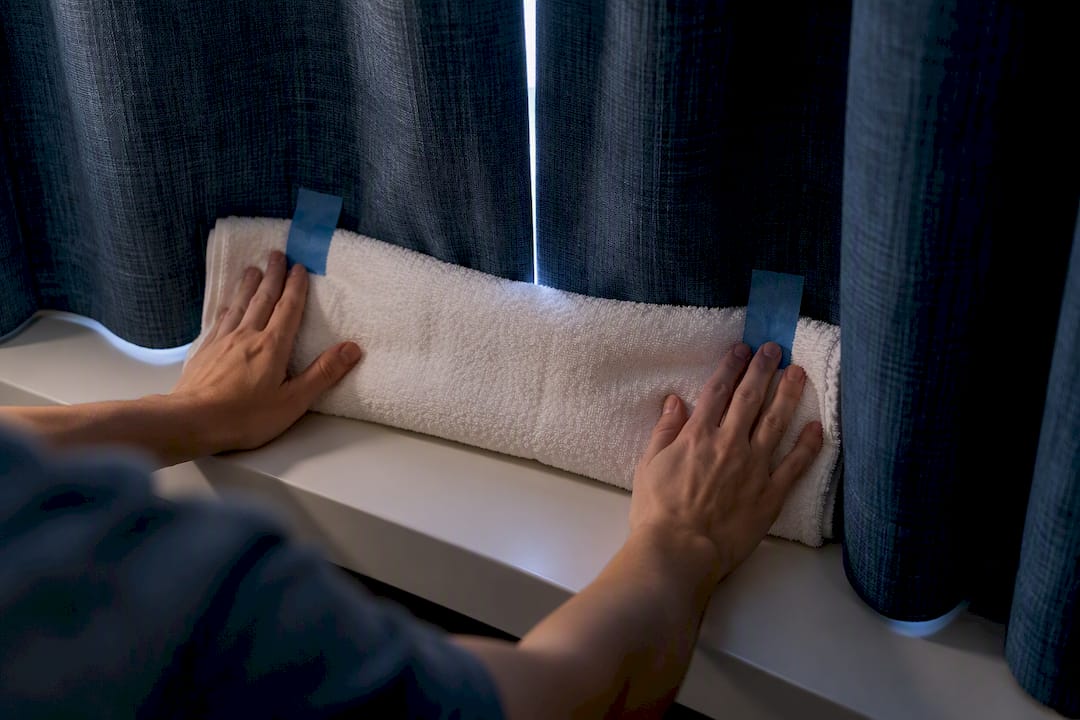
None of these fixes need tools, and all of them pack into a gallon bag. But they are still working against a window treatment you do not control, which is exactly why a contoured mask remains the more reliable layer. The mask travels with you into any room, works instantly, and does not depend on whether the curtains actually reach the window frame.
Blocking Light Around Windows Without Touching the Curtains
You do not have to fight the curtains at all if you attack the light at its other entry points.
A rolled towel pressed into the windowsill track blocks the thin strip of light that sneaks in where the curtain meets the frame, which is often the single brightest leak in a room. If the window has a gap on either side where the drapes do not fully extend to the wall, a second towel or a spare shirt draped over the top corner and weighted down with a book handles it.
Sleep shields, sometimes marketed as portable window blockers, are essentially rigid or foldable opaque panels you wedge into the window frame using tension rather than adhesive. They are worth packing if you frequently book rooms with east-facing windows and know sunrise will hit early.
For streetlight glow specifically, rather than sunrise, closing the sheer inner layer of curtains first, then the blackout layer, adds a second barrier that a single panel alone will not give you. If the room has no sheer layer, a hand towel hung directly against the glass, behind the blackout curtain, does something similar.
None of these hacks require you to trust hotel housekeeping to have installed proper blackout lining, which, frankly, varies wildly by property and price point.
Combining a Mask With Room Darkening for the Best Result
Layering beats relying on any single fix, and the two layers reinforce each other instead of just duplicating effort.
Do your best to darken the room first: close both curtain layers, wedge a towel against the worst gaps, and unplug or cover anything glowing. Then put on your contoured mask as the final seal against whatever light gets through anyway. This two-layer approach matters because a mask handles the light hitting your eyelids directly, while room darkening handles the ambient glow that would otherwise light up the whole space and disrupt your sense of day and night even with your eyes closed.
Travel gear reviewers consistently recommend pairing a mask with earplugs and a supportive travel pillow, since noise and neck discomfort undo the benefit of a dark room just as fast as light does. Treat your travel sleep kit as one system: mask for your eyes, earplugs for your ears, a towel or clip for the window, and tape or a patch as an adjunct if you have already confirmed it is safe for you.
How Room Lighting Color Affects Sleep, and How to Adjust It
Not all light disrupts sleep equally. Blue and white light, the kind most hotel lamps and bathroom fixtures use by default, suppresses melatonin more aggressively than warm amber or red-toned light.
If your hotel room has adjustable lighting, switch every lamp to its warmest setting before bed, or turn off overhead lights entirely and use a single low lamp for the last hour before you sleep. Many hotel bathrooms have a harsh white light that leaks under the door; switching to the bathroom’s night-light setting, if one exists, or simply keeping that door fully closed, removes a surprisingly bright source most travelers overlook.
Avoid turning on the main room lights at all if you wake up during the night. A short burst of white overhead light can be enough to reset your body’s sense that it is time to be awake, making it harder to fall back asleep. Keep a phone flashlight on its dimmest setting, or use the hotel bathroom light only with the door mostly closed, as your middle-of-the-night option instead.
Managing Light From Devices and Hotel Alarm Clocks
The glowing alarm clock on the nightstand is often brighter than travelers realize once the rest of the room goes dark. Most hotel clock radios default to full brightness, and many do not have an obvious dimmer button, so the fastest fix is turning the entire unit to face the wall or covering it with a hand towel.
Phone screens deserve the same treatment. Enable night mode or a blue-light filter before bed, and place your phone screen-down or across the room if you tend to check it during the night. Charging cables with a lit indicator light are another overlooked source. Slide the charger and cable behind a lamp base or inside a drawer rather than leaving it on the nightstand next to your face.
If you are wearing a mask, most of this becomes moot the moment you have it on. But for the window between getting into bed and actually falling asleep, killing device light matters just as much as killing curtain leaks.
Troubleshooting Common Sleep Mask and Tape Problems on the Road
Mask keeps sliding off during the night. Tighten the strap slightly, or look for a mask with a rear adjustment buckle rather than a stretch-only band, which loses tension over a long trip.
Mask leaves marks or feels too tight in the morning. You likely need a mask with deeper cups or a softer nose bridge foam. A too-shallow cup forces the strap tighter to compensate, which is what leaves marks.
Mouth tape won’t stay on, or peels by morning. Skin oils and humidity break down weaker adhesives fast. Clean and dry the skin around your mouth before applying, and confirm you are using a tape actually designed for skin, not a generic adhesive.
You wake up gasping or panicked with tape on. Remove it immediately, and do not try mouth taping again without talking to a doctor. This is a sign it is not right for you, regardless of what worked for someone else.
Patch causes redness or itching. Stop use and switch application sites next time; test a new small area before your next overnight use.
The Overlooked Truth About Travel Sleep Gear
Most advice on this topic treats the mask, the tape, and the patch as competing options, as if you have to pick one winner. That framing misses how these tools actually work together, and it is worth saying plainly: darkness is the dominant lever. A mask that seals well will outperform almost any single hack you can improvise with a hotel curtain, because it removes the variable entirely instead of trying to manage someone else’s window treatment.
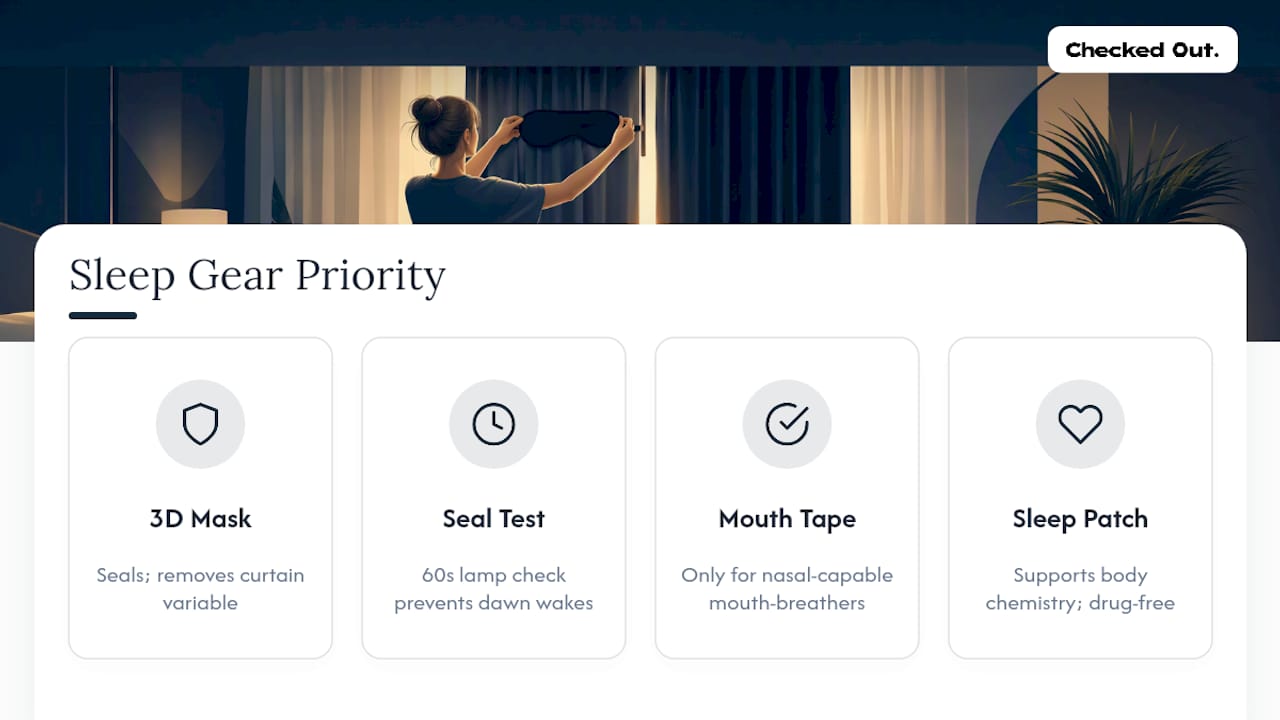
What surprises me is how many travelers skip the 60-second seal test out of sheer exhaustion, then blame the mask itself when they wake up at dawn. The mask was never the problem. The fit was. That single habit, checking your seal against a lamp before you actually need it, prevents more bad nights than any material upgrade.
Mouth tape and patches are adjuncts, not headline acts, and treating them that way keeps expectations honest. Tape helps a specific group of nasal-capable mouth-breathers, not everyone. A patch supports your body’s own chemistry rather than overriding it, which is the entire point of choosing drug-free tools over synthetic melatonin in the first place. Checked Out Wellness builds its Sleep Patch, Mouth Tape, and 3D Sleep Mask around that same order of priority, manufactured to ISO 22716 GMP standards in South Korea, with the mask doing the heavy lifting and the other two supporting it when they genuinely fit your situation. If you want to go deeper on the mechanics of mouth taping specifically, Checked Out Wellness’s own breakdown covers the safety screening in more detail than most travel articles bother to.
— Geeta
Build Your Drug-Free Travel Sleep Kit
Checked Out Wellness offers a contoured mask that seals better than fabric drapes, mouth tape made from skin-safe material, and a transdermal patch delivering cofactors such as magnesium, B6, B12, and GABA.
These products are manufactured in South Korea to ISO 22716 GMP standards and designed considering packing, fit, and durability concerns of frequent travelers. The 3D Sleep Mask runs $24 and anchors the kit; the Mouth Tape is $44 for travelers who pass the nasal breathing screen described earlier in this guide; the Sleep Patch is $39 for those who want extra biochemical support on long trips or across time zones. If you deal with any respiratory condition, nasal obstruction, or reflux, talk to a clinician before trying mouth tape, full stop.
Browse the full travel sleep collection and build the kit that matches your own screening results tonight.
Sources
This article is general information, not a substitute for advice from a qualified doctor. Consult a qualified healthcare professional about your own circumstances before acting on anything here.
FAQ
Can a Sleep Mask Really Replace Hotel Blackout Curtains?
A contoured 3D mask can outperform imperfect hotel curtains because it seals directly against your face rather than depending on the window fit. It won’t fix a room that’s blindingly lit, but for the light leaks that ruin most hotel sleep, a good mask closes the gap curtains leave open.
Is Mouth Taping Safe for Everyone to Try While Traveling?
No. Mouth taping is only appropriate for people who can breathe comfortably and fully through their nose while awake, confirmed with a simple sitting test before bed. Clinical evidence supports benefit in selected mild sleep apnea mouth-breathers, but people with nasal obstruction, reflux, or respiratory disease should avoid it without medical clearance.
What Does a Transdermal Sleep Patch Actually Do?
A transdermal sleep patch delivers drug-free cofactors like magnesium, B6, B12, and GABA through the skin over several hours, supporting your body’s natural melatonin production instead of replacing it. Checked Out Wellness’s Sleep Patch is priced at $39 and is designed as a travel-friendly adjunct rather than a sedative.
How Do I Know If My Sleep Mask Has a Light Leak?
Stand facing a bright lamp or window with the mask on and look for pinpricks or lines of light, usually at the nose bridge or temples. This 60-second check, done as soon as you check into a hotel room, catches seal problems before you need the mask at night.
What Type of Tape Should I Use for Mouth Taping?
Use a porous, skin-safe tape specifically made for sleep, never a generic household or medical adhesive. Sleep Foundation’s product testing found that tapes built for skin reduce irritation risk compared with ordinary adhesive strips.
Recommended

Travelers' Drug-Free Fix to Block Hotel Curtains: 60-Second Mask
The fastest fix for a too-bright hotel room is a contoured 3D sleep mask, not the drapes. Flat masks and hotel blackout curtains still leak light at the edges, but a mask with contoured eye cups and a snug nose bridge blocks it at the source, on your face, in any room. Add porous mouth tape if you breathe easily through your nose, or a drug-free transdermal sleep patch if you want extra biochemical support, and you have a travel kit that works whether the curtains close all the way or not.
Table of Contents
Why Hotel Blackout Curtains Don’t Actually Block Light
Hotel curtains almost never seal completely. There is a gap where the panels meet in the middle, a strip of light along the floor track, and often a translucent sheer layer that glows the moment a streetlight or sunrise hits it. You can pull the heaviest blackout drapery closed and still wake up at 5 a.m. because a two-inch sliver of hallway light or dawn is aimed directly at your eyes.
That gap matters more than most travelers realize. Research summarized by sleep mask reviewers shows that even light reaching closed eyelids can suppress melatonin production and disrupt the depth of sleep, which is exactly what happens when a curtain seam leaks a beam across the room. You are not imagining that you sleep worse in a room with imperfect blackout coverage. Your eyelids are transparent enough to let ambient light through, and your brain treats that light as a signal to stay alert.
This is the gap a portable, personal blocking tool is built to close. Instead of trying to control someone else’s window treatment, you control the two inches of space around your own eyes.
What Travel Masks, Mouth Tape, and Patches Actually Do
Each of these tools solves a different problem, and knowing which one fixes what saves you from packing something that will not help.
A contoured (3D) sleep mask uses raised cups over each eye instead of flat fabric pressed against your eyelids. That air gap does two things: it stops the mask from smudging your lashes or applying pressure that leaves you blinking awake, and it lets the nose bridge seal tighter without the whole mask shifting. Contoured masks consistently outperform flat ones for blocking light in bright environments, which makes them the better pick for hotel rooms with uncooperative curtains or a wall of city lights outside.
Mouth tape is a thin, skin-safe strip placed over closed lips to encourage nasal breathing through the night. It does not block light at all. What it can do, for the right person, is reduce mouth-breathing and the snoring that comes with it. A 2022 clinical study found that mouth-taping in selected mild obstructive sleep apnea patients who breathe through their mouths reduced their AHI (apnea-hypopnea index) by roughly 47%, with most participants also seeing their snoring index improve.
Transdermal sleep patches work differently again. They deliver drug-free cofactors like magnesium, B6, B12, and GABA through the skin over several hours, supporting your body’s own melatonin production rather than replacing it with synthetic melatonin. Think of a patch as backup support for your sleep chemistry, not a light-blocking tool.
Travelers weighing all three should consider:
How Do You Choose the Right Light-Blocking Tool for Your Trip?
Start with a quick self-check before you pack anything.
When you are comparing masks, look closely at the strap (adjustable, non-slip is best), the nose bridge design (a soft, moldable seal beats a flat foam strip), cup depth (deeper for back sleepers, shallower for side sleepers), and lining material (breathable cotton or silk over synthetic mesh for long-haul comfort).
Patches earn a spot in your bag if you cross time zones often or specifically want to avoid synthetic melatonin. Many drug-free sleep patches, including the Sleep Patch from Checked Out Wellness, are also sold through monthly subscriptions, which suits travelers who want a consistent supply without reordering every trip.
Pro Tip: Pack your mask in the same spot in every bag you travel with. The two seconds it takes to find it on a red-eye flight are the two seconds you don’t want to spend patting down three pockets while the cabin lights are still on.
Who Should Avoid Mouth Taping or Pause Before Trying a Patch?
Safety screening takes less time than choosing a movie for the flight, and it matters more.
Run the same nasal breathing test described above: sit upright, close your lips, and breathe through your nose for several minutes. If you feel any air hunger, congestion, or panic, do not tape your mouth that night.
The clinical evidence on mouth taping is real but narrow. The 2022 study cited earlier only enrolled mouth-breathers with mild obstructive sleep apnea, a specific and pre-screened group, and about 65% of participants responded well. That is not the same as saying mouth tape helps everyone, or that it is safe without screening. Physician commentary reviewed by Prevention echoes this: the concept is plausible, but the evidence base is still thin, and doctors specifically warn people with nasal obstruction, reflux, or respiratory disease to skip it without a medical evaluation first.
Avoid mouth taping if any of these apply to you:
For patches, test a small area of skin first, follow the product’s directions for placement and duration, and stop immediately if you notice redness, itching, or irritation.
Step-by-Step: Testing and Using Each Tool in a Hotel Room
Pro Tip: Do your first mouth-tape trial at home, not on a trip. You want to learn how your body reacts somewhere you can pull the tape off calmly, not in an unfamiliar hotel room at midnight.
Keeping Your Kit Working Trip After Trip
A mask that has been balled up in the bottom of a backpack for six months will not seal as well as a fresh one, and a damaged strap ruins the fit fast.
Wash silk masks by hand in cool water and let them air dry; cotton-lined masks usually tolerate a gentle machine cycle in a mesh bag; foam-cupped masks should be spot-cleaned only, since submerging foam can break down the contour. Do this roughly every one to two weeks of regular use, more often if you sweat at night.
Pack your mask in a hard clamshell case if you have room, or fold it along its natural crease and slide it into a zippered pouch to protect the nose bridge shape. Carrying a cheap flat backup mask in your carry-on is smart insurance if the good one gets crushed in checked luggage.
Keep a few extra items in your travel bag:
If your mask seal fails and you have no backup, roll a bath towel and press it against the bottom of the hotel door, or clip a spare shirt over the worst light gap in the curtains with the room’s hangers.
Testing Your Mask Seal Before You Actually Need It
Do this the moment you check in, not at bedtime when you are exhausted and just want to collapse.
Turn on every light in the room, including the bathroom light with the door cracked, and put your mask on standing in front of the window. Walk slowly toward the brightest source in the room. Any light leak will show up as a bright line or point, usually at the nose bridge, the outer corners near your temples, or where the strap meets the cup.
If you find a leak at the nose bridge, most contoured masks have a moldable foam strip you can pinch to reshape the seal, the same concept used in N95-style respirators. Press it gently against the bridge of your nose and hold for a few seconds so it holds the new shape. A leak at the temples usually means the strap is too loose, or the mask is sitting too high on your face rather than centered over your closed eyes.
Cleaning between trips matters just as much as the initial seal check. Body oils and makeup residue break down foam padding faster than normal wear, and a mask that has lost its cup shape will not seal the same way twice. Wipe the interior lining with a gentle, alcohol-free cleaning wipe after every few uses, and let it air out fully before you fold it back into your bag.
Keep the packaging or a small drawstring pouch specifically for the mask, separate from cables and toiletries that can crush the cups. A crushed cup is the single most common reason a mask that sealed perfectly at home suddenly leaks light on a trip.
Portable Blackout Alternatives When Hotel Curtains Fail
Sometimes the curtains simply will not close all the way, no matter how you tug them, and you need a backup plan that does not involve calling the front desk at midnight.
Clip-on portable blackout curtains, sold as compact travel accessories, use suction cups or clip hardware to attach a light-blocking panel directly to the window frame or curtain rod. They pack down small and work well when a hotel’s existing drapes are thin or too short for the window. Temporary adhesive blackout film, the kind sold in pre-cut sheets, sticks directly to glass and can be removed without residue, which makes it a reasonable option if you are staying somewhere for several nights and the window is your main light source.
Painter’s tape and a folded bath towel solve the gap-in-the-middle problem fast. Tape the towel across the seam where two curtain panels meet, or drape it over the curtain rod so it hangs down and covers the worst offending strip of light. Binder clips or the hotel’s own pants hangers can pinch curtain panels together at the point where they gap most.
None of these fixes need tools, and all of them pack into a gallon bag. But they are still working against a window treatment you do not control, which is exactly why a contoured mask remains the more reliable layer. The mask travels with you into any room, works instantly, and does not depend on whether the curtains actually reach the window frame.
Blocking Light Around Windows Without Touching the Curtains
You do not have to fight the curtains at all if you attack the light at its other entry points.
A rolled towel pressed into the windowsill track blocks the thin strip of light that sneaks in where the curtain meets the frame, which is often the single brightest leak in a room. If the window has a gap on either side where the drapes do not fully extend to the wall, a second towel or a spare shirt draped over the top corner and weighted down with a book handles it.
Sleep shields, sometimes marketed as portable window blockers, are essentially rigid or foldable opaque panels you wedge into the window frame using tension rather than adhesive. They are worth packing if you frequently book rooms with east-facing windows and know sunrise will hit early.
For streetlight glow specifically, rather than sunrise, closing the sheer inner layer of curtains first, then the blackout layer, adds a second barrier that a single panel alone will not give you. If the room has no sheer layer, a hand towel hung directly against the glass, behind the blackout curtain, does something similar.
None of these hacks require you to trust hotel housekeeping to have installed proper blackout lining, which, frankly, varies wildly by property and price point.
Combining a Mask With Room Darkening for the Best Result
Layering beats relying on any single fix, and the two layers reinforce each other instead of just duplicating effort.
Do your best to darken the room first: close both curtain layers, wedge a towel against the worst gaps, and unplug or cover anything glowing. Then put on your contoured mask as the final seal against whatever light gets through anyway. This two-layer approach matters because a mask handles the light hitting your eyelids directly, while room darkening handles the ambient glow that would otherwise light up the whole space and disrupt your sense of day and night even with your eyes closed.
Travel gear reviewers consistently recommend pairing a mask with earplugs and a supportive travel pillow, since noise and neck discomfort undo the benefit of a dark room just as fast as light does. Treat your travel sleep kit as one system: mask for your eyes, earplugs for your ears, a towel or clip for the window, and tape or a patch as an adjunct if you have already confirmed it is safe for you.
How Room Lighting Color Affects Sleep, and How to Adjust It
Not all light disrupts sleep equally. Blue and white light, the kind most hotel lamps and bathroom fixtures use by default, suppresses melatonin more aggressively than warm amber or red-toned light.
If your hotel room has adjustable lighting, switch every lamp to its warmest setting before bed, or turn off overhead lights entirely and use a single low lamp for the last hour before you sleep. Many hotel bathrooms have a harsh white light that leaks under the door; switching to the bathroom’s night-light setting, if one exists, or simply keeping that door fully closed, removes a surprisingly bright source most travelers overlook.
Avoid turning on the main room lights at all if you wake up during the night. A short burst of white overhead light can be enough to reset your body’s sense that it is time to be awake, making it harder to fall back asleep. Keep a phone flashlight on its dimmest setting, or use the hotel bathroom light only with the door mostly closed, as your middle-of-the-night option instead.
Managing Light From Devices and Hotel Alarm Clocks
The glowing alarm clock on the nightstand is often brighter than travelers realize once the rest of the room goes dark. Most hotel clock radios default to full brightness, and many do not have an obvious dimmer button, so the fastest fix is turning the entire unit to face the wall or covering it with a hand towel.
Phone screens deserve the same treatment. Enable night mode or a blue-light filter before bed, and place your phone screen-down or across the room if you tend to check it during the night. Charging cables with a lit indicator light are another overlooked source. Slide the charger and cable behind a lamp base or inside a drawer rather than leaving it on the nightstand next to your face.
If you are wearing a mask, most of this becomes moot the moment you have it on. But for the window between getting into bed and actually falling asleep, killing device light matters just as much as killing curtain leaks.
Troubleshooting Common Sleep Mask and Tape Problems on the Road
Mask keeps sliding off during the night. Tighten the strap slightly, or look for a mask with a rear adjustment buckle rather than a stretch-only band, which loses tension over a long trip.
Mask leaves marks or feels too tight in the morning. You likely need a mask with deeper cups or a softer nose bridge foam. A too-shallow cup forces the strap tighter to compensate, which is what leaves marks.
Mouth tape won’t stay on, or peels by morning. Skin oils and humidity break down weaker adhesives fast. Clean and dry the skin around your mouth before applying, and confirm you are using a tape actually designed for skin, not a generic adhesive.
You wake up gasping or panicked with tape on. Remove it immediately, and do not try mouth taping again without talking to a doctor. This is a sign it is not right for you, regardless of what worked for someone else.
Patch causes redness or itching. Stop use and switch application sites next time; test a new small area before your next overnight use.
The Overlooked Truth About Travel Sleep Gear
Most advice on this topic treats the mask, the tape, and the patch as competing options, as if you have to pick one winner. That framing misses how these tools actually work together, and it is worth saying plainly: darkness is the dominant lever. A mask that seals well will outperform almost any single hack you can improvise with a hotel curtain, because it removes the variable entirely instead of trying to manage someone else’s window treatment.
What surprises me is how many travelers skip the 60-second seal test out of sheer exhaustion, then blame the mask itself when they wake up at dawn. The mask was never the problem. The fit was. That single habit, checking your seal against a lamp before you actually need it, prevents more bad nights than any material upgrade.
Mouth tape and patches are adjuncts, not headline acts, and treating them that way keeps expectations honest. Tape helps a specific group of nasal-capable mouth-breathers, not everyone. A patch supports your body’s own chemistry rather than overriding it, which is the entire point of choosing drug-free tools over synthetic melatonin in the first place. Checked Out Wellness builds its Sleep Patch, Mouth Tape, and 3D Sleep Mask around that same order of priority, manufactured to ISO 22716 GMP standards in South Korea, with the mask doing the heavy lifting and the other two supporting it when they genuinely fit your situation. If you want to go deeper on the mechanics of mouth taping specifically, Checked Out Wellness’s own breakdown covers the safety screening in more detail than most travel articles bother to.
Build Your Drug-Free Travel Sleep Kit
Checked Out Wellness offers a contoured mask that seals better than fabric drapes, mouth tape made from skin-safe material, and a transdermal patch delivering cofactors such as magnesium, B6, B12, and GABA.
These products are manufactured in South Korea to ISO 22716 GMP standards and designed considering packing, fit, and durability concerns of frequent travelers. The 3D Sleep Mask runs $24 and anchors the kit; the Mouth Tape is $44 for travelers who pass the nasal breathing screen described earlier in this guide; the Sleep Patch is $39 for those who want extra biochemical support on long trips or across time zones. If you deal with any respiratory condition, nasal obstruction, or reflux, talk to a clinician before trying mouth tape, full stop.
Browse the full travel sleep collection and build the kit that matches your own screening results tonight.
Sources
This article is general information, not a substitute for advice from a qualified doctor. Consult a qualified healthcare professional about your own circumstances before acting on anything here.
FAQ
Can a Sleep Mask Really Replace Hotel Blackout Curtains?
A contoured 3D mask can outperform imperfect hotel curtains because it seals directly against your face rather than depending on the window fit. It won’t fix a room that’s blindingly lit, but for the light leaks that ruin most hotel sleep, a good mask closes the gap curtains leave open.
Is Mouth Taping Safe for Everyone to Try While Traveling?
No. Mouth taping is only appropriate for people who can breathe comfortably and fully through their nose while awake, confirmed with a simple sitting test before bed. Clinical evidence supports benefit in selected mild sleep apnea mouth-breathers, but people with nasal obstruction, reflux, or respiratory disease should avoid it without medical clearance.
What Does a Transdermal Sleep Patch Actually Do?
A transdermal sleep patch delivers drug-free cofactors like magnesium, B6, B12, and GABA through the skin over several hours, supporting your body’s natural melatonin production instead of replacing it. Checked Out Wellness’s Sleep Patch is priced at $39 and is designed as a travel-friendly adjunct rather than a sedative.
How Do I Know If My Sleep Mask Has a Light Leak?
Stand facing a bright lamp or window with the mask on and look for pinpricks or lines of light, usually at the nose bridge or temples. This 60-second check, done as soon as you check into a hotel room, catches seal problems before you need the mask at night.
What Type of Tape Should I Use for Mouth Taping?
Use a porous, skin-safe tape specifically made for sleep, never a generic household or medical adhesive. Sleep Foundation’s product testing found that tapes built for skin reduce irritation risk compared with ordinary adhesive strips.
Recommended